
To prevent code creep, make every code level traceable to the documentation behind it, and check that trace on a schedule. The same routine stops the opposite drift, where cautious providers slide to lower levels than the chart supports. Both are noncompliant, and both are easiest to catch before the claim goes out. Our free 30-day Revenue Leakage Audit measures both patterns in your EHR data, per provider and per payer, so you start from numbers instead of guesses.
TL;DR
- Code creep is a gradual drift in code levels that the documentation does not support. Downcoding, which leaves earned revenue unbilled, is its mirror image, and both are noncompliant.
- The main causes are documentation burden, time pressure, outdated guidelines and coding without provider input.
- Prevention rests on four habits: provider involvement in E/M selection, ongoing education with feedback, a baseline audit with periodic samples, and monitoring of remittances for payer downcoding.
- When a payer downcodes without reviewing the record, an appeal with the supporting documentation is the standard response.
- A pre-claim review of coding, documentation and charge capture catches problems when they cost the least to fix.
Table of Contents
- What code creep and downcoding mean in a physician practice
- What causes code levels to drift
- A prevention routine that works for independent practices
- When a payer downcodes your claims
- Where manual routines break down
- Our perspective
- Start with a measured baseline
- FAQ
- Sources
What code creep and downcoding mean in a physician practice
In a physician practice, code creep is the slow upward movement of the codes you report, such as E/M levels, without a matching change in what was documented and done. It is not a formal billing term with one fixed definition, so it helps to anchor it to the terms regulators and coding bodies use.
Upcoding means reporting a higher-level service or a more complex diagnosis than the medical necessity, medical facts or documentation support. Creep is how upcoding often looks from the inside: no single dramatic claim, just a pattern that moves a little each quarter.
Downcoding is the reverse. A provider downcodes when a service is not reported at the optimal level the documentation and medical necessity support. AAPC makes the point plainly: it is as noncompliant as upcoding, because services must be reported exactly at the level provided.
Accurate coding sits between the two. The code matches the documentation and the medical necessity, no higher and no lower. That is the target, and everything below serves it.

Why it matters in dollars and in risk
The two errors carry different risks:
- Upward drift can lead to payer audits, reimbursement takebacks and charges of abusive or fraudulent billing, according to Physicians Practice.
- Downward drift can preempt legitimate revenue and, in the same source's words, present a compliance risk equal to overcoding.
A practice that only worries about audits tends to push its providers toward the safe, low level. A practice that only worries about revenue does the opposite. Neither is the goal. For a deeper look at the audit side, see our guide on how to find upcoding audit risk in 30 days.
What causes code levels to drift
Drift is rarely deliberate. It comes from the way a busy practice works.
Documentation burden and time pressure. Heavy documentation demands and limited time lead to errors of omission, and overly cautious physicians and coders may default to lower code levels. When a note leaves out work the provider actually did, the coder cannot credit it, and the level slips down.
Out-of-date knowledge. Undercoding can result from failing to stay current on guidelines, from unfamiliarity with payer policies, or from failing to capture all services provided. The same gaps push other providers up when they guess at what a level requires.
Coders working without the provider. AHIMA notes that aspects of medical decision-making are known only to the provider, and that assigning codes from a coder's reading of the note alone leads to errors and potential fraud and abuse concerns. A coder who cannot ask a question will either round up or round down.
Payers adjusting what you billed. Payer downcoding happens when a payer assigns a lower-level code than the one submitted, without reviewing the medical record, and pays less. It is a different problem from your own drift, but it shows up in the same place: the gap between the level you billed and the level you were paid.

A prevention routine that works for independent practices
You do not need a compliance department. The OIG's voluntary compliance guidance for individual and small group practices lays out a step-by-step approach: identify risks, put standards in place, educate staff and keep open lines of communication so problems get reported. The routine below applies that approach to coding drift.
1. Anchor every level to the chart
CMS puts it bluntly: medical records must support the claim, and undocumented care is treated as care not provided. That rule cuts both ways. A level that the note cannot defend is a risk, and work that never made it into the note is revenue you cannot bill.
The principle applies to every specialty. Even narrow service lines, such as spinal decompression billing codes and coverage, depend on the billed service being supported by the record.
For time-based visits, the documented time has to be there and has to be consistent with the level. Our five checks for time-based E/M coding walk through what to verify before any claim leaves.
2. Put providers into code selection
AHIMA's guidance on E/M practices says to involve care providers in code selection, give ongoing training and feedback, verify E/M categories and patient status, track global periods and monitor compliance. In practice this means:
- The provider selects or confirms the E/M level, not only the coder.
- Coders have a fast way to query a note, and queries are answered in days, not weeks.
- Category and patient status (new or established) are checked before the level is set.
- Global periods are tracked so that follow-up visits are not billed as separate services by mistake.
3. Educate on a plan, not on an incident
The AMA advises developing education plans for physicians that cover E/M code usage, bundling and unbundling rules, modifiers and payer-specific policies, in order to reduce denials and prevent inaccurate coding. Build that plan around your own data. If one provider's level mix differs sharply from peers in the same specialty, start there. If a payer's policy changed, brief everyone who bills to that payer.
Feedback has to be specific. "Document more" changes nothing. "Your 99214 notes lack the data reviewed and the risk discussion" does.
4. Take a baseline, then audit on a schedule
The OIG recommends periodic internal audits that compare claims with medical records, with benchmarking to measure progress. It suggests reviewing a random sample, for example five or more records per federal payer or per physician. It also describes a baseline audit, a snapshot of claims, as the way to set a consistent method for finding problem areas and for judging later improvement.
A workable cadence for a small practice:
| Step | What to do | Why |
|---|---|---|
| Baseline | Sample records per provider and per major payer | Sets the starting point for benchmarking |
| Compare | Match each billed level to the note and to medical necessity | Finds both over-supported and under-supported claims |
| Trend | Track level distribution by provider over time | Shows drift before an auditor does |
| Retest | Repeat after education or workflow changes | Confirms the fix held |
If you want the step-by-step version, our guides on how to self-audit physician billing records and physician group audit methodology cover sampling and scoring. The annual coding review guide shows how to make the review a fixed part of the year.
5. Watch remittances for payer downcoding
The OIG's own audit advice covers your claims. Payer behavior needs a separate watch. The AMA suggests proactively monitoring remittance advice and denial reports, because many payers adjust payment without notifying the provider or changing the billed code. Compare billed levels with paid levels by payer each month. A consistent gap on one payer is a pattern worth acting on.
When a payer downcodes your claims
For payer downcoding, the physician should appeal with supporting clinical documentation, and the AMA resource includes a sample appeal letter. Your appeal is only as strong as the note behind it, which is why steps 1 to 3 come first.
The AMA's position is that physicians should be able to submit supporting documentation before payment is reduced, and any adjustment should come with a clear clinical rationale and appeal instructions. It also argues that algorithm-based programs often ignore CPT guidance on setting E/M levels by medical decision-making or total time. The AAFP adds that automatic downcoding can imply that higher-level coding is fraudulent and miss the true complexity of care. Those are policy arguments. For your practice, the working answer is a complete record and a fast appeal.
An appeal checklist:
- Pull the claim, the remittance and the full note.
- Match the documented decision-making or time to the CPT level billed.
- State the clinical rationale in the appeal, citing the note.
- Log the outcome by payer, so you can see patterns.
- Feed the result back into provider education.
If the payer escalates to a full review, our guide on how to prepare for a payer audit lists what to assemble, and the piece on the healthcare compliance audit trail explains why a dated record of your own corrections matters.
Where manual routines break down
Every step above works. The difficulty is doing it every month with a small team. A five-record sample per provider shows you a slice, not the pattern across all charts. Spreadsheets of level distributions go stale. Coder queries wait in a provider's inbox. Corrections need a signature, and signatures lag.
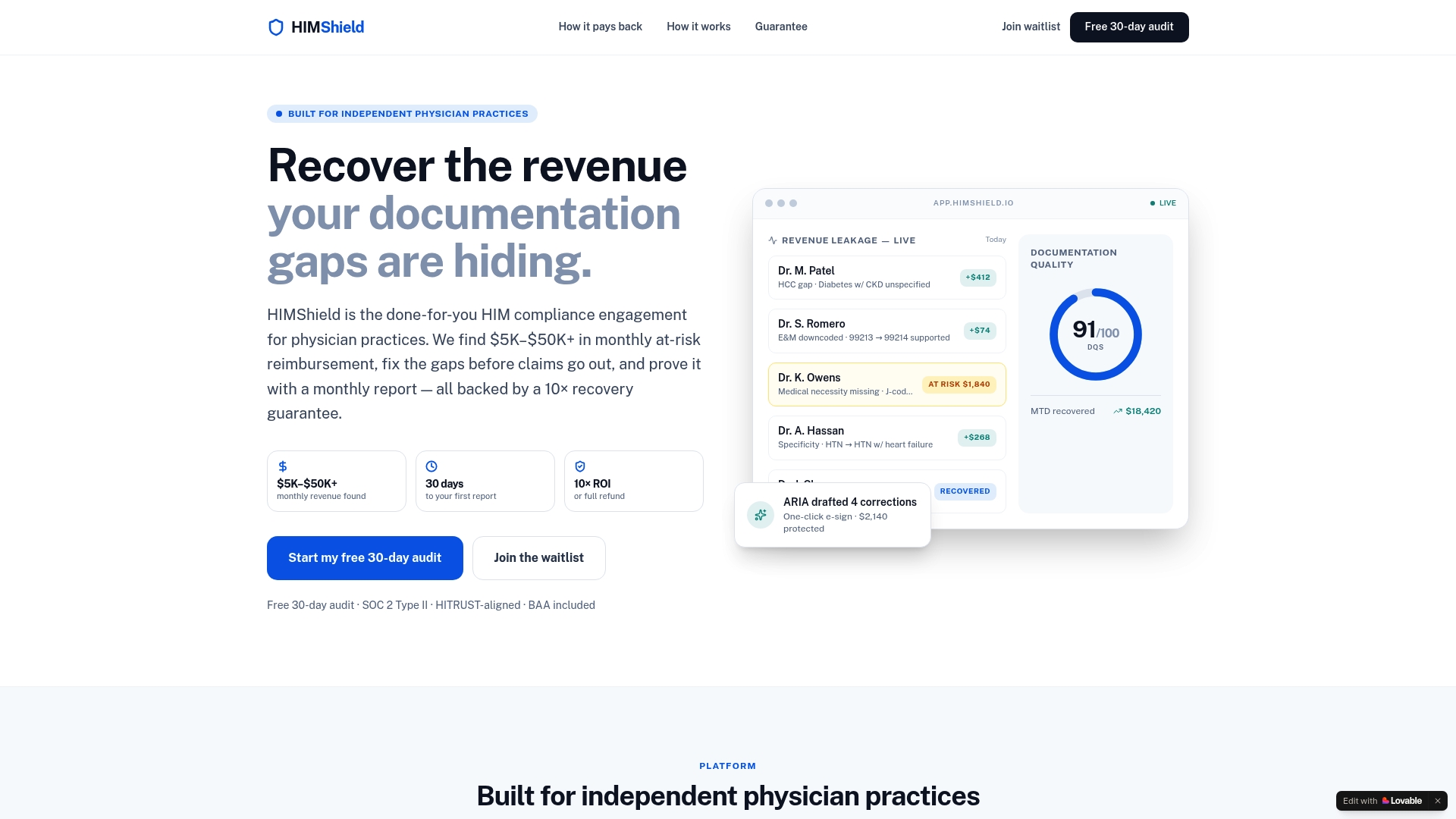
This is the part we built HIMShield to take on. Our platform identifies and quantifies coding, documentation and charge-capture gaps in your EHR data before claims are submitted. It produces per-provider, per-payer Revenue Leakage Reports, so you can see which provider and which payer account for drift in either direction. It also gives real-time documentation quality scoring, sends automated compliance alerts, and drafts corrections that a physician signs with one click. When a payer audit does arrive, it assembles a submission-ready response.
There is a broader view of how this fits a compliance program in our posts on practice compliance program benefits, medical coding compliance and medical coding risk detection.
Our perspective
Most practices come to us worried about one direction of error. Some fear the auditor. Others fear the lost revenue. In our view they are the same problem: a code level that is not tied to the documentation.
That is why we do not start with a lecture on coding. We start with your own EHR data. Our free 30-day Revenue Leakage Audit quantifies gaps in coding, documentation and charge capture, per provider and per payer, and delivers a report. Our model is built to work without new staff or software training for your team, because a compliance tool that needs another full-time person defeats its purpose for an independent practice.
Our positioning is simple. We offer a done-for-you approach with a guaranteed 10× revenue recovery, and we stand behind it. Physicians keep control of the final word, because corrections reach them as drafts for one-click e-signature, in line with the principle that the provider knows the decision-making behind the note.
Elena
Start with a measured baseline
A baseline is the first thing the OIG guidance asks for, and it is the first thing we deliver. The free 30-day Revenue Leakage Audit scans your EHR data for coding, documentation and charge-capture gaps and quantifies them by provider and by payer. Our performance guarantee comes with it, and you decide on a paid subscription after you have seen the report.
Request your free 30-day Revenue Leakage Audit, or see how the HIM compliance engagement works.
FAQ
Is code creep the same as upcoding?
Not exactly. Upcoding is reporting a higher level than the documentation or medical necessity supports. Code creep describes a gradual drift of levels over time, which can end up as a pattern of upcoding. The cure is the same: tie each level to the note and audit the pattern.
Is downcoding really a compliance problem if it lowers my claims?
Yes. Both AAPC and Physicians Practice treat reporting below the supported level as noncompliant. It also leaves revenue you earned unbilled.
How many records should I review in an internal audit?
The OIG suggests a random sample of five or more records per federal payer or per physician as a starting point, with a baseline audit to benchmark later results. Larger samples give a clearer picture of patterns.
What should I do when a payer lowers my E/M level?
Appeal with the supporting clinical documentation. The AMA provides a sample appeal letter in its payer downcoding resource, and recommends tracking remittances so you catch adjustments the payer did not announce.
Sources
- Upcoding vs. Downcoding: Know the Difference, Physicians Practice
- Downcoding Is as Bad as Upcoding, AAPC
- Hospital-Wide Intervention in Billing and Coding, PMC
- Payer downcoding: What is it and what should you do about it, AOA
- Don't Let Authorization Lead Code Selection, AAPC
- Dangerous E/M Coding Practices, AHIMA
- Medicare Fraud & Abuse: Prevent, Detect, Report, CMS
- OIG Compliance Program for Individual and Small Group Physician Practices, HHS OIG
- Engage physicians to get your private practice's claims paid, AMA
- Payer E/M downcoding programs, AMA
- How physicians can fight back against payer downcoding, AMA
- The AAFP Advocates Against Payer Downcoding Policies, AAFP