
Upcoding is a documented audit trigger, not a theoretical one. It draws scrutiny from CMS's CERT program, targeted probe reviews, and False Claims Act enforcement, and it can produce recoupment, per-claim penalties, treble damages, and exclusion from federal programs. If you suspect any high-risk codes in your practice, the first move is a focused internal audit of those codes with findings documented in writing, before a payer runs that audit for you.
TL;DR:
- Upcoding detection relies on statistical outliers in billing patterns, such as disproportionate high-level visit codes, rather than proof of intent.
- Medicare's CERT program reviews about 50,000 claims annually, exposing widespread coding gaps that can lead to large liabilities.
- Common high-risk areas include E/M inflation, modifier misuse, unbundling, coding for HCC and DRG inflation, and misusing templates or auto-population features.
- Practices should conduct regular audits, enforce EHR controls, and educate coders to prevent upcoding, especially in top violation areas like high-level E/M and telehealth codes.
- Early internal identification and prompt correction of upcoding issues, combined with voluntary disclosure protocols, significantly reduce legal and financial exposure.
Table of Contents
- Understanding Upcoding Audit Risk: What It Is and How It Differs From Other Errors
- How Payers and Regulators Detect Upcoding
- Legal and Financial Consequences of Upcoding
- Where Upcoding Actually Shows Up: High-Risk Areas to Audit First
- Building a Prevention Program That Actually Reduces Audit Risk
- What to Do If You Find Upcoding
- The Real Gap Between Compliance Policy and Compliance Practice
- HIMShield Turns Audit Prevention Into a Routine, Not a Scramble
- Sources
Understanding Upcoding Audit Risk: What It Is and How It Differs From Other Errors
Upcoding means billing a higher-level or more complex code than your documentation actually supports. It is not the same as an honest typo or a missed modifier. The government distinguishes between reckless or knowingly false claims and simple billing mistakes, but both can trigger civil liability. That distinction matters less than most practices assume, because recoupment doesn't require proof of intent.
The mechanics show up in a few recurring patterns:
- E/M inflation: billing level 4 or 5 visits when the documented medical decision-making or time doesn't support it.
- Unbundling: billing separately for procedures that should be reported as a single bundled code.
- Modifier misuse: attaching modifiers like 25 or 59 to justify separate payment for services that were part of the same encounter.
- DRG and HCC gaming: inflating diagnosis codes to push a hospital stay into a higher-paying DRG or a patient into a richer risk-adjustment category.
Undercoding sits at the other end of the spectrum. It underreports the service level and leaves money on the table rather than exposing you to fraud liability, but the OIG treats it as a documentation and revenue-integrity problem, not a legal one on its own.
How Payers and Regulators Detect Upcoding
Detection starts with statistics, not suspicion. CMS and commercial payers benchmark your E/M level distribution against regional and specialty norms. If your practice bills a disproportionate share of level 5 visits compared to peers coding the same specialty, you show up as a statistical outlier long before a human reviewer opens a chart.
CMS's Comprehensive Error Rate Testing program is the backbone of federal detection. It randomly selects roughly 50,000 Medicare claims annually and compares the billed code against submitted documentation to calculate a national improper payment rate.
50,000 claims a year. That's the sample size CERT reviews to build the national Medicare improper payment estimate, and it's the reason a single documentation gap can ripple into a much larger extrapolated liability.
Beyond CERT, watch for these operational triggers:
- Targeted Probe and Educate (TPE) reviews, which typically sample 20 to 40 claims per provider and escalate to broader extrapolation audits if error rates exceed CMS thresholds.
- Medicare Advantage plans running targeted reviews of diagnosis coding tied to HCC risk scores.
- Abrupt shifts in your code mix, especially a sudden jump in high-level E/M or high-weight DRG billing after a new EHR template or coder joins.
- Denial patterns that cluster around specific codes or providers.
- Whistleblower qui tam suits, which remain one of the most common ways upcoding schemes come to light.
None of these triggers require a payer to prove intent before opening a review. A statistical anomaly is enough to start the clock.
Legal and Financial Consequences of Upcoding
The math escalates faster than most practices expect. Under the False Claims Act, providers found liable for upcoding face civil penalties of up to $28,619 per false claim, adjusted annually for inflation, on top of treble damages on the total amount improperly billed. Multiply that per-claim exposure across a year of claims for one high-volume code, and a documentation gap that looked minor on a single chart turns into a seven-figure liability.

The statute of limitations under the False Claims Act generally runs several years from the violation, with potential extensions if the government discovers it later. That window is long enough for a pattern to compound across thousands of claims before anyone notices.
Beyond the FCA, several other exposures stack on top:
- Civil Monetary Penalties Law (CMPL): additional fines ranging roughly from $10,000 to $50,000 per violation, separate from FCA damages.
- Program exclusion: mandatory or discretionary exclusion from Medicare and Medicaid, which can end a practice's ability to bill federal payers entirely.
- Criminal exposure: intentional schemes can bring fines up to $250,000 and imprisonment up to 10 years per count for the individuals involved.
DOJ enforcement data shows healthcare fraud accounts for the majority of False Claims Act recoveries in recent years, and qui tam whistleblower suits drive a large share of those cases. Recoveries measured in the billions across the industry aren't an abstraction. They reflect thousands of individual practices that treated a coding pattern as routine until an auditor didn't.
Where Upcoding Actually Shows Up: High-Risk Areas to Audit First
Most upcoding findings cluster around a short list of predictable weak points. Prioritizing an internal review around these areas gets you the fastest reduction in exposure.
- E/M level inflation. A level 5 office or emergency department visit billed without medical decision-making or time documentation to support it is the single most common finding in payer audits.
- Telehealth and time-based coding. Virtual visits and time-based codes require precise start and stop documentation. A missing timestamp or a template that assumes the maximum time bracket is an easy target for reviewers. Our telehealth coding compliance checklist covers the specific documentation elements payers check first.
- Modifier misuse. Modifiers like 25 and 59 get flagged when they appear on a high percentage of claims from the same provider, especially without a clear clinical justification in the chart. A closer look at modifier usage patterns usually surfaces the same handful of recurring mistakes.
- Unbundling. Reporting component procedures separately instead of using the correct bundled code, often caught through NCCI edit violations.
- HCC and DRG diagnosis inflation. Adding chronic condition codes that aren't supported by current-encounter documentation to boost risk-adjustment payments.
- EHR cloning and auto-population. Copy-forward notes, smart phrases, and macros that carry forward yesterday's exam findings into today's note are a documented driver of unsupported claims, and reviewers know exactly what to look for.
Building a Prevention Program That Actually Reduces Audit Risk
A prevention program only works if it runs on a schedule, not in reaction. The OIG has long recommended that practices conduct baseline audits and follow up with periodic reviews rather than waiting for a payer letter to prompt the first look.
Cadence and sample size that hold up. Run a baseline audit of 10 to 20 charts per provider annually at minimum, and increase that to quarterly reviews for any provider flagged in prior audits or working with a new coder or template. A physician group audit methodology built around consistent sampling gives you defensible documentation if a payer ever challenges your findings.
EHR controls that close the biggest gap. Since copy/paste and template overuse are recurring contributors to unsupported documentation, your EHR governance matters as much as your coder training:
- Sanitize templates so smart phrases don't pre-populate exam findings the clinician hasn't actually performed.
- Limit copy/paste function on prior notes, or require an attestation when it's used.
- Validate any computer-assisted coding output against CMS's NCCI edit logic before submission.
- Require physician sign-off on any auto-suggested code before it reaches the claim.
- Maintain a clear audit trail showing who documented, edited, and coded each encounter, which becomes critical if a payer later questions the chart's integrity.
Operational measures that catch what software misses. Build a coder review workflow where a second set of eyes checks high-risk codes before submission. Set clear documentation standards tied to your EHR templates, not generic payer language. And if your compensation model ties pay to RVUs, build in guardrails, because RVU pressure is one of the most consistent correlates investigators look for when a provider's coding pattern drifts upward over time.
Pro Tip: Track your E/M level distribution monthly against national benchmarks, not just at year-end. Catching a drift in month two is a training conversation. Catching it after a full year of claims is a repayment problem.
Coder training deserves its own line item. A single annual refresher on E/M guidelines and modifier rules, tied to real findings from your internal audits rather than generic slides, closes more gaps than any software control alone. Solid record-keeping practices around clinical documentation give your coding team a stronger foundation to work from in the first place.
What to Do If You Find Upcoding
Finding a problem internally is far better than having a payer find it first, but the response has to be methodical.
- Run a focused internal review. Scope the affected codes, providers, and date range, and document your methodology as carefully as your findings. A sloppy internal review can undermine your credibility later.
- Stop the ongoing issue immediately. Correct the template, retrain the coder, or fix the workflow causing the pattern before you calculate what you owe.
- Calculate and repay overpayments promptly. Statutory timelines apply, and consulting counsel before you disclose anything formally protects your practice from missteps in the process.
- Consider the OIG Self-Disclosure Protocol. A complete submission requires a documented internal investigation and accurate damage calculation. Voluntary disclosure doesn't erase liability, but it consistently produces better outcomes than a government-initiated finding, and incomplete submissions get rejected outright.
The Real Gap Between Compliance Policy and Compliance Practice
Most practices already have a compliance policy sitting in a binder somewhere. The gap is always in execution: nobody owns the monthly review, the EHR template quietly drifts toward higher-level defaults, and RVU pressure does the rest without anyone deciding it should. The practices that stay clean aren't the ones with the best policy language. They're the ones where someone actually looks at the numbers every month and asks why they moved.
— Elena
HIMShield Turns Audit Prevention Into a Routine, Not a Scramble
Everything above, the E/M benchmarking, the template audits, the coder review workflow, is exactly what HIMShield automates for independent practices that don't have a full-time compliance department to run it manually.
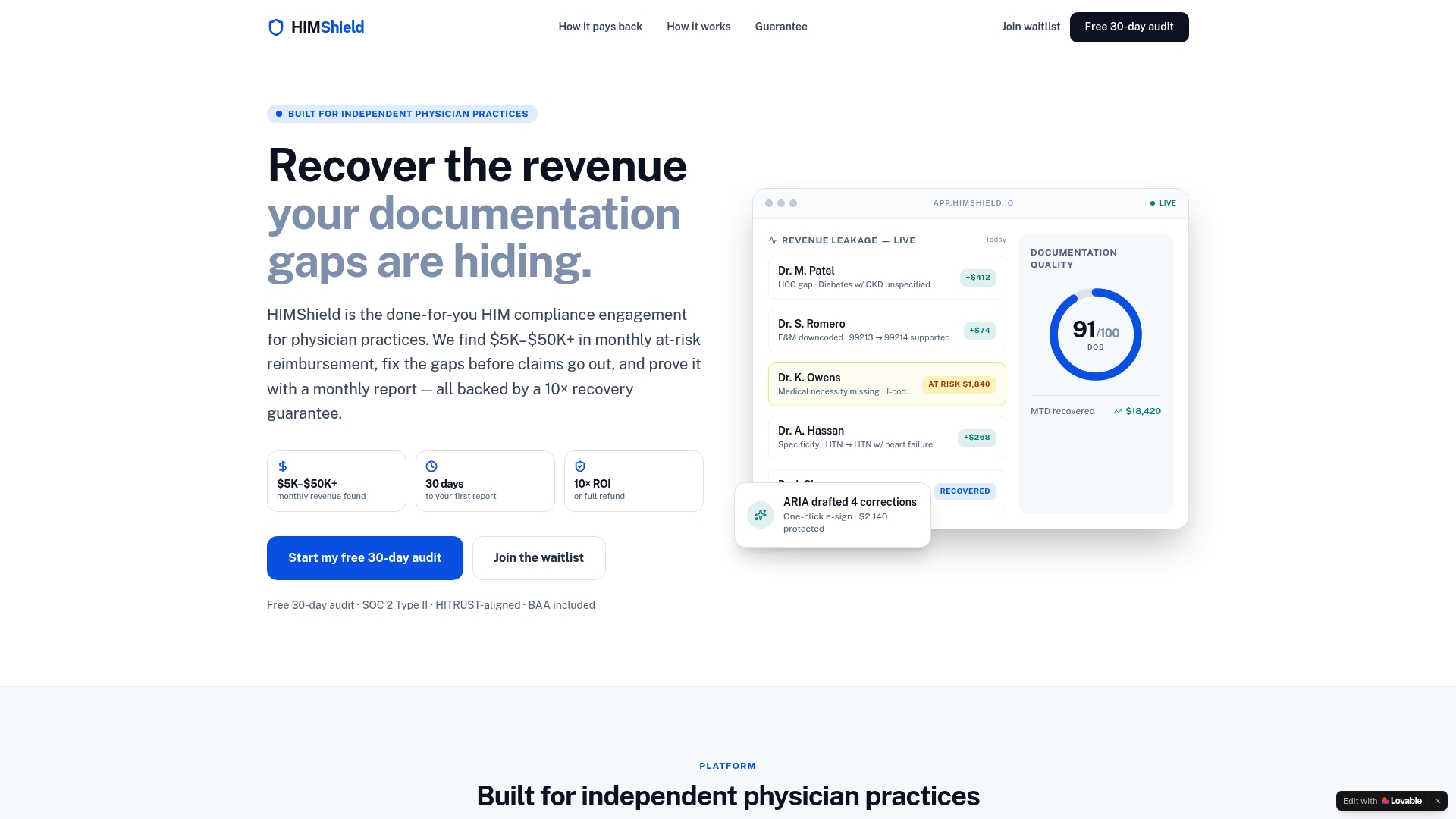
HIMShield scans your EHR data to identify and quantify coding, documentation, and charge-capture gaps before claims go out the door, not after a payer flags them. It scores documentation quality in real time, drafts corrections you can approve with a one-click physician e-signature, and builds submission-ready response packets if a payer audit does land on your desk. Practices typically see the gaps fastest in the first 30 days, which is exactly the window HIMShield's free audit is built around: connect your EHR, get a per-provider, per-payer revenue leakage report, and see what's at risk before you pay another penalty for finding out the hard way.
Sources
- CMS — Comprehensive Error Rate Testing (CERT)
- PMC — literature review on upcoding and Medicare impact