
Payer audit preparation is defined as the systematic process of reviewing claims, coding accuracy, and clinical documentation before a payer formally requests records. Independent physician practices face increasing scrutiny from both commercial payers and federal programs in 2026, with the OIG Work Plan and the False Claims Act setting the compliance framework that governs every audit. Preparing for a payer audit as a physician means building a defense before the notice arrives, not after. The practices that survive audits with minimal recoupment are the ones that treat compliance as a daily operation, not a crisis response.
What triggers payer audits and how to monitor your risk
Payer audits are triggered by statistical outliers in your billing data. Auditors use automated systems to compare your CPT code volumes, evaluation and management (E/M) level distributions, and charge patterns against national and regional benchmarks. When your practice bills a disproportionately high volume of a specific procedure code, or consistently selects the highest E/M levels, your claims move to the top of the review queue.
The 2026 OIG Work Plan identifies high-risk billing areas and audit priorities that federal auditors actively pursue. Reviewing the OIG Work Plan quarterly gives you a direct window into where federal scrutiny is concentrated. Practices that align their documentation and training with OIG priorities reduce their exposure before auditors ever look at a single chart.
Common audit triggers include:
- High-volume CPT codes that deviate significantly from peer benchmarks
- Consistent upcoding patterns in E/M services, even without intent
- Unusual modifier usage or frequent use of unlisted procedure codes
- High denial rates followed by repeated appeals on the same service types
- Billing for services with incomplete or missing clinical documentation
Auditors flag procedure codes with unusually high volumes or E/M levels that deviate from benchmarks. Monitoring your own data monthly against national figures prevents a surprise audit from being your first signal that something is wrong. Most practice management systems can generate CPT frequency reports, and comparing those reports to CMS national utilization data takes less than an hour per month.
Pro Tip: Set a calendar reminder to pull your top 20 billed CPT codes each month and compare them to Medicare national utilization data. A single outlier code can be the reason your practice gets flagged.
How to maintain documentation and coding compliance
Accurate clinical documentation is the foundation of every successful audit defense. Payers do not reimburse procedures. They reimburse documented, medically necessary services. Every note must capture the clinical reasoning behind the service, the patient's condition, and why the billed procedure was appropriate. A CPT code without supporting documentation is a liability, not a claim.

Treating documentation as primary evidence for audit defense means capturing clinical reasoning and medical necessity in every encounter note, not just the procedure code. This is the single most controllable risk in your practice. Physicians who document thoroughly as a habit rarely face recoupment demands, because their records speak for themselves.
Consistent documentation requires structured training and EMR template discipline. Follow these steps to build a compliant documentation culture:
- Audit your EMR templates quarterly. Pre-populated fields that auto-populate clinical findings create documentation that does not reflect the actual encounter. Payers treat these as fraudulent.
- Train physicians and clinical staff on medical necessity standards. Every billed service must connect to a diagnosis that supports it. Review medical necessity documentation examples with your team at least twice per year.
- Conduct independent coding audits every 6–12 months. Certified coders reviewing 10–20 charts per provider identify hidden errors before payers do.
- Review denied claims for documentation patterns. Repeated denials on the same service type signal a systemic documentation gap, not a one-time error.
Errors in documentation and coding are the biggest vulnerabilities in independent practices, and also the most controllable through training and audits. Practices that invest in ongoing education see fewer denials and face shorter, less costly audits when reviews do occur.
Pro Tip: Ask your certified coder to flag the top three documentation deficiencies after each internal audit. Fixing those three issues practice-wide delivers more risk reduction than any other single action.
How to conduct internal audits and build a compliance program
Internal audits are the most reliable early warning system available to independent physician practices. Quarterly chart-to-claim audits reviewing 10–25 claims per provider track error rates and identify risk before external auditors arrive. That sample size is small enough to be manageable and large enough to reveal systemic patterns.
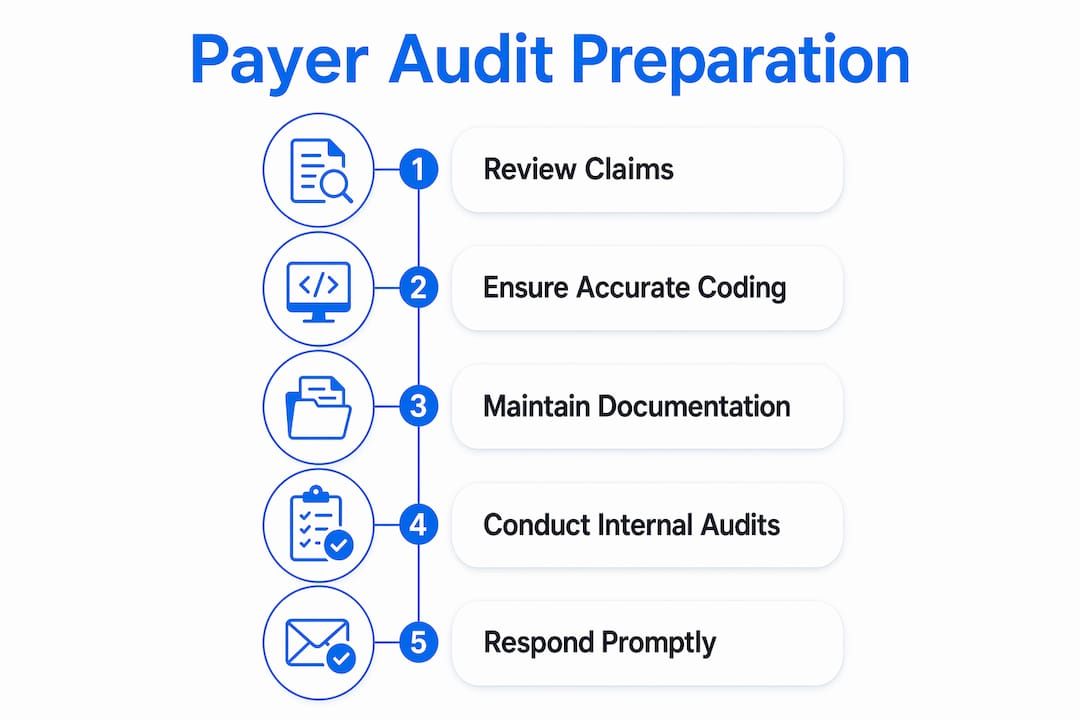
The audit must be conducted by an independent consultant, not your internal billing manager. Internal audits conducted by independent certified coders avoid bias and produce findings that match payer expectations. When your own billing team reviews their own work, they tend to rationalize errors rather than flag them. An outside coder has no incentive to protect anyone.
A complete compliance program follows the OIG's 7 core elements, which include written policies, designated compliance leadership, open communication channels, training, internal monitoring, enforcement, and prompt response to detected violations. Practices with a written compliance program in place demonstrate good faith to auditors. That good faith matters when a payer decides whether to expand an audit or close it.
The table below shows how internal audit frequency compares across practice sizes and risk levels:
| Practice profile | Recommended audit frequency | Sample size per provider |
|---|---|---|
| Low-risk, single specialty | Every 12 months | 10–15 charts |
| Moderate-risk, multi-specialty | Every 6 months | 15–20 charts |
| High-risk or prior audit history | Every quarter | 20–25 charts |
Use audit findings to update written policies, retrain staff, and correct EHR workflows immediately. A concurrent audit program integrates compliance review into daily operations rather than treating it as a periodic event. Practices that correct errors continuously avoid the large recoupment demands that come from years of undetected systemic billing mistakes.
Pro Tip: After each internal audit, issue a written corrective action plan with a 30-day deadline. Documented corrective action is one of the strongest defenses you can present to a payer or federal auditor.
How should you respond when a payer audit notice arrives?
The first 72 hours after receiving an audit notice are the most consequential. Your response in that window sets the tone for everything that follows. Assign a single point of contact immediately. That person manages all communication with the payer, coordinates document collection, and tracks submission deadlines. Audit responses that involve multiple staff members speaking to auditors without a script create inconsistencies that expand audit scope.
Implement a predefined audit response protocol with designated roles for document collection, internal review, and payer communication. Scripted communication reduces the risk of submitting irrelevant or inconsistent information. Every document you send is part of the record. Sending too much, or the wrong records, gives auditors more material to review.
Follow these steps when an audit notice arrives:
- Read the audit notice in full. Identify the audit type, the payer, the service dates, and the specific claims or codes under review.
- Do not supplement or alter records. Adding clinical notes after the fact is a compliance violation. Submit only what existed at the time of service.
- Organize records chronologically. Disorganized submissions prompt auditors to expand the audit scope. Clear, complete records signal a well-managed practice.
- Track all deadlines. Medicare overpayments over $25 must be refunded within 60 days. Missing that window creates additional liability.
- Involve legal counsel for regulatory audits. OIG, ZPIC/UPIC, and DOJ audits require healthcare legal counsel before you submit a single document.
Failing to involve legal counsel early in a federal audit can lead to self-incrimination and loss of legal protections. The first 72 hours after an audit notice are critical, and involvement of healthcare legal counsel is advised for OIG, ZPIC/UPIC, or DOJ audits before submitting any documents.
Consistent upcoding, even without intent, can be charged under the False Claims Act as reckless disregard, risking treble damages and federal program exclusion. That risk makes a calm, organized, legally supported response the only acceptable approach.
Key Takeaways
Physicians who build compliance into daily operations face shorter audits, smaller recoupments, and stronger reimbursement protection than those who prepare only after a notice arrives.
| Point | Details |
|---|---|
| Monitor billing data monthly | Compare your top CPT codes against national benchmarks to catch outliers before payers do. |
| Document medical necessity in every note | Clinical reasoning in each encounter note is your primary audit defense, not the procedure code alone. |
| Conduct independent internal audits | Use certified outside coders every 6–12 months to find errors before external auditors do. |
| Build a written compliance program | Follow the OIG's 7 core elements and update policies after every internal audit finding. |
| Respond to audit notices with a protocol | Assign one point of contact, organize records chronologically, and involve legal counsel for federal audits. |
What I've learned from watching practices get blindsided by audits
The practices that struggle most in audits are not the ones with the worst billing. They are the ones that never looked. I have seen independent physicians with genuinely excellent clinical care face five-figure recoupment demands because their EMR templates auto-populated the same physical exam findings for every patient. The documentation looked complete. It was not defensible.
The mindset shift that changes outcomes is treating your documentation as evidence from the moment you write it, not from the moment you receive an audit notice. When you write a note knowing it must stand alone as proof of medical necessity, your language changes. You stop relying on templates to carry the clinical story. You start writing notes that a payer reviewer, a judge, or a jury could read and understand without your explanation.
Compliance programs also work best when physicians own them, not just billing managers. The annual coding review is not a billing department task. It is a physician responsibility. Practices where the lead physician reviews audit findings personally, asks questions, and drives corrective action see measurably better outcomes than those where compliance is delegated entirely to administrative staff.
The financial case for proactive audit readiness is straightforward. A single recoupment demand can cost more than an entire year of compliance investment. The practices that build the habit early spend less, recover more, and sleep better when audit notices arrive.
— Elena
Himshield helps your practice stay audit-ready year-round
Independent physician practices carry real financial risk every time a claim goes out the door without a compliance check behind it. Himshield is built specifically for practices like yours.
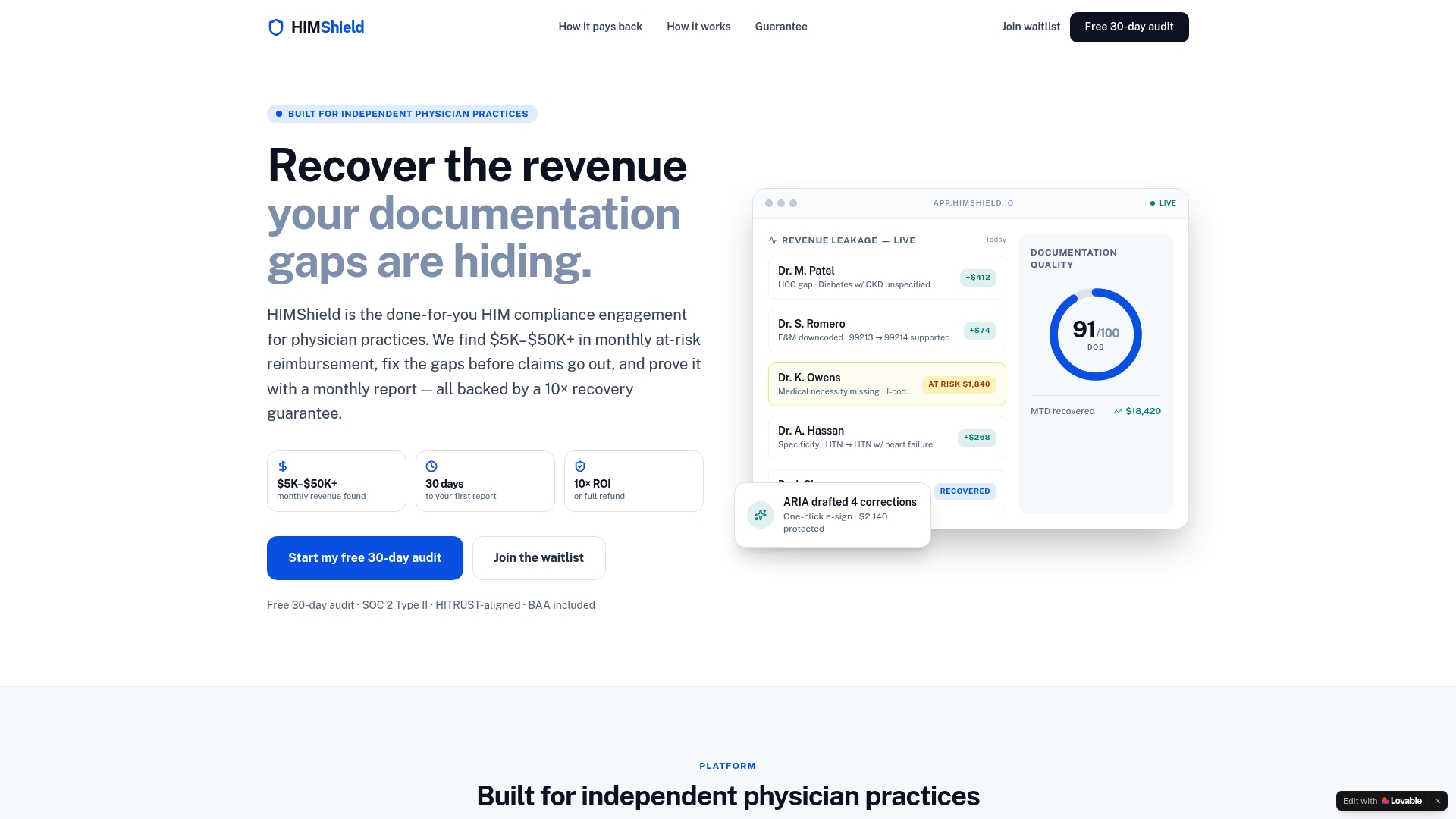
Himshield connects directly to your EHR and scans claims for coding errors, documentation gaps, and charge-capture risks before they become denials or audit triggers. The platform flags the same patterns that payer auditors look for, giving you the chance to correct them first. Practices using Himshield have identified $5K–$50K+ in at-risk reimbursement that would otherwise have gone unrecovered. Visit Himshield to see how automated audit readiness protects your revenue and keeps your practice compliant with 2026 payer requirements.
FAQ
What does it mean to prepare for a payer audit as a physician?
Payer audit preparation means reviewing your claims, coding, and clinical documentation before a payer formally requests records. The goal is to identify and correct errors proactively so your practice can withstand scrutiny without recoupment.
What are the most common payer audit triggers for physicians?
Auditors flag practices with high volumes of specific CPT codes, consistent high-level E/M billing, and documentation that does not support billed services. Monitoring your billing data monthly against national benchmarks is the most reliable way to catch these patterns early.
How often should an independent practice conduct internal audits?
Independent coding audits every 6–12 months, reviewing 10–20 charts per provider, reduce audit risk and identify systemic errors before payers do. High-risk practices or those with prior audit history should audit quarterly.
What should you do immediately after receiving a payer audit notice?
Assign a single point of contact, read the audit notice in full, and organize records chronologically without altering or supplementing them. For OIG, ZPIC/UPIC, or DOJ audits, involve healthcare legal counsel before submitting any documents.
Can unintentional billing errors lead to False Claims Act liability?
Consistent upcoding, even without intent, can be charged under the False Claims Act as reckless disregard. Identifying and correcting systemic errors early, and refunding Medicare overpayments over $25 within 60 days, demonstrates good faith and reduces legal exposure.