
Medical coding compliance means that every code on a claim accurately reflects the clinical documentation and meets federal and payer billing rules. It exists to protect your organization from audit exposure, recoupment, and fraud allegations while ensuring patients are correctly represented in the health record. Primary accountability sits with coders, compliance officers, and clinical documentation improvement (CDI) teams working in concert.
Quick action checklist:
- Pull your denial and modifier reports now — spikes in either are the fastest signal of a compliance gap.
- Confirm that documentation supports the level of service billed before the claim leaves the practice.
Table of Contents
- What medical coding compliance covers in your organization
- Why coding compliance protects your revenue and your license
- U.S. regulations and guidelines that govern coding compliance
- How to build a coding compliance program around OIG's 7 elements
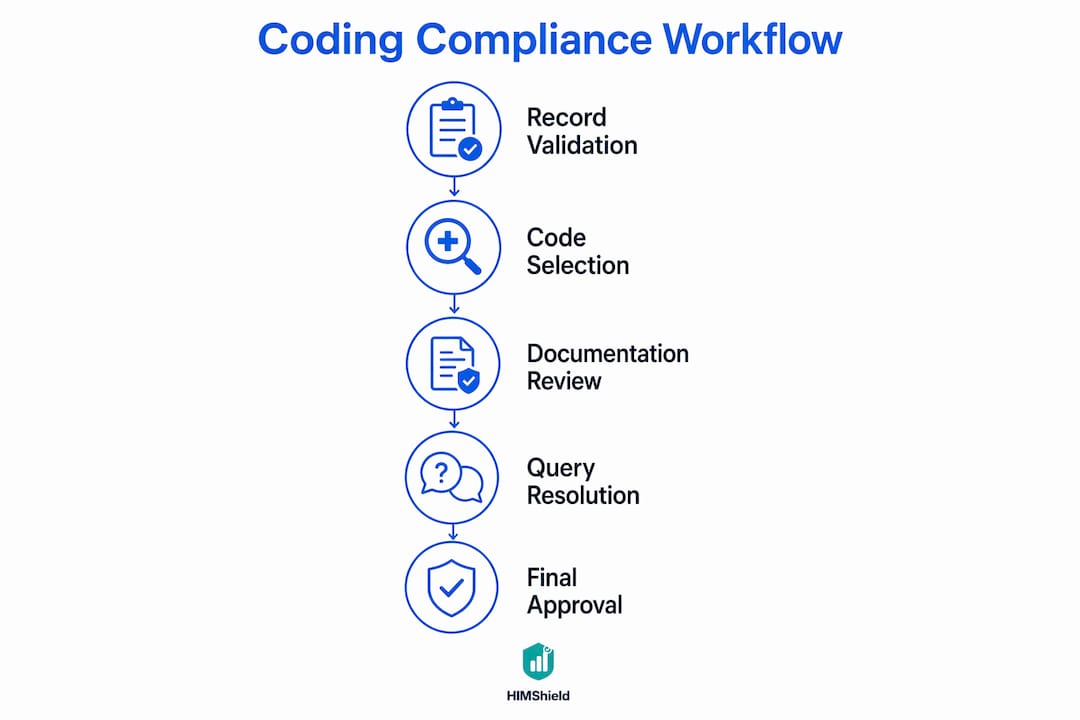
- What a compliant coding workflow looks like day to day
- Best practices that reduce audit risk and common mistakes to avoid
- What happens during a coding compliance review or audit
- How to respond to findings and run a corrective action plan
- Tool categories that support coding compliance and what to expect from each
- Key Takeaways
- Why compliance programs are revenue assets, not overhead
- Himshield helps independent practices protect earned revenue
- Useful sources and primary references
What medical coding compliance covers in your organization
Medical coding compliance is the practice of following legal and ethical standards so that claim codes match clinical documentation and federal billing rules. The scope is broader than most coders initially expect.
Code sets in scope under HIPAA include four systems, each with a distinct purpose:
- ICD-10-CM covers diagnosis coding across all care settings.
- ICD-10-PCS covers hospital inpatient procedure coding.
- CPT covers outpatient procedures and physician services.
- HCPCS Level II covers supplies and services not captured by CPT.
Adherence to ICD-10-CM guidelines is required under HIPAA for all healthcare settings, and the same principle extends to the other adopted code sets under CMS authority.
A coder's compliance responsibility spans three overlapping zones. First, code selection integrity: choosing the most specific, accurate code supported by documentation. Second, documentation integrity: confirming the record actually supports the code before submission. Third, billing and submission rules: applying modifier logic, NCCI edits, and payer-specific policies correctly.
Roles map clearly to each zone. Coders own code selection and flag documentation gaps. CDI specialists query providers to close those gaps before coding. Billing staff apply submission rules and catch claim-level errors. The compliance officer sets policy, monitors trends, and escalates. Providers are ultimately accountable for the documentation that makes accurate coding possible.
A concrete example: an Evaluation and Management (E/M) level 4 visit requires documented medical decision-making or time that supports that level. If the note reflects a straightforward problem, billing level 4 is a compliance failure regardless of what the provider intended. The coder's job is to catch that mismatch before the claim goes out.
Pro Tip: Build a short documentation checklist tied to your top 10 billed CPT codes. Coders who reference it at the point of coding catch mismatches in seconds rather than during a post-payment audit.
Why coding compliance protects your revenue and your license
A well-run compliance program does more than keep auditors away. Operationalizing controls reduces denials and recoupments, turning compliance into a direct revenue-protection asset. Cleaner claims move through payer adjudication faster, which shortens your accounts receivable cycle.

The legal and financial stakes are real. The Office of Inspector General (OIG) and CMS investigate billing patterns that deviate from peers, and findings can result in recoupments, civil monetary penalties, or exclusion from Medicare and Medicaid. A single post-payment audit covering two years of claims can produce a recoupment demand that threatens a small practice's cash flow.
Operationally, every denial creates downstream work: appeals, rebilling, provider time spent on documentation addenda, and staff hours that could go elsewhere. The importance of coding compliance shows up most visibly in denial rates and days in AR, two metrics that deteriorate quickly when coding controls are weak.
Patient safety and data integrity are also at stake. Incorrect diagnosis codes follow a patient through the health system, affecting risk stratification, care coordination, and downstream clinical decisions. HIPAA requires that the codes on claims accurately represent the encounter, so a compliance failure is simultaneously a data-quality failure.
Pro Tip: Run a modifier frequency report monthly. An unusual spike in modifier 25 or modifier 59 is one of the most common triggers for a payer audit and one of the easiest patterns to catch internally before it escalates.
U.S. regulations and guidelines that govern coding compliance
Every coding compliance program in the United States answers to a layered set of authorities. Knowing where each rule originates helps you defend claims and cite the right source during an audit.
| Authority | What it governs | Primary source |
|---|---|---|
| HIPAA Administrative Simplification | Mandates use of standard code sets (ICD-10-CM, ICD-10-PCS, CPT, HCPCS) for electronic transactions | CMS Adopted Standards |
| CMS ICD-10-CM Official Guidelines | Diagnosis code selection rules, specificity requirements, sequencing | CDC/CMS joint publication, updated annually |
| NCCI Policy Manual | PTP edits, MUEs, add-on code edits preventing inappropriate bundling | CMS NCCI Manual |
| OIG Work Plan | Annual list of high-risk billing areas under active review | OIG website |
| Medicare/Medicaid billing rules | Coverage, medical necessity, place-of-service, incident-to rules | CMS Internet-Only Manuals (IOMs) |
| AMA CPT guidelines | Procedure code definitions, parenthetical instructions, modifier rules | AMA CPT Professional codebook |
The NCCI program includes three edit types that directly affect daily coding: Procedure-to-Procedure (PTP) edits that deny a Column Two code when billed with a Column One code on the same date, Medically Unlikely Edits (MUEs) that cap the maximum units of service for a given code, and Add-on Code (AOC) edits that govern codes reportable only with a primary procedure. Providers are obligated to code correctly even when no NCCI edit exists to catch a specific error.
Key operational points for your team:
- ICD-10-CM diagnosis codes must be reported to the highest level of specificity the documentation supports.
- CPT codes must represent the most comprehensive service performed; unbundling component services into separate codes is prohibited.
- Incident-to and shared/split billing rules for advanced care practitioners (ACPs) carry their own documentation requirements and are a frequent audit target.
- OIG audit triggers often align with the annual Work Plan, so reviewing it each fall is a practical way to prioritize your internal audit calendar.
How to build a coding compliance program around OIG's 7 elements
An effective coding compliance program operationalizes OIG's seven core elements. Here is how each element translates into coding-specific controls:
-
Written policies and procedures. Document your coding policies by code set, specialty, and payer. Include modifier governance, query protocols, and claim correction procedures. Review and version-control annually.
-
Designated compliance officer or committee. Assign a named individual with authority to escalate findings to leadership. In smaller practices, this role is often combined with HIM leadership, but the accountability must be explicit.
-
Training and education. Onboarding training for new coders, annual refreshers for all staff, and targeted remediation modules after audit findings. Measure effectiveness with pre/post accuracy assessments and track trends over time.
-
Effective lines of communication. A confidential reporting mechanism (hotline or anonymous form) so coders can escalate red flags without fear of retaliation. This is one of the most underbuilt elements in small practices.
-
Auditing and monitoring. Prospective and retrospective audits on a defined cadence, with targeted sampling for high-risk codes, high-volume providers, and new service lines. An annual coding review aligned to the OIG Work Plan is a practical starting point.
-
Enforcement and discipline. Consistent, documented responses to violations. Coders and providers who repeatedly bill incorrectly after education must face a defined consequence, or the program loses credibility.
-
Timely response to detected offenses. A written protocol for what happens when a potential violation is found: scope assessment, root-cause analysis, claim correction or refund, and documentation of the response.
While federal law does not strictly mandate a written coding compliance plan, auditors treat its absence as a negative indicator. A documented program with version history and senior sign-off is your first line of defense in any investigation.
| Program maturity level | Characteristics |
|---|---|
| Ad hoc | No written policies; audits only after a denial or complaint |
| Developing | Written policies exist; audits are annual but not risk-stratified |
| Defined | OIG elements documented; regular audits; training tracked |
| Managed | Risk-based audit sampling; metrics dashboard; remediation tracked |
| Optimized | Continuous monitoring; predictive analytics; closed-loop remediation |
What a compliant coding workflow looks like day to day
Coding compliance is continuous operations, not a one-time checklist. A practical three-pass workflow keeps risk low without slowing throughput.
Pass 1 — Validation. Before coding begins, confirm the record is complete: the provider has signed the note, the date of service matches the encounter, and required elements (chief complaint, assessment, plan) are present. Flag incomplete records for CDI query rather than coding from an insufficient note.
Pass 2 — Coding integrity. Select codes to the highest specificity the documentation supports. Cross-reference NCCI edits for any procedure pair. Verify modifier rationale is documented, not assumed. For E/M codes, confirm the documented MDM or time supports the selected level.
Pass 3 — Policy alignment. Check payer-specific rules for the patient's coverage. Confirm medical necessity language is present for high-dollar or high-scrutiny procedures. Apply any applicable LCD (Local Coverage Determination) requirements before the claim is released.
Automated gates should be placed between Pass 2 and Pass 3 for high-dollar procedures, modifier 25 and modifier 59 combinations, and any provider flagged in a recent audit. A human review trigger at this point catches the claims most likely to generate a denial or audit request before they leave the practice.
Responsibility at each handoff is explicit. The coder signs off on code selection. The CDI specialist resolves open queries before the claim moves to billing. Billing staff apply submission rules and hold claims that fail edits. The compliance officer reviews flagged claims and tracks patterns. Documentation quality is the single most important preventive control; even a strong coding program cannot compensate for a provider note that does not support the billed service.
Best practices that reduce audit risk and common mistakes to avoid
Daily and weekly habits that protect your program:
- Validate medical necessity before coding any procedure with a high denial rate in your specialty.
- Run a modifier governance check weekly: flag any modifier applied more than a defined threshold percentage of the time for a given code.
- Use a documentation gating rule: no code is submitted without a signed, dated note that supports it.
- Query providers through a formal CDI process rather than making assumptions about undocumented conditions.
- Review ICD-10 specificity on your top 20 diagnosis codes quarterly; unspecified codes in high-volume positions are a common audit red flag.
Common pitfalls that create audit exposure:
- Modifier misuse: Appending modifier 25 to every E/M billed with a procedure, or using modifier 59 as a default override without documented clinical rationale.
- Unbundling: Reporting component services separately when a single comprehensive CPT code describes the full service.
- Cloned notes: Copy-forward documentation that does not reflect the actual encounter. Payers and auditors identify these quickly through metadata and content analysis.
- Insufficient diagnosis specificity: Coding to an unspecified or symptom-level code when the documentation clearly supports a definitive diagnosis.
- Upcoding E/M levels: Selecting a higher complexity level than the documented MDM or time supports.
Coders are often the first to detect patterns that indicate fraud, waste, or abuse. Red flags include a provider whose E/M distribution skews heavily toward level 4 and 5 visits, a sudden spike in a specific procedure code, or documentation that reads identically across multiple encounters. Empowering coders to escalate these patterns without fear of retaliation strengthens the entire program.
Pro Tip: Peer review at least 10 charts per coder per quarter. Pair it with a short feedback session. Accuracy trends from peer review are more actionable than post-denial data because they catch errors before they become claims.
What happens during a coding compliance review or audit
Understanding the audit process removes the panic and lets you respond strategically. Most reviews follow a predictable sequence.
-
Intake and notification. You receive a written request identifying the audit type (prepayment, post-payment, RAC, MAC, OIG), the time period under review, and the documentation requested. Preserve all communications from this point forward.
-
Sample selection. Auditors select a statistically valid or targeted sample of claims, often focused on high-dollar codes, outlier utilization, or specific CPT/ICD-10 combinations flagged by data analytics. Retrospective risk-lens methods are common, and rules can vary by provider type, particularly for incident-to and shared/split billing scenarios.
-
Documentation review. Auditors compare billed codes to the supporting documentation. They check that the code selected matches the documented service, that medical necessity is established, that modifiers are supported, and that signatures and dates are present.
-
Findings report. A written report identifies overpayments, underpayments, or coding errors. Each finding typically includes the claim, the billed code, the auditor's supported code, and the dollar difference.
-
Remediation or appeal. You have the right to appeal findings you disagree with. For findings you accept, a corrective action plan (CAP) is required. Recoupment timelines vary by payer and audit type; prepare for the possibility of extrapolation, where a finding rate from the sample is applied to a broader claim universe.
Typical outcomes include partial or full overturns on appeal, recoupment demands, required provider education, and ongoing monitoring periods. Preparing a payer audit response plan before you receive a request is far less stressful than building one under a deadline.
A sample checklist of what auditors will verify:
- Signed and dated provider note for each billed date of service
- Documentation of medical necessity for the primary diagnosis
- Modifier rationale documented in the record, not just appended to the claim
- E/M level supported by documented MDM or total time
- No unbundled services that should be captured by a single comprehensive code
- Incident-to or shared/split billing documentation where applicable
How to respond to findings and run a corrective action plan
A finding is not a verdict. How you respond determines whether it becomes a one-time correction or a recurring liability.
Stepwise corrective action plan:
- Verify scope. Confirm which claims, providers, and time periods are implicated. Do not assume the auditor's sample captures the full picture; run your own internal pull to understand the true scope.
- Root-cause analysis. Identify whether the error is a coder knowledge gap, a documentation failure, a system configuration issue, or a policy gap. The fix must match the cause.
- Remediation steps. Assign specific actions: provider education, policy update, coder retraining, EHR template revision, or a combination. Set a completion date for each.
- Metrics and timeline. Define how you will measure success: re-audit accuracy rate, denial rate for the affected code, documentation query resolution time. Set a 90-day re-audit date.
- Re-audit. Pull a new sample of the same code or provider after remediation. If accuracy has not improved, escalate the intervention.
When to correct claims, refund payers, or self-disclose depends on the nature and magnitude of the finding. Overpayments identified internally should generally be refunded within 60 days under the CMS 60-day rule. Patterns that suggest systemic fraud require legal counsel and may warrant a voluntary self-disclosure to the OIG. Document every investigative step in writing; good-faith documentation of your response is a material factor in how regulators treat the matter.
Involve legal counsel when the finding involves potential false claims, when the dollar amount is significant, or when the pattern extends across multiple providers or years. Involve executive leadership when the finding could affect the organization's payer contracts or public reputation.
Pro Tip: Prepare a responsibility matrix before any audit begins. Map which team owns evidence collection, who approves the response letter, and who communicates with the payer. A clear matrix cuts response time significantly and prevents the kind of disorganized reply that makes auditors look harder.
Tool categories that support coding compliance and what to expect from each
Choosing the right tools depends on what your program actually needs, not what a vendor's demo looks like.
| Tool category | What it delivers | Key selection criteria |
|---|---|---|
| Coding audit platforms | Risk-scored claim samples, coder accuracy tracking, finding documentation | Audit trail, configurability by specialty, integration to EHR |
| EHR-integrated validation | Real-time code suggestions, documentation completeness alerts at point of care | FHIR API access, EHR vendor compatibility, alert specificity |
| Rules/edits engines | NCCI PTP, MUE, and add-on code edit checks before claim submission | Edit library currency, payer-specific rule support, override logging |
| CDI platforms | Provider query management, HCC gap identification, documentation improvement tracking | Query workflow, provider-facing interface, analytics on query acceptance rates |
| Analytics and dashboards | Denial trend analysis, modifier frequency reports, provider outlier detection | Data refresh frequency, drill-down capability, export for audit response |
What to look for when evaluating any tool:
- Data access: can it connect to your EHR and claims system without a manual export?
- Configurability: can you set rules by specialty, payer, and provider rather than applying a one-size-fits-all edit set?
- Audit trail: does it log every override, every query, and every review decision in a format you can produce during an audit?
- Defensibility: can you export findings in a format that supports your response to a payer or OIG request?
On AI-assisted coding: assistive AI that surfaces code suggestions for human review is a practical efficiency gain. Autonomous AI that submits codes without human sign-off is a compliance risk. Any AI tool used in the coding workflow needs a defined validation process, ongoing accuracy monitoring, and a clear human-in-the-loop checkpoint before claim submission. The top coding compliance software options vary significantly in how they handle this boundary, so evaluate it explicitly.
The Medicare Advantage compliance ecosystem adds another layer of complexity for practices with significant MA volume, particularly around risk adjustment coding and HCC documentation requirements. Tools that handle both fee-for-service and risk adjustment in a single workflow reduce the chance of a gap between the two.
Key Takeaways
Medical coding compliance requires accurate code selection, complete documentation, and adherence to federal billing rules across every claim your practice submits.
| Point | Details |
|---|---|
| OIG's 7 elements are your blueprint | Build written policies, assign a compliance officer, train staff, audit regularly, and document every response. |
| Documentation is the root control | No coding program compensates for a provider note that does not support the billed service. |
| Audits follow a predictable path | Intake, sample selection, documentation review, findings, and remediation or appeal — prepare your response matrix before a request arrives. |
| Modifier and denial trends are early warnings | Monthly modifier frequency reports and denial analysis catch compliance gaps before they trigger a payer audit. |
| Himshield detects risk before it becomes a denial | Himshield scans coding, documentation, and charge-capture gaps in independent practices, giving you a clear picture of at-risk revenue. |
Why compliance programs are revenue assets, not overhead
The conventional framing of coding compliance as a cost center gets it backwards. Every dollar recovered through a corrective action plan, every denial prevented by a documentation gate, and every audit overturned through a well-documented response is direct revenue that would otherwise leave the practice. The organizations that treat compliance as a financial discipline rather than a regulatory obligation consistently outperform peers on clean claim rates and days in AR.
What most programs underestimate is the compounding effect of small, consistent controls. A modifier governance rule that catches 15 unsupported modifier 25 claims per month does not look dramatic on a dashboard. Over a year, across a multi-provider group, it represents a material reduction in audit exposure and a cleaner billing profile that payers notice. The practices that struggle are not the ones with a single catastrophic billing error; they are the ones with chronic low-level drift that goes unmonitored until a RAC or MAC pulls a sample.
The other underappreciated factor is coder empowerment. Coders who feel safe escalating a red flag without fear of pushback from a provider or a billing manager are the most effective early-warning system a practice has. Building that culture is not a technology problem; it is a leadership decision. Pair it with the right tools and a clear escalation path, and compliance stops being reactive.
Himshield helps independent practices protect earned revenue
Independent physician practices face the same audit exposure as large health systems, with a fraction of the compliance infrastructure. Himshield closes that gap by scanning your coding, documentation, and charge-capture data to surface risks before they become denials or audit findings.
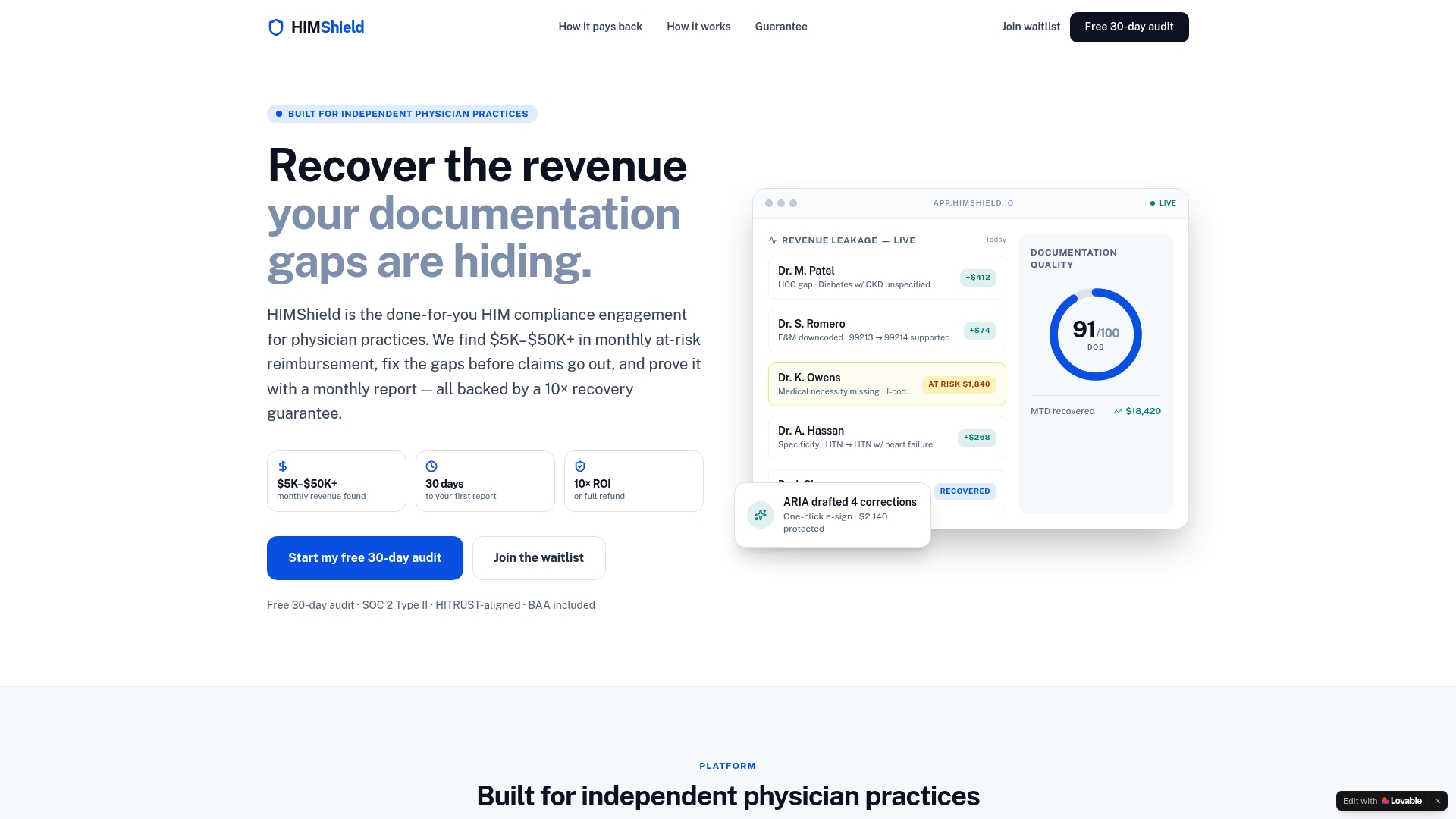
The platform delivers automated risk detection across your claim history, flags documentation gaps tied to specific CPT and ICD-10 codes, and provides physician-friendly guidance your providers can act on without a compliance translator. Practices using Himshield typically identify $5K–$50K+ in recoverable or at-risk revenue within the first review cycle.
What you can expect from Himshield:
- Clear risk scores by provider, code, and claim type
- Targeted audit samples focused on your highest-exposure areas
- Guidance on documentation improvement tied to specific findings
- An audit trail that supports your response to any payer or OIG request
If you are ready to see where your practice stands, start with Himshield and get a clear picture of your coding and documentation risk in days, not months.
Useful sources and primary references
These primary sources belong in your audit documentation file. Cite the official version, not a summary.
- CMS Adopted Standards and Operating Rules — the authoritative list of HIPAA-mandated code sets (ICD-10-CM, ICD-10-PCS, CPT, HCPCS). Use this to defend code set selection in any audit response.
- CMS ICD-10-CM Official Guidelines FY2026 — the joint CMS/NCHS coding guidelines updated October 1, 2025. Required reading for diagnosis code specificity and sequencing rules; cite the specific section when defending a code assignment.
- CMS NCCI Policy Manual — the complete PTP, MUE, and add-on code edit policies. Use this when appealing a claim denied under an NCCI edit or when building your internal edit engine.
- AAPC: The Role of Medical Coders in Compliance — practical guidance on coder responsibilities, red flag identification, and escalation. Useful for training materials and job description development.
- OIG Compliance Program Guidance — a step-by-step breakdown of the OIG's seven elements applied to coding. Use this as your program design template and benchmark.
- AANEM Coding and Billing Compliance Guidance — specialty-specific compliance guidance that reinforces the value of written policies and annual program review. Useful for audit posture documentation.
- Himshield Blog: What Is a Coding Audit? — a practical guide to audit methodology and how audits improve claim accuracy; a useful operational reference for compliance staff building an internal audit program.
This article is general information for educational purposes. Confirm current rules, rates, and regulatory requirements with CMS, the OIG, or a qualified healthcare compliance professional for your specific situation.