
A dependable coding correction workflow prevents denials, recovers revenue already earned, and leaves an audit trail that holds up under payer review. The framework runs in four steps: detect, triage, correct and document, verify, and track. Every correction must also follow payer rules for replacement claims, void or cancel actions, and reopenings, or it risks creating new problems instead of fixing old ones.
TL;DR:
- Use code 7 to replace a valid service billed incorrectly, and code 8 to void a claim that should never have been filed.
- Request a reopening for clerical mistakes, such as a transposed digit or wrong service date, because these corrections can bypass the formal appeals process.
- Document each correction’s rationale against the original chart, retain timestamps and editor identity, and obtain physician attestation when clinical details remain unclear.
- Track clean claim rate, denial reasons, correction time, and recovered revenue monthly; flag NCCI conflicts, place of service mismatches, and unusual E/M levels before submission.
Table of Contents
- The 4-step coding correction workflow: detect, triage, correct and document, verify
- Pre-submission controls that stop errors from becoming corrections
- Post-submission corrections: replacement vs. void/cancel, reopenings, and escalation
- Governance and audit trail: policies, roles, and evidence retention
- Tooling and metrics: what automation should do and the KPIs to track
- What independent practices get wrong about correction workflows
- Get a Revenue Leakage Audit Before You Build the Workflow Yourself
- FAQ
- Sources
- Primary sources for coding correction rules
The 4-step coding correction workflow: detect, triage, correct and document, verify
Four steps carry the entire workflow, and each one has its own owner, inputs, and output.
- Detect: surface the error before or shortly after submission.
- Triage: score and route the finding to the right reviewer.
- Correct and document: fix the code and preserve the reasoning.
- Verify and track: confirm the fix worked and log the outcome.
Detection draws from several sources at once: EHR edit reports, charge-capture audits, denial-pattern analytics, pre-bill scrubber edits, post-payment sampling, and automated risk alerts that flag anomalies before a claim ever leaves the building. A practice that relies on only one of these misses the others' blind spots.
Triage is where most practices lose time without a scoring rule. A workable one weighs four factors: payer sensitivity, dollar impact, clinical uncertainty, and audit likelihood. High-dollar claims tied to payers with aggressive post-payment review should route to a senior coder or compliance lead immediately; low-dollar, low-ambiguity fixes can clear through a standard queue.

Correction and documentation is the step most exposed to risk. Every draft correction needs a documented rationale, a link back to the original chart note, and, when the clinical picture is unclear, a physician clarification and attestation rather than a coder's guess. The OIG compliance guidance for physicians is direct on this point: diagnosis and procedure codes reported on a claim must trace back to what is actually documented in the medical record, and that documentation must be available to coding staff at the time the code is assigned.
Verification closes the loop. A second reviewer confirms the correction matches the chart, the system logs who made the change and when, and the team tracks time-to-correction so recurring patterns surface instead of repeating quietly.
Pro Tip: Route every correction with a dollar impact above your practice's materiality threshold through a second reviewer, even when the fix looks obvious.
Pre-submission controls that stop errors from becoming corrections
The cheapest correction is the one you never have to make. Most downstream denials trace back to a handful of pre-bill gaps, and closing them reduces the volume hitting your correction queue.
- Confirm the full chart, including late addenda, is available to the coder before a code is finalized, not after.
- Run standardized pre-bill edits for mismatched modifiers, missing documentation elements, and unbundling conflicts.
- Build E/M documentation checkpoints that confirm the level billed matches the note's medical decision-making or time documentation, with a physician signature and attestation on file.
- Reconcile every encounter to its charge before submission, and validate place-of-service codes against where the service actually happened.
OIG audits have repeatedly identified E/M service miscoding and place-of-service errors have been identified as significant sources of incorrect Medicare payments as recurring sources of incorrect Medicare payments, which is why these two checkpoints carry outsized weight in a pre-bill review.
Staffing matters as much as the checklist. Coders who can reach a physician directly for a same-day clarification resolve ambiguity before the claim goes out, instead of after a denial forces the question. Practices that build this collaboration into the daily schedule, rather than treating it as an exception process, see fewer corrections downstream.
Post-submission corrections: replacement vs. void/cancel, reopenings, and escalation
Once a claim has been submitted, the fix you choose depends on what actually went wrong. The Medicare Claims Processing Manual draws a clear line between a replacement claim, which resubmits the full corrected claim under frequency code 7, and a void or cancel, filed under frequency code 8 when a claim should never have been paid at all.
| Scenario | Correct action | Frequency code |
|---|---|---|
| Wrong code, service still valid | Replacement claim | 7 |
| Claim submitted in error entirely | Void/cancel | 8 |
| Clerical or minor error (date, digit transposition) | Reopening | N/A, outside appeals |
Clerical errors, like a transposed digit or a wrong date of service, generally qualify for a reopening rather than a formal appeal. CMS guidance under Section 937 of the MMA allows these minor corrections, including telephone reopenings with some Medicare Administrative Contractors, to be processed outside the appeals track entirely.
Before filing anything, assemble the original Document Control Number, document the provider clarification that supports the change, and confirm no duplicate claim is sitting in the system. When the correction touches a pattern rather than a single claim, or when the dollar exposure is substantial, escalate to a repayment analysis or formal appeal instead of handling it as a routine fix.
Governance and audit trail: policies, roles, and evidence retention
A correction that cannot be explained six months later is a liability, not a fix. OIG compliance guidance for billing operations calls for written standards of conduct, documented correction procedures, and a regular training schedule, and those three elements form the backbone of a defensible program.
A simple role matrix keeps accountability clear:
- Detect: coding or billing staff, or an automated alert.
- Triage: senior coder or compliance lead, applying the scoring rule.
- Authorize: physician attestation for any clinically ambiguous change.
- Submit: billing staff, following the replacement/void/reopening rules.
- Verify: a second reviewer, independent of the original coder.
Every correction's audit trail needs a timestamp, the name of who made the change, the physician attestation where one applies, and a retained copy of both the original chart note and the corrected claim. Our coding workflow guide walks through how centralized, distributed, and hybrid staffing models assign these roles differently depending on practice size.
Pro Tip: Schedule an annual coding review alongside quarterly spot audits so patterns surface well before a payer's own review does.
Tooling and metrics: what automation should do and the KPIs to track
Four metrics tell you whether your coding correction workflow is actually working: clean claim rate, denial rate by reason code, median time-to-correct, and total recovered revenue. Track all four monthly, not just the ones that look good.
Automation earns its place when it does specific jobs well:
- Link every claim directly to its supporting chart note, automatically.
- Flag anomalies like NCCI edit conflicts, place-of-service mismatches, and E/M level outliers before submission.
- Draft the correction itself, with a rationale attached, ready for physician review.
- Log every edit with a timestamp and user ID, building the audit trail as a byproduct of the work rather than a separate task.
Versioning CPT and ICD references matters here too: AMA publishes CPT errata and technical corrections on an ongoing basis, and a workflow that doesn't track which rule version applied to which chart risks retroactively misapplying a new rule to an old claim.
The operational signals worth watching daily are narrow: NCCI edit flags, POS mismatches, and E/M level anomalies. These three account for a disproportionate share of preventable denials, which is why they deserve a dedicated alert rather than a monthly report.
What independent practices get wrong about correction workflows
The biggest failure mode we see isn't bad coding. It's coding corrections made without a documented rationale, so the same error resurfaces three months later because nobody tracked why the first fix was made. Traceability, not speed, is what makes a correction defensible.
Practices that build structure around detection and documentation tend to find their first material recovery within the first 30 days, simply because prioritized, high-dollar corrections surface early. Our 4 Step Coding Correction Process breaks this down into the operational checklists we use with practices directly.
— Elena
Get a Revenue Leakage Audit Before You Build the Workflow Yourself
Running this workflow by hand takes dedicated staff time every single week. Our Free 30-day Revenue Leakage Audit maps the four steps directly onto your own EHR data: we detect coding, documentation, and charge-capture gaps, quantify what they're costing you per provider and per payer, and hand you a report you can act on immediately, with no new software to learn and no new staff to hire.
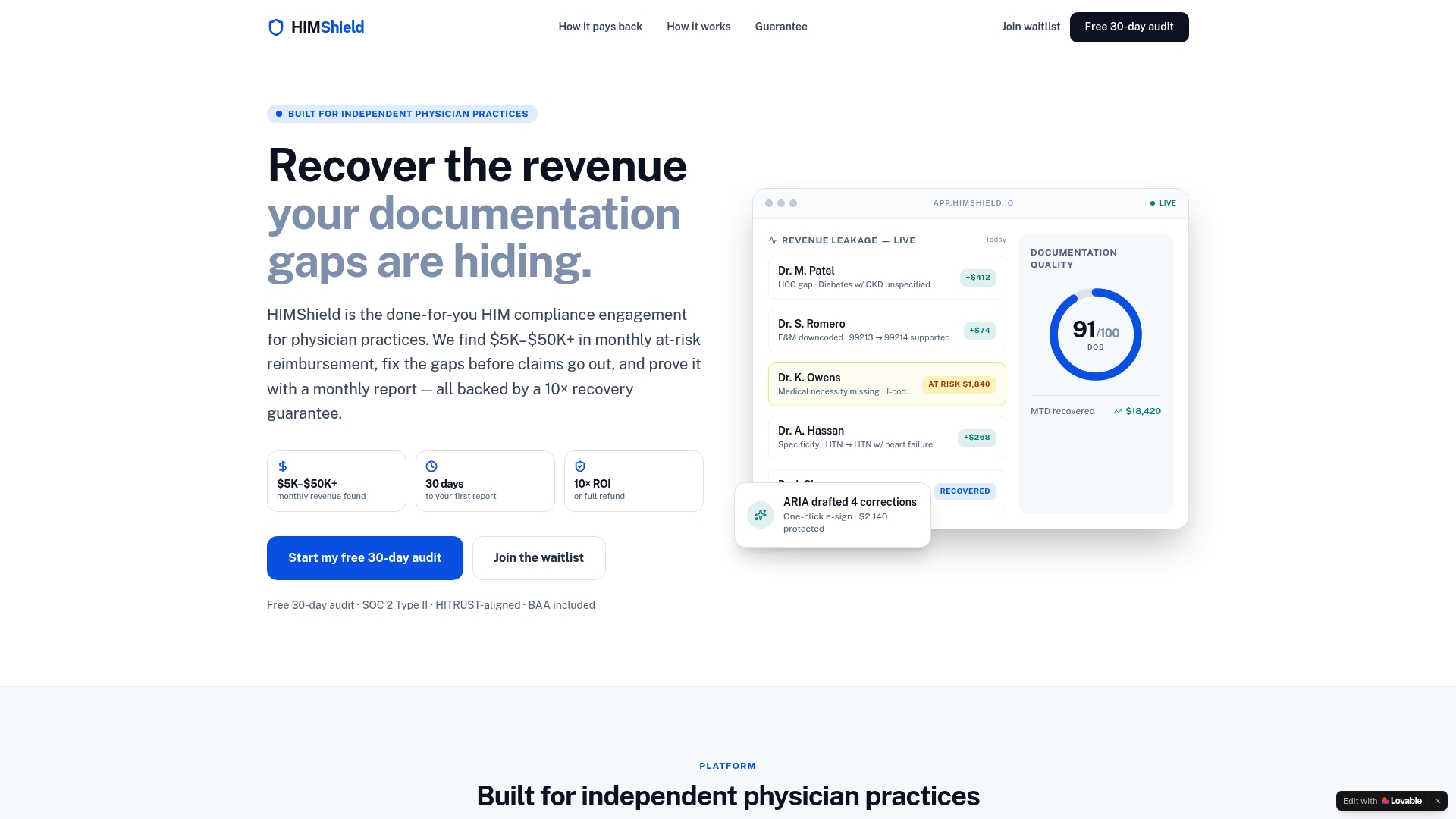
Some platforms go further than a one-time report by linking flagged claims to supporting chart notes, drafting corrections for physician review, and assembling submission-ready documentation for payers.
| What you get | How it maps to the workflow |
|---|---|
| Per-provider, per-payer leakage report | Detect |
| Automated compliance alerts | Triage |
| One-click physician e-signature on drafted corrections | Correct & document |
| Audit-ready evidence packages | Verify & track |
Request your free Revenue Leakage Audit and see what your practice is leaving on the table before your next billing cycle closes.
FAQ
What is the difference between a replacement claim and a void/cancel claim?
A replacement claim resubmits the entire corrected claim under frequency code 7 and is used when the service was valid but coded or billed incorrectly. A void or cancel, filed under frequency code 8, is used when the original claim should never have been submitted at all.
When should a practice request a reopening instead of filing an appeal?
Reopenings apply to clerical or minor errors, such as a transposed digit or an incorrect date of service, and can be processed outside the formal appeals track under Section 937 of the MMA. An appeal is reserved for substantive disagreements about coverage or coding determinations, not simple clerical fixes.
What documentation does a coding correction need to withstand an audit?
Every correction needs a clear rationale tied to the original chart note, a timestamp, the identity of who made the change, and physician attestation when the clinical picture was ambiguous. OIG guidance requires that reported codes trace directly back to documentation available at the time of coding.
How much does HIMShield's audit cost?
The Free 30-day Revenue Leakage Audit has no published price and precedes any paid subscription. Paid HIMShield subscriptions are scaled to provider count and chart volume, with details available directly from our team.
Sources
E/M level miscoding and incorrect place-of-service coding are among the most frequently cited issues in OIG audits of Medicare payments. A practical, operational list of common coding errors and fixes is available from One For All Medical Billing.
- Medicare Claims Processing Manual (replacement/void guidance)
- I. Physician relationships with payers | OIG
- CPT errata & technical corrections | AMA
Primary sources for coding correction rules
The rules behind this workflow come from a small set of primary sources: the CMS Medicare Claims Processing Manual for replacement, void/cancel, and reopening procedures, OIG compliance guidance for documentation and provider relationships, and AMA resources for CPT code maintenance and errata.