
Precise ICD-10-CM, CPT, and HCPCS coding cuts audit triggers by eliminating the unspecified or unsupported claims that payer edit engines flag as statistical outliers. When your codes carry the full clinical picture, payer automated reviews find nothing to question. Three actions your team can take today:
- Query for missing laterality before the claim leaves the practice. A knee pain code without left/right designation is an immediate red flag for payer medical necessity edits.
- Use combination codes wherever ICD-10-CM offers them. A single combination code replaces two or three less-specific codes and removes the bundling ambiguity that triggers NCCI edits.
- Require supporting clinical indicators in the note before assigning a high-complexity E/M or a procedure code. Labs, vitals, and imaging findings documented in the same encounter are what make a code defensible.
Coding to the highest level of specificity consistent with documentation is the standard CMS and every major payer expects. Practices that meet it consistently face fewer automated reviews, fewer denials, and a narrower audit target.
Table of Contents
- Why coding specificity reduces audits: the payer mechanics behind the trigger chain
- What common audit triggers actually look like in your charts
- Concrete steps to build specificity into your coding workflow
- How specificity changes what internal and external audits look for
- Metrics that show whether your specificity work is paying off
- How pre-submission automation operationalizes specificity at scale
- Key Takeaways
- The cultural shift that makes specificity stick
- Himshield catches specificity gaps before they become denials
- Authoritative sources and further reading
Why coding specificity reduces audits: the payer mechanics behind the trigger chain
Every claim you submit passes through a layered review funnel before a dollar is released. Understanding that funnel is the fastest way to see why specificity matters.

Stage 1: Edit engines. Payers run claims through National Correct Coding Initiative (NCCI) edits, Medically Unlikely Edits (MUEs), and local coverage determination (LCD) medical necessity checks. An unspecified diagnosis code, a modifier applied without supporting documentation, or a CPT code that conflicts with the ICD-10 principal diagnosis will fail one of these edits automatically.

Stage 2: Statistical outlier detection. Claims that clear the edits still feed into payer analytics models. Payers compare your practice's coding patterns against peers in the same specialty and geography. A high rate of unspecified codes, a modifier-25 frequency above the norm, or an E/M level distribution skewed toward 99214–99215 without corresponding documentation complexity all generate outlier flags. Those flags move your practice up the audit queue.
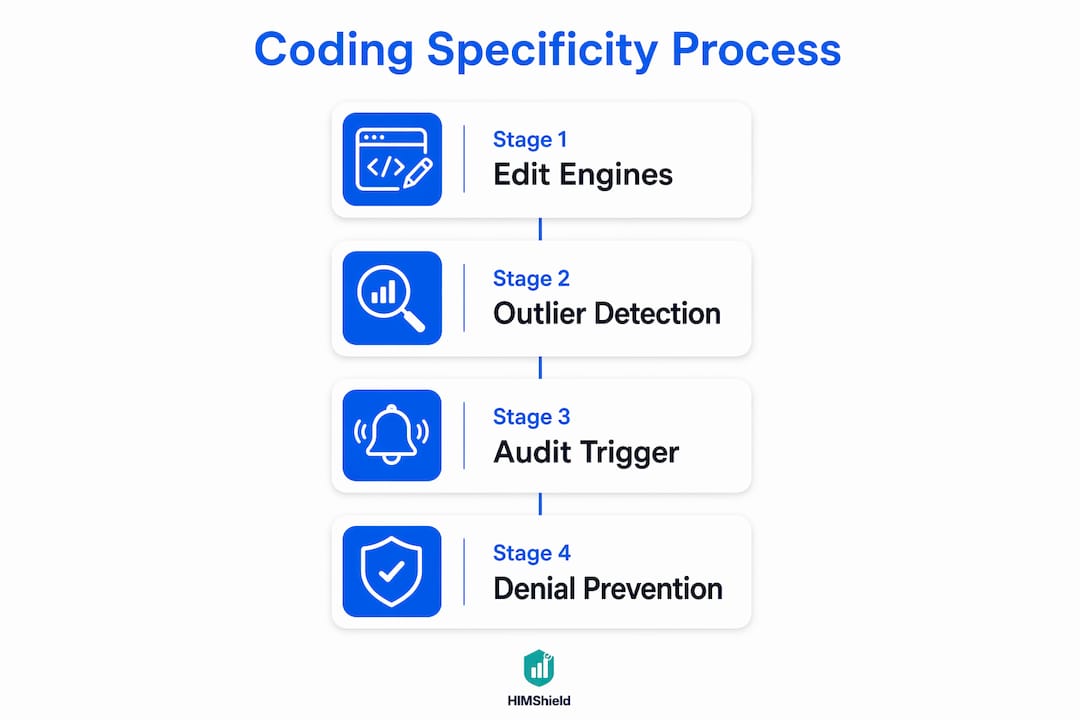
Stage 3: Targeted audit. Once flagged, a practice faces either a prepayment review (claims held before payment) or a post-payment audit (recoupment demand after payment). Both are costly in staff time and cash flow. Payers are increasingly using clinical validation and documentation specificity as audit triggers, not just high-dollar claims or DRG shifts.
The financial stakes extend beyond fee-for-service. Under value-based contracts, RAF and HCC scoring depend directly on diagnostic specificity. Under-coding a chronic condition loses capitation revenue; over-coding invites recoupment. Specificity is the only position that protects both sides.
The single most effective audit-prevention strategy is front-loading specificity at the point of care — before the claim is generated, not after a denial arrives. Retrospective correction costs three to five times more in staff time than getting the code right on the first pass.
Pro Tip: Build a short specificity checklist into your EHR encounter template for your top 20 diagnosis codes by volume. Coders and providers who see the prompt at documentation time capture laterality, acuity, and complications before the chart is closed.
| Coding accuracy band | Audit exposure level | Denial rate impact | First-pass clean claim rate |
|---|---|---|---|
| 80–85% | High | Elevated; statistical outlier risk | Below industry benchmark |
| 95%+ | Low | Minimal; within payer tolerance | At or above benchmark |
Operating at 80–85% accuracy leaves a practice statistically exposed. The 95%+ band is the modern target for practices that want to stay out of payer crosshairs.
What common audit triggers actually look like in your charts
Most audit triggers are not exotic. They show up in the same five or six patterns, chart after chart.
-
Unspecified diagnosis codes when a more specific ICD-10 exists. Example: M79.3 (panniculitis, unspecified) assigned when the note clearly documents right shoulder panniculitis. The more specific code exists; not using it is a compliance violation that heightens audit probability.
-
Missing laterality. A fracture, joint pain, or nerve injury code without a side designation fails payer edits in most LCD policies. One missing character in the ICD-10 code can convert a clean claim into a denial.
-
Absent clinical indicators for medical necessity. A high-complexity E/M or a diagnostic procedure needs supporting documentation: abnormal labs, a worsening vital trend, or imaging findings referenced in the assessment. Without that linkage, the code is unsupported and the claim is vulnerable.
-
Modifier misuse. Modifier-25 appended to an E/M on the same day as a minor procedure is appropriate only when a separately identifiable service is documented. Routine use without that documentation is one of the most common RAC and OIG audit focus areas.
-
Unbundling. Billing component codes separately when a comprehensive CPT code covers the full service triggers NCCI edits and signals upcoding to payer analytics.
-
Conflicting documentation across the EHR. A diagnosis in the assessment that contradicts the HPI, or a procedure note that does not match the operative report, creates internal inconsistency that auditors flag immediately.
-
Failure to capture comorbidities that affect HCC. A patient with documented Type 2 diabetes and CKD Stage 3 whose claim carries only the diabetes code is under-coded for RAF purposes and leaves the practice exposed to both revenue loss and a gap-closure audit.
A single unspecified code rarely causes a catastrophic audit on its own. The problem is pattern: when payer analytics see a practice consistently using unspecified codes across a diagnosis category, the entire claim history for that category becomes a target.
Concrete steps to build specificity into your coding workflow
Specificity does not happen by telling coders to "be more specific." It requires structured interventions at three points: documentation, coding review, and provider feedback.
-
Add discrete fields to EHR encounter templates. For your highest-volume diagnoses, build laterality, acuity (acute vs. chronic), and complication fields directly into the template. A provider who checks a box for "left" cannot submit a bilateral-unspecified code.
-
Implement concurrent coding review. Coders who review charts within 24–48 hours of the encounter can query the provider while the clinical details are still fresh. Retrospective queries answered weeks later produce vague responses that do not support a specific code.
-
Use a focused, non-leading query template. The query best practice is a concise question tied to a documented finding, not a leading prompt. A compliant query looks like this:
"Dr. [Name], the 10/15 progress note documents right knee pain with effusion and restricted ROM. Can you clarify whether this represents an acute injury, an acute-on-chronic condition, or a chronic condition? Please document your clinical basis."
That query is specific, non-leading, and tied to documented clinical findings. It gives the provider a clear choice without suggesting the answer.
-
Run daily coder huddles for high-risk cases. A 10-minute daily check on cases with missing laterality, open queries, or high-complexity E/M assignments catches problems before claims drop.
-
Tie provider education to audit findings. Audit data reveals systemic causes — a specific provider's pattern, a specialty-specific documentation gap — that generic training misses. Monthly case-based feedback sessions using real de-identified examples from your own charts are more effective than annual compliance lectures.
-
Set escalation rules for ambiguous cases. Define when a coder should query versus infer. The rule of thumb: infer only when the documentation clearly supports the code and no clinical judgment is required. Any ambiguity about diagnosis, acuity, or laterality triggers a query.
Pro Tip: Link your medical necessity documentation standards to your top 10 CPT codes by denial rate. Coders who know exactly what supporting language each payer requires for those codes will resolve the majority of your denial volume.
How specificity changes what internal and external audits look for
Internal and external audits serve different masters, and specificity affects each differently.
Internal audits are a practice's self-assessment tool. Their goals are process improvement, coder education, and early detection of patterns before a payer finds them. When specificity is high, internal audits shift from correcting errors to confirming that workflows are holding. The sample size needed to reach statistical confidence shrinks, and auditors spend less time on basic code-level corrections and more time on complex case analysis.
External audits (RAC, OIG, MAC, commercial payer) are adversarial by design. Their goal is recoupment or compliance enforcement. A practice with high specificity presents a narrower audit target: fewer unspecified codes, fewer unsupported modifiers, and cleaner documentation trails. When an external auditor does pull records, the documentation supports the codes, and the response is straightforward.
Recommended audit cadence for independent practices:
- Concurrent review: Weekly for high-risk providers (new coders, providers with recent denial spikes, or those billing high-complexity E/M at above-average rates).
- Rolling retrospective review: Monthly sample of 5–10 charts per coder, focused on the diagnosis categories with the highest payer edit rates for your specialty.
- Annual deep-dive: Full annual coding review by specialty, covering laterality capture rates, combination code utilization, HCC gap rates, and modifier usage patterns.
Sample scope items for an internal specificity audit:
- Laterality capture rate for musculoskeletal and ophthalmology diagnoses
- Combination code utilization rate versus multi-code equivalent assignments
- HCC-eligible diagnosis capture rate versus RAF target
- Modifier-25 usage rate and documentation support rate
- Unspecified code rate by diagnosis category and by provider
The AHIMA per-code audit methodology — reviewing every code decision rather than a binary right/wrong per record — gives the most granular view of specificity gaps and is the preferred approach for internal specificity-focused audits.
Metrics that show whether your specificity work is paying off
Tracking the right numbers is what separates a compliance program from a compliance performance. These are the metrics that matter.
Key metrics to monitor:
- Audit hit rate: Number of claims selected for payer review per 1,000 submitted. A declining rate over 6–12 months after specificity interventions is the clearest signal of progress.
- First-pass clean claim rate: Percentage of claims paid on the first submission without edit, denial, or request for additional documentation. Industry benchmark for well-run practices is above 95%.
- Denial rate by denial reason code: Segment denials by CO-4 (procedure inconsistent with modifier), CO-11 (diagnosis inconsistent with procedure), and CO-50 (medical necessity). Specificity improvements should reduce CO-11 and CO-50 denials measurably.
- Average days in A/R: Denials and rework inflate A/R days. A reduction in specificity-related denials typically produces a 3–7 day improvement in average A/R within 90 days.
- RAF/HCC variance: For practices with value-based contracts, compare documented HCC-eligible diagnoses against captured diagnoses. A persistent gap signals under-coding that costs capitation revenue.
| Metric | Baseline (80–85% accuracy) | Target (95%+ accuracy) |
|---|---|---|
| First-pass clean claim rate | Below benchmark | At or above 95% |
| Denial rate (CO-11, CO-50) | Elevated | Materially reduced |
| Average A/R days | Higher; rework inflated | Reduced by 3–7 days |
| RAF/HCC capture variance | Significant gap | Minimal gap |
ROI calculation framework:
- Calculate your current monthly denial volume and average cost to rework each denial (staff time plus resubmission delay).
- Estimate the percentage of denials attributable to specificity gaps (CO-11, CO-50, and medical necessity denials are the primary categories).
- Apply a conservative 30–40% reduction in those denial categories as the projected impact of specificity interventions.
- Add recovered RAF revenue for practices with value-based contracts.
- Compare total projected savings against the cost of the intervention (training, workflow changes, or a pre-submission review tool).
A practice submitting 600 claims per month with a 12% denial rate and an average rework cost of $25 per claim spends roughly $1,800 per month on denial rework alone. A 35% reduction in specificity-related denials recovers approximately $630 per month in direct rework cost, plus the revenue from claims that would otherwise have been written off.
How pre-submission automation operationalizes specificity at scale
The practices that sustain 95%+ accuracy rates do not rely on manual review alone. They front-load specificity checks into the claim workflow before submission, which is where automation delivers the most leverage.
The pre-submission workflow looks like this: EHR data is extracted at or near claim generation, run through automated specificity checks (laterality, combination-code rules, medical necessity indicators, modifier logic), and flagged issues are routed to the coder or provider for resolution before the claim drops. EHR-integrated tools with predictive analytics identify likely denials before submission, which is a fundamentally different operating model than working denials after the fact.
Features that matter in a pre-submission specificity tool:
- Discrete-data checks that read structured EHR fields (laterality, acuity, complication flags) rather than relying on free-text parsing
- Combination-code rule enforcement that flags multi-code assignments when a single combination code exists
- Automated query drafts that generate compliant, non-leading physician queries for documentation gaps
- Per-provider risk scoring that identifies which providers generate the most specificity-related risk, so audit resources go where they are needed most
- Payer-specific edit logic that mirrors the NCCI, MUE, and LCD rules your actual payers apply
Himshield is built around this pre-submission model. The platform scans EHR data, quantifies coding and documentation gaps by provider and payer, auto-drafts physician queries with one-click e-signature, and assembles submission-ready audit responses when a payer does come calling. For independent practices that cannot staff a full-time HIM team, that workflow coverage is what keeps earned revenue from becoming a denial or a recoupment.
Pro Tip: When evaluating any pre-submission tool, ask specifically whether it integrates with your EHR via FHIR API or requires manual chart uploads. FHIR-native integration means the specificity check happens automatically at claim generation — not as an extra manual step that coders skip under volume pressure. You can see how this works in practice at Himshield's workflow overview.
Key Takeaways
Coding specificity reduces audits because it removes the unspecified, unsupported, and inconsistent codes that payer edit engines and analytics models use to select claims for review.
| Point | Details |
|---|---|
| Specificity cuts audit triggers | Unspecified codes and missing laterality are the top automated review flags; removing them narrows your audit target. |
| 95%+ accuracy is the operational target | Practices at 80–85% accuracy carry elevated statistical outlier risk; the 95%+ band keeps claims within payer tolerance. |
| Front-load checks before submission | Pre-submission specificity review costs far less than reworking denials or responding to post-payment audits. |
| Track the right metrics | Monitor first-pass clean claim rate, CO-11/CO-50 denial rates, A/R days, and RAF/HCC capture variance to measure real progress. |
| Himshield automates pre-submission risk detection | The platform scans EHR data, flags specificity gaps, and auto-drafts physician queries before claims are submitted. |
The cultural shift that makes specificity stick
The hardest part of improving coding specificity is not the technical work. It is getting providers to see documentation as a clinical and financial asset, not a billing afterthought.
Most practices approach this wrong. They lead with compliance risk, which puts providers on the defensive, and then wonder why documentation quality does not improve. The more effective frame is financial clarity: when a provider documents the laterality, the acuity, and the comorbidities, the practice gets paid accurately for the care that was actually delivered. That is not a compliance burden. It is professional integrity.
The practices that sustain high specificity rates share one structural feature: they close the feedback loop quickly. Audit findings go back to the provider within two weeks, in a case-based format that shows the specific documentation gap and the specific code it prevented. No punitive language, no compliance lecture. Just a clear before-and-after that a clinician can act on. Turning audit data into targeted education is what separates practices that improve from practices that audit the same errors year after year.
Credentials matter here too. A CPC, RHIA, RHIT, or CHC leading the specificity program brings authority that a generic compliance memo cannot. Providers respond differently when the feedback comes from someone who can explain the ICD-10 logic, the payer edit rationale, and the revenue impact in the same conversation. Pair that expertise with healthcare SaaS adoption best practices when rolling out new documentation tools, and you get adoption rates that hold past the first 90 days.
The change management principle that works: make the right thing the easy thing. If the EHR template prompts for laterality, providers do not have to remember it. If the coder gets an automated flag before the claim drops, the query goes out the same day. Specificity becomes the default, not the exception.
Himshield catches specificity gaps before they become denials
Independent practices that want to protect their revenue without adding headcount have a direct path: identify the specificity gaps before the claim leaves the practice.
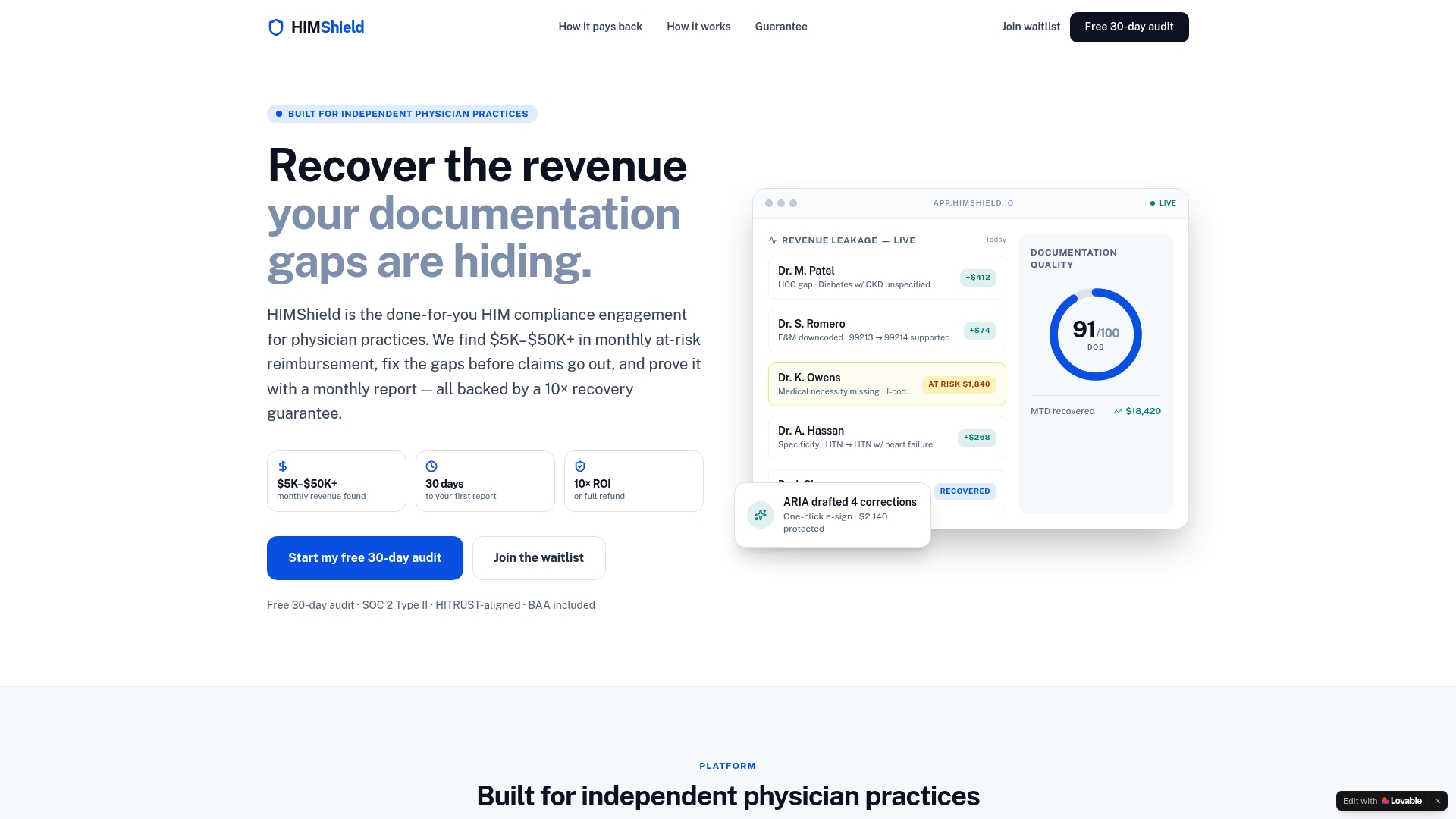
Himshield connects to your EHR, scans claim data for coding and documentation gaps, and delivers per-provider Revenue Leakage Reports that show exactly where specificity is costing you money. The platform auto-drafts compliant physician queries, scores documentation quality in real time, and builds submission-ready audit responses when a payer requests records. You get the compliance defense of a full HIM team without the overhead.
Three outcomes practices see after deploying Himshield:
- Fewer denials from CO-11 and CO-50 medical necessity edits, because specificity gaps are resolved before submission
- Faster first-pass payment as clean claims move through payer edits without manual intervention
- Audit-ready documentation assembled automatically, so a payer records request does not consume days of staff time
Start with a free 30-day audit and see exactly how much revenue your current specificity gaps are putting at risk.
Authoritative sources and further reading
-
ICD-10 Diagnosis Coding: Why It Is Important to Code to the Highest Specificity (UTMB) — Clinical coding guidance from a major academic medical center explaining why specificity is both a compliance standard and a reimbursement requirement.
-
Why Coding Specificity Matters (AAPC) — Practical breakdown of how unspecified codes and missing laterality increase payer audit probability, with examples.
-
The Future of Coding Audits: Trends, Triggers, and Tech Tools (ICD10monitor via MedLearn) — Industry analysis of how payer audit triggers have expanded to include clinical validation and documentation specificity, plus the role of EHR-integrated analytics.
-
Why 80–85% Medical Coding Accuracy Is No Longer Enough (Billient) — Data-driven argument for the 95%+ accuracy benchmark, with analysis of how lower accuracy bands create statistical outlier risk and RAF/HCC revenue exposure.
-
Elevating Coding Audits: How to Utilize Audit Data to Drive Awareness, Education, and Operational Improvements (E4.Health) — Practical framework for converting audit findings into targeted provider education and operational fixes that reduce repeat errors.
-
Why Regular Coding Audits Are Essential for Compliance (MedCycle Solutions) — Guidance on compliant query language and audit cadence, useful for practices building internal review programs.
-
How to Choose the Right Coding Audit Method (AHIMA) — AHIMA's comparison of per-code versus per-record audit methodologies, with guidance on which approach best surfaces specificity gaps.
-
A Data-Driven Approach to Defining Risk-Adjusted Coding Specificity Metrics (PMC/NIH) — Peer-reviewed research using 487,775 hospitalization records to model coding specificity patterns and identify facilities that over- or under-specify diagnoses against industry standards.