
A physician billing self-audit is a structured internal review of medical claims, documentation, and coding accuracy designed to catch revenue leakage and compliance gaps before payers or regulators do. The Office of Inspector General (OIG) endorses regular self-audits as a proactive measure that demonstrates good faith and can reduce penalties when issues surface. Practices that skip this process risk leaving significant revenue uncollected. The industry term for this practice is a prospective compliance review, though "self-audit physician billing records" describes the same systematic process most administrators recognize. This guide covers the preparation, step-by-step methodology, common pitfalls, and escalation criteria you need to run an effective billing compliance review in 2026.
What does a self-audit of physician billing records require?
Before you review a single claim, you need the right records, the right people, and a defined scope. Pulling together these elements upfront determines whether your audit produces defensible findings or just a pile of unorganized data.
Records and documentation to gather:
- Patient charts and progress notes for the audit period
- Submitted claims and remittance advice (EOBs and ERA files)
- Payer contracts and fee schedules
- Current CPT, ICD-10, and HCPCS code books or EHR reference tools
- Previous audit reports and corrective action plans
- Staff training records and coding policy documents
Defining your audit scope is the next critical step. Specify which providers, payers, date ranges, and service types you will review. A scope that is too broad produces shallow findings. A scope that is too narrow misses systemic patterns. Most practices find that stratifying by payer type (Medicare, Medicaid, commercial) and service category (E/M visits, procedures, preventive care) produces the most useful results.
Assembling the right team matters as much as gathering the right records. Auditor independence requires that reviewers do not audit their own work. Assign a lead auditor, a clinical reviewer familiar with documentation standards, and a billing specialist who understands payer rules. If your practice is small, consider rotating the auditor role quarterly to preserve objectivity.

Pro Tip: Pull your denial reports from the last 90 days before setting your audit scope. The top denial reason codes will tell you exactly where to focus first.
Step-by-step process for conducting a billing compliance review
A well-run medical billing self-assessment follows a repeatable sequence. Skipping steps or changing the order mid-audit produces unreliable results.
-
Select your sample. Quarterly self-audits should review 20–50 charts per provider. Use random sampling stratified by payer, service type, and provider to make your findings defensible. Avoid cherry-picking charts, since that introduces bias and undermines the audit's value.
-
Pull the corresponding claims. Match each sampled chart to its submitted claim. Confirm that the billed CPT codes, diagnosis codes, and modifiers align with what the documentation actually supports.
-
Review coding accuracy against documentation. Check that the level of service billed matches the documented history, exam, and medical decision-making. Flag any instance where the billed code exceeds what the note supports (upcoding) or falls short of it (undercoding). Both cost the practice money.
-
Audit modifier use. Modifier misuse is one of the most common and costly errors in physician billing. Review modifier 25, modifier 59, and modifier 51 applications against payer-specific rules. A detailed reference on modifier usage in physician billing can help your team apply the correct standard.
-
Calculate your error rate. Divide the number of charts with at least one error by the total charts reviewed. Track this rate by provider and service type.
-
Perform root cause analysis. Common audit findings cluster into three categories: coding errors, documentation gaps, and improper modifier use. Identifying which category drives your errors tells you where to focus training and workflow changes.
-
Document findings and build a corrective action plan. Record every finding with the chart number, error type, financial impact, and recommended fix. Assign ownership for each corrective action and set a deadline.
-
Schedule your follow-up audit. A corrective action plan without a follow-up audit is just a wish list. Schedule the next review within 60–90 days to confirm that changes held.
| Audit step | Key output |
|---|---|
| Sample selection | Stratified chart list by payer and provider |
| Coding review | Error log with CPT and diagnosis discrepancies |
| Modifier audit | Modifier misuse report by claim type |
| Error rate calculation | Provider-level accuracy percentage |
| Root cause analysis | Categorized error drivers |
| Corrective action plan | Assigned tasks with deadlines and follow-up date |
Pro Tip: Track your error rate over four consecutive quarters. A downward trend confirms your corrective actions are working. A flat or rising trend signals a systemic training gap.
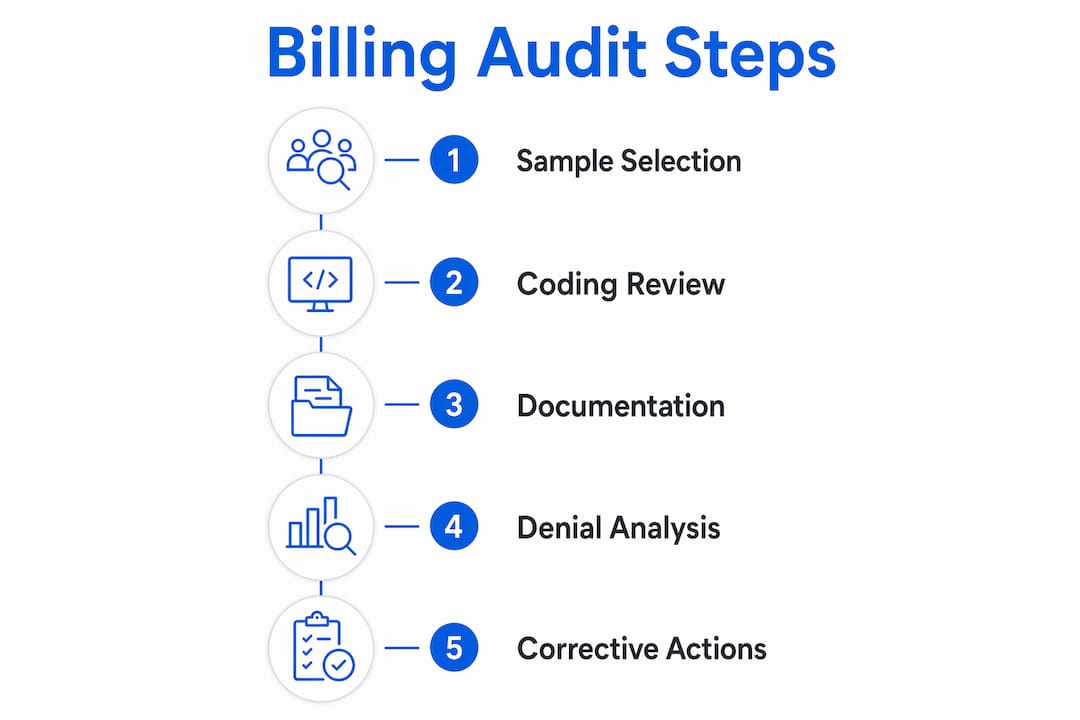
Audit findings used to implement targeted corrective actions improve both revenue and compliance over time. Think of the self-audit as a diagnostic tool, not a punitive one.
Common pitfalls in self-auditing and how to avoid them
Even well-intentioned audits fail when practices overlook a few recurring traps. Knowing these pitfalls before you start saves time and protects your findings.
Auditor bias is the most common structural problem. When coders review their own work, error rates drop artificially. Rotating auditors or assigning an independent reviewer eliminates this blind spot. If your practice lacks internal capacity, a periodic external review fills the gap.
Templated and copy-paste documentation creates serious audit risk. Copied notes lack the individualized detail that payers require to establish medical necessity. Audit reviewers flag notes that repeat verbatim across visits, and payers use the same logic to deny claims. Train clinicians to document each encounter as a standalone record.
Missed voluntary self-disclosure is a compliance risk that practices rarely discuss openly. When an audit uncovers a pattern of overpayments, the Voluntary Self-Disclosure Protocol (VDP) offers a path to report and repay with a 1.5x multiplier on overpayments. Failing to disclose and being caught later triggers treble damages at 3x. The math is straightforward.
"A self-audit that uncovers a problem and leads to voluntary disclosure is a compliance success, not a failure. The practices that get into serious legal trouble are the ones that find problems and do nothing."
Diagnosis linkage errors are another frequent finding. Every billed service must connect to a diagnosis that supports medical necessity. Auditors check that the ICD-10 code on the claim matches the condition documented in the note and that the service is clinically appropriate for that diagnosis.
Record retention gaps undermine audit defensibility. Federal law requires most medical records to be retained for at least six years from the date of service or the date the record was created. Confirm your retention policy covers the full audit window before you pull charts.
When should you escalate to an external audit?
Self-audits are effective for routine monitoring, but certain performance signals require a higher level of scrutiny. Knowing when to escalate protects your practice from regulatory exposure.
The clearest trigger is performance. If your internal coding accuracy falls below 90% or your denial rate exceeds 10% in any quarter, escalate to an external audit immediately. Practices with documented compliance programs and regular audits face two to three times lower penalties when issues are discovered. That gap in outcomes makes the case for external review when internal metrics deteriorate.
Financial benchmarks tell the same story. A net collection ratio below 95% or a denial rate above 5% signals that revenue leakage has moved beyond what a self-audit can address alone. Practices missing two to four financial benchmarks simultaneously leave significant revenue uncollected.
| Audit type | Frequency | Chart volume | Typical cost |
|---|---|---|---|
| Internal self-audit | Quarterly | 20–50 per provider | Staff time only |
| External audit | Annually | 100–200 (statistically valid) | $3,000–$15,000+ |
External audits use statistically valid random samples of 100–200 charts, which makes findings defensible in front of payers and regulators. Internal audits use smaller samples and are better suited for ongoing monitoring than for formal defense. The two approaches complement each other. Quarterly self-audits catch problems early. Annual external audits validate your internal process and prepare you for payer or OIG scrutiny.
Pro Tip: Schedule your annual external audit in the first quarter of each year. That timing lets you incorporate findings into your annual training calendar before mid-year billing patterns are set.
A concurrent audit program that runs alongside your quarterly reviews gives practices the most complete picture of billing accuracy across the year.
Key Takeaways
A self-audit of physician billing records is the most cost-effective compliance tool available to independent practices, and the structure of that audit determines whether findings are defensible or disposable.
| Point | Details |
|---|---|
| Audit quarterly, 20–50 charts | Review this volume per provider each quarter to catch errors before payers do. |
| Stratify your sample | Segment by payer, provider, and service type to produce defensible, actionable findings. |
| Track your error rate | Monitor coding accuracy by provider across quarters to confirm corrective actions are working. |
| Escalate at the 90% threshold | If coding accuracy drops below 90% or denials exceed 10%, move to an external audit immediately. |
| Use VDP when overpayments surface | Voluntary self-disclosure carries a 1.5x multiplier versus 3x treble damages if regulators find it first. |
Why most self-audit programs fail within six months
Most self-audit programs start strong and collapse by the third quarter. I have seen this pattern repeatedly across independent practices of every size. The root cause is almost never a lack of intent. It is a lack of structure.
The practices that sustain effective audit programs treat the process like a clinical protocol, not an administrative task. They assign a named owner, block time on the calendar, and tie audit findings directly to the next training session. When the audit reveals that modifier 25 is being misapplied on 30% of same-day E/M claims, the training calendar for the following month reflects that finding. The audit and the education cycle are connected.
The other failure point is isolation. Audits conducted in a silo, without feedback loops to clinicians and front-desk staff, produce findings that never change behavior. The most effective programs I have observed include a brief monthly review where the lead auditor shares top findings with the clinical team. No blame, no drama. Just data and a plan.
Balancing thoroughness with resource constraints is real. A two-person billing department cannot run the same audit program as a 20-person revenue cycle team. The answer is not to skip the audit. It is to right-size the sample, focus on your highest-risk service lines, and use technology to reduce manual review time. Practices that align their audit scope with their actual capacity sustain the program. Practices that set unrealistic targets abandon it.
The annual coding review is the anchor that keeps the quarterly process honest. Without it, quarterly audits drift in scope and lose their benchmarking value.
— Elena
How Himshield supports your billing audit and revenue recovery
Independent practices that complete a self-audit often discover the same thing: the findings are clear, but the path from finding to recovery is not.
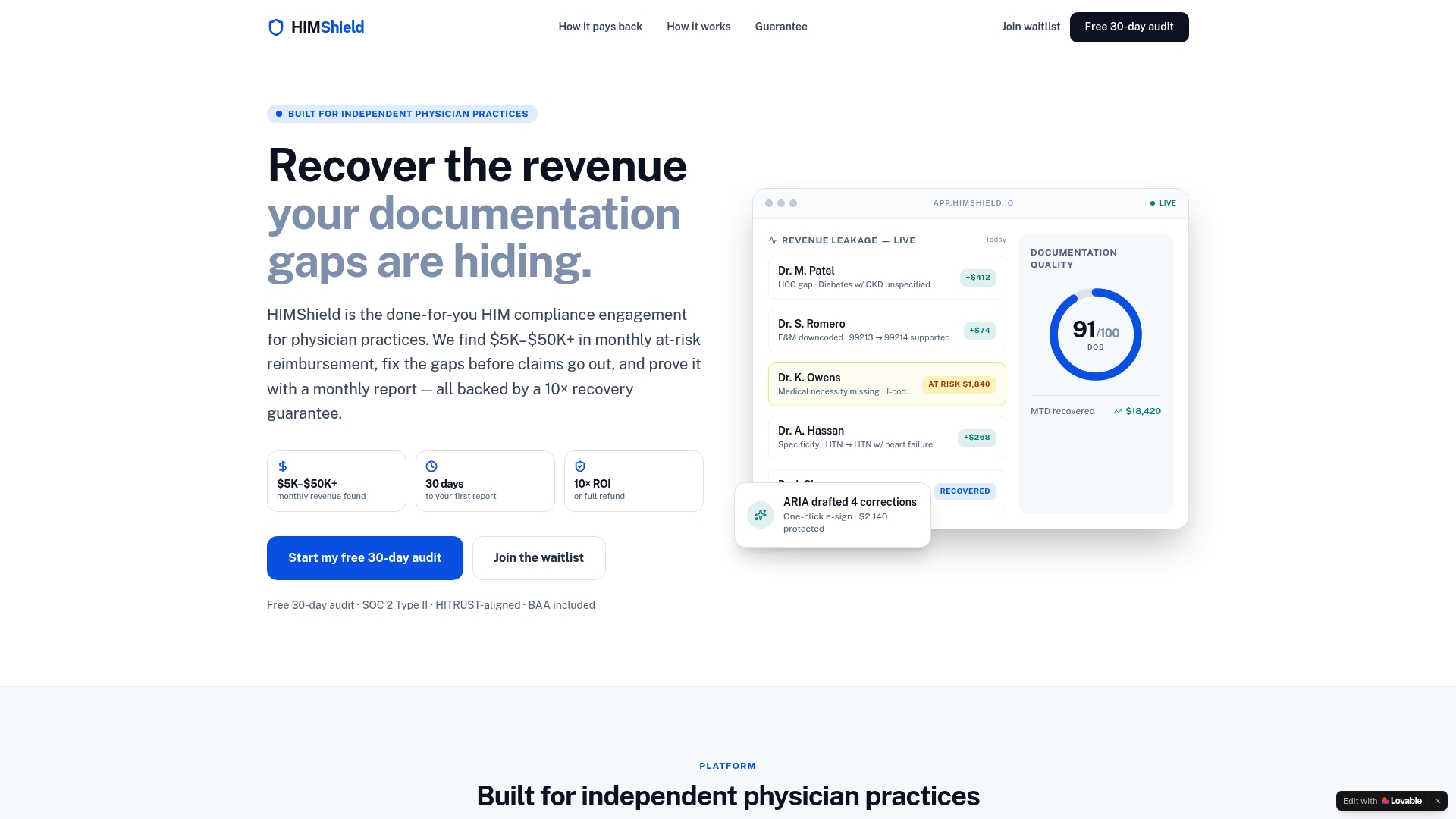
Himshield is built for exactly that gap. The platform scans your coding, documentation, and charge-capture data to identify risks before they become denials or regulatory flags. Practices using Himshield have recovered $5K–$50K+ in hidden revenue by acting on audit findings with speed and precision. If your self-audit has surfaced coding gaps, modifier errors, or documentation issues, Himshield gives you the revenue recovery tools to act on them. The physician group audit methodology built into the platform aligns with 2026 compliance standards so your practice stays ahead of payer scrutiny.
FAQ
What is a self-audit in physician billing?
A self-audit in physician billing is an internal review of claims, documentation, and coding accuracy conducted by practice staff to identify errors and compliance gaps. The OIG endorses this process as a proactive compliance measure that demonstrates good faith.
How many charts should I review in a physician billing self-audit?
Quarterly self-audits should cover 20–50 charts per provider, stratified by payer and service type. Annual external audits use statistically valid samples of 100–200 charts for regulatory defensibility.
How often should a physician practice conduct a billing compliance review?
Practices should conduct internal billing compliance reviews quarterly and supplement them with an annual external audit. This combination catches errors early and validates the internal process against a higher standard.
What triggers the need for an external audit?
Escalate to an external audit when internal coding accuracy falls below 90% or the denial rate exceeds 10% in any quarter. Practices with documented compliance programs and regular audits face two to three times lower penalties when problems are discovered.
What is the Voluntary Self-Disclosure Protocol and when does it apply?
The Voluntary Self-Disclosure Protocol (VDP) allows practices to proactively report overpayments to regulators, resulting in a 1.5x repayment multiplier instead of the 3x treble damages applied when regulators discover the issue independently. Use it whenever a self-audit uncovers a pattern of overpayments.