
An annual coding review in a physician practice is a structured audit of billing records, clinical documentation, and CPT code accuracy designed to meet OIG and CMS compliance standards while recovering lost reimbursement. Independent practices that skip this process risk leaving significant revenue uncollected. Comprehensive audits reveal missed revenue ranging from $57,000 to $450,000 annually due to undercoding and missing complexity add-on codes like G2211. The industry standard term for this process is a medical coding audit, and both terms are used throughout this guide. OIG and CMS expect practices to maintain coding accuracy at or above 95%, making the annual coding review a non-negotiable compliance activity for any independent practice.
What does an annual coding review for a physician practice require?
A defensible annual coding review starts with a clearly defined scope. You need to specify which providers are included, pull 12 months of historical claims data, and gather corresponding clinical notes and denial reports. Focused audits by provider and code category yield more meaningful results than broad, unsegmented reviews. That specificity is what separates a useful audit from a checkbox exercise.
Qualified reviewers are non-negotiable. CPC-certified coders or credentialed auditors bring the technical knowledge to distinguish a legitimate E/M level from an unsupported one. Practices that rely on billing staff without formal audit training routinely miss documentation gaps that a certified reviewer would flag immediately.

Before pulling a single chart, run a pre-audit denial data analysis. Denial analytics allow targeted audits, directing your team toward the CPT codes and providers generating the most revenue leakage. This step alone can cut audit time significantly while increasing the financial return of the review.
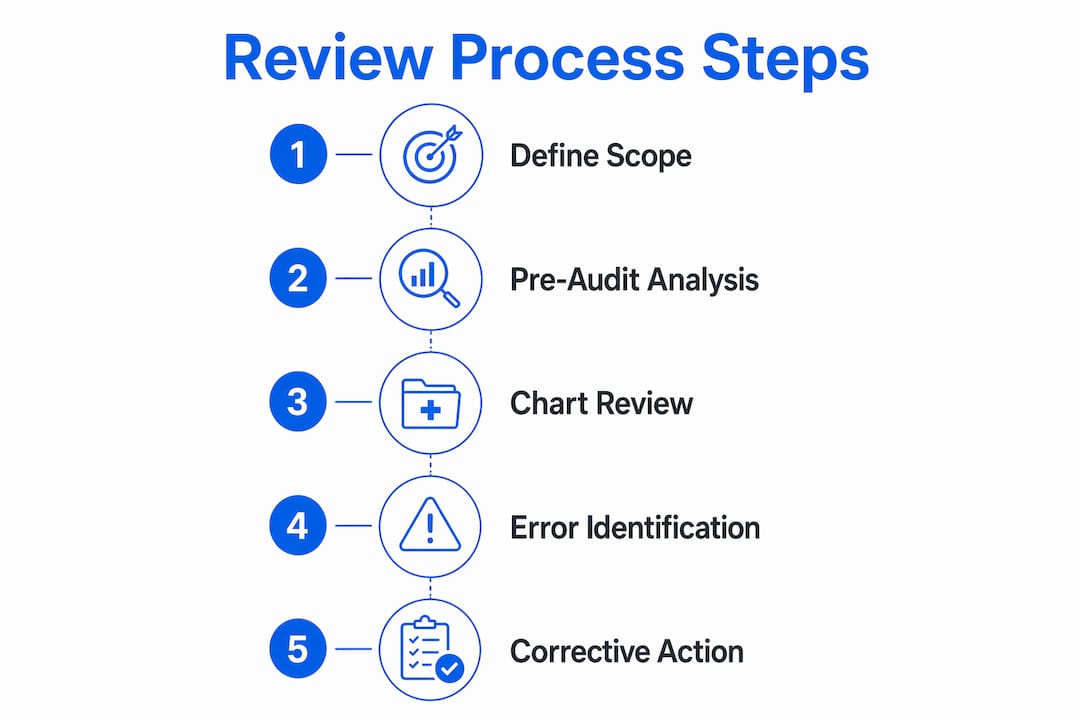
Benchmarking is the final prerequisite most practices overlook. Compare each provider's E/M code distribution against specialty norms. Practices billing 99214/99215 at rates two standard deviations above peers effectively flag themselves as audit targets for UPIC and RAC reviewers. Catching that outlier pattern internally is far less costly than having a federal auditor catch it first.
Resources needed before starting your annual coding assessment:
- 12 months of claims data by provider and CPT code
- Denial reports segmented by payer and code category
- Clinical documentation (office notes, procedure records)
- CPC-certified coder or external auditor
- Specialty benchmarking data for E/M code distribution
- Audit criteria and scoring rubric defined in writing before review begins
Pro Tip: Define your audit criteria in writing before reviewing a single chart. Post-hoc rationalization, adjusting standards after seeing results, destroys the legal defensibility of your findings.
How to execute the annual coding review step by step
A structured execution process protects your findings and makes corrective actions easier to defend. Follow these steps in order.
-
Define sample size and selection method. Pull a random sample of at least 10 charts per provider for each major code category under review. Random selection is critical. A hand-picked sample introduces bias and weakens defensibility if the audit is ever reviewed externally.
-
Map billed codes to documentation. For each chart, verify that the CPT code billed matches what the clinical note actually supports. Focus on E/M levels 99214 and 99215, which carry the highest reimbursement and the highest audit scrutiny. 63% of improper payments for 99214 stem from incorrect coding, with the remainder from missing documentation.
-
Verify Medical Decision Making or total time documentation. Under current CMS guidelines, E/M level selection rests on either Medical Decision Making (MDM) or total time. Check that the note explicitly documents the complexity of problems addressed, the amount and complexity of data reviewed, and the risk of complications. Vague language like "discussed plan" does not satisfy MDM requirements.
-
Audit Modifier 25 usage. Modifier 25 is one of the most misused modifiers in physician billing. It applies only when a significant, separately identifiable E/M service is performed on the same day as a procedure. Review the proper modifier use guidelines and flag every instance where the clinical note does not clearly support a separate E/M service.
-
Check for missing complexity add-on codes. G2211 is a complexity add-on code for office visits that reflects the longitudinal care relationship between a primary care physician and a patient. Many practices have never billed it. Missing this code consistently across a panel of patients represents direct, recoverable revenue.
-
Flag discrepancies without attribution. Record every finding objectively. Do not assign blame or intent during the initial review. Findings should describe what the documentation shows versus what was billed, nothing more.
-
Compile findings by provider and code category. Aggregate results to identify patterns. A single miscoded chart is a training opportunity. A pattern across 40% of a provider's charts is a compliance risk that requires immediate corrective action.
Pro Tip: Use a concurrent audit program alongside your annual retrospective review. Concurrent audits catch errors before claims are submitted, reducing denial rates in real time.
What are the most common pitfalls in a physician coding audit?
Modifier 25 misuse is the single most common finding in physician practice audits. Coders apply it reflexively when a procedure and an E/M service appear on the same date, without confirming that the clinical note documents a distinct, separately identifiable evaluation. That habit creates significant overpayment exposure.
Insufficient MDM documentation is the second major failure point. Physicians often document the plan clearly but omit the complexity of the decision-making process that justifies a high-level E/M code. A note that lists a prescription without describing the risk analysis behind it does not support 99215.
Undercoding is just as damaging as overcoding. Practices that consistently bill 99213 for visits that qualify as 99214 lose thousands of dollars per provider per year. Multi-provider practices can lose $280,000–$450,000 annually from suppressed reimbursement alone. The audit process must look in both directions.
Outdated documentation habits compound every other problem. Physicians trained before the 2021 AMA E/M revisions often still document using the old history, exam, and medical decision-making framework. That approach no longer aligns with current CMS requirements, and it produces notes that fail audit review even when the clinical care was appropriate.
Common errors to flag during your medical coding review process:
- Modifier 25 applied without a separately identifiable E/M service in the note
- E/M level unsupported by MDM or total time documentation
- G2211 never billed despite qualifying longitudinal care relationships
- 99214/99215 billing rate exceeding specialty norms by two standard deviations
- Procedure codes billed without corresponding operative or procedure notes
Pro Tip: Build EHR documentation prompts that require physicians to select the complexity level of problems addressed before signing a note. This single workflow change reduces MDM deficiencies without adding documentation time.
How do you verify and maintain coding accuracy after the annual review?
Post-audit action determines whether the review produces lasting improvement or just a one-time report. A corrective action plan must include three components: provider education, workflow changes, and a mandatory follow-up audit. Immediate intervention with follow-up audits prevents the persistence of noncompliant coding patterns. Schedule the repeat audit within 60–90 days of the initial findings.
Follow these steps to build a sustainable post-audit process:
-
Deliver provider-specific feedback. Share individual findings with each physician in a private, non-punitive setting. Frame the conversation around documentation quality and revenue recovery, not compliance failure. Physicians respond better when they understand the financial and clinical stakes.
-
Update EHR templates and workflows. If audit findings reveal a systemic documentation gap, fix the template. Add required fields for MDM complexity, total time, and procedure note completion. Workflow changes produce more consistent results than education alone.
-
Conduct a focused repeat audit within 60–90 days. Pull a new random sample from the same providers and code categories flagged in the initial review. This step confirms whether the corrective actions worked and provides documented evidence of good-faith compliance effort.
-
Establish quarterly focused reviews as a permanent practice. Audit readiness should be an ongoing operational state, not a reactive response to a denial spike. Monthly or quarterly internal reviews reduce the labor and disruption costs of surprise external audits.
-
Monitor denial patterns continuously. Set up a monthly denial report segmented by CPT code and provider. A rising denial rate on a specific code is an early warning that a documentation or coding problem has re-emerged. Catch it at the monthly review, not at the next annual audit.
Ongoing monitoring tools to keep in place year-round:
- Monthly denial reports by CPT code and provider
- Quarterly focused internal audits on high-risk code categories
- Benchmarking reports comparing provider E/M distribution to specialty norms
- CDI best practices integrated into physician onboarding and annual training
- Leadership review of audit findings at the practice management level
Key Takeaways
A structured annual coding review, anchored by pre-audit denial analysis, certified reviewers, and mandatory follow-up audits, is the most reliable way for independent physician practices to protect revenue and maintain OIG and CMS compliance.
| Point | Details |
|---|---|
| Start with denial data | Analyze denial reports before pulling charts to focus the audit on high-risk codes and providers. |
| Use certified reviewers | CPC-certified coders or auditors identify documentation gaps that billing staff routinely miss. |
| Audit Modifier 25 and G2211 | Modifier 25 misuse and missing G2211 codes are the two most common sources of compliance risk and lost revenue. |
| Follow up within 60–90 days | A mandatory repeat audit after corrective actions confirms improvement and documents good-faith compliance effort. |
| Make audit readiness permanent | Monthly denial monitoring and quarterly focused reviews reduce the cost and disruption of external audits. |
What I have learned from years of physician coding audits
The most consistent mistake I see in independent practices is treating the annual coding assessment as a compliance formality rather than a revenue tool. Administrators schedule the audit, file the report, and move on. The findings sit in a folder. Nothing changes. That pattern is expensive.
The practices that get the most value from their medical coding review process are the ones that connect audit findings directly to the EHR workflow. When a physician sees that a documentation gap cost the practice $18,000 in a single quarter, the conversation about template changes becomes very short. Numbers move people in ways that compliance memos never do.
Documentation must reflect clinical complexity to align reimbursement with the actual care delivered. That principle sounds obvious, but most physicians were never trained to think about documentation as a financial record. They were trained to document for clinical continuity. Bridging that gap is the real work of a compliance officer.
The other lesson I keep relearning is that undercoding is invisible until you look for it. Overcoding generates denials and audit flags. Undercoding just quietly drains revenue month after month. A practice that has never audited its G2211 utilization, or that consistently bills 99213 for visits that qualify as 99214, is losing money it has already earned. The annual audit is the only reliable way to see that loss clearly.
Audit readiness is not a project. It is a permanent operational posture. Practices that build quarterly reviews and monthly denial monitoring into their standard workflow handle external audits with confidence. Practices that audit once a year and hope for the best spend far more time and money when a UPIC or RAC reviewer comes calling.
— Elena
How Himshield helps practices recover revenue from coding gaps
Independent physician practices that want a faster path to coding accuracy and audit readiness use Himshield to identify revenue leakage before it becomes a denial or an audit finding.
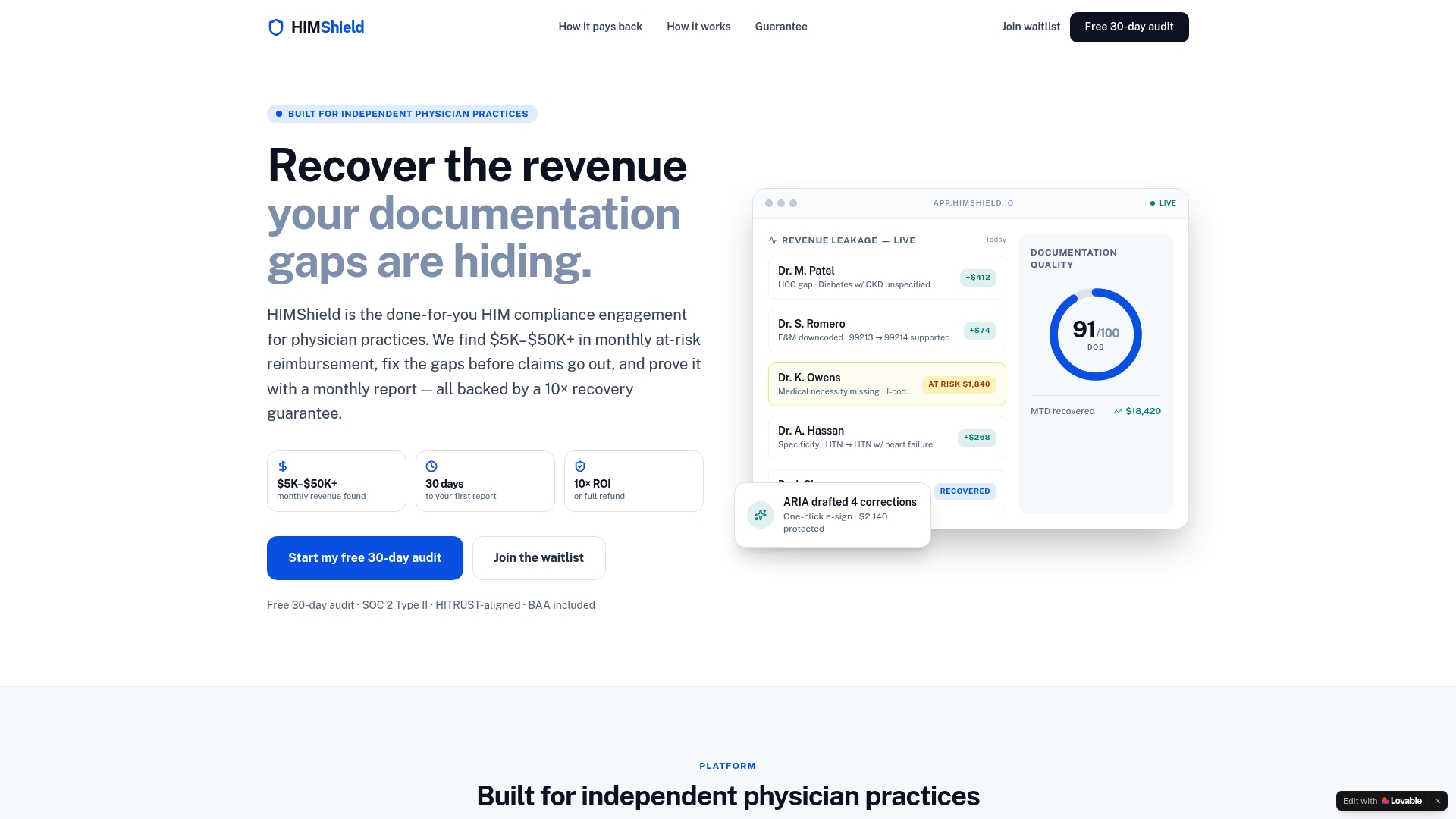
Himshield connects directly to your EHR, scans claims and documentation for coding errors, underbilled complexity codes, and charge-capture gaps, and delivers clear findings your team can act on immediately. Practices using Himshield have recovered between $5,000 and $50,000 or more in hidden revenue within the first 30 days. If you want to see exactly where your practice is losing reimbursement, start with a free revenue leakage report or learn more about how Himshield works to protect every dollar your physicians have earned.
FAQ
What is an annual coding review in a physician practice?
An annual coding review is a structured audit of a practice's billing records and clinical documentation to verify CPT code accuracy, compliance with CMS and OIG standards, and optimal reimbursement. It is also called a medical coding audit and should include at least one comprehensive review per year plus quarterly focused checks.
How often should a physician practice conduct a coding audit?
OIG and CMS recommend at least one comprehensive annual coding audit supplemented by quarterly focused reviews to maintain coding accuracy above 95%. Practices with high-volume E/M billing or recent denial spikes should increase review frequency.
What are the most common errors found in a physician billing review?
The most common findings are Modifier 25 misuse, insufficient Medical Decision Making documentation for 99214 and 99215, and failure to bill complexity add-on codes like G2211. 63% of improper payments for 99214 result from incorrect coding rather than missing documentation.
How much revenue can an annual coding assessment recover?
Structured audits reveal missed revenue ranging from $57,000 to $450,000 annually depending on practice size and the extent of undercoding. Multi-provider practices that have never audited G2211 utilization often find the largest recoverable amounts.
What should a corrective action plan include after a coding review?
A corrective action plan must include provider-specific education, EHR workflow updates, and a mandatory repeat audit within 60–90 days. Immediate intervention with follow-up audits is the most reliable method to prevent noncompliant coding patterns from persisting.