
Medical coding risk detection is the process of scanning claims, charts, and documentation to find coding errors and unsupported diagnoses before they trigger a payer audit or repayment demand. The single most impactful first move is to run a focused data scan of your highest-risk diagnosis codes and pull a sample of charts tied to them. From there, you build a remediation plan and fix the documentation gaps you find. This guide covers the methods, tools, and workflows that make that process repeatable.
TL;DR:
- The majority of high-risk diagnosis codes lack proper documentation support, increasing the risk of audits and repayment demands.
- Running monthly outlier reports by provider and code helps identify patterns that could trigger audits before payer review.
- Combining rule-based, NLP, and hybrid detection methods improves risk identification, but validation and ongoing review are essential to avoid false positives.
- Developing internal coding policies, targeted audit programs, and regular micro-audits help small practices control coding accuracy without extensive staffing.
- Automated platforms streamline risk scans, reporting, and remediation, but practices must maintain policies and human oversight to effectively defend coding decisions.
Table of Contents
- Why coding risk detection matters: audit exposure and OIG/CMS context
- Common coding risk types and red flags to watch for
- Methods and technologies for detecting coding risk
- Implementing a practical coding risk detection program for an independent practice
- Practical platform approach: how automated HIM compliance supports detection and remediation
- Compliance lessons from audit and risk-adjustment coding work
- How HIMShield can help protect your revenue and compliance standing
- Sources
- FAQ
Why coding risk detection matters: audit exposure and OIG/CMS context
Independent practices tend to underestimate how closely their coding gets scrutinized until a repayment letter arrives. The government has been direct about where the problems concentrate.
Roughly 70% of certain high-risk diagnosis codes lacked supporting documentation in medical records reviewed by the OIG toolkit on high-risk diagnosis codes, and some individual codes failed validation more than 90% of the time. That is not a rounding error. It means auditors already know which code groups to pull first, and if your practice bills those codes without matching documentation, you are a target before the audit even starts.
The mechanics matter here. Risk Adjustment Data Validation, known as RADV, is the process CMS and Medicare Advantage plans use to confirm that submitted diagnosis codes are backed by medical record evidence. Hierarchical Condition Category (HCC) codes drive risk-adjusted payments, so a diagnosis that boosts a patient's risk score without chart support does not just risk a denial. It risks a clawback, because the payment already happened based on a code that cannot be validated.
The practical fallout from unaddressed coding risk includes:
- Repayment demands that claw back revenue already collected and booked
- Civil penalties in cases where patterns suggest more than isolated mistakes
- Denied claims that stall cash flow while staff rework the submission
- Audit escalation, where one flagged code group leads to a broader chart pull
- Reputational exposure with payers who track outlier practices over time
Understanding what a coding audit actually involves helps frame why detection has to happen before submission, not after a payer notice arrives.
Common coding risk types and red flags to watch for
Not every diagnosis code carries the same exposure. Some fail validation constantly because the documentation habits around them are weak across the industry, not just in your practice.
- History-only diagnoses billed as active. A condition noted in the patient's history without current evaluation, monitoring, or treatment does not support an active HCC code.
- No supporting medications or procedures. A diagnosis with no matching prescription, lab order, or procedure in the same encounter is an easy audit target.
- Unspecified codes used out of habit. Coders default to vague codes when documentation is thin, which flags as a pattern rather than a one-off.
- Chronic conditions without an annual reassessment. Payers expect chronic HCC diagnoses to be reevaluated at least once a year, not carried forward indefinitely.
- Sudden volume jumps in a specific code. A code that barely appeared last quarter and now shows up constantly draws attention fast.
- Provider-level outliers. One clinician coding a condition at a much higher rate than peers in the same specialty is a classic audit trigger.
- Inconsistent code combinations. Diagnoses that rarely appear together in clinical reality but show up paired repeatedly in your data suggest a documentation or coding process problem.
During chart review, coders should check whether the note supports the code under a Monitoring, Evaluation, Assessment, and Treatment framework, confirm the diagnosis links to a current visit rather than a stale problem list entry, and verify that the specificity of the code matches what the clinician actually documented. Coding with more specificity, rather than defaulting to broad categories, reduces both audit flags and denials.
Pro Tip: Run a monthly outlier report by provider and code before your payer does. A pattern you catch internally is a policy update. A pattern a payer catches is an audit.
Methods and technologies for detecting coding risk
There is no single tool that catches everything, and treating any one method as sufficient is how gaps slip through. The strongest programs combine three layers.

Rule-based detection runs SQL queries and business-rule checks against known high-risk code lists, the kind the OIG toolkit publishes with sample logic you can adapt to your own EHR data. These checks are transparent and easy to explain during an audit, but they are rigid. They only catch what you already told them to look for.
NLP and machine learning approaches compare clinical documentation against submitted codes to find mismatches a rule engine would miss, and they can flag anomalies in coding patterns across a whole provider panel. The tradeoff is false positives: an unsupervised model trained without clear business rules tends to flag legitimate documentation as risky, which burns clinician time chasing nothing. NLP tools work best when constrained by defined rules and checked against a known sample, not left to run unsupervised.
Hybrid workflows are where most of the real gains happen. Automated tools triage the full claim volume and surface the highest-risk cases, then coders do targeted human review on that shortlist instead of sampling blindly. This is also where integrating audit tools directly into EHR workflows pays off, since the alerts show up where coders already work instead of in a separate dashboard nobody checks.
Whichever mix you use, validate it the same way you would validate any clinical tool:
- Define a sample size large enough to estimate your true error rate with confidence, not just a handful of convenient charts
- Track both false positives and false negatives, since a tool that never misses anything but flags everything is not actually saving time
- Re-check the model or rule set periodically, because coding guidelines and documentation habits both drift over time
- Document the validation process itself, since auditors may ask how you know your detection system works
The gap is the whole argument for building a detection layer instead of relying on end-of-year spot checks.
Implementing a practical coding risk detection program for an independent practice
Building this from scratch feels like a lot when you are already short-staffed, but the sequence below scales down to a two-person coding team without losing rigor.
- Run a baseline data scan. Pull your claims history against the high-risk code lists in the OIG toolkit and identify which codes and which providers show the heaviest concentration. This is your starting map, not a one-time report to file away.
- Write or update internal coding policies for grey areas. AHIMA's guidance on internal coding policies walks through how to document your rationale for ambiguous cases so a coder is not making a judgment call from memory every time the same scenario comes up. Version these policies, cite the ICD-10-CM or Coding Clinic guidance behind each one, and archive prior versions.
- Design targeted audit samples and a remediation workflow. Instead of sampling charts at random, pull from the codes and providers your baseline scan flagged, and build a clear correction process that routes findings back to the clinician for a signature or amendment. Closing the loop with the physician, not just flagging the error internally, is what makes the correction defensible later.
- Train coders and run regular micro-audits. Short, frequent chart checks using the MEAT framework catch drift faster than a single annual audit, and they keep the policy updates from step 2 actually in use rather than filed and forgotten.
- Measure outcomes and report KPIs. Track your error rate over time, the dollar amount of revenue leakage identified and recovered, and the average time between finding an error and correcting it. These three numbers tell you whether the program is working or just generating paperwork.
An annual coding review schedule built around these five steps keeps the work from piling up at year-end when staff have the least bandwidth to handle it.
Pro Tip: Assign one person ownership of the KPI report, even if coding work is shared. A metric nobody owns is a metric nobody checks.
Practical platform approach: how automated HIM compliance supports detection and remediation
Independent practices rarely have a dedicated compliance department, which is exactly the gap automated HIM platforms are built to close. A platform model that supports the workflow above typically includes:
- Automated risk scans that run against EHR data on a schedule instead of waiting for a manual pull
- Per-provider, per-payer Revenue Leakage Reports that show exactly where documentation gaps concentrate, rather than a single practice-wide number
- Prioritized alerts ranked by dollar exposure and audit likelihood, so coders work the highest-risk items first
- One-click physician guidance for correcting documentation, which keeps the clinician in the loop without adding a separate approval process
Automation alone does not lower your error rate. It lowers the time it takes to find the problem. The error rate only drops when automated alerts feed into the same targeted human review and documented policy structure described in the implementation steps above. A rule engine that flags a gap still needs a coder or physician to confirm it and a policy that explains why the correction is right.
Practices that maintain documented internal coding policies and regular audits are better positioned to defend their coding choices when a payer or RADV audit arrives.
That is the standard any detection platform should be measured against: not just how many issues it finds, but whether the practice can defend the fix six months later when an auditor asks.
Compliance lessons from audit and risk-adjustment coding work
The practices that stay out of audit trouble are not the ones with the fanciest software. They are the ones with documented policies, focused audits on their actual risk areas, and a habit of measuring whether corrections stick.
The biggest trap I see is teams handing detection entirely to an AI tool and treating its output as final. Unsupervised models flag plenty of noise, and a coder who stops questioning the alerts starts rubber-stamping them, which defeats the purpose. The tool should narrow the pile. A person should still open the chart.
For a small practice with limited coding staff, prioritize the codes the OIG toolkit already flags as high-risk before building anything custom. You do not need to detect every possible error in year one. You need to close the gaps most likely to get pulled first, and let the program grow from there.
— Elena
How HIMShield can help protect your revenue and compliance standing
Running the baseline scan, building policies, and designing audit samples is real work, and most independent practices do not have a spare coder to dedicate to it full time. HIMShield built its platform to do that scanning and reporting automatically, without asking your practice to hire new staff or retrain on new software.
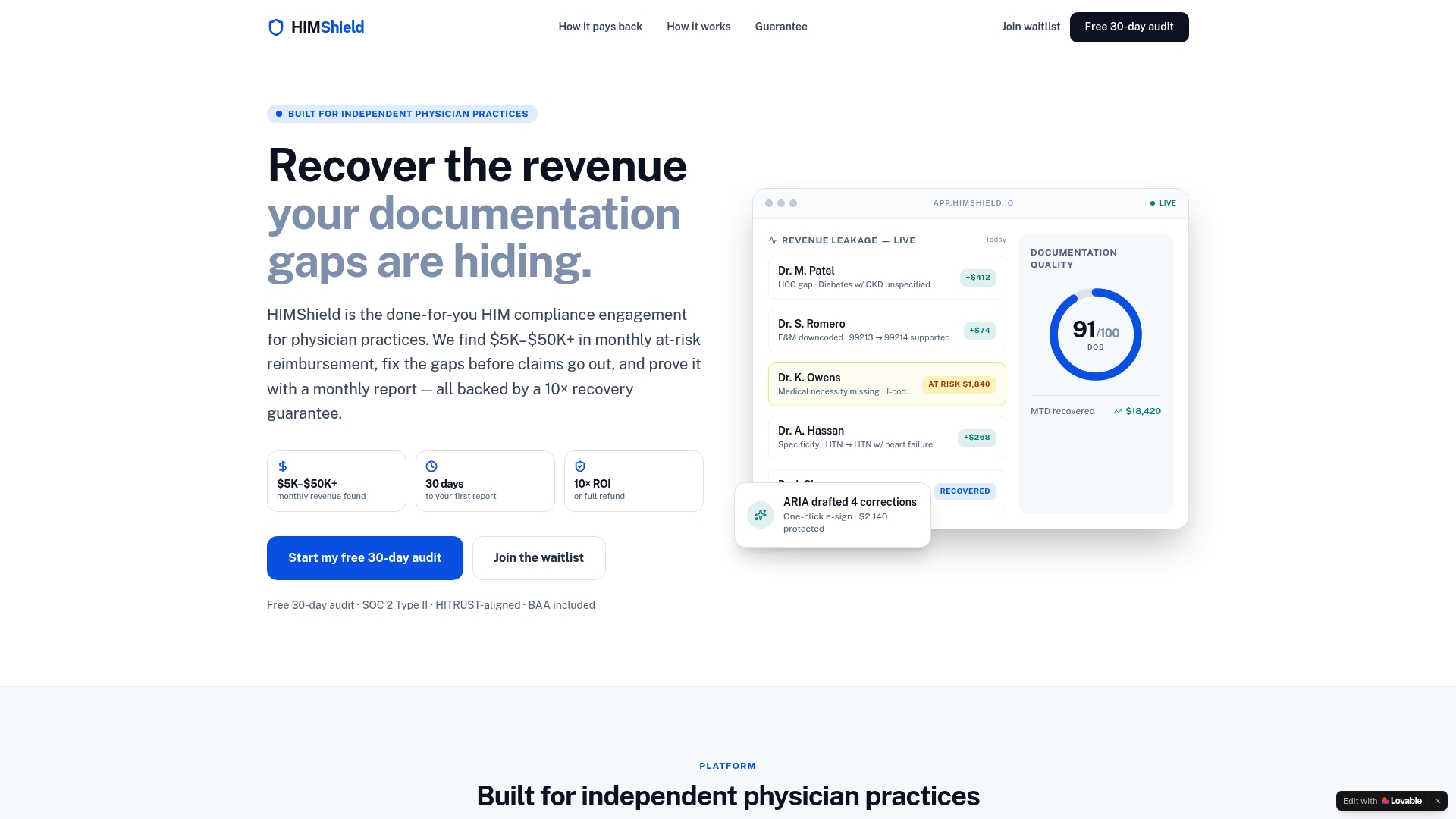
The platform connects to your EHR, scans your coding and documentation against known risk patterns, and delivers a quantified report showing exactly where revenue is at risk and which fixes matter most. From there, the compliance engagement supports:
- Per-provider, per-payer visibility into where documentation gaps concentrate
- Prioritized, dollar-ranked alerts instead of an unsorted error list
- One-click physician e-signature for drafted corrections
- Submission-ready responses if a payer audit follows
If your practice wants to see where its own risk sits before a payer finds it first, claim your free 30-day Revenue Leakage Audit and see the numbers for your own charts.
Sources
Building a detection program on your own findings is a good start, but the primary sources behind those findings are worth reading directly.
- Toolkit: To Help Decrease Improper Payments in Medicare Advantage Through the Identification of High-Risk Diagnosis Codes | OIG
- How to Create Internal Coding Policies for Risk Adjustment | AHIMA Journal
- How to Become a Risk Adjustment Coder in 2026
FAQ
What are 5 common medical coding errors?
The most frequent errors include billing a history-only diagnosis as if it were currently active, using unspecified codes when more specific documentation exists, missing medications or procedures that should support a diagnosis, failing to reassess chronic conditions annually, and inconsistent code combinations that do not reflect clinical reality. The OIG toolkit documents several of these patterns directly in its high-risk code groupings.
Is CRC certification worth it?
A Certified Risk Adjustment Coder (CRC) credential is a common qualification for risk-adjustment coding roles, which focus on diagnosis-only chart review to capture HCCs accurately. Since risk-adjustment work draws heavy audit scrutiny, the credential signals familiarity with the documentation standards auditors expect.
Who gets paid more, a medical biller or coder?
Pay depends heavily on specialization, credentials, and experience rather than the biller-versus-coder distinction alone. Risk-adjustment coders, who need diagnosis-focused expertise and often hold a CRC credential, tend to work in a more specialized and heavily audited niche than general billing roles.
What is the average salary for a risk adjustment coder?
Salary figures for risk-adjustment coders vary by region, employer, and experience level, and no single verified national figure covers every setting. What is consistent is that the role requires diagnosis-only chart review, prior coding experience, and often a CRC credential, which typically positions it above entry-level coding pay.