
Physician group audit methodology is the structured framework used to evaluate billing accuracy, documentation integrity, and compliance across physician practices. Healthcare administrators and HIM professionals rely on this process to catch coding errors, reduce regulatory exposure, and protect earned revenue before external agencies come knocking. The OIG Work Plan continuously updates enforcement priorities, making a defined audit methodology not optional but operationally necessary. Understanding the physician group audit methodology explained here gives your team a concrete foundation for building a defensible, repeatable compliance program.
What are the core components of physician group audit methodology?
A physician group audit methodology is built on six sequential stages: planning, sampling, review, analysis, reporting, and remediation. Each stage has a defined purpose, and skipping any one of them produces incomplete findings that fail to hold up under scrutiny.
The planning stage defines scope, selects providers, and identifies high-risk CPT codes or service lines to target. Sampling follows immediately. 2026 guidance recommends quarterly chart-to-claim audits using random samples of 10–25 claims per provider per quarter to monitor error rates and target education. That sample size is large enough to detect patterns but small enough to complete within a reasonable review cycle.
The review stage is where auditors examine each claim against its supporting documentation. Reviewers check medical necessity, modifier usage, diagnosis coding, and whether the level of service billed matches what the note actually supports. External audits typically review 10–50 records per provider, recovering 30–60% of identified revenue leakage through resubmissions and appeals. That recovery range reflects the real financial stakes of a thorough review.

Analysis converts individual findings into patterns. Root-cause analysis identifies whether errors stem from coder training gaps, EHR template problems, or provider documentation habits. An effective audit methodology includes clear sampling methods, root-cause pattern analysis, and operational recommendations to prevent error recurrence. Findings without recommendations are just a list of problems.

The reporting stage delivers structured findings to leadership, with error rates by provider, by code, and by service category. Remediation closes the loop with targeted education, workflow changes, and a follow-up audit to confirm improvement.
Pro Tip: Use your chart audit workflow as a living document. Update it each quarter based on new denial patterns and OIG focus areas so your team is never reviewing against outdated criteria.
- Planning. Define audit scope, select providers, and identify target codes.
- Sampling. Pull 10–25 random claims per provider per quarter.
- Review. Examine each claim against supporting clinical documentation.
- Analysis. Apply root-cause analysis to convert errors into patterns.
- Reporting. Deliver structured findings with error rates and recommendations.
- Remediation. Execute targeted education and schedule a follow-up audit.
How do federal regulations shape physician group audit risk?
Federal audit programs directly determine which billing patterns draw scrutiny and how quickly your practice must respond when errors surface. The OIG Work Plan is a dynamic planning tool that guides audits based on current enforcement priorities and emerging risks throughout 2026. Practices that align their internal audit focus with the OIG Work Plan catch problems before Recovery Audit Contractors (RACs), Medicare Administrative Contractors (MACs), and Unified Program Integrity Contractors (UPICs) do.
Statistical outlier detection is the most reliable early warning signal available to your team. Statistical outliers in billing patterns, such as a high frequency of CPT 99215 compared to the specialty average, significantly increase government audit risk. A provider billing CPT 99215 at 45% frequency when the specialty average sits at 22% will trigger a probe review. Monitoring your own outlier data before a contractor does gives you time to correct and document the rationale.
"Monitoring statistical outliers helps proactively identify providers at risk for government audits before formal investigations begin. The OIG Work Plan is a living document that enables practices to adjust audit methodologies in real time based on the latest government focus areas."
The 60-day rule adds a financial urgency to internal audit findings. Internal audits detecting Medicare billing errors require repayment within 60 days if the overpayment exceeds $25. That rule means a well-run internal audit program is not just a compliance exercise. It is a legal obligation management tool.
Key federal audit programs your methodology must account for:
- RAC audits. Target improper payments through post-payment review of Medicare and Medicaid claims.
- MAC reviews. Conduct prepayment and post-payment audits based on local coverage determinations.
- UPIC investigations. Focus on fraud, waste, and abuse across Medicare and Medicaid programs.
- OIG investigations. Pursue cases involving False Claims Act violations and systematic billing abuse.
What differentiates specialty-specific audit approaches?
Specialty context changes everything in a physician group audit. A modifier 25 attached to an evaluation and management service means something very different in a primary care setting than it does in a pain management practice. Specialty-specific audit risks and coding patterns require auditors trained in vertical conventions to properly assess multi-specialty physician group billing.
Cardiology practices face high scrutiny on echocardiography interpretation codes, stress testing bundles, and catheterization procedure billing. Orthopedic groups carry risk around surgical modifier combinations, global period billing, and physical therapy overlap. Pain management practices draw attention for high-volume injection coding, drug testing frequency, and evaluation and management upcoding. Pediatric groups see audit focus on well-child visit bundling and vaccine administration coding.
Pro Tip: Build a specialty-specific risk register for each service line in your group. List the top five high-risk CPT codes, common modifier errors, and the relevant OIG or MAC guidance for each specialty. Review and update it annually.
Multi-specialty groups face compounding risk because a single audit sample may cross multiple specialties, each with its own documentation standards and coding conventions. Effective audits incorporate specialty-specific coding nuances to reduce false positive findings and increase acceptance during government reviews. An auditor who applies primary care documentation standards to a cardiology note will generate findings that do not reflect actual billing errors.
Proper modifier usage in physician billing is one of the most common sources of specialty-specific audit findings. Modifier 59, modifier 51, and modifier 25 each carry specific documentation requirements that vary by payer and specialty. Your audit checklist must reflect those distinctions explicitly.
| Specialty | Common high-risk codes | Primary audit trigger |
|---|---|---|
| Cardiology | 93306, 93015, 93458 | Procedure bundling, interpretation overlap |
| Orthopedics | 27447, 29881, modifier 59 | Global period violations, modifier stacking |
| Pain management | 64483, 99215, G0431 | Injection frequency, E&M upcoding |
| Pediatrics | 99392, 90460, 99213 | Bundling errors, vaccine administration |
How can HIM professionals implement a sustainable audit program?
A sustainable physician group auditing process runs on a defined cadence with clear ownership at every level. Monthly reviews focus on denial rates, clean claim rates, and accounts receivable aging. These metrics surface billing problems in near real time, before they accumulate into significant revenue leakage. Quarterly audits pull the 10–25 random claims per provider and feed findings into provider-level scorecards. Annual audits conduct a full revenue cycle management review across all payers and service lines.
Peer-to-peer chart reviews with standardized checklists can detect recurring audit issues and improve long-term compliance within physician teams. Clinicians reviewing 3–5 charts from peers periodically catch patterns that solo reviewers miss because they bring clinical context to the documentation assessment. That clinical perspective is something a coder alone cannot replicate.
Continuous internal auditing coupled with staff training reduces the normalization of deviance and audit risk in physician practices by correcting recurring errors early. When the same error appears in three consecutive quarterly audits without correction, it signals a systemic problem, not an isolated mistake.
Practical steps for building a sustainable program:
- Assign a named compliance owner for each provider or service line.
- Use denial management data to identify which CPT codes generate the most rejections.
- Build standardized audit checklists that reflect current payer policies and OIG focus areas.
- Schedule provider education sessions within 30 days of each quarterly audit report.
- Track error rate trends over rolling 12-month periods to measure program effectiveness.
- Prepare a written response protocol for external audit requests before one arrives.
Pro Tip: Connect your annual coding review to your budget cycle. Audit findings from the prior year should directly inform staffing, training, and technology investments for the coming year.
Documentation must include clinical context at the point of care because retrospective audits often ignore the rationale behind complex coding decisions. A note that documents medical necessity clearly at the time of service is far more defensible than one reconstructed after a denial. Train providers to treat every note as a potential exhibit, because under a government audit, it is.
When an external audit does arrive, your internal audit history becomes your strongest defense. A practice that can show consistent quarterly reviews, documented remediation, and declining error rates over time demonstrates good faith compliance. That record materially changes how regulators and contractors approach the investigation.
Key Takeaways
A physician group audit methodology succeeds when it combines structured sampling, specialty-aware review, federal compliance alignment, and continuous provider education into one repeatable program.
| Point | Details |
|---|---|
| Use structured sampling | Pull 10–25 random claims per provider each quarter to detect patterns and guide education. |
| Align with OIG priorities | Review the OIG Work Plan regularly and adjust your audit focus to match current enforcement areas. |
| Apply specialty-specific criteria | Use auditors and checklists trained on each specialty's coding conventions to avoid false findings. |
| Act on the 60-day rule | Repay Medicare overpayments above $25 within 60 days of discovery to avoid False Claims Act exposure. |
| Build a continuous program | Monthly metrics, quarterly audits, and annual reviews create a defense record that protects the practice. |
What I've learned from watching audit programs succeed and fail
I have reviewed audit programs across independent practices and multi-specialty groups, and the pattern is consistent. The programs that fail treat auditing as a one-time event triggered by a denial spike or an external letter. The programs that work treat auditing as a standing operational function, the same way a practice treats scheduling or credentialing.
The most underrated element of any physician group audit methodology is the remediation phase. Practices invest real effort in the review and reporting stages, then hand providers a findings memo and consider the job done. That approach produces the same errors in the next quarter's sample. Effective remediation requires a follow-up audit, a documented education session, and a measurable reduction in the error rate before the finding is closed.
The other shift I advocate for is moving specialty-specific audit design from a nice-to-have to a requirement. A generalist audit checklist applied to a pain management group will miss the highest-risk billing patterns and flag low-risk items that waste everyone's time. Specialty-aware audit design is not more complicated. It is more accurate, and accuracy is what protects revenue.
— Elena
Himshield makes physician group auditing faster and more defensible
Independent physician practices face the same audit risks as large health systems but with far fewer internal resources to manage them. Himshield connects directly to your EHR, scans for coding, documentation, and charge-capture risks, and delivers clear findings within 30 days.
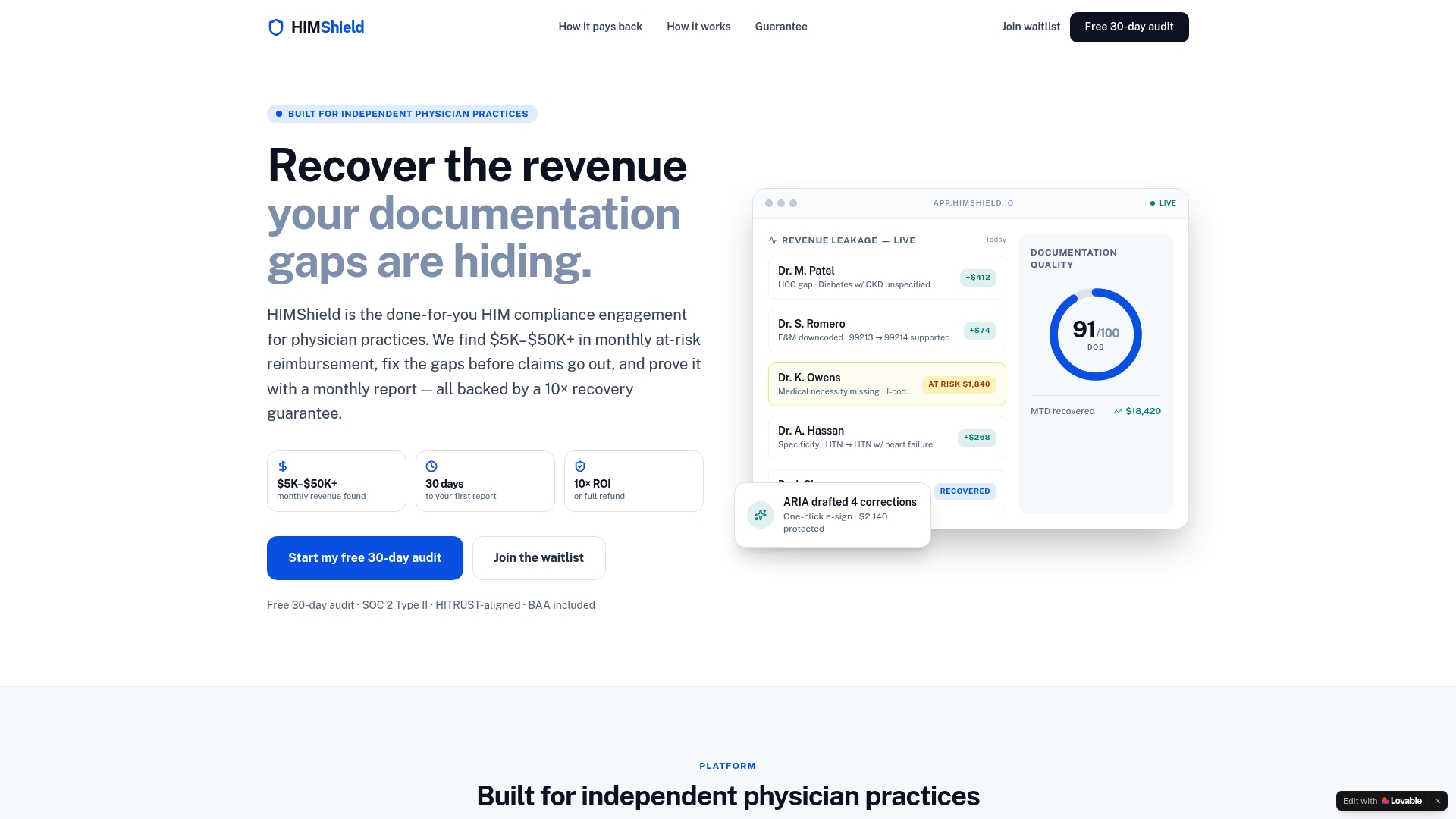
Practices using Himshield recover $5K–$50K+ in hidden revenue by catching errors before they become denials or trigger external audits. The platform flags statistical outliers, identifies modifier errors, and surfaces HCC gaps across your entire provider panel, not just a sample. If you are ready to build a defensible audit program without adding headcount, see how Himshield works or visit Himshield's revenue recovery page to see what your practice may be leaving on the table.
FAQ
What is the recommended audit sample size for physician groups?
2026 guidance recommends quarterly chart-to-claim audits using random samples of 10–25 claims per provider per quarter. External audits typically review 10–50 records per provider depending on scope and payer requirements.
How quickly must a practice repay a Medicare overpayment?
Practices must repay Medicare overpayments exceeding $25 within 60 days of discovery. Failure to repay within that window creates False Claims Act exposure.
How does the OIG Work Plan affect audit methodology?
The OIG Work Plan identifies current enforcement priorities and emerging billing risks throughout the year. Practices that align their internal audit focus with the Work Plan catch high-risk patterns before government contractors do.
Do audit approaches differ by medical specialty?
Specialty-specific audit risks require auditors trained in each specialty's coding conventions, modifier rules, and documentation standards. A cardiology audit checklist differs significantly from one designed for pediatrics or pain management.
How often should a physician group conduct internal audits?
Best practice calls for monthly monitoring of denial rates and clean claim rates, quarterly chart-to-claim audits per provider, and a full revenue cycle audit annually. That cadence creates a continuous compliance record and reduces external audit risk.