
A healthcare compliance program is a formal, documented system that identifies and corrects coding, billing, and documentation risks before they trigger audits or penalties. The practice compliance program benefits go well beyond regulatory box-checking. Independent physician practices that build effective programs reduce criminal liability, recover lost revenue, and create more consistent clinical workflows. The Office of Inspector General (OIG), Department of Justice (DOJ), and Centers for Medicare & Medicaid Services (CMS) all treat program quality as a direct factor in enforcement decisions. This article breaks down exactly what those benefits look like in practice.
1. How compliance programs cut financial and legal risk
A well-structured compliance program is the single most effective defense against federal enforcement action. Under federal sentencing guidelines, an effective program reduces an organization's culpability score by three points. That reduction directly lowers criminal fines and increases the likelihood that regulators decline to bring charges at all.
The financial stakes for independent practices are real. A single billing audit finding can trigger repayment demands, exclusion from Medicare, or civil monetary penalties. Practices with documented compliance programs enter those situations with a measurable legal advantage.
"Effective compliance programs can reduce an organization's culpability score by three points under federal sentencing guidelines, lowering criminal fines and creating the conditions for regulators to decline charges entirely."
Three specific protections drive this risk reduction:
- Documented internal governance: Written policies, reporting structures, and designated compliance oversight create a paper trail that demonstrates good faith.
- Proactive internal audits: Regular self-audits show regulators that the practice found and corrected problems before external review.
- Corrective action records: Documented responses to identified issues prove the program is functional, not decorative.
Practices that treat compliance as a living system rather than a policy binder consistently receive better outcomes in DOJ and OIG investigations.
2. Operational gains: billing accuracy, workflow efficiency, and audit readiness
Compliance programs produce measurable operational improvements, not just legal protection. Data-driven enforcement now flags practices with statistical billing deviations versus peers. That means a practice billing at outlier rates for evaluation and management codes, for example, will draw scrutiny even without a complaint.

Integrated compliance monitoring catches those patterns internally first. Compliance programs reduce claim denials, improve payment rates, and lower fraud exposure by strengthening billing workflows and documentation quality. Fewer denials mean faster cash flow and less time spent on appeals.
Pro Tip: Align your internal audit workplan with the OIG's annual Work Plan priorities. The OIG publishes updated targets each year, and matching your internal reviews to those targets keeps your practice ahead of external scrutiny.
The table below shows how compliance program activities map to specific operational outcomes:
| Compliance activity | Operational outcome |
|---|---|
| Regular coding audits | Fewer claim denials and faster reimbursement |
| Documentation training | Reduced audit risk and stronger medical necessity support |
| Billing workflow review | Detection of charge-capture gaps before submission |
| Incident logging | Faster corrective action and audit-ready records |
| OIG Work Plan alignment | Proactive risk identification before external review |
Audit readiness is not a one-time event. Practices that maintain continuous monitoring spend far less time scrambling when a payer or federal auditor requests records.
3. Staff engagement, training effectiveness, and compliance culture
Compliance programs change how staff behave, not just what policies say. Employees who trust leadership are 2.5 times more likely to be engaged at work. Consistent compliance policies build that trust by showing staff that rules apply equally and that leadership takes accountability seriously.
Annual compliance checklists do not build culture. Role-specific, ongoing training does. A front-desk coordinator needs different compliance knowledge than a physician or a billing specialist. Effective programs deliver training that matches each role's actual risk exposure.
Four practices that build a genuine compliance culture:
- Role-specific training modules: Tailor content to the actual tasks each staff member performs, not generic healthcare law overviews.
- Consistent disciplinary enforcement: Apply the same consequences for the same violations regardless of seniority. Inconsistency destroys credibility.
- Anonymous reporting channels: Give staff a way to flag concerns without fear of retaliation. This surfaces problems before they become enforcement issues.
- Regular feedback loops: Share audit findings and corrective actions with staff so they understand why policies exist and what changed.
Pro Tip: Track training completion by role and date. Regulators now look for linked training records tied to specific risk areas, not just sign-in sheets from an annual meeting.
4. Key elements and implementation timeline for small practices
The OIG's 2026 General Compliance Program Guidance (GCPG) identifies seven elements that every effective compliance program must include. These elements must be live and functional, evidenced by linked training records, audit plans, and corrective actions. A policy document sitting in a drawer does not qualify.
The seven required elements are:
- Written policies and procedures
- Compliance leadership and oversight structure
- Effective training and education
- Open lines of communication and reporting
- Internal monitoring and auditing
- Enforcement and disciplinary standards
- Response and corrective action processes
For small and mid-size practices, baseline implementation typically takes 8–12 weeks. The process starts with a risk assessment in weeks 1–2, then moves through policy development, staff training, and monitoring setup.
| Phase | Weeks | Key deliverable |
|---|---|---|
| Risk assessment | 1–2 | Identified coding, billing, and documentation gaps |
| Policy development | 3–5 | Written procedures aligned to OIG GCPG elements |
| Staff training | 6–8 | Role-specific training with completion records |
| Monitoring setup | 9–12 | Audit schedule, reporting cadence, and incident log |
Small practice owners retain legal responsibility for HIPAA compliance even when they delegate daily tasks. Structured oversight reporting, not micromanagement, is the right model. A monthly review of audit findings and a quarterly compliance report to ownership satisfies that accountability without consuming clinical time.
5. Compliance program ROI: protecting revenue and reducing hidden costs
Compliance programs pay for themselves by preventing losses that most practices never see coming. Viewing compliance as a proactive business function helps healthcare leaders protect financial resources and patient trust more effectively than reactive responses to audits or denials.
The hidden costs of non-compliance include denied claims, repayment demands, legal fees, and staff time spent on appeals. A practice that catches a coding error pattern internally corrects it at near-zero cost. The same error caught by a Medicare contractor triggers a formal review, potential overpayment demand, and reputational risk.
Healthcare enforcement increasingly uses analytics to identify statistical anomalies in billing patterns. Proactive internal audits are now the only reliable way to find those anomalies before external reviewers do. Practices that run regular internal audits aligned to their payer mix and specialty-specific risk areas consistently outperform peers on clean claim rates.
6. Why small practices need compliance programs now, not later
The argument that compliance programs are only for large health systems is outdated. Enforcement now focuses on data patterns and ongoing operational compliance rather than isolated policy documents. Small practices appear in those data sets the same as large ones.
Independent practices also face a specific vulnerability: they often lack the internal resources to catch billing and documentation errors before submission. A solo or small-group practice submitting claims without a compliance review process is operating without a safety net. One audit finding can erase months of revenue.
The good news is that compliance program frameworks for small practices are well-defined and achievable without a full-time compliance officer. The OIG GCPG provides a clear roadmap. The investment in setup pays back quickly when the first internal audit catches a charge-capture gap or a documentation deficiency before it becomes a denial.
7. How compliance programs improve patient trust and practice reputation
Compliance programs protect more than revenue. They protect the relationship between a practice and its patients. Patients who experience billing errors, privacy breaches, or inconsistent care documentation lose confidence in the practice. That loss of trust translates directly into patient attrition.
A practice with documented compliance processes signals to patients, payers, and referral sources that it operates with integrity. Payers increasingly factor compliance history into credentialing and contract decisions. Referral partners consider compliance standing when deciding where to send patients.
The reputational benefit compounds over time. A practice with a clean audit history and consistent documentation quality builds a track record that protects it during contract renegotiations and credentialing reviews. That track record is an asset with measurable financial value.
Key takeaways
A well-implemented compliance program reduces legal liability, recovers hidden revenue, and builds the operational foundation that independent practices need to survive data-driven enforcement in 2026.
| Point | Details |
|---|---|
| Legal risk reduction | Effective programs cut culpability scores by three points under federal sentencing guidelines. |
| Billing accuracy gains | Compliance monitoring catches charge-capture gaps and reduces claim denials before submission. |
| Staff engagement | Consistent compliance policies make employees 2.5x more likely to be engaged at work. |
| Implementation timeline | Small practices can build a baseline program in 8–12 weeks starting with a risk assessment. |
| Proactive ROI | Internal audits catch billing anomalies before external reviewers flag them, preventing costly repayment demands. |
Why I think compliance is the most undervalued asset in independent practice
Most physicians I talk to see compliance as a cost center. They budget for it reluctantly, staff it minimally, and treat it as something to survive rather than use. That framing is costing them money.
The practices that get the most out of compliance programs are the ones that connect compliance activity directly to revenue protection. They run internal audits not because the OIG requires it, but because they know their billing patterns are visible to payers and federal contractors. They train staff not to check a box, but because a well-trained biller catches errors that would otherwise become denials.
The shift from reactive to proactive compliance is not philosophical. It is financial. A practice that waits for an audit to discover its documentation gaps pays for that discovery in repayment demands, legal fees, and lost productivity. A practice that finds those gaps internally pays almost nothing to fix them.
The 2026 enforcement environment makes this more urgent, not less. Regulators now use analytics to identify outlier billing patterns at the practice level. That means every independent practice is already in the data set. The question is whether your internal compliance activity is strong enough to find problems before the data does.
— Elena
Himshield makes compliance management practical for independent practices
Independent practices that want the protection of a full compliance program without building one from scratch have a clear option.
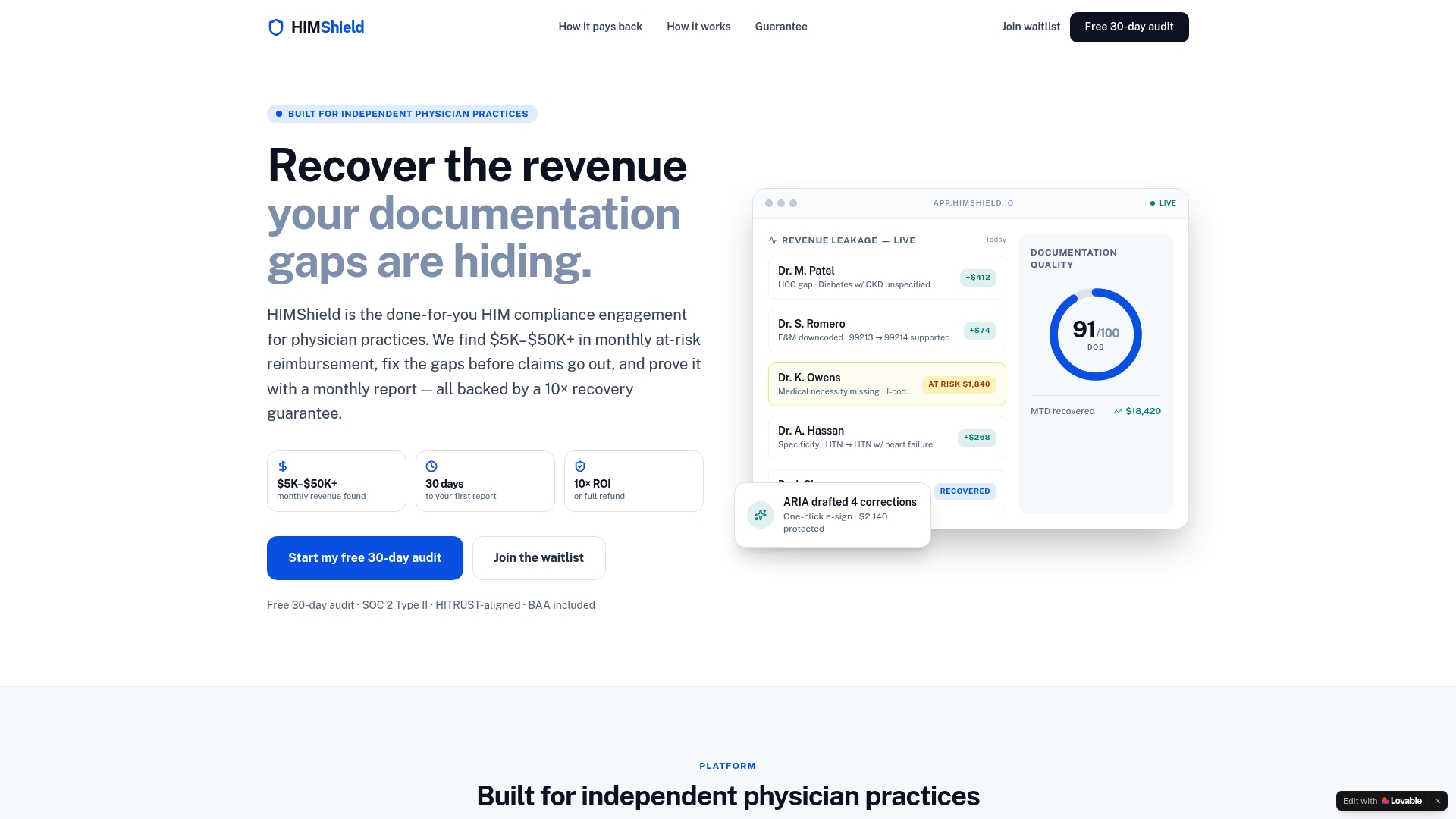
Himshield connects directly to your EHR and scans for coding, documentation, and charge-capture risks before they become denials or audits. The platform aligns with the OIG's seven-element framework and delivers physician-friendly guidance that your team can act on immediately. Practices using Himshield recover $5K–$50K+ in hidden revenue by catching errors that manual review misses. If you want to see exactly how the platform works and what it finds in your specific data, see how it works and connect your EHR in under 30 days.
FAQ
What are the main practice compliance program benefits?
The primary benefits are reduced legal liability, fewer claim denials, improved billing accuracy, and stronger audit readiness. Effective programs also cut culpability scores under federal sentencing guidelines, which lowers criminal fines and can lead regulators to decline charges.
How long does it take to establish a compliance program in a small practice?
Baseline implementation typically takes 8–12 weeks, starting with a risk assessment in weeks 1–2. The process covers policy development, role-specific staff training, and monitoring setup before the program is fully operational.
Why do independent practices need compliance programs in 2026?
Enforcement agencies now use analytics to flag practices with statistical billing deviations versus peers. Small practices appear in those data sets, making proactive compliance monitoring the only reliable way to catch billing anomalies before external auditors do.
What are the seven elements of an effective healthcare compliance program?
The OIG's 2026 GCPG requires written policies, compliance leadership, training and education, open reporting channels, internal monitoring, disciplinary standards, and corrective action processes. All seven elements must be active and evidenced by linked records, not just documented in a policy manual.
Does a small practice need a full-time compliance officer?
No. Small practices can meet OIG requirements with a designated part-time compliance role supported by structured reporting cadences and an integrated platform. The owner retains legal accountability but does not need to manage daily compliance tasks directly.