
Yes, for many outpatient E/M encounters, you may select the code based on total time instead of medical decision making. Document the exact minutes spent on the date of service and list the qualifying activities that made up that time. That single habit, an exact time statement paired with a short activity list, is what separates a defensible claim from an audit target. The rest comes down to knowing your thresholds, your exclusions, and your payer's prolonged-service rules.
TL;DR:
- Precise documentation of the exact time spent and activities performed on the encounter date is essential to defend time-based E/M billing claims.
- Total time includes activities like reviewing tests, exams, counseling, and documentation, but excludes clinical staff time, travel, and work on different dates.
- Accurate coding relies on best practice for note details, avoiding vague statements, copy-paste templates, and double-counting, especially in split or shared visits.
- When visits exceed the maximum CPT thresholds, post-visit prolonged-service codes can be billed in 15-minute segments, but payer policies vary and must be verified.
- Running automated pre-claim reviews helps identify documentation mismatches, prevents denials, and recovers potential revenue before claims are submitted.
Table of Contents
- What Counts Toward Total Time for E/M Coding
- What Are the CPT Time Thresholds for Office E/M Codes?
- How Should You Document Time-Based E/M Visits?
- Should You Code by Time or Medical Decision Making?
- Prolonged Services: 99417 vs. G2212 and Payer Variations
- Do EHR Time Calculators Actually Track Time Accurately?
- A Compliance Checklist Practices Can Run Before Every Claim
- Why Getting This Right Protects Both Revenue and Clinicians
- How Himshield Helps Practices Bill Time-Based E/M Codes Correctly
- Where to Verify These Rules Directly
- Sources
What Counts Toward Total Time for E/M Coding
Total time includes every qualifying activity the physician or qualified health professional personally performs on the date of the encounter, whether face-to-face or not. The CMS MLN E/M guide and prolonged-services guidance from UTH outline what qualifies:
- Preparing to see the patient, such as reviewing recent test results
- Reviewing history obtained separately, from staff or from a prior record
- Performing a medically necessary exam or evaluation
- Counseling or educating the patient, family, or caregiver
- Ordering medications, tests, or procedures and communicating results
- Documenting the encounter in the health record, including independent interpretation of tests
Clinical staff time doesn't count. Neither does time spent on a separately billable procedure, travel, or any work performed on a different calendar date. A physician who spends 8 minutes reviewing labs, 12 minutes examining the patient, 10 minutes counseling on a new diagnosis, and 6 minutes documenting has a defensible total of 36 minutes, not an estimate rounded up to "about 40."
What Are the CPT Time Thresholds for Office E/M Codes?
The AAFP's coding series on time-based billing lays out the CPT descriptor ranges coders rely on most. These minute ranges apply to office and outpatient E/M codes for both new and established patients.
These are the CPT descriptor ranges, not payer-specific rules. Individual payers, including some Medicare Administrative Contractors, layer on additional documentation expectations, so verify local policy before you rely on the ranges alone. Whatever you do, document the exact minute count you calculated, not the range it falls into.
How Should You Document Time-Based E/M Visits?
The safest note format states an exact number, not a range, and lists what filled that time. Vague phrasing is the single biggest reason time-based claims get denied or flagged in a payer audit.
A note that reads "Total time spent on the date of the encounter: 34 minutes" followed by a short bulleted list holds up far better than "approximately 30-35 minutes spent with patient." Your activity list should be specific:
- Reviewed outside records and recent labs
- Examined patient and discussed treatment options
- Counseled on medication changes and lifestyle modifications
- Documented encounter and ordered follow-up testing
The Hopkins Medicine guidance on time-based billing flags copy-paste time statements as one of the clearest audit red flags. A template phrase that reads identically across ten different patient encounters tells an auditor the number wasn't calculated for that visit at all.
For split or shared visits, sum the distinct, non-overlapping time each qualified professional spent, and document who performed which portion. Never double-count minutes when two clinicians were both in the room for the same task.
Pro Tip: When counseling or care coordination made up most of the visit, add one line explaining why: "Majority of visit time spent counseling on new cancer diagnosis and coordinating oncology referral." That single sentence gives an auditor context instantly, instead of leaving them to guess why a straightforward visit ran 40 minutes.
Should You Code by Time or Medical Decision Making?
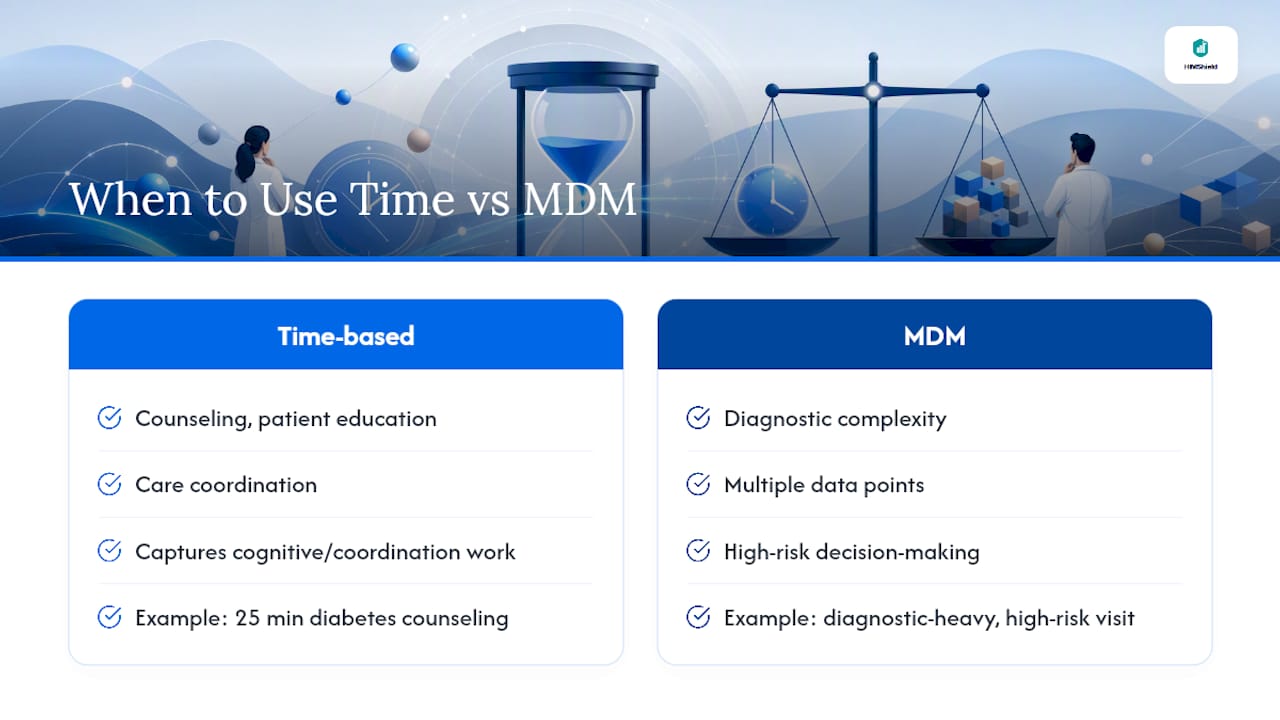
Pick whichever method actually reflects the work you did that day. When counseling, patient education, or care coordination dominated the visit, time usually captures the effort better than MDM does. MedAxiom's analysis of time-based billing makes this point directly: MDM can undercount cognitive and coordination work in encounters that aren't procedurally complex.
A visit dominated by diagnostic complexity, multiple data points, and high-risk decision-making usually scores higher under MDM. A visit where you spent 25 minutes explaining a new diabetes diagnosis and adjusting a care plan usually scores higher under time.
Document which method you used and why. A note that hedges between both methods, listing partial MDM elements alongside a rough time estimate, confuses reviewers and invites a second look. Choose one, support it fully, and move on.
Prolonged Services: 99417 vs. G2212 and Payer Variations
Once a visit runs past the top of the time range for 99205 or 99215, you may qualify for a prolonged-services add-on. CPT 99417 and HCPCS G2212 both bill in 15-minute increments, but they aren't interchangeable, and the AAFP's coding series notes that Medicare uses a different threshold than commercial payers applying CPT rules.
- CPT 99417 typically applies once total time exceeds the maximum required for 99205 or 99215
- HCPCS G2212 is the Medicare-specific equivalent, with its own minimum threshold before the first increment applies
- Both are billed per full 15-minute increment beyond the base code's time
Commercial payers and Medicare don't always apply the same cutoff or the same add-on code. Verify each payer's published policy before submitting a prolonged-services claim, since a mismatch between the add-on code and the payer's rule set is an easy, avoidable denial.
Do EHR Time Calculators Actually Track Time Accurately?
EHR timers are useful, but they're not a substitute for judgment. The AAFP's guidance points to several recurring failure modes that quietly inflate or deflate a recorded total.
- Forgetting to open the chart when entering the room, undercounting real time
- Leaving a chart open on a second device or browser tab, double-counting minutes
- Mobile or tablet access that the system never logs at all
The fix is reconciliation, not more automation layered on top of a flawed timer. Cross-check the system-generated total against your narrative documentation every time, and require an exact time statement in the note regardless of what the timer says. A single line tying the recorded minutes to the specific activities performed gives you a paper trail that holds up even if the timer output looks unusual on review.
A Compliance Checklist Practices Can Run Before Every Claim
Run these five checks before any time-based claim goes out the door:
- Verify the exact minute count against the note, not an estimate
- Confirm the activity list matches what actually happened that date
- Exclude any time tied to a separately billable procedure
- Recalculate split/shared math so no minutes are double-counted
- Confirm the prolonged-services code matches that specific payer's threshold
Manually running this checklist on every chart doesn't scale past a handful of providers. Automated pre-claim review closes that gap by comparing the documented narrative against the billed code and flagging mismatches, like a note describing 22 minutes of activity billed as a 40-minute visit, before the claim ever leaves the building. Practices that run a small internal sample audit first typically find the same handful of templates causing most of their denials, which makes the fix fast once you know where to look. Himshield's pre-claim automated review is built around exactly that kind of detection.
Why Getting This Right Protects Both Revenue and Clinicians
Time-based coding, done correctly, is really a fairness question. It's the mechanism that makes sure a physician who spends 35 minutes counseling a frightened patient through a new diagnosis gets paid for that work the same way a physician gets paid for a procedure. When documentation is vague or copy-pasted, practices leave real revenue on the table and hand auditors an easy target at the same time. Getting the exact-minute habit right protects both. Himshield's mission is built around exactly that overlap: protecting the revenue independent practices have already earned.
— Elena
How Himshield Helps Practices Bill Time-Based E/M Codes Correctly
Fixing a vague time statement after a denial arrives is expensive. Catching it before the claim goes out costs you almost nothing. Himshield scans your EHR data ahead of submission, flags documentation-to-code mismatches like the ones covered above, and quantifies exactly how much revenue is sitting in gaps you didn't know existed. Every independent practice gets a free 30-day audit and a per-provider, per-payer Revenue Leakage Report before any subscription decision.
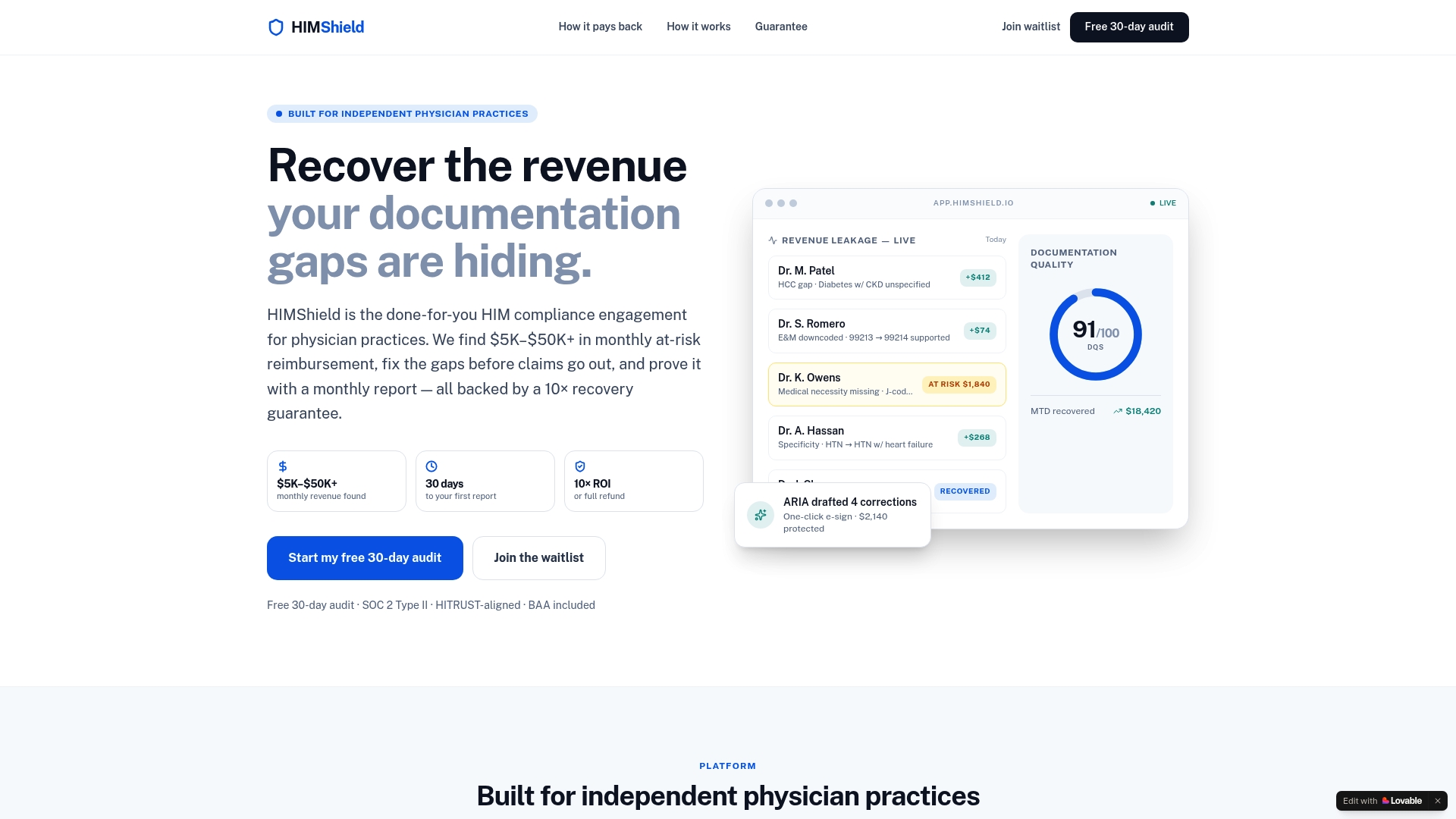
Three things happen fast once you connect your EHR:
- Coding and documentation errors surface automatically, including time-statement mismatches
- Denials tied to those errors drop because corrections happen before submission, not after
- Recovered revenue lands in a clear, per-provider report you can act on immediately
See exactly what's hiding in your own charts with HIMShield's free 30-day audit.
Where to Verify These Rules Directly
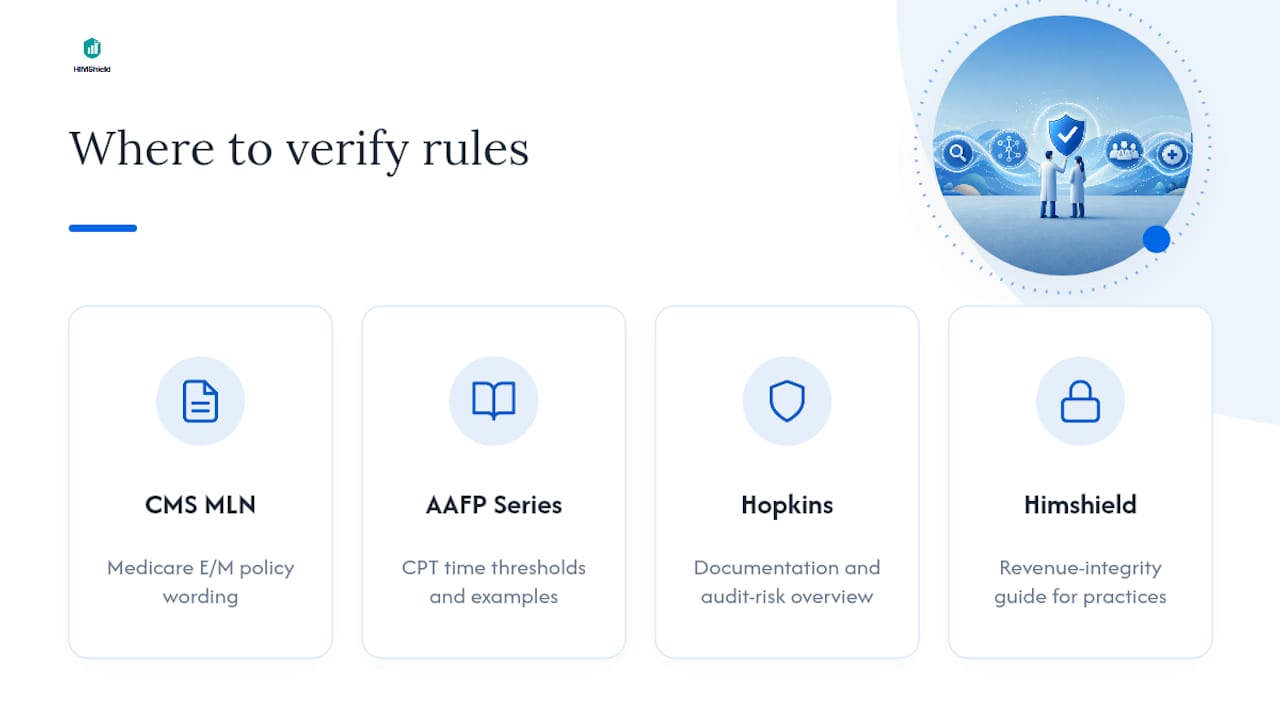
For full policy wording and payer-specific detail, go straight to the source: the CMS MLN E/M services guide for Medicare rules, the AAFP's time-based coding series for CPT thresholds and practical examples, the Hopkins Medicine overview on documentation and audit risk, and Himshield's own guide on revenue integrity for physician practices.
Sources
- E/M office visit coding series: Tips for time-based coding — AAFP
- Evaluation and Management Services guide — CMS MLN
- Time-Based Billing for E/M Services — Medicine Matters (Hopkins)