
An undocumented diagnosis is a condition the patient has, or that you treated, but that the medical record does not clearly support. The risk runs in two directions. Conditions you fail to capture mean lost reimbursement and inaccurate risk scores. Conditions you report without clinical support mean denials, recoupment and audit exposure. Both come from the same place: the note.
This guide is for independent practice owners, administrators and HIM professionals. It explains where documentation gaps come from, what they cost, how analytics can find them and how to fix them without adding a single unsupported code.
TL;DR
- A documentation gap is incomplete, nonspecific, conflicting or missing documentation. A diagnosis that is not in the record cannot be reported, and one that is in the record without clinical support cannot be defended.
- Payers pay for what is documented. Thin records can lead to claim denials or recoupment, and risk adjustment audits look for diagnoses that lack supporting clinical indicators.
- Analytics can flag likely gaps in EHR data, but a clinician and a coder must validate each one through a compliant, non-leading query.
- The fix is a repeatable loop: baseline audit, physician query, education from real charts, then ongoing monitoring.
- Our free 30-day audit quantifies the gaps in your own data before you commit to anything.
Table of Contents
- What an undocumented diagnosis actually is
- Why the note controls the claim
- The cost of gaps: two kinds of risk
- Where gaps hide in a typical independent practice
- How documentation-gap analytics works, and where it stops
- From flag to fix: validating without adding unsupported codes
- Building a loop that keeps gaps closed
- Our perspective
- See your own gaps in 30 days
- FAQ
- Sources
What an undocumented diagnosis actually is
The term covers more than a blank field. AHIMA's physician office query guidelines describe the situations that call for a query:
- Clinical indicators of a diagnosis, but no documentation of the condition.
- Clinical evidence of a higher degree of specificity or severity.
- Uncertainty about a cause-and-effect relationship between two conditions.
- An underlying diagnosis behind presenting symptoms.
- Drugs or treatment with no diagnosis to support the therapy.
In a small practice these show up in familiar ways. A patient on insulin whose note says only "diabetes." A problem list that carries a chronic condition no one addressed at the visit. A medication refill with no linked diagnosis. A "history of" entry that should read as a current, managed condition, or the reverse.
AAPC's Thought Leadership Team makes a point worth repeating to your clinicians: many providers document well for patient care but are unaware of the details needed for accurate code selection. The care was good. The record did not carry it to the claim.
Why the note controls the claim
Coding in the US follows the ICD-10-CM Official Guidelines, which are required under HIPAA when you assign diagnosis codes. The FY2026 guidelines state that a joint effort between the provider and the coder is essential to complete and accurate documentation. They also say that without consistent, complete documentation, accurate coding cannot be achieved, and that the entire record should be reviewed to determine the reason for the encounter and the conditions treated.
The practical consequence is simple. A coder cannot code what the provider did not document. A biller cannot defend what the coder was not able to support. Each handoff inherits the weakness of the note.
The principle runs through Medicare payment. The American Institute of Healthcare Compliance describes it as 'no documentation, no payment': services must meet the reasonable and necessary standard, and records that do not justify the condition can lead to denials or recoupment. The same logic applies to coverage questions in every specialty. Whether the topic is Medicare rehab coverage under Parts A, B and D or an office visit in your own clinic, the payer pays for what the record supports.
The cost of gaps: two kinds of risk
Revenue you earned but never captured
When a condition is unspecified or missing, the claim goes out understated. AAPC notes that an unspecified or poorly specified condition may produce a risk score that does not reflect the patient's true health. It can also fail to produce accurate reimbursement for a condition that costs more to treat.
For chronic conditions, timing matters too. The ICD-10-CM guidelines allow chronic conditions treated on an ongoing basis to be coded as many times as the patient receives care. For risk adjustment, reporting at least once each calendar year is necessary for an accurate risk score. A condition that was documented in March and never addressed again is a gap by December.
Time-based services show the same pattern. American Medical Compliance points out that payers reimburse on what is documented, not on intention, and that incomplete diagnoses often lead to payment delays. This is the "leaving money on the table" problem. It is quiet, it repeats every day, and no denial letter ever tells you about it.
We cover the mechanics in more detail in why practices lose reimbursement and how documentation affects reimbursement.
Diagnoses reported without support
The other side is audit exposure. Under 42 C.F.R. § 422.310(e), CMS conducts RADV audits that ask Medicare Advantage organizations to submit sample medical records. Per the PY2024 RADV audit methods guidance, a discrepancy is identified when an HCC used for payment is not validated by the record. If the payment error is greater than $0, CMS starts collection.
Those findings travel down to the practices whose charts supported the diagnoses. A 2024 OIG audit of one Medicare Advantage contract found that 362 of 1,220 sampled enrollees' HCCs were not validated. The OIG estimated at least $130 million in net overpayments for 2015. Your practice is not the plan, but your documentation is the evidence the plan relies on.
One payer's provider education material states that RADV audits look specifically for diagnoses lacking supporting clinical indicators. It adds that agreeing to a diagnosis without clinical support can draw False Claims Act scrutiny. It recommends that providers document clinical reasoning instead of just ticking a checkbox.
See our walkthrough of the RADV audit process for physician practices for what happens when a request arrives.

Where gaps hide in a typical independent practice
Gaps cluster in predictable places. Check these first:
- Chronic conditions not re-assessed each year. The diagnosis lives on the problem list but no visit note shows it was evaluated or managed.
- Nonspecific codes. Documentation says "anemia" or "heart failure" when the clinical picture supports a more specific type. Our guide on unspecified code denials goes deeper.
- Treatment without a diagnosis. A prescription or order exists with no linked condition in the assessment.
- Template and copy-forward text. Carried-over language that no longer matches the visit.
- Inconsistent clinical indicators. A diagnosis whose vitals, labs or measurements do not agree with it.
- Unclosed queries. A question went to the physician and the answer never reached the permanent record.
An OIG finding of 70% gaps in coding risk, which we discuss in our piece on detecting medical coding risk, is a reminder that these patterns are common, not exceptional.
How documentation-gap analytics works, and where it stops
Analytics tools scan EHR data for patterns that suggest a missing or weak diagnosis: medications without matching conditions, labs with no linked assessment, chronic conditions not seen this year, or specificity that does not match the clinical picture. AHIMA's CDI toolkit explains that NLU and NLP tools can scan EHR documents for key phrases and flag potential query opportunities based on current or previous documentation.

The same toolkit is clear about the limit. These tools can also produce erroneous diagnoses from templates, questionnaires, misspellings and abbreviations, and CDI review helps prevent the noise and inappropriate reporting that could lead to a denied claim.
So a flag is a lead, not a diagnosis. The right use of analytics is to point the human review at the charts most likely to matter, then to size the opportunity so you can prioritize it. It never supplies the diagnosis itself.
From flag to fix: validating without adding unsupported codes
The discipline is what separates compliant recovery from risk. Use this sequence for every flagged chart.
- Confirm the clinical indicators. Auditors compare the record to evidence-based standards and ask whether objective indicators such as vitals, labs and treatment support the diagnosis. If the indicators are not there, stop. No query will fix that.
- Send a compliant query. AHIMA recommends that physician office queries be clear, concise and non-leading, and that they include clinical indicators specific to the patient. Offer options, including "other" and "unable to determine."
- Let the physician decide. The provider uses clinical judgment. Nobody on the billing side picks the diagnosis.
- Record the answer properly. Query responses belong in the permanent health record, for example as an addendum or late entry.
- Code only what the final record supports. Then review whether earlier claims need correction under your compliance policy.
Our physician query process best practices and a review of common query response failures cover wording, turnaround and the mistakes that make answers unusable.
Building a loop that keeps gaps closed
One-time cleanups fade. AAPC recommends a baseline audit schedule that checks documented diagnoses were accurately coded and included in claims. It also recommends a training program that addresses audit findings using actual medical records.
The American Institute of Healthcare Compliance adds that mature programs need routine internal and external auditing to validate query accuracy and find educational gaps. It suggests reporting through metrics like query response rates and denial reduction.
For a small practice, that translates into a light monthly rhythm:
| Cadence | Activity | Owner |
|---|---|---|
| Every claim batch | Pre-submission check for unspecified codes and treatment without a diagnosis | Billing lead |
| Monthly | Review open queries and response times | HIM or practice administrator |
| Quarterly | Per-provider documentation review using real charts | Compliance lead with physicians |
| Yearly | Confirm chronic conditions were assessed and documented in the calendar year | Physicians and coders |
Education works best when it is short and tied to the provider's own notes. We explain why in physician documentation education in 2026. If you want a sequence to start from, our 90-day first HCC documentation plan lays one out for independent practices.
Our perspective
Most practices we talk to believe their documentation problem is a physician problem. We see it as a visibility problem. Nobody can fix a gap they cannot see, and EHR data rarely shows you which providers, which payers and which conditions are costing you money.
That is why we built HIMShield around quantification first. Our platform scans EHR data for coding, documentation and charge-capture gaps before claims go out, and produces per-provider, per-payer Revenue Leakage Reports. Your administrator sees where the at-risk reimbursement is. Your physicians get guidance that is short and specific to their own charts.
We also believe recovery has to be defensible. Our approach drafts corrections for physician e-signature in one click, and the physician stays in control of the clinical decision. If a payer audit arrives, we assemble a submission-ready response from the same record.
We designed it to work without new staff or software training, because independent practices do not have spare hours. We stand behind that with a free 30-day audit and a performance guarantee.
Elena
See your own gaps in 30 days
If you want numbers instead of estimates, our free 30-day Revenue Leakage Audit is built for that. We analyze your EHR data for coding, documentation and charge-capture gaps and quantify them per provider and per payer. You get the report first. A paid subscription, with pricing scaled to provider count and chart volume, comes only after you have seen it.
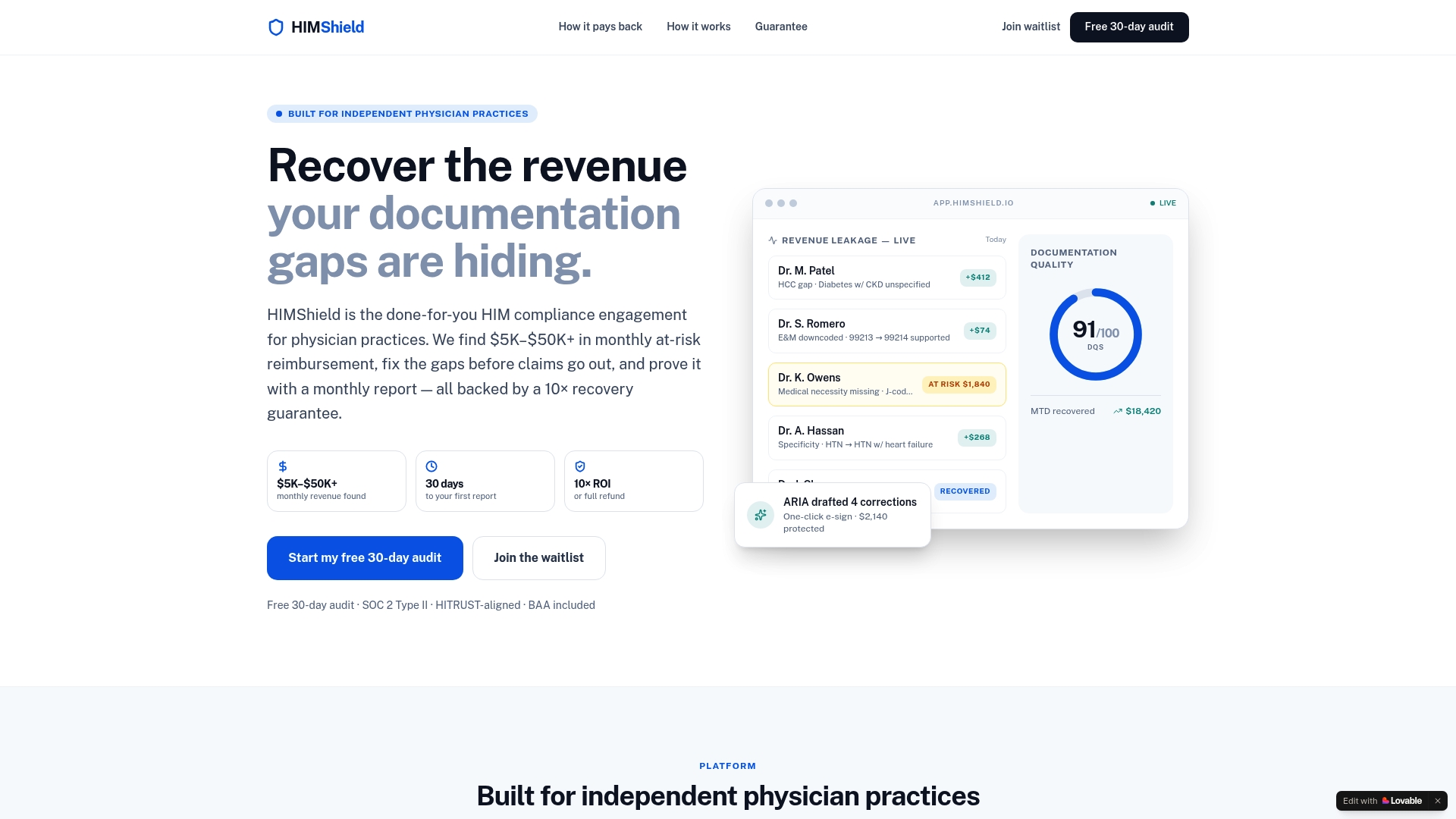
Already know you need ongoing protection, including audit defense? Learn more about our HIM compliance engagement.
FAQ
What is the difference between an undocumented diagnosis and an unsupported one?
An undocumented diagnosis is a condition that is clinically present or treated but absent or vague in the record, so it cannot be reported accurately. An unsupported diagnosis is the reverse: a code was reported but the record lacks the clinical indicators to back it. The first costs you revenue and the second creates audit exposure.
Can a coder or billing staff add a diagnosis that was missed?
No. Only the treating provider can establish a diagnosis. When staff spot clinical indicators without a documented condition, the compliant route is a non-leading query with the patient's clinical indicators. The provider's answer then goes into the permanent record, for example as an addendum.
Does every chronic condition need to be documented every year?
For risk adjustment, the 2024 ICD-10-CM guidance as summarized by AAPC says chronic conditions must be reported at least once per calendar year for an accurate risk score. The condition should be evaluated and supported in the note at a face-to-face encounter, not just listed on the problem list.
How quickly can a practice find its documentation gaps?
That depends on your EHR data and chart volume. Our free audit runs for 30 days and ends with a quantified report by provider and payer, so you see where the gaps are before you decide on anything further.
Sources
- Guidelines for Physician Office Query Practice (AHIMA)
- Measuring Effectiveness of Your CDI Program (American Institute of Healthcare Compliance)
- ICD-10-CM Official Guidelines for Coding and Reporting FY2026 (CMS)
- Risk Adjustment Documentation and Diagnosis Coding (AAPC)
- Payment Year 2024 RADV Audit Methods Guidance (CMS)
- Medicare Advantage Compliance Audit of Diagnosis Codes, Contract H3330 (HHS OIG)
- Documentation and Ethics: If It's Not Charted, Did It Happen? (American Medical Compliance)
- The Imperative of Clear Clinical Documentation (Blue Cross of Idaho)
- AHIMA Clinical Documentation Integrity (CDI) Toolkit
- Medicare Rehab Coverage: What Parts A, B and D Pay For