
Physician documentation education is the process of training healthcare providers to create clear, accurate, and compliant medical records that support patient care, legal defense, and revenue integrity. Without it, practices face claim denials, compliance failures, and gaps in care continuity that cost real money. Research shows 40% of emergency medicine residents lack understanding of medical decision-making components, and 93% have received no formal medical coding training. That knowledge deficit does not stay in residency. It follows physicians into practice, where it quietly erodes billing accuracy and clinical quality. Understanding why physician documentation education matters is the first step toward fixing it.
Why physician documentation education matters for compliance
Accurate documentation is a legal and regulatory requirement, not a best practice suggestion. CMS guidelines, College of Physicians & Surgeons of Alberta standards, and HL7 data frameworks all require that records reflect specific, verifiable clinical findings. Vague entries like "follow-up PRN" fail compliance review. Replacing them with defined timeframes such as "follow-up in 3 weeks" is required for peer review alignment and patient record standards.
The medico-legal risk from poor documentation is concrete. EHR metadata audit logs serve as primary evidence in malpractice litigation, proving the timing and authenticity of every entry. A note that looks complete but was auto-populated without physician review can become a liability. Dictation and auto-population features increase efficiency but create clinically inaccurate records when physicians do not actively verify them. Education teaches physicians to audit their own EHR entries, not just sign off on them.

Documentation education also reduces the risk of template abuse. Many physicians rely on copy-forward notes or pre-built templates that carry forward outdated or incorrect information. Training programs that explain why accuracy matters, not just what to document, produce lasting behavior change.
Key compliance risks that education directly addresses:
- Vague follow-up instructions that fail peer review standards
- Unverified auto-populated data that creates medico-legal exposure
- Copy-forward template errors that carry incorrect findings into future records
- Missing clinical reasoning that weakens legal defensibility
Pro Tip: Audit a random sample of 10 charts per physician each quarter. Look specifically for auto-populated fields that contradict the visit narrative. That single check catches the most common compliance failures before they reach a payer or attorney.
How does documentation education improve patient care quality?
Physician documentation is a clinical skill, not a clerical task. A well-written note communicates clinical reasoning, captures the physician's intent, and gives the next provider everything they need to continue care without starting over. When that reasoning is missing or buried in template bloat, care continuity breaks down.
Four ways thorough documentation directly improves patient outcomes:
- Continuity across providers. A covering physician reading a clear note can act confidently. A note that says "patient doing well, continue current plan" forces them to guess.
- Accurate treatment planning. Documented comorbidities, allergies, and prior responses to treatment prevent duplicate testing and dangerous drug interactions.
- Reduced medical errors. Incomplete records are a leading contributor to adverse events. When a physician documents the reasoning behind a decision, the next clinician can identify if that reasoning no longer applies.
- Stronger care coordination. Specialists, nurses, and care managers all rely on physician notes to align their work. A clear note reduces phone calls, delays, and redundant assessments.
Note length does not equal note quality. Excessive template-driven bloat increases cognitive load and reduces the clinical value of a record. Concise notes of 2–3 pages are preferred over lengthy ones padded with copied text. Education programs that teach physicians to write with purpose, not volume, produce records that actually get read and acted on.
What are the financial benefits of documentation education?
Documentation quality directly determines reimbursement. Every relative value unit (RVU) assigned to a visit depends on what the physician documented. If the record does not support the level of service billed, the claim gets denied or downcoded. Education closes that gap between the care delivered and the revenue captured.
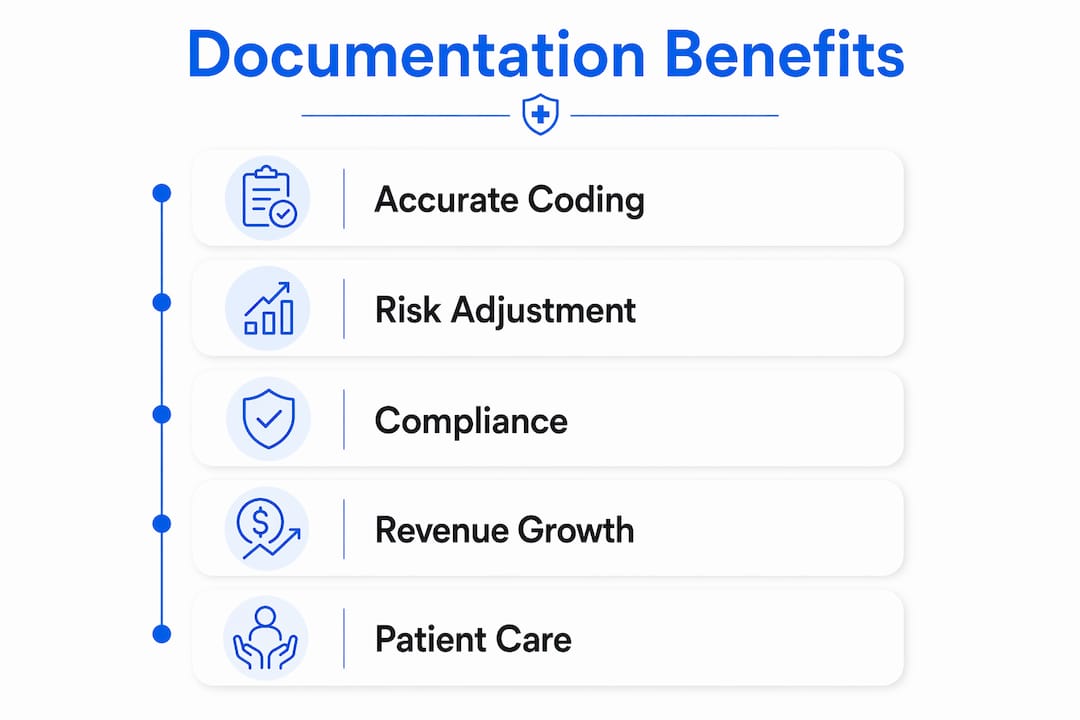
The financial impact of structured training is measurable. Clinical documentation integrity programs with peer-to-peer education reduce history and physical documentation time by about 75%, dropping average time per chart from 11 minutes to 2.5 minutes. That time savings translates directly into physician capacity and reduced administrative burden.
| Documentation gap | Financial consequence | Education fix |
|---|---|---|
| Missing comorbidity capture | Lost HCC risk adjustment revenue | Train on ICD-10 specificity and HCC coding |
| Underdocumented medical decision making | Claim downcoding | Teach medical decision-making components |
| Template errors in billing fields | Claim denial or audit trigger | Audit and verify EHR auto-populated data |
| Vague or incomplete notes | Payer recoupment risk | Standardize note structure with CDI programs |
Ongoing education sustains these gains. A one-time training session produces a short-term improvement. Practices that build revenue integrity into their documentation culture through regular feedback, scorecards, and CDI engagement see consistent reductions in denials and missed reimbursement.
What are the most common gaps in physician documentation knowledge?
The knowledge deficit is wider than most administrators realize. Baseline assessments confirm that 93% of emergency medicine residents have no formal medical coding training. That figure reflects a systemic gap in medical education, not individual failure. Physicians are trained to treat patients, not to document for payers, auditors, or the next provider in the care chain.
Common documentation knowledge gaps include:
- Medical decision-making (MDM) components. Many physicians cannot accurately define the three elements of MDM under current CMS guidelines, which directly affects E/M coding accuracy.
- ICD-10 specificity. Physicians frequently document diagnoses at a general level when a more specific code exists, leaving reimbursement on the table.
- Timely documentation. Memory-based records become only about 60% accurate after delays over 4 hours. The 4-hour rule is widely cited in documentation best practices but rarely taught in clinical training.
- Template dependency. Physicians who rely heavily on pre-built templates often produce documentation that is technically complete but clinically meaningless.
The consequences compound over time. A physician who underdocuments comorbidities for five years does not just lose reimbursement on individual claims. They create a pattern that triggers payer audits and puts the entire practice at risk.
Pro Tip: Use a brief self-assessment quiz on MDM components as the opening exercise in any documentation training session. Physicians who score poorly are more receptive to education than those who assume they already know the material.
What are the best practices for physician documentation education?
Effective documentation education requires more than a one-hour compliance lecture. Teaching physicians why and how produces stronger understanding and lasting behavior change than simply telling them what the rules are. That distinction matters because physicians respond to clinical reasoning, not administrative mandates.
Multimodal curricula and real-time feedback
Structured programs that combine case-based learning, live coding reviews, and real-time EHR feedback outperform single-format training. A structured multimodal documentation curriculum addresses gaps in resident training by layering knowledge across multiple sessions rather than front-loading it in one. The same principle applies to practicing physicians.
Peer-to-peer education models
Physicians learn more readily from other physicians than from compliance officers or administrators. CDI best practices recommend embedding physician advisors into documentation improvement programs to deliver feedback in clinical language. When a cardiologist explains to a colleague why documenting heart failure with reduced ejection fraction matters for risk adjustment, the message lands differently than a billing memo.
Tailoring education to learning styles
Physician education must adapt to varied learning styles. Structured learners prefer concise data and clear rules. Intuitive learners benefit from deeper explanations and case examples. A one-size-fits-all curriculum loses both groups. Effective programs assess physician preferences and adjust delivery accordingly.
HIM and physician collaboration
Health information management (HIM) professionals bring coding expertise that most physicians lack. Regular collaboration between HIM teams and clinical staff, through documentation scorecards, query workflows, and joint chart reviews, creates a feedback loop that sustains improvement. HIM and physician alignment is one of the most underused tools in documentation quality programs.
Key Takeaways
Physician documentation education is the single most effective intervention for protecting compliance, improving patient care, and recovering lost revenue in independent physician practices.
| Point | Details |
|---|---|
| Compliance requires specificity | Replace vague entries like "follow-up PRN" with defined timeframes to meet CMS and peer review standards. |
| Documentation is a clinical skill | Clear notes support care continuity, reduce medical errors, and communicate clinical reasoning across providers. |
| Education drives revenue recovery | CDI programs with peer-to-peer training cut documentation time by 75% and improve comorbidity capture. |
| Knowledge gaps are systemic | 93% of EM residents have no formal coding training; that deficit persists into independent practice without intervention. |
| Teaching beats telling | Education that explains why documentation rules exist produces lasting behavior change; mandates alone do not. |
What I've learned from watching documentation education fail and succeed
I've seen practices invest in documentation training and walk away frustrated when nothing changed. The pattern is almost always the same. The training was a lecture. A compliance officer read slides. Physicians sat in the back of the room and checked their phones. Six months later, the denial rate was identical.
The programs that actually work share one quality: they treat physicians as clinicians, not rule-breakers. When you show a physician how a missing comorbidity code cost their practice $4,200 in risk adjustment revenue last quarter, they pay attention. When you show them that their 11-minute chart notes can be cut to 2.5 minutes without losing clinical value, they want to know how. The financial and clinical stakes are real. Education that makes those stakes visible gets results.
The other thing I've learned is that sustainability requires infrastructure. A great training session fades without reinforcement. Practices that build documentation feedback into their monthly workflow, through scorecards, CDI queries, and regular chart audits, hold their gains. Practices that treat training as a one-time event start the cycle over again in 12 months.
The physicians I've seen improve fastest are not the ones who were told to document better. They are the ones who were shown exactly where their documentation fell short, given a clear explanation of why it mattered, and supported with tools that made improvement practical. That combination works every time.
— Elena
How Himshield supports your documentation education program
Himshield identifies the documentation and coding gaps that cost independent practices the most revenue before they become denials or audits.
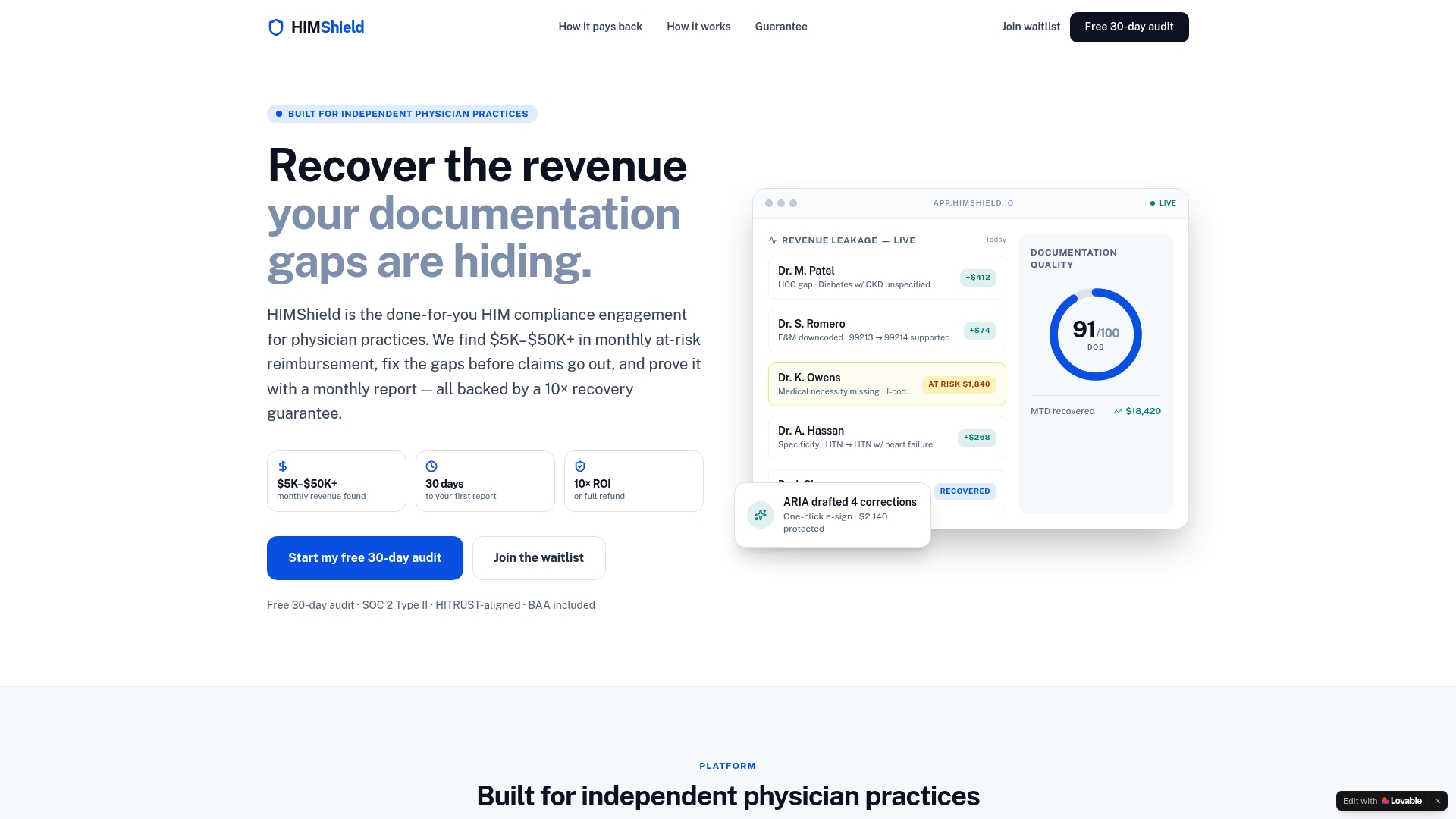
The platform scans your EHR data, quantifies at-risk reimbursement, and delivers physician-friendly guidance that supports real behavior change. Himshield's automated risk detection flags underdocumented comorbidities, MDM gaps, and charge-capture errors with the specificity your physicians need to act. Pair that with Himshield's revenue recovery tools and you get a documentation improvement program backed by data, not guesswork. See how Himshield works to connect your EHR and recover hidden revenue within 30 days.
FAQ
Why does physician documentation education matter for revenue?
Documentation quality determines the level of service billed and the comorbidities captured for risk adjustment. Practices without structured education consistently leave reimbursement unclaimed and face higher claim denial rates.
What is the 4-hour rule in medical documentation?
The 4-hour rule states that memory-based records become only about 60% accurate after delays over 4 hours. Documenting at or near the time of the encounter protects both clinical accuracy and legal defensibility.
How does documentation education reduce claim denials?
Education trains physicians to document medical decision-making components, use specific ICD-10 codes, and verify EHR auto-populated fields. Each of those skills directly reduces the most common triggers for claim denials and payer audits. Practices can also reduce claim denials by pairing education with regular chart audits.
What is the difference between teaching and telling in physician education?
Teaching explains why documentation rules exist and how they affect patient care and revenue. Telling simply states the rules. Research confirms that teaching produces stronger understanding and lasting behavior change than telling alone.
How long does it take to see results from documentation training?
Peer-to-peer CDI programs have demonstrated measurable results within a single documentation cycle. History and physical documentation time dropped from 11 minutes to 2.5 minutes per chart in one structured program, showing that well-designed education produces rapid, quantifiable improvement.