
Physician query response failures are one of the most preventable threats to documentation accuracy in clinical practice. The most frequent failures include query fatigue from over-querying, leading or templated queries that lack patient-specific clinical indicators, and poorly structured response options that push physicians toward non-compliant answers. Healthy CDI programs show moderate physician agreement rates; when agreement rates climb unusually high, auditors flag them as evidence of leading language. AHIMA and ACDIS guidelines are clear: every compliant query must be clear, concise, non-leading, and grounded in the patient's own medical record.
The stakes are real. Poorly managed queries produce incomplete records, inaccurate codes, and audit exposure that can cost independent practices far more than the revenue they were trying to protect. The sections below break down every major failure type, the myths that sustain them, and the practical steps your team can take right now.
Common physician query response failures: types and causes

Most query failures trace back to a small set of structural and workflow problems. Recognizing them by name is the first step toward fixing them.
Common failure types:
- Query fatigue. When CDI teams send too many queries, physicians start skimming or ignoring them. Setting high query volume targets drives this pattern directly, lowering engagement and degrading response quality across the board.
- Leading or templated queries. A query that steers the physician toward a specific diagnosis without neutral clinical options is non-compliant. Leading or templated queries without patient-specific data push physicians to document conditions that may not be fully supported.
- Yes/no query design. Yes/no queries are generally non-compliant except in limited present-on-admission situations. A "yes" answer tells a coder almost nothing about clinical context.
- Missing patient-specific indicators. Queries that paraphrase findings or omit the source location within the record fail the AHIMA standard for compliant query design.
- No "other" or free-text option. Forcing a physician to choose from a closed list without an open-ended option removes their ability to document a more specific or different clinical reality.
- Failure to offer "unable to determine" appropriately. Overusing this option as a checkbox lets physicians dismiss queries without engaging clinically.
Underlying causes include poor workflow integration that buries queries in EHR notification queues, physician burnout that reduces tolerance for administrative tasks, and CDI teams that prioritize query volume over query quality. Each of these causes compounds the others.
Myths that undermine effective physician query responses
Several persistent misconceptions keep query processes broken even when teams know the rules. Clearing them up changes how both physicians and CDI staff approach the work.
- Myth: Queries are meant to catch physician errors. Queries exist to resolve ambiguity in the record, not to audit clinical judgment. Physicians often perceive queries as critiques, which triggers defensive responses. Framing queries as a collaborative documentation tool changes that dynamic.
- Myth: Yes/no queries are acceptable if the intent is clear. They are not, with narrow exceptions. A yes/no answer without a documented diagnosis in the health record does not meet compliance standards.
- Myth: Queries should educate physicians about coding. Including ICD-10-CM codes, DRG details, or reimbursement impact in a query is a compliance violation, not a teaching moment. The goal is record clarity, nothing more.
- Myth: Physicians must respond immediately. Workflow reality matters. Queries sent without regard for physician schedules or EHR access patterns produce low-quality, rushed responses.
- Myth: "Unable to determine" is always a valid out. When physicians use this option repeatedly to avoid engaging with a query, it signals a process failure, not a clinical one. The option exists for genuine clinical uncertainty, not as a dismissal mechanism.
- Myth: High agreement rates prove a strong CDI program. Very high agreement rates can signal leading language and draw audit scrutiny. Moderate rates, paired with accurate documentation, reflect a healthier program.
Standards and best practices for timely, compliant query responses
AHIMA and ACDIS set the compliance floor. Your internal policies build on it.
AHIMA mandates compliant queries be clear, concise, and non-leading, citing patient-specific clinical indicators directly from the medical record. Queries must never reference reimbursement impact, DRG weight, length of stay, or quality scoring. The ACDIS guidance reinforces that queries should include patient-specific clinical indicators, the location of those indicators in the record, the name and position of the documenting clinician, and the timing of the finding.
Practical compliance standards your team should follow:
- Send queries only when documentation is conflicting, ambiguous, incomplete, or fails one of the five criteria: legibility, completeness, clarity, consistency, or precision.
- Log every query for follow-up, track response rates, and trend documentation issues over time.
- Audit query formats regularly. Inappropriate formats caught in audit become educational opportunities, not compliance violations.
- Set response time expectations in policy, and communicate them clearly to physicians at onboarding and during ongoing education.
- Monitor agreement rates as a quality signal, not just a volume metric. A high negative response rate may indicate over-querying; a high positive rate may indicate leading language.
Audit readiness depends on this monitoring. Queries reviewed retrospectively must show that the language was non-leading, that no new information was introduced, and that the query was necessary in the first place.
Best practices to reduce physician query response failures
The most effective CDI programs treat query design as a clinical communication skill, not an administrative checkbox.
Refine your query templates. Remove any language that implies a preferred answer. Offer multiple clinically reasonable diagnostic options, and always include an "other" free-text field. Removing "unable to determine" from query options and replacing it with an "other" field requiring clinical explanation produced a dramatic improvement in response rates at the University of Texas Southwestern Hospitals.
Integrate queries into physician workflow. Queries buried in EHR notification queues get ignored. Work with your IT and physician champions to surface queries at the point of documentation, not hours later.
Shift the framing from punitive to collaborative. Presenting queries as educational and collaborative reduces defensive responses. Physicians who understand that queries improve patient record accuracy, not just coding metrics, engage more consistently.
Quote the record word-for-word. Paraphrasing clinical findings introduces risk. Quoting directly avoids the appearance of leading and keeps the query grounded in documented evidence.
Never introduce new information. A query that references a diagnosis not previously documented in the current admission is non-compliant, regardless of how clinically obvious the connection seems.
Pro Tip: Balance query volume against query quality. A smaller number of well-constructed, patient-specific queries produces better agreement rates and lower audit risk than a high volume of templated queries. Track your agreement rate monthly and investigate any sustained climb above your program's baseline.
Himshield supports independent practices in identifying documentation and query process risks before they become denials or audit findings, giving your CDI team the compliance defense it needs.
What physician queries are and why they matter
A physician query is a formal request from a CDI professional or coder to a treating physician, asking for clarification when the health record is incomplete, ambiguous, conflicting, or imprecise. The query process is the primary mechanism for improving documentation accuracy and ensuring that coded data reflects the patient's true clinical picture.
Queries benefit every stakeholder. Accurate documentation supports appropriate reimbursement, correct severity of illness and risk of mortality classifications, and defensible coding under payer audit. For independent physician practices, where each claim carries direct revenue impact, a well-managed query process is one of the most practical tools for protecting earned dollars.
Queries may be initiated concurrently, pre-bill, or retrospectively, and they apply to all payer types regardless of reimbursement impact. The attending physician carries final responsibility for the documented diagnosis, which is why query compliance protects both the practice and the patient record.
How query response failures affect clinical outcomes and reimbursement
When physician query responses fail, the damage runs in two directions: clinical and financial.
On the clinical side, incomplete or inaccurate documentation distorts severity of illness scores, risk of mortality classifications, and quality reporting metrics. A patient whose comorbidities are underdocumented may appear lower-acuity than they are, affecting care coordination and downstream treatment decisions. Documentation weaknesses contribute directly to lost reimbursement and can expose practices to medical liability when the record does not reflect the care actually delivered.
On the financial side, non-compliant or unanswered queries produce codes that do not capture the full complexity of the encounter. That translates to lower DRG weights, missed hierarchical condition category (HCC) capture, and claim denials. For independent practices operating on tight margins, these losses accumulate quickly. A single missed complication or comorbidity per encounter, multiplied across hundreds of patients, represents real revenue left uncaptured.
How technology and automated tools support the query process
Automated CDI platforms reduce the manual burden on both coders and physicians by surfacing documentation gaps at the point of care rather than after discharge. Natural language processing tools scan clinical notes in real time, flagging ambiguous language, missing diagnoses, and conflicting documentation before a query is even needed.
EHR-integrated query workflows eliminate the friction of separate query portals. When a query appears directly in the physician's documentation workflow, response rates improve and turnaround time drops. Automated tracking logs every query, response, and outcome, giving CDI managers the data they need to audit query quality and trend documentation issues over time.
Himshield's platform connects to your EHR via FHIR API, scanning for coding, documentation, and charge-capture risks automatically. It identifies query-worthy gaps before they become denials, and delivers physician-friendly guidance that fits into existing workflows rather than adding to administrative load.
Training and education methods that reduce query failures
Education is the most durable fix for recurring query response failures. One-time onboarding is not enough; effective programs build query literacy into ongoing physician development.
Physician champions are the most effective delivery mechanism. A respected peer explaining why a query matters clinically carries more weight than a policy memo from compliance. Pair champion-led education with case-based examples drawn from your own query audit data, so physicians see real patterns from their own practice rather than generic scenarios.
CDI staff need parallel training on physician documentation education and query design. Reviewing query formats in team meetings, tracking individual query agreement rates, and celebrating documentation improvement all reinforce a culture of accuracy rather than volume. When CDI professionals understand the clinical context behind a query, they write better queries and earn more physician trust.
Escalation protocols matter too. At Brigham and Women's Hospital, CDI Director Deb Jones developed a policy to escalate "unable to determine" responses from lower-level clinicians, and found that simply having the policy in place reduced those responses.
Legal and audit risks from inadequate physician query responses
Inadequate query responses create layered legal and audit exposure. From a compliance standpoint, queries that use leading language, introduce new information, or reference reimbursement impact are non-compliant on their face. If those queries produce code changes that inflate reimbursement, the practice faces False Claims Act risk, not just a coding correction.
Payer audits, including Recovery Audit Contractor (RAC) reviews and Medicare Administrative Contractor (MAC) audits, specifically target patterns of high agreement rates, unusual DRG shifts, and documentation that appears to have been added in response to a query rather than reflecting contemporaneous clinical judgment. A retrospective query response documented as an addendum must be clearly labeled and kept as a permanent part of the medical record.
Audit preparation requires that your query log be complete, your formats be auditable, and your agreement rates fall within a defensible range. Practices that cannot produce a clean query audit trail face recoupment demands and, in serious cases, referral to the Office of Inspector General. The cost of a non-compliant query process far exceeds the cost of fixing it.
Key Takeaways
Effective physician query management requires compliant query design, workflow integration, and ongoing education to protect both documentation accuracy and practice revenue.
| Point | Details |
|---|---|
| Query fatigue is a top failure cause | High query volume lowers physician engagement; prioritize quality over quantity to maintain response accuracy. |
| Leading language triggers audit risk | Very high physician agreement rates signal leading queries and draw payer scrutiny during audits. |
| Yes/no queries are non-compliant | Except for present-on-admission cases, queries must offer multiple clinically reasonable response options. |
| "Unable to determine" needs management | Removing this checkbox and requiring free-text clinical reasoning dramatically improves response quality. |
| Audit exposure is real and layered | Non-compliant queries that inflate reimbursement carry False Claims Act risk beyond simple coding corrections. |
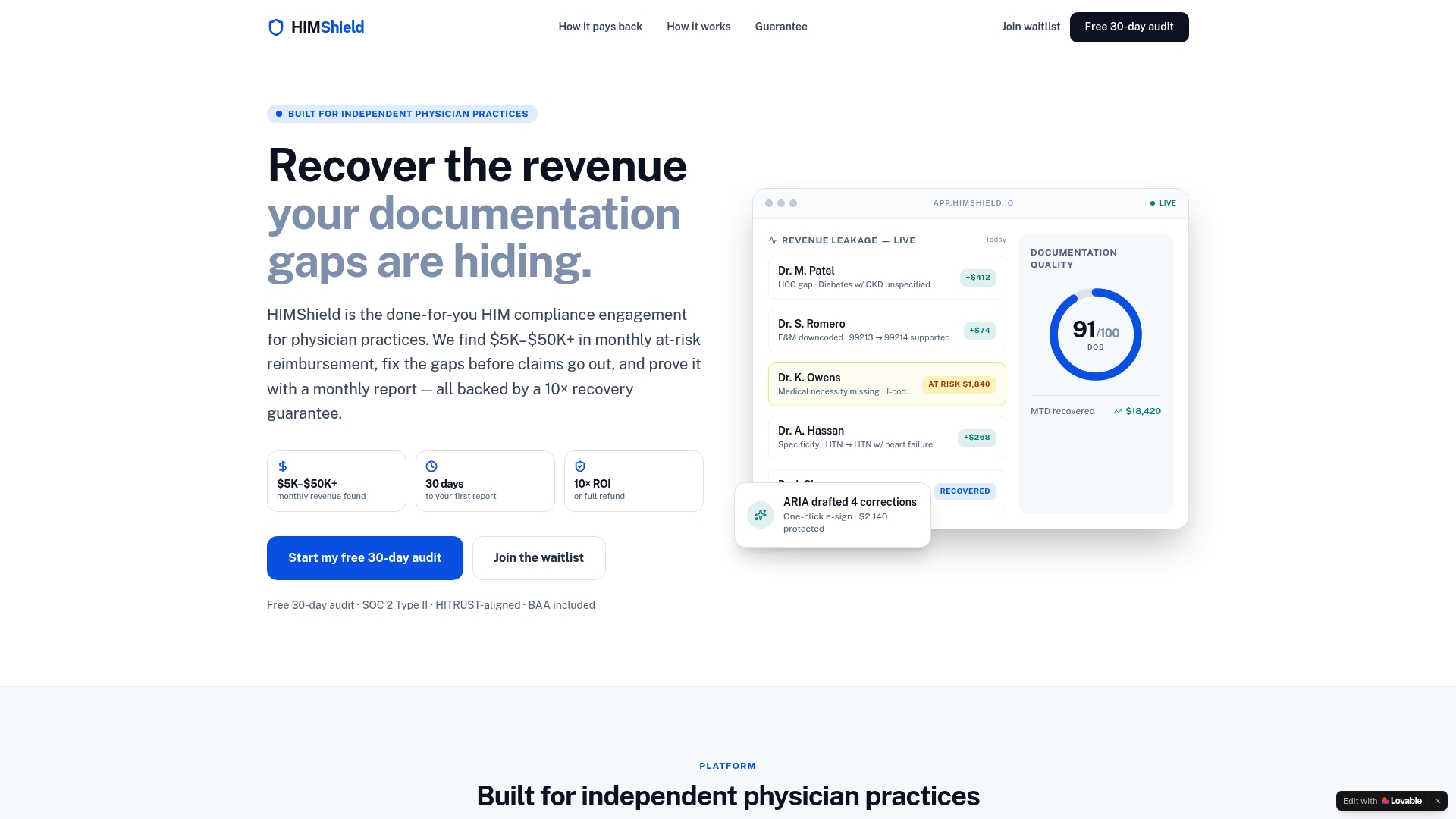
Protect your practice before the next audit. Himshield scans your documentation and query processes to identify coding and charge-capture risks automatically. Recover hidden revenue and build the compliance defense your practice needs, starting today.