
Revenue leakage in independent medical practices is the avoidable loss of earned revenue through specific operational and billing failures. Independent practice revenue leakage examples range from unworked denied claims to payer underpayments that post as zero-balance transactions and never trigger an alert. Practices lose 13%–18% of gross revenue annually to these preventable gaps. For a practice billing $150,000 per month, that translates to $216,000–$420,000 in losses every year. The industry term for closing these gaps is revenue integrity, and it starts with knowing exactly where the money disappears.
1. What are the top independent practice revenue leakage examples?
Revenue leakage falls into six distinct categories, each with a measurable financial footprint. Understanding all six is the first step toward recovering what your practice has already earned.
- Denial leakage. Unworked denied claims account for roughly 45% of total leakage. This is the largest single source of lost revenue.
- Undercoding. Billing lower-complexity codes than documentation supports causes 25%–30% revenue loss in many practices.
- Charge capture failures. Services delivered but never billed represent 3%–5% of services lost, equaling roughly $72,000 per year in a mid-size practice.
- Uncollected patient balances. Practices collect only 55%–65% of patient-owed amounts, writing off 35%–45% as uncollected.
- Payer underpayments. Claims paid below contracted rates affect 2%–7% of adjudicated claims and rarely trigger any alert.
- Timely filing write-offs. Late submissions account for roughly 1.2% of gross charges and are nearly impossible to recover once the deadline passes.
Each category bleeds revenue quietly. The practices that recover the most are the ones that track all six, not just denials.
2. How do claim denials and appeals cause revenue leakage?

Denials are the most visible form of revenue loss, but visibility does not mean they get fixed. 35% of denied claims are never reworked, converting temporary rejections into permanent write-offs. Across U.S. providers in 2025, denied amounts produced $48.4 billion in net revenue loss. Only about 42% of appealed denials are overturned, which means the majority of rework still fails.
The root cause is almost always a front-end error. Front-end failures such as missed eligibility verification or absent prior authorizations create a chain reaction. That chain turns a five-minute administrative task into an aging, uncollected account. Common denial triggers include:
- Insurance eligibility not verified at scheduling
- Missing or expired prior authorizations
- Medical necessity documentation gaps
- Incorrect patient demographic data
- Duplicate claim submissions
Pro Tip: Run eligibility checks at the time of scheduling, not just at check-in. Catching coverage issues 48 hours before the appointment eliminates the most common denial trigger before the claim is ever submitted.
Reactive denial management, chasing claims after they are rejected, costs more staff time and recovers less money than preventing the denial in the first place. The MGMA data consistently shows denials as the top revenue-cycle leak reported by independent practices. Shifting resources upstream is the most direct path to reducing claim denials and protecting earned revenue.
3. What role does undercoding play in revenue leakage?
Undercoding is the practice of billing a lower-level code than the clinical documentation actually supports. The most common example in primary care is billing a 99213 office visit when the documentation clearly supports a 99214. That single coding error costs approximately $38 per Medicare encounter. Across hundreds of visits per month, the cumulative loss is significant.
A family medicine practice billing case study found that correcting E/M coding patterns recovered over $280,000 annually without adding a single new patient. That recovery came entirely from billing what the documentation already supported. Undercoding also extends beyond office visits to missed billable services such as Chronic Care Management (CCM), Annual Wellness Visits, and transitional care codes that go unbilled because no one flagged the eligibility.
Key undercoding risks to audit regularly:
- E/M level selection in office and outpatient visits
- Chronic Care Management (CCM) enrollment and monthly billing
- Preventive services billed with the wrong modifier
- Procedure codes missing from the encounter due to charge capture gaps
- Incident-to billing errors that reduce the allowable rate
Pro Tip: Schedule a coding review every six months using a sample of 20–30 charts per provider. Compare billed codes against documentation complexity. A single review cycle routinely surfaces $10,000–$30,000 in recoverable undercoded revenue.
Updated E/M guidelines from the American Medical Association took effect in 2021 and again in 2023, shifting complexity weighting toward medical decision-making. Many practices never updated their coding habits to match. That gap between documentation and billing is pure, recoverable revenue.
4. How do charge capture errors, patient balances, and payer underpayments drain revenue?
These three leakage types share one trait: they are largely invisible in standard billing reports. Charge capture gaps, uncollected patient balances, and payer underpayments do not generate denial notices. They simply reduce the revenue that posts to your ledger.
| Leakage Type | Typical Rate | Monthly Loss (at $150K billed) | Recoverable? |
|---|---|---|---|
| Charge capture gaps | 3%–5% of services | ~$6,000 | Yes, with workflow audits |
| Patient balance write-offs | 35%–45% of balances | $5,850–$8,100 | Partially, with collections improvement |
| Payer underpayments | 2%–7% of paid claims | ~$4,200 at 3% rate | Yes, with contract variance audits |
Charge capture failures happen when a service is delivered but never entered into the billing system. A provider performs a joint injection, a nurse administers a vaccine, or a care coordinator completes a CCM call. If the charge is not captured before the encounter closes, the revenue is gone. At 3%–5% of services, that equals roughly $72,000 per year for a practice billing $150,000 monthly.
Patient balances are a growing problem as high-deductible health plans shift more cost to patients. Practices that collect only at checkout and send one statement recover far less than those with structured follow-up protocols. Patient balances of 300 patients per month at a $45 average represent $5,850–$8,100 in monthly unrecovered revenue when collection rates fall below 65%.
Payer underpayments are the most dangerous of the three. Underpayments post as zero-balance transactions, meaning the claim appears resolved in your billing system. No alert fires. No worklist item appears. The practice accepts the payment and moves on, unaware that the payer paid $12 less than the contracted rate on every physical therapy code for six months.
Pro Tip: Reconcile your electronic remittance advices (ERAs) against your contracted fee schedules for your top 10 CPT codes per payer, quarterly. This single audit step surfaces the majority of underpayment patterns before the appeal window closes.
5. What operational strategies prevent and recover revenue leakage?
Recovering 3%–5% of net patient revenue currently lost to leakage requires no new patients and no new providers. It requires better operational discipline applied to the revenue cycle you already have. The following strategies address leakage at every stage.
- Front-end eligibility verification. Use real-time eligibility tools at the scheduling stage, not just at check-in. Proactive eligibility scrubbing prevents the chain reaction that turns front-desk errors into denied claims and bad debt.
- Claim scrubbers before submission. Automated claim scrubbers catch coding errors, missing modifiers, and duplicate submissions before the claim leaves your system. This reduces first-pass denial rates without adding staff.
- Contract variance audits. Compare ERA payments against contracted rates for your highest-volume CPT codes per payer. File appeals within contract windows rather than accepting partial payments at face value.
- Provider coding education. Regular education on E/M documentation requirements and updated AMA guidelines reduces undercoding without requiring a full audit cycle every time guidelines change.
- Revenue integrity as a dashboard metric. Track denial rate, underpayment rate, charge capture rate, and patient collection rate as executive-level metrics. These numbers belong on your monthly financial review, not buried in a billing report.
- HIM compliance integration. Health Information Management (HIM) practices, including documentation audits and coding accuracy reviews, close operational gaps that billing software alone cannot detect. The role of HIM in revenue integrity is often underutilized in independent practices.
The shift from reactive to proactive is the single most impactful change an independent practice can make. Denial management after the fact costs more and recovers less than preventing the error at the source.
Key Takeaways
Independent practices lose 13%–18% of gross revenue annually to preventable billing failures across six distinct leakage categories, all of which are recoverable with targeted operational changes.
| Point | Details |
|---|---|
| Denials drive the most leakage | 45% of revenue leakage comes from denials; 35% of denied claims are never reworked. |
| Undercoding is quietly costly | Billing 99213 instead of 99214 loses $38 per Medicare visit; one practice recovered $280K annually by fixing this. |
| Payer underpayments go undetected | Underpayments post as zero-balance transactions and require ERA-to-contract audits to surface. |
| Front-end prevention beats denial management | Eligibility verification at scheduling stops the chain reaction before a claim is ever submitted. |
| Revenue integrity is an executive metric | Denial rate, charge capture rate, and underpayment rate belong on your monthly financial dashboard. |
Why most practices fix the wrong problem first
The conventional advice is to work your denial queue harder. I have seen practices hire additional billing staff specifically to chase denied claims, and their denial rate stays flat because the root cause is upstream. The denials keep coming because eligibility is still not being verified at scheduling, and prior authorizations are still being requested the morning of the procedure.
The leakage categories that deserve more attention are undercoding and payer underpayments. Both are invisible in standard billing reports. Both require a deliberate audit to surface. And both can be addressed without adding a single patient to your schedule. A practice that corrects its E/M coding patterns and runs quarterly ERA reconciliations is doing more for its financial health than one that added two FTEs to work denials reactively.
Protecting practice revenue is not a billing department issue. It is an operational leadership issue. The practices that treat revenue integrity as a clinical quality metric, something measured, reviewed, and improved monthly, recover significantly more than those that treat it as a back-office function. The revenue is already there. The work is in finding it.
— Elena
Himshield identifies your revenue gaps before they become permanent losses
Independent practices that want to close revenue leakage without adding staff or patients need a tool that works inside their existing workflow. Himshield connects directly to your EHR and runs automated audits across coding, documentation, and charge capture to surface the gaps that standard billing software misses.
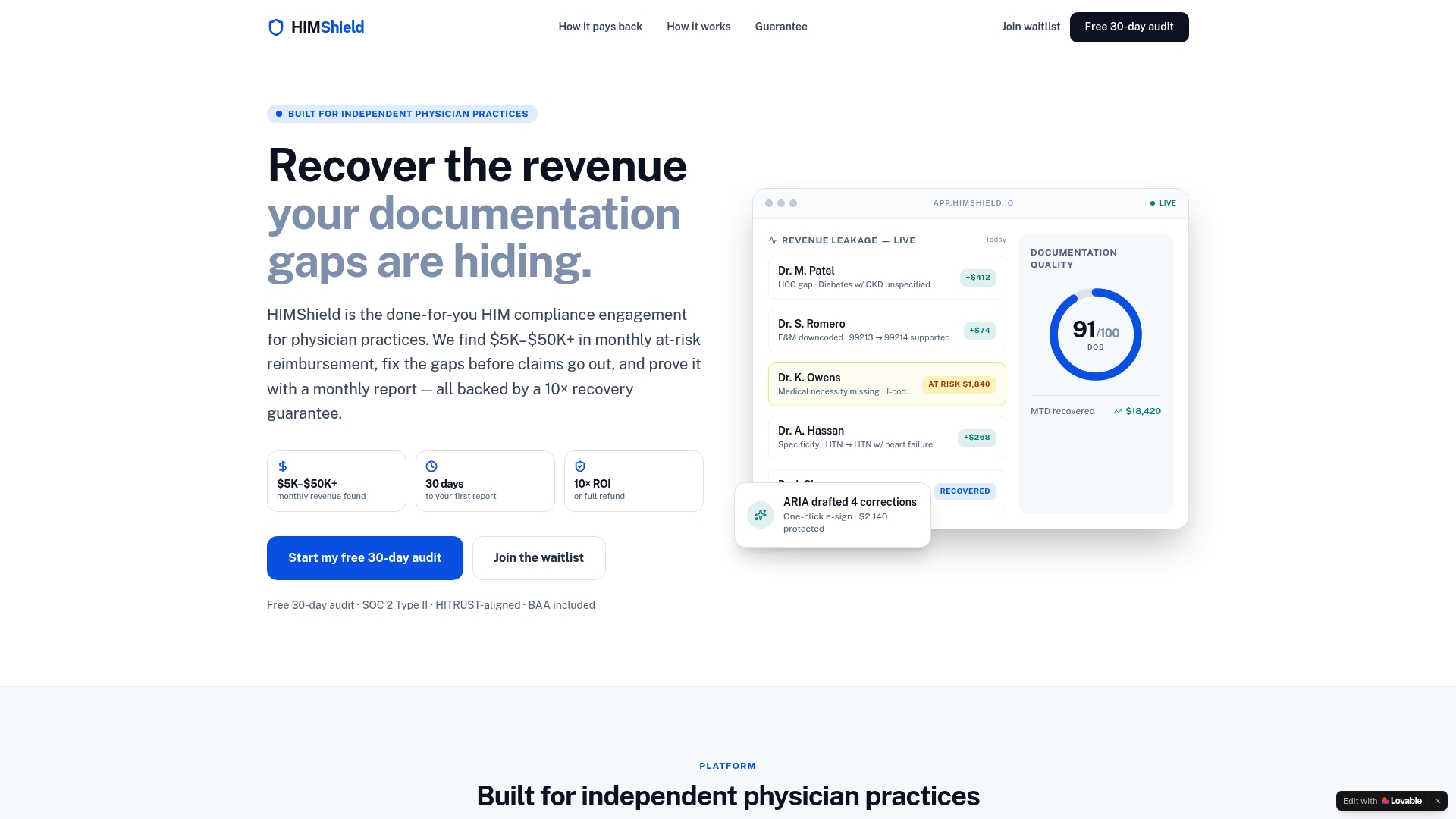
Himshield quantifies your at-risk reimbursement across all six leakage categories and delivers physician-friendly guidance on exactly what to fix. Practices typically recover $5K–$50K+ in hidden revenue within the first audit cycle. For practices that want to understand the full process, the how it works page walks through EHR connectivity and the 30-day discovery timeline. Your earned revenue is already in your records. Himshield finds it.
FAQ
What is revenue leakage in an independent medical practice?
Revenue leakage is the preventable loss of earned revenue through billing failures, coding errors, and operational gaps. Independent practices lose 13%–18% of gross revenue annually to these avoidable sources.
What are the most common examples of revenue leakage?
The six most common examples are unworked claim denials, undercoding, charge capture failures, uncollected patient balances, payer underpayments, and timely filing write-offs. Denials account for approximately 45% of total leakage.
How do payer underpayments go undetected?
Payer underpayments post as zero-balance transactions in billing systems, so no denial alert fires. Detecting them requires reconciling electronic remittance advices against contracted fee schedules for each payer.
Can a practice recover lost revenue without adding new patients?
Yes. Practices can recover 3%–5% of net patient revenue by improving coding accuracy, charge capture workflows, and denial prevention without increasing patient volume or adding providers.
How often should a practice audit for revenue leakage?
Coding and charge capture audits should run every six months. Contract variance audits for payer underpayments should run quarterly to stay within appeal windows and recover the maximum amount.