
Clinical documentation is the legal and financial foundation that determines whether a physician practice gets paid, how much, and how fast. Every CPT code submitted to a payer must be supported by notes that prove medical necessity, capture complexity, and justify the service billed. When documentation falls short, reimbursement follows. Understanding why documentation affects reimbursement is the first step toward protecting the revenue your practice has already earned.
Why documentation affects reimbursement: the coding connection
Clinical notes dictate every coding decision a biller makes. The CPT and ICD codes assigned to a claim come directly from what the physician documented, not from what was done in the room. If the note does not capture the complexity of medical decision making (MDM), the coder defaults to a lower level code, and the practice collects less than it earned.
Incomplete or vague documentation creates three specific billing problems:
- Missing MDM elements. A note that lists a diagnosis without documenting the data reviewed, the risk assessed, or the management options considered cannot support a high-level evaluation and management (E/M) code like 99215.
- Absent medical necessity language. Payers require documentation to show why a service was clinically necessary. A note that describes what was done but not why gives auditors grounds to deny or downcode the claim.
- Unsigned or late-signed notes. CMS and most commercial payers require notes to be authenticated before a claim is submitted. Unsigned EHR entries create compliance gaps that trigger payer audit risks and potential recoupments.
Incomplete documentation leads to delayed payments, increased staff workload, and audit vulnerabilities. Each of those outcomes compounds the others: delays force rework, rework increases cost, and audit exposure raises the stakes for every claim in the queue.
Pro Tip: Train physicians to document MDM explicitly by noting the number and complexity of problems addressed, the amount of data reviewed, and the risk of complications. These three elements directly map to the 2021 AMA E/M framework still governing 2026 coding requirements.

Payers use automated pre-payment reviews to flag high-frequency billing codes as audit triggers. Practices that consistently bill the same code level regardless of patient complexity draw scrutiny. Accurate documentation is the only defense.
What are the financial impacts of poor documentation on independent practices?
Poor documentation does not just cause denials. It causes two separate revenue problems: claims that get rejected and claims that get paid at the wrong rate. Most billing teams track denials. Very few track undercoding losses buried inside accepted claims.
Independent practices with poor documentation face 15–20% claim denial rates, with substantial monthly revenue held in appeals. A practice billing $100,000 per month at an 18% denial rate traps $18,000 monthly in unresolved claims. That money is not lost yet, but recovering it costs staff time, delays cash flow, and often results in partial payment after appeals.
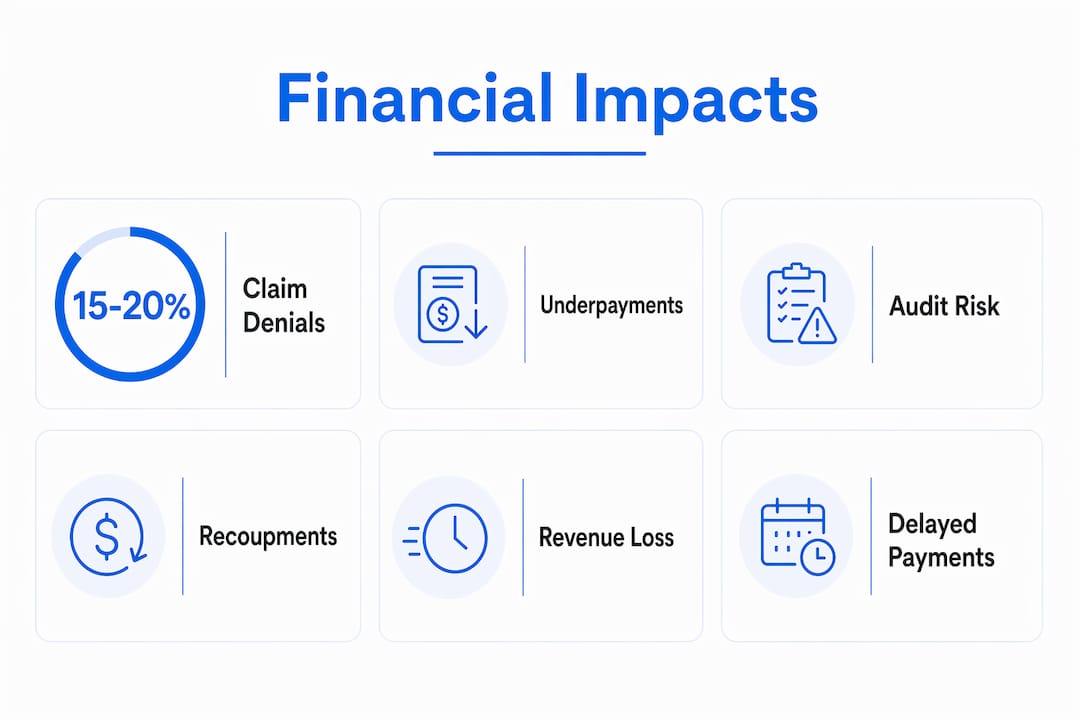
The undercoding problem is quieter and more damaging over time. Practices that undercode visits at 99213 or 99214 when documentation supports 99215 lose 8–14% of their annual E/M revenue. That loss never shows up in a denial report because the claim was accepted. The practice simply collected less than it should have, every single day, without a flag or alert.
| Revenue risk | Trigger | Financial impact |
|---|---|---|
| Claim denials | Missing medical necessity or unsigned notes | 15–20% of monthly billing held in appeals |
| Undercoding | Fear of audit or incomplete MDM documentation | 8–14% of annual E/M revenue uncaptured |
| Payer recoupments | Documentation fails retrospective audit | Repayment of previously collected funds plus interest |
| Incident-to billing lapses | Supervision not documented | Physician rate lost; APP rate applied instead |
Inadequate documentation is the main trigger for payer audits and recoupments, risking payment returns and interest charges years after the original claim. Denial rates can exceed 20% in practices with weak documentation standards. That threshold moves a documentation problem from a billing inconvenience into a financial crisis.
Administrators often underestimate documentation issues by focusing only on denied claims and ignoring undercoding losses in accepted claims. Both problems require attention, and fixing only one leaves significant revenue on the table.
What best practices improve clinical documentation to maximize reimbursement?
Improving documentation quality requires a structured approach across three areas: physician behavior, workflow design, and compliance monitoring. No single fix covers all three.
-
Align templates with 2026 coding requirements. EHR note templates should be built around the 2021 AMA E/M framework, which governs current coding. Templates that prompt physicians to document MDM elements, including the number of problems, data reviewed, and risk level, reduce the chance of a note that cannot support the code billed.
-
Train clinicians on MDM documentation. Physicians who understand medical decision making document more completely because they see the clinical logic, not just the billing requirement. Training sessions that use real claim examples from your own practice are more effective than generic compliance modules.
-
Document at the point of care. Revenue cycle begins at the point of care. Delayed or incomplete EHR notes restrict coders and slow reimbursement cycles. Physicians who complete notes before leaving the exam room give coders accurate, timely information and eliminate the query cycle that delays billing.
-
Audit billing patterns regularly. Monitoring your practice's code distribution against national benchmarks reveals undercoding patterns before they become systemic. A practice where 80% of established patient visits bill at 99213 when the specialty average is closer to 40% has a documentation problem, not a patient complexity problem.
-
Implement a clinical documentation improvement (CDI) program. CDI best practices for medical groups include concurrent review of notes before billing, targeted physician feedback, and tracking of query rates over time. CDI programs reduce denials and support higher-level coding where documentation justifies it.
Pro Tip: Healthcare experts advise viewing documentation as legal evidence of care provided, not as a billing task. That mindset shift changes how physicians approach note completion and significantly reduces audit exposure.
Incident-to billing compliance also requires strict documentation and supervision adherence. When a physician does not document the required level of supervision for an advanced practice provider (APP) visit, the practice collects the APP rate instead of the physician rate. That gap compounds across hundreds of visits per year.
How documentation practices influence the entire revenue cycle management process
Documentation quality does not affect just one step in billing. It shapes every stage of the revenue cycle, from charge capture through final payment.
The cascade works like this:
- Charge capture accuracy. A complete note gives the coder the information needed to assign the correct CPT and ICD codes on the first pass. An incomplete note forces a coder query, which delays charge entry and pushes the claim past timely filing windows in some cases.
- Clean claim submission. Claims built on thorough documentation pass payer edits at higher rates. Accurate EHR documentation reduces claim rejections and accelerates payment turnaround. Each rejection that does not happen is a billing cycle that does not get extended.
- Denial prevention. Payers deny claims when documentation does not support the service billed. Clean documentation eliminates the most common denial reason before the claim leaves the practice. The role of health information management (HIM) in revenue integrity is precisely this: catching documentation gaps before they become denial events.
- Audit defense. When a payer conducts a retrospective review, documentation is the only evidence available. Practices with complete, specific notes recover a higher percentage of challenged claims. Practices with vague or missing notes repay funds they already collected.
Revenue integrity programs that integrate documentation improvement directly into billing workflows outperform those that treat documentation as a separate clinical function. The two are inseparable. Every note a physician writes is a financial document as much as a clinical one.
Key Takeaways
Accurate clinical documentation directly determines reimbursement outcomes because it validates medical necessity, justifies coding levels, and provides the only defense against payer audits and recoupments.
| Point | Details |
|---|---|
| Documentation drives coding | CPT and ICD code selection depends entirely on what the physician documents in the clinical note. |
| Denial rates signal documentation gaps | Practices with weak documentation face 15–20% denial rates, trapping significant monthly revenue in appeals. |
| Undercoding is a silent loss | Billing 99213 when documentation supports 99215 costs practices 8–14% of annual E/M revenue. |
| CDI programs reduce risk | Concurrent documentation review and physician feedback catch gaps before claims are submitted. |
| Point-of-care completion matters | Notes completed at the time of service give coders accurate data and prevent billing delays. |
What I've learned watching practices leave revenue behind
The most consistent pattern I see in independent practices is not aggressive billing. It is excessive caution that quietly drains revenue. Physicians undercode because they fear audits. Billing teams accept denials without appealing because the rework feels overwhelming. Administrators focus on denial reports and miss the undercoding losses hiding inside every accepted claim.
Documentation gaps often go unnoticed for months. A practice does not receive a letter saying "you undercoded 300 visits this quarter." The revenue simply does not arrive. By the time the pattern surfaces, the loss is already baked into the budget as a baseline.
The mindset shift that actually changes outcomes is treating every clinical note as legal evidence, not a billing form. When physicians understand that their documentation is the only proof a service occurred at the level billed, they write differently. They include the reasoning, not just the result. That change alone can recover meaningful revenue without changing a single billing process.
Billing professionals who bring code distribution data to physician conversations, rather than compliance warnings, get faster results. Show a physician that their 99213 rate is twice the specialty average and that their own notes often support 99215. That conversation is specific, non-threatening, and financially concrete. It works.
— Elena
Himshield identifies the documentation gaps costing your practice revenue
Independent practices lose revenue to documentation problems every day, and most of it never shows up in a denial report. Himshield connects directly to your EHR and scans for coding, documentation, and charge-capture risks before they become denials or audits.
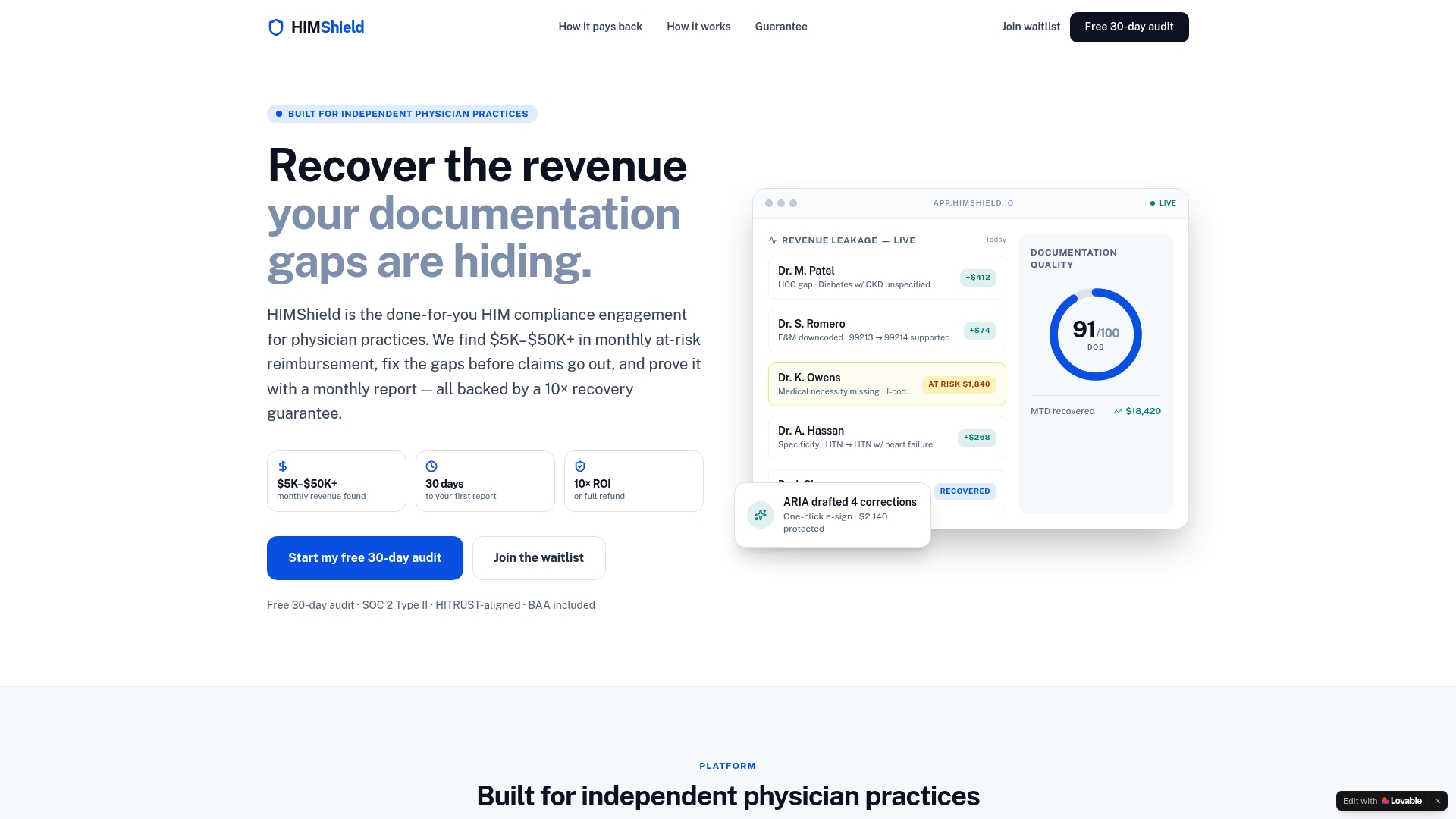
The platform flags undercoding patterns, missing MDM elements, and incident-to compliance gaps across your actual claims data. Practices using Himshield typically identify $5K–$50K+ in at-risk reimbursement within the first 30 days. If you want to see exactly where your documentation is costing you money, learn how it works or visit Himshield to get started.
FAQ
Why does documentation affect reimbursement so directly?
Payers reimburse based on what is documented, not what was done. If a clinical note does not support the code billed, the claim is denied or downcoded regardless of the actual service provided.
What is the most common documentation error that causes claim denials?
Missing medical necessity language is the leading reason payers reject claims. Documentation must explain why a service was clinically required, not just describe what was performed.
How does undercoding differ from a claim denial?
Undercoding occurs when a claim is accepted but paid at a lower rate than the documentation supports. It does not appear in denial reports, which is why practices lose 8–14% of E/M revenue to undercoding without realizing it.
What is a CDI program and how does it help reimbursement?
A clinical documentation improvement (CDI) program reviews notes concurrently with billing to catch gaps before claims are submitted. CDI programs reduce denial rates and support accurate, higher-level coding where documentation justifies it.
How does poor documentation trigger payer audits?
Payers flag billing patterns that look inconsistent with documentation standards, such as high-frequency use of specific codes without supporting clinical complexity. Inadequate documentation is the primary audit trigger, and practices found deficient face recoupment of previously paid claims plus interest.