
Fix MEAT documentation for your top HCCs and run pre-bill MEAT checks before claims go out. That single change recaptures missed risk-adjustment revenue faster than any other fix. Grounded in CMS CY 2026 guidance and AHIMA's practice brief, this approach lowers denials and audit exposure within one quarter. Tools like compliance software platforms can help practices put it into motion without adding staff.
TL;DR:
- Running pre-bill sample reviews for top HCC categories helps identify and fix documentation gaps before claims are submitted, boosting revenue recovery.
- Incorporating MEAT prompts and soft edits into templates and workflows improves documentation specificity and reduces risks of denials or audits.
- Conducting a mid-year RADV mock review ensures compliance and identifies missing or weak documentation, especially for high-dollar or high-risk conditions.
- Ongoing KPI tracking for recapture rates, audit pass rates, and query response times sustains documentation quality and revenue integrity over time.
- Prioritizing clear, current documentation of high-impact HCCs with ownership and quick provider feedback yields faster results and internal buy-in.
Table of Contents
- Priority action checklist: 8 steps to implement this quarter
- How to document MEAT in encounter notes with exact phrasing
- Workflow and EHR tactics for prompts, edits, and recapture lists
- Audit readiness and RADV: what reviewers check and how to prepare
- Monitoring, governance, and KPIs to sustain improvement
- Provider education and coder collaboration that actually sticks
- A 90-day documentation improvement approach from HIMShield
- A practitioner's view on where small practices should start
- Recover revenue with HIMShield's free Revenue Leakage Audit
- FAQ
- Sources
Priority action checklist: 8 steps to implement this quarter
HCC documentation improvement works best as a sequence, not a scramble. Assign owners to each step below and review progress every two weeks.
- Run a 30-day pre-bill sample on your top HCC categories and correct MEAT gaps before claims go out.
- Publish condition recapture lists inside the EHR for annual wellness visits and chronic care follow-ups.
- Build minimal MEAT prompts into templates for your five highest-value HCCs.
- Start weekly coder-provider huddles with five-minute, case-based tips.
- Add pre-bill soft edits that flag unspecified or low-specificity codes.
- Design a nonpunitive query workflow and track turnaround time.
- Name a single governance owner and hold a monthly KPI review.
- Schedule a mock RADV review in the third quarter, ahead of year-end recapture pushes.
A few of these steps compound quickly:
- Pre-bill sampling surfaces the exact notes that need fixing, not just the codes.
- Recapture lists stop chronic conditions from quietly disappearing off claims year over year.
- Weekly huddles turn documentation feedback into a habit instead of an annual lecture.
Pro Tip: Start with your top three HCCs by dollar impact. Fixing those first produces visible results that make the rest of the plan easier to sell internally.
How to document MEAT in encounter notes with exact phrasing
MEAT stands for Monitor, Evaluate, Assess, and Treat, and AHIMA's practice brief treats it as the backbone of compliant HCC coding. Each element needs a distinct line in the note, not a vague reference to a chronic problem.
- Monitor: "A1c 8.2% today."
- Evaluate: "Reviewed A1c trend, upward pattern noted."
- Assess: "Diabetes, uncontrolled, plan to adjust medications."
- Treat: "Increased metformin to 1,000 mg and scheduled diabetes education."
The same logic applies across high-weight conditions: diabetic nephropathy needs a stated causal link between diabetes and kidney findings, CHF needs current functional status, CKD needs a staged assessment with trend data, COPD needs exacerbation frequency, and metastatic cancer needs active treatment status, not history alone.
A diagnosis sitting on the problem list with no fresh assessment this visit often fails RADV review because reviewers look for contemporaneous evidence, not copied-forward text. RADV also expects a signed note, a clear date of service, a genuine face-to-face encounter, and specialist linkage when a manifestation code depends on it.
Workflow and EHR tactics for prompts, edits, and recapture lists
Good documentation habits stick when the EHR makes them the easy option. Template design should stay light: short, optional prompts that expand only when clicked, with specialty-specific defaults so a cardiology note and an endocrinology note do not share the same fields.
- Keep MEAT prompts to one line each, visible but not intrusive.
- Set pre-bill soft edits to flag unspecified codes and missing MEAT evidence on your top HCCs only.
- Surface recapture lists automatically during annual wellness visits and chronic care appointments.
- Limit active prompts to the top three HCCs per encounter to avoid alert fatigue.
Pro Tip: If a provider ignores a prompt three times in a row, that's a signal for a one-on-one conversation, not a louder alert.
Audit readiness and RADV: what reviewers check and how to prepare
The CMS RADV checklist lists the minimum elements reviewers expect in a valid record: a legible, signed note, a clear date of service, a genuine face-to-face encounter, and documentation from an acceptable provider type.
OIG found that diagnoses reported only on in-home health risk assessments, and HRA-linked chart reviews with no further workup, drove an estimated $7.5 billion in Medicare Advantage risk-adjusted payments for 2023. That makes HRA-only diagnoses one of the riskiest entries a practice can carry into an audit.
A mock RADV run in the third quarter gives a practice time to correct gaps before year-end recapture closes out. Choose between a full-scope random sample or a targeted sample built around your highest-dollar HCCs.
| RADV requirement | What reviewers expect |
|---|---|
| Signed note | Legible provider signature on file |
| Date of service | Matches the claim submitted |
| Face-to-face encounter | Documented visit, not a remote-only HRA |
| Provider type | Acceptable clinician type for the diagnosis |
| Specialist linkage | Required for conditions like diabetic nephropathy |
- Retain records according to CMS attestation timelines and keep specialist notes linked where a manifestation code depends on them.
- Treat an annual coding review as the natural home for scheduling your mock RADV.
Monitoring, governance, and KPIs to sustain improvement
A documentation program without metrics drifts within a few months. Track a small set of numbers and review them on a fixed schedule.
- Recapture rate: chronic conditions re-documented this year versus last year.
- Percent of sampled HCCs that pass a MEAT audit.
- Pre-bill catch rate versus post-payment recovery rate.
- Query turnaround time from coder flag to provider response.
- Coding specificity rate across your top HCC categories.
Persistent revenue leakage usually comes from small, repeated gaps rather than one large error, according to RCM-focused analysis, which is exactly why ongoing KPI tracking matters more than a one-time cleanup. Operations teams should see dashboards weekly; practice leadership needs a monthly summary tied to dollar impact, not just percentages. When a KPI slips, trace it back to a specific template, provider, or query bottleneck before assuming the whole program needs a rebuild. For more on how small gaps compound, see why documentation affects reimbursement.
Provider education and coder collaboration that actually sticks
Long compliance trainings rarely change behavior. AAPC's guidance on closing the coder-provider gap favors short, case-based formats over formal courses, and that holds true across specialties.
- Five-minute tips delivered in huddles beat hour-long annual sessions.
- One-page condition playbooks for top HCCs give providers a quick reference at the point of care.
- A nonpunitive query approach keeps providers engaged instead of defensive about feedback.
- Coder education should prioritize hierarchy logic, specificity, and linking evidence directly to the note.
Presenting audit results as a shared goal, not a scorecard, keeps the relationship collaborative. For more formats that work in practice, see why physician documentation education matters.
A 90-day documentation improvement approach from HIMShield
Some platforms are built around priorities similar to those this guide covers: fast detection, clear prioritization, and physician-friendly fixes. A 90-day clinical handoff approach can break into three phases.
- Days 1 to 30: Run a quick audit across your EHR data to quantify revenue leakage by provider and payer.
- Days 31 to 60: Fix the highest-impact MEAT and specificity gaps identified in the audit.
- Days 61 to 90: Reinforce new workflows and start tracking the KPIs covered above.
Automated risk detection and revenue leakage reports can shorten the diagnostic phase from months to weeks, and one-click physician e-signature on corrections can help providers avoid administrative burden.
Pro Tip: Treat the first 30 days as discovery only. Fixing before you measure means you can't prove what worked.

A practitioner's view on where small practices should start
When staff is limited, start with one high-dollar HCC category and fix it completely before moving to the next. Governance matters more than any single tool: a named owner who reviews KPIs monthly will outperform a practice that buys software and never checks the dashboard. Begin with a lightweight audit, pick two measurable goals, and build from there.
— Elena
Recover revenue with HIMShield's free Revenue Leakage Audit
Fixing HCC documentation on your own takes months of pulling charts and cross-checking payer rules. HIMShield's free 30-day Revenue Leakage Audit does that work for you, without adding staff or requiring new software training.
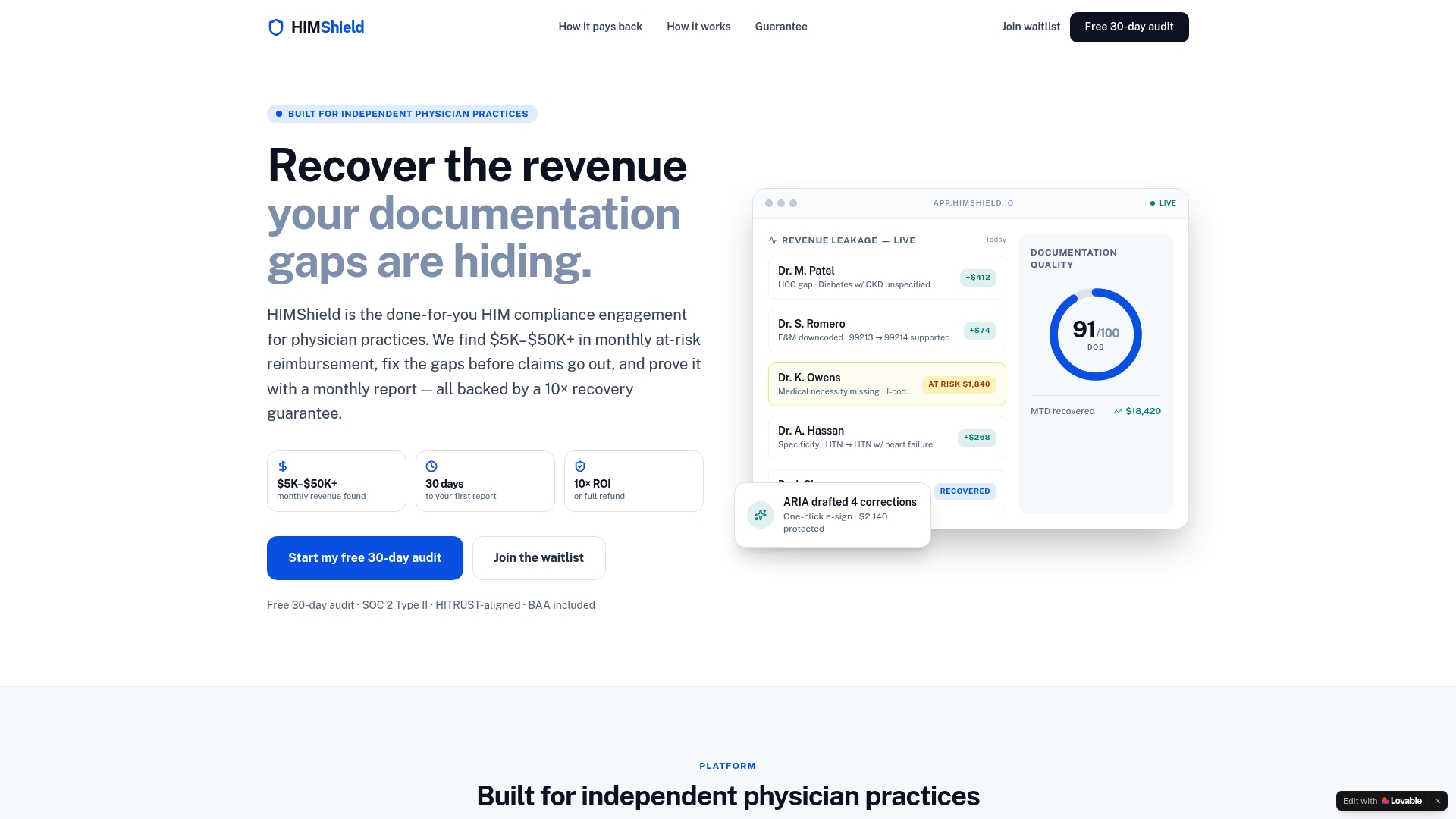
- Per-provider, per-payer revenue leakage report built from your own EHR data.
- Prioritized list of documentation and coding fixes ranked by dollar impact.
- A roadmap for applying the fixes to future encounters, not just past claims.
The audit is built for independent physician practices in the United States that want a clear, quantified starting point before committing to a full engagement. Visit HIMShield to see how the compliance engagement works after the audit, or request your free Revenue Leakage Audit today.
FAQ
What are the new HCC codes for 2026?
CMS phases in updates under the CY 2026 risk adjustment implementation memo, which covers the continued rollout of the 2024 CMS-HCC model along with updated MOR and MMR record types. Practices should review the memo directly rather than rely on secondhand code lists, since model versions and record types are still being phased in.
How do I improve HCC coding accuracy?
Focus first on MEAT documentation for your highest-value HCCs and add pre-bill checks that catch unspecified codes before claims submit, a practice AHIMA's guidance supports. Pair that with weekly coder-provider huddles so feedback reaches providers while the encounter is still fresh.
What is the average salary for an HCC coder in the U.S.?
Salary data for HCC coders specifically is not publicly listed in a way that separates it from general medical coding roles. Figures vary by region, certification, and employer, so practices should check current postings and regional coding association data rather than rely on a single national number.
What are the five C's of clinical documentation?
Definitions of the "five C's" vary by source and are not a standardized framework referenced in CMS or AHIMA guidance on HCC documentation. Practices are better served focusing on the MEAT criteria, which is the documented standard both CMS and AHIMA point to for risk adjustment accuracy.
Why do problem-list-only diagnoses fail an audit?
A diagnosis listed on the problem list without a fresh assessment that visit lacks the contemporaneous evidence RADV reviewers require. Correcting it is straightforward: document a current Monitor, Evaluate, Assess, or Treat element every time the condition is addressed, rather than letting last year's note carry forward unchanged.
Sources
- CY 2026 Risk Adjustment Implementation Information (CMS)
- Medicare Advantage: Questionable Use of Health Risk Assessments Continues To Drive Up Payments to Plans by Billions (OIG)
- Documentation and Coding Practices for Risk Adjustment and Hierarchical Condition Categories (AHIMA)