
Documentation gaps in your EHR are not a paperwork problem. They are a revenue problem, and they are fixable in weeks, not years. Undercoding, vague diagnoses, and missing charge capture quietly drain reimbursement from nearly every independent practice, and MGMA's benchmarking data confirms denials and coding errors are now the biggest leaks in the revenue cycle. Below, you'll find how to detect these gaps, prioritize the fixes, and decide when a remediation engagement pays for itself.
TL;DR:
- Most practices lose revenue mainly due to undercoding, vague diagnoses, and missing charge capture, which can be identified within days using a structured review process.
- Health practices should focus on quick operational fixes like improving documentation templates, assigning charge reconciliation ownership, and conducting frequent, targeted training to prevent recurring gaps.
- A single misstep in documentation, such as undercoding or missing orders, can cost between $30 and $50 per encounter, with revenue losses compounded over time and across many visits.
- Running a small, regular audit on high-volume providers helps detect specific documentation patterns causing the greatest revenue leakage before expanding efforts practice-wide.
- Using AI tools cautiously with pilot testing, specific go/no-go metrics, and ongoing rechecks minimizes new risks while supporting documentation accuracy improvement.
Table of Contents
- What Are the Most Common EHR Documentation Gaps?
- How Documentation Gaps Turn Into Denials and Lost Revenue
- How Do You Detect EHR Documentation Gaps Before They Cost You?
- Fixes You Can Deploy This Month
- How Do You Pilot AI Documentation Tools Without Creating New Risk?
- The Patient Safety Cost of Incomplete Documentation
- Legal and Compliance Risks Tied to Documentation Gaps
- Training Clinicians So Gaps Don't Reappear
- An Editorial Take: Treat Documentation Like a Revenue KPI
- Get a Free Revenue Leakage Audit Before You Guess at the Fix
- Sources
- FAQ
What Are the Most Common EHR Documentation Gaps?
Most independent practices lose revenue to the same handful of documentation failures, repeated across thousands of encounters. Once you know the pattern, you can find it in your own charts within a day.
Undercoding tops the list. Physicians who under-document E/M complexity, or skip the medical-necessity language a payer wants to see, routinely bill a level lower than the visit actually supports. Multiply that across a full patient panel and the loss compounds fast.
Non-specific ICD-10 documentation is the second major culprit. When a note says "abdominal pain" instead of naming the underlying condition, coders have no choice but to use an unspecified code. Payers increasingly flag those codes for review, and some deny them outright. Himshield's guide on ICD-10 specificity breaks down exactly which conditions need more granular language.
The remaining gap types show up less often individually but add up in aggregate:
- Missing orders or unsigned notes that block charge capture entirely, even when the service was performed correctly
- EHR-to-charge mapping failures, where a template update or workflow change silently stops a code from reaching the biller
- Modifier and bundling errors caused by incomplete procedure detail, especially on same-day add-on services
- Copy-paste and template overuse, which produces notes that read as complete but don't actually document what happened that visit
Each of these gap types has a different fix, which is why a blanket "document more" instruction to providers rarely moves the needle.
How Documentation Gaps Turn Into Denials and Lost Revenue
The mechanics are straightforward once you trace them. A visit gets undercoded by one E/M level, and that single encounter loses maybe $30 to $50 in reimbursement. It sounds trivial until you realize it happens on a meaningful share of visits, every week, for the life of the practice.
Missing or delayed charge posting is the second mechanism. When a charge never makes it from the note to the biller, the claim doesn't just underpay. It doesn't get submitted at all, and that revenue is effectively gone until someone catches the gap manually.
The third mechanism is the one that costs the most in staff time: documentation triggers a payer edit or outright denial. Now someone on your team has to appeal it, resubmit it, or write it off. AHIMA estimates the administrative labor to rework a single denied claim runs $25 to $118, not counting the reimbursement itself.
The scale of this is bigger than most administrators assume. MGMA's January 2026 Stat poll found denials and appeals account for 48% of all revenue-cycle leakage, with coding issues, missed modifiers, and documentation gaps as recurring contributors. A separate blinded audit of 752 inpatient discharges found that 16% had a DRG change on review, and documentation issues caused 56% of those changes.
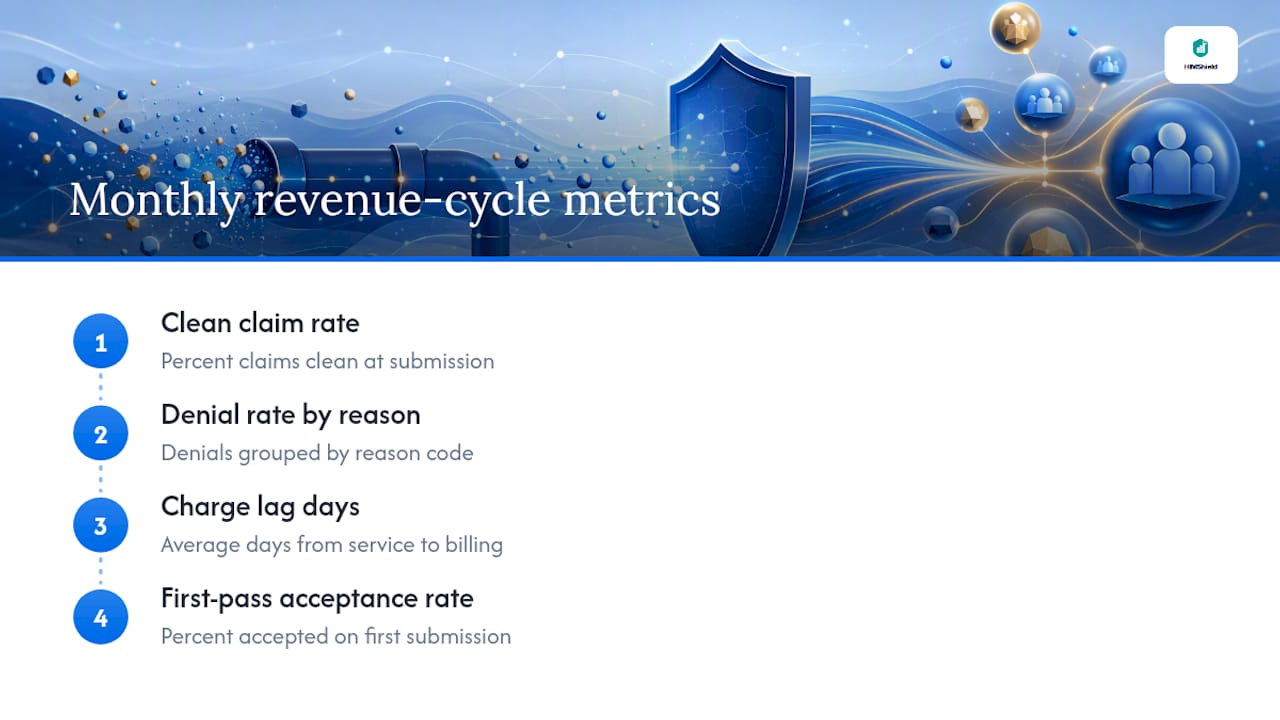
Four numbers tell you whether this is happening in your practice: clean claim rate, denial rate by reason code, charge lag days, and first-pass acceptance rate. Track those monthly and the gaps stop hiding.
How Do You Detect EHR Documentation Gaps Before They Cost You?
You don't need a large audit firm to find these gaps. A structured, repeatable process run internally, or with a compliance partner, surfaces most of them in under a week.
- Pull a random sample of 20 to 30 charts per provider, spanning at least two weeks, and compare the documented E/M level and diagnosis against what was actually billed. Flag every mismatch, not just the obvious ones.
- Sort your denials by root cause, not just by payer. Separate documentation-driven denials (missing signature, insufficient specificity) from eligibility or authorization issues. This tells you where to focus first.
- Reconcile the day's schedule against posted charges every week. Any visit that appears on the schedule but never generates a charge is a leak, and exception-based review catches it before it becomes a pattern.
- Track first-pass acceptance rate as your leading indicator. A drop here almost always shows up as a denial spike two to three weeks later.
Pro Tip: Run your first audit on your two highest-volume providers only. You'll find your biggest recoverable dollars fastest, and you'll have a template ready before you expand to the full group.
Himshield's annual coding review guide includes a cadence template if you want to build this into a quarterly rhythm rather than a one-time fire drill.
Fixes You Can Deploy This Month
Not every fix requires new software or a consulting engagement. Several of the highest-leverage changes are operational, and you can start them this week.
- Add a same-day or next-day CDI touchpoint. A quick review of charts flagged as incomplete, paired with a fast physician query process, closes gaps before the claim goes out instead of after it bounces back.
- Standardize your note templates so plan-of-care language and medical-necessity phrasing are built in, not left to memory. Himshield's medical necessity documentation examples give you exact phrasing to model.
- Assign one named owner to weekly charge-capture reconciliation. Diffusing this responsibility across the front desk and billing team is how missed charges slip through for months.
- Run monthly spot-training using your own audit examples, not generic compliance modules. Providers change behavior faster when they see their own chart flagged.
For E/M-specific gaps, the 99214 documentation checklist gives providers a nine-point reference they can use in real time.
Pro Tip: If your denial rate for a single reason code exceeds 5% of total claims, stop auditing and start fixing that one issue immediately. Broad audits are useful for discovery, but a concentrated denial pattern needs a targeted intervention, not another data-gathering round.
If internal fixes stall after two audit cycles, or if the same gap keeps reappearing across providers, that's your signal to bring in an outside remediation engagement rather than keep running the same playbook.
How Do You Pilot AI Documentation Tools Without Creating New Risk?
AI-assisted documentation and coding tools are spreading fast. MGMA reports 68% of medical groups are expanding AI use in the revenue cycle. Speed of adoption is not the same as safety, and a badly piloted tool can introduce new documentation gaps instead of closing existing ones.
- Run a parallel-coding pilot first. Have the tool code a sample of charts alongside your existing coders, stratified by specialty and by payer, before it touches a live claim.
- Set your go/no-go metrics in advance. First-pass acceptance rate, denial trend by reason code, and coder productivity without a drop in accuracy should all move in the right direction before you scale beyond the pilot group.
- Demand an audit trail. Every suggestion the tool makes should show why it made that suggestion, with a human reviewer signing off before submission, not after.
- Recheck the tool after every EHR update. Template changes and workflow tweaks break mappings quietly, and a tool that worked fine in January can start missing charges after a March upgrade.
A structured approach to AI adoption in healthcare settings applies directly here: pilot narrow, measure specifically, and expand only after the numbers hold up across more than one specialty.
The Patient Safety Cost of Incomplete Documentation
Revenue leakage is the number administrators watch, but documentation gaps carry a clinical cost too, and it shows up in ways that eventually become financial ones. A vague diagnosis or an unsigned order doesn't just confuse a coder. It creates a gap in the clinical record that the next provider, the next specialist, or the next covering physician has to work around.
Missing medication reconciliation, incomplete allergy documentation, or a plan of care that was never fully written into the chart can lead to duplicated tests, delayed follow-up, or a treatment decision made without the full picture. None of that shows up on a denial report, but it shows up in malpractice exposure and in care coordination failures that eventually surface during an audit or a lawsuit.
The connection between documentation quality and safety is direct: a chart that accurately reflects clinical reasoning gives the next clinician what they need to make a fast, correct decision. A chart padded with copy-paste text or missing key findings does the opposite, and it slows care down exactly when speed matters. Practices that treat documentation improvement purely as a billing exercise tend to miss this half of the equation, and it's often the half that surfaces first in a payer or state board review.
Legal and Compliance Risks Tied to Documentation Gaps
Documentation gaps expose a practice to more than a denied claim. Unsigned orders, missing medical-necessity language, and inconsistent notes are exactly what payer audits and government reviews look for first, because they're objective and easy to flag.
A pattern of undercoding can look defensible in isolation, but a pattern of upcoding relative to documentation, even unintentional, is what triggers a formal payer audit or a False Claims Act inquiry. The gap between what was documented and what was billed is the single most common finding in post-payment reviews, and it's the finding that turns a routine audit into a repayment demand with interest.
Incomplete records also weaken your position if a claim denial escalates to appeal. Payers request the note, and if the note doesn't support the code, the appeal fails regardless of whether the care itself was appropriate. That's a compliance risk sitting on top of a revenue risk, and the two compound each other. Practices that keep clean, specific, signed documentation as a standing habit are the ones that come through a payer audit with a request for clarification instead of a repayment demand.
Training Clinicians So Gaps Don't Reappear
Training only works when it's specific, recurring, and tied to real chart examples instead of generic compliance slides nobody remembers a month later. The practices that keep documentation quality high long term build training around three habits.
First, make feedback fast and personal. A provider who sees their own flagged chart within days of the visit, alongside the specific language that would have supported a higher code or avoided a denial, corrects the behavior far faster than one who receives a quarterly summary report. Himshield's guide on physician documentation education covers why timing matters as much as content.
Second, train on patterns, not incidents. If three providers are all under-documenting the same diagnosis category, that's a template or workflow problem, not three individual mistakes, and the fix belongs at the system level.
Third, tie training to the KPIs your practice already tracks. When providers understand that a specific documentation habit connects directly to denial rate or clean claim rate, the training stops feeling like compliance theater and starts feeling like something that protects their own compensation.
An Editorial Take: Treat Documentation Like a Revenue KPI
Most practices audit documentation once a year and call it compliance. That's backwards. Documentation quality should sit on the same monthly dashboard as collections and AR days, with one person accountable for it the way someone owns billing.
Small, frequent audits beat large annual ones every time, because they catch drift before it becomes a pattern across dozens of charts. Training tied to a provider's own flagged examples changes behavior faster than any generic module ever will.
— Elena
Get a Free Revenue Leakage Audit Before You Guess at the Fix
Running your own audit takes staff time you may not have, and guessing which gap type is costing you the most money means you're fixing the wrong thing first. Himshield's Free 30-day Revenue Leakage Audit gives you what a manual chart pull can't: a quantified, per-provider, per-payer breakdown of exactly where documentation is costing you reimbursement, delivered without adding new staff or software training to your plate.
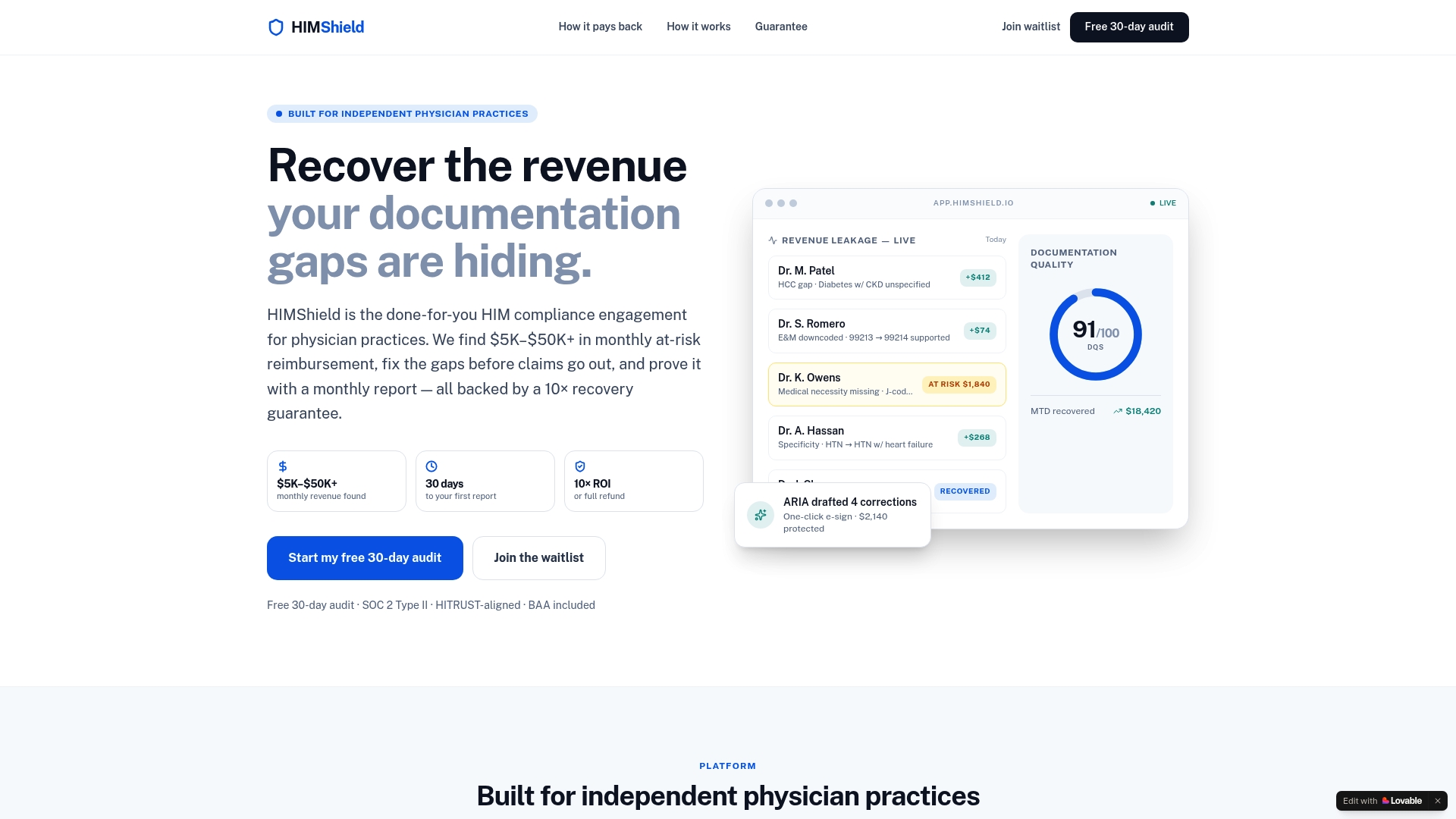
The audit identifies your highest-revenue gaps first, whether that's undercoding on a specific provider's E/M visits, a charge-capture mapping break after your last EHR update, or a denial pattern tied to one payer's edits. You get a prioritized list of fixes, not a generic compliance report. If your internal fixes have stalled through two audit cycles, or if you'd rather see the quantified numbers before committing staff time to chasing them, an external pass makes more sense than another round of guesswork.
If the audit uncovers ongoing risk that needs continuous monitoring rather than a one-time fix, Himshield's HIM compliance engagement picks up where the audit leaves off. Start with the free 30-day audit and see the number before you decide what to fix.
Sources
The MGMA Stat poll on revenue-cycle leaks, the inpatient DRG audit study, and TMS Billings' documentation error breakdown back the figures cited above. iRCM's revenue leakage analysis offers additional context on typical recovery ranges.
- Detecting and fixing leaks across the revenue cycle
- Causes and consequences of miscoding and documentation quality (audit study)
FAQ
What Counts as an EHR Documentation Gap?
An EHR documentation gap is any missing, vague, or incomplete piece of clinical documentation that prevents accurate coding or charge capture, such as an unsigned order, a non-specific diagnosis, or a note that doesn't support the billed E/M level. These gaps are the direct cause of many denials and undercoded claims tracked in MGMA's revenue-cycle data.
How Much Revenue Do Documentation Gaps Actually Cost?
The exact figure varies by practice size and specialty, but a blinded audit of 752 inpatient discharges found 16% had a DRG change on review, with 56% of those changes caused by documentation issues alone. Reworking a single denied claim from a documentation error costs $25 to $118 in administrative labor, before counting the lost reimbursement itself.
How Often Should a Practice Audit Its Documentation?
Monthly spot audits on a small chart sample catch drift faster than an annual review, and they let you correct provider behavior before a pattern spreads across the group. A quarterly deeper review, paired with monthly KPI tracking on clean claim rate and denial reasons, covers most independent practices well.
Can Himshield Help Identify Documentation Gaps Specific to My Practice?
Yes. Himshield's Free 30-day Revenue Leakage Audit scans your EHR data to quantify coding, documentation, and charge-capture gaps by provider and by payer, then prioritizes the fixes by revenue impact. It's built specifically for independent practices that want quantified numbers before committing staff time to remediation.
Is Fixing Documentation Gaps Worth It if My Denial Rate Is Already Low?
Yes, because undercoding and missed charges often don't show up as denials at all. A claim that's paid at a lower level than the visit supports goes through clean, with no denial flag, which means a low denial rate can hide a steady undercoding problem that only a chart-level audit will surface.