
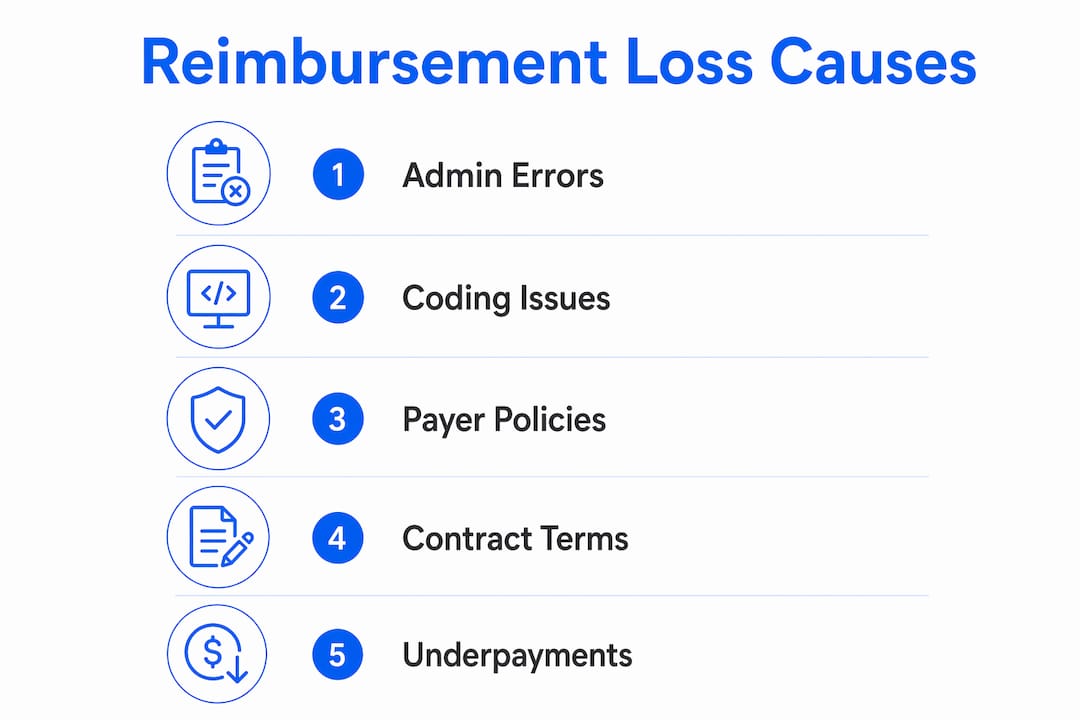
Lost reimbursement in medical practices is defined as revenue earned through patient care but never collected, due to claim denials, underpayments, or delayed payments that go unresolved. The core reasons why practices lose reimbursement are administrative breakdowns, coding inaccuracies, and payer policy gaps. Most physicians assume slow payments reflect payer delays, but slow reimbursement originates from credentialing gaps, coding errors, and submission failures inside the practice itself. Revenue leakage, the industry term for this cumulative loss, looks like normal denial volumes but adds up to significant financial damage across a fiscal year. Himshield exists specifically to detect these risks before they become denials or audits.
What administrative errors cause practices to lose reimbursement?
Administrative failures are the single largest source of lost reimbursement, and they occur before a physician ever documents a note. Most revenue loss originates from registration errors, prior authorization lapses, and insurance sequencing mistakes. These are upstream failures, and they are entirely preventable.
The most common administrative errors that trigger denials or delays include:
- Incorrect patient demographics. A transposed date of birth or misspelled name causes an immediate claim rejection. Staff must verify demographics at every visit, not just at registration.
- Eligibility not verified before service. Claims delay or deny when eligibility is not confirmed before the appointment. Real-time eligibility checks through your EHR eliminate this risk.
- Prior authorization lapses. Procedures performed without active authorization are denied outright. Tracking authorization expiration dates in a shared workflow prevents this.
- Credentialing gaps. Credentialing lapses cause claims to enter long manual review cycles with generic denial codes, wasting staff time on appeals that go nowhere.
- Insurance sequencing errors. Billing the wrong payer first, or listing primary and secondary coverage incorrectly, creates coordination-of-benefits denials that require significant rework.
Each of these errors shares one trait: they are invisible at the point of care. A physician sees a patient, delivers excellent care, and documents thoroughly. None of that matters if the claim never reaches adjudication correctly. The financial write-off that follows is not a clinical failure. It is an operational one.
Pro Tip: Run a monthly credentialing audit against your active payer roster. Credentialing gaps do not produce obvious rejection codes. They produce pended claims that age silently in your AR until they are written off.

How do coding inaccuracies and downcoding impact practice revenue?
Coding errors are the second major driver of lost reimbursement, and the most financially damaging type rarely triggers a denial. Undercoding, particularly Evaluation and Management (E/M) downcoding, causes millions in lost revenue because payments are reduced without any alert or denial notice. The practice receives a payment, assumes it is correct, and moves on.
The most financially damaging coding issues include:
- E/M downcoding by payer algorithms. Automated payer systems evaluate a limited set of documentation data points and assign a lower E/M level than the physician documented. The result is a reduced payment on a "paid" claim, with no denial to trigger a review.
- Modifier misuse. Incorrect or missing modifiers cause bundling conflicts and claim rejections. The modifier usage rules for physician billing change annually, and outdated modifier application is a consistent source of lost revenue.
- Medical necessity mismatches. A diagnosis code that does not support the procedure billed triggers a medical necessity denial. This is a documentation problem as much as a coding problem.
- Telehealth coding errors. Telehealth-related coding denials increased 84% from 2024 to 2025, while outpatient coding denials rose 26% over the same period. Telehealth billing rules remain a high-risk area in 2026.
That 84% increase in telehealth denials is not a coincidence. Payer policies for virtual care billing have changed repeatedly, and practices that have not updated their coding workflows are absorbing the financial impact silently.
Pro Tip: Pull a quarterly report of your E/M code distribution by provider. If one physician consistently bills at lower complexity levels than peers with similar patient panels, that is a downcoding signal worth investigating before it compounds.
Clinical documentation improvement, or CDI, is the standard industry approach to closing the gap between what physicians document and what coders can accurately bill. CDI best practices for medical groups focus on real-time documentation feedback rather than retrospective chart review, which is far more effective at preventing coding revenue loss.
What are the effects of payer policies and contract terms on reimbursement?
Payer behavior creates a category of revenue loss that most practices never measure. The most deceptive form is the contractual underpayment. An Explanation of Benefits (EOB) marked "paid" bypasses denial workflows entirely. EOBs marked "paid" often mask contractual underpayments that are never reviewed for rate accuracy. The practice accepts the payment, and the gap between what was owed and what was paid disappears into the general ledger.
The table below outlines the most common payer-driven causes of reimbursement loss and their typical financial impact on independent practices.
| Payer-driven issue | Financial impact |
|---|---|
| Contractual underpayments on "paid" claims | Hidden revenue loss with no denial trigger |
| E/M downcoding by automated algorithms | Reduced payment per visit, compounding over time |
| Retroactive denials and clawbacks | Unexpected balance sheet adjustments months later |
| Flat reimbursement rates over multiple years | Effective rate reduction as costs rise |
| Manual review cycles from credentialing gaps | Delayed cash flow and increased write-off risk |
Retroactive denials deserve specific attention. A payer may audit a prior period and recoup payments already received, creating a cash flow disruption that is difficult to forecast or defend without strong documentation. Practices that track underpayment data systematically are better positioned to identify these patterns and use the data as leverage in contract renegotiations. Treating underpayment as a one-time cleanup project misses its strategic value entirely.
Understanding how payer mix affects revenue is equally important. A practice heavily weighted toward payers with aggressive downcoding algorithms faces structurally lower reimbursement regardless of coding accuracy. That is a contract problem, not a billing problem.
What practical steps can practices take to prevent reimbursement loss?
Prevention is more cost-effective than rework. Effective prevention shifts focus from fixing denied claims to controlling the conditions that produce them. The following steps address the root causes described throughout this article.
- Verify eligibility before every visit. Real-time eligibility verification through your EHR eliminates the most common source of immediate claim rejections. Build this into the scheduling workflow, not just check-in.
- Mandate claim edit resolution before submission. No claim should leave your system with an unresolved edit. Requiring staff to clear all edits before submission catches sequencing errors, missing modifiers, and demographic mismatches at the lowest-cost point in the cycle.
- Conduct quarterly credentialing audits. Cross-reference your active provider roster against each payer's credentialing database every quarter. Gaps surface before they generate pended claims.
- Implement documentation templates tied to payment rules. Templates that reflect current E/M guidelines and medical necessity criteria reduce the gap between what physicians document and what payers require. This is the core of CDI.
- Track underpayments and use the data in contract negotiations. Every underpayment you identify and quantify becomes evidence in your next payer negotiation. Underpayment recovery is most effective when treated as a strategic tool, not a billing correction.
- Train staff on annual coding changes. CPT updates, E/M guideline revisions, and telehealth billing rules change every year. Staff who are not current on these changes produce denials that are entirely avoidable.
- Use technology to detect risk before submission. Platforms like Himshield scan claims for coding, documentation, and charge-capture risks before they reach the payer. Early detection eliminates the cost of rework and the revenue loss from denied claims.
Pro Tip: Build a denial reason code log and review it monthly. Patterns in denial codes reveal systemic problems. Three denials for the same modifier error in one month signal a training gap. Ten underpayments from the same payer in one quarter signal a contract problem.
Reducing claim denials requires a structured process, not just individual vigilance. The steps to reduce claim denials in physician practices combine upstream controls with denial tracking to create a feedback loop that improves over time.
Key Takeaways
Practices lose reimbursement primarily through administrative errors, coding inaccuracies, and undetected payer underpayments, all of which are preventable with upstream controls and systematic tracking.
| Point | Details |
|---|---|
| Administrative errors drive most denials | Registration mistakes, eligibility failures, and credentialing gaps cause the majority of preventable claim denials. |
| E/M downcoding is silent revenue loss | Undercoded claims are paid at reduced rates with no denial alert, making them the hardest losses to detect. |
| "Paid" EOBs can hide underpayments | Claims marked paid often contain contractual shortfalls that bypass denial workflows entirely. |
| Prevention beats rework every time | Upstream controls like claim edit mandates and documentation templates cost far less than reworking denied claims. |
| Underpayment data has negotiation value | Tracking underpayments systematically gives practices leverage in payer contract renegotiations. |
The case for fixing the process, not just the claim
After years of working with independent physician practices on revenue integrity, the pattern I see most often is this: practices invest heavily in denial management and almost nothing in denial prevention. They build teams to appeal claims that should never have been denied in the first place. The math never works in their favor.
The uncomfortable truth is that most revenue loss is not dramatic. It does not show up as a large denial that triggers an urgent response. It accumulates in small increments: a modifier missed here, an underpayment accepted there, a credentialing gap that ages silently in the AR. By the time the total is visible, months of revenue have already been written off.
What I have found actually works is treating the billing workflow as a quality control process, not a transaction process. That means measuring what leaves your system before it reaches the payer, not just what comes back denied. It means tracking underpayments with the same rigor you apply to denials. And it means feeding that data back into your payer contracts, because the practices that negotiate from data consistently outperform those that negotiate from intuition.
The practices that recover the most revenue are not the ones with the largest billing teams. They are the ones that catch problems earliest.
— Elena
How Himshield helps practices recover hidden revenue
Independent practices that have addressed their most obvious denial sources often find a second layer of revenue loss hiding in underpayments and coding gaps that standard billing workflows never surface.
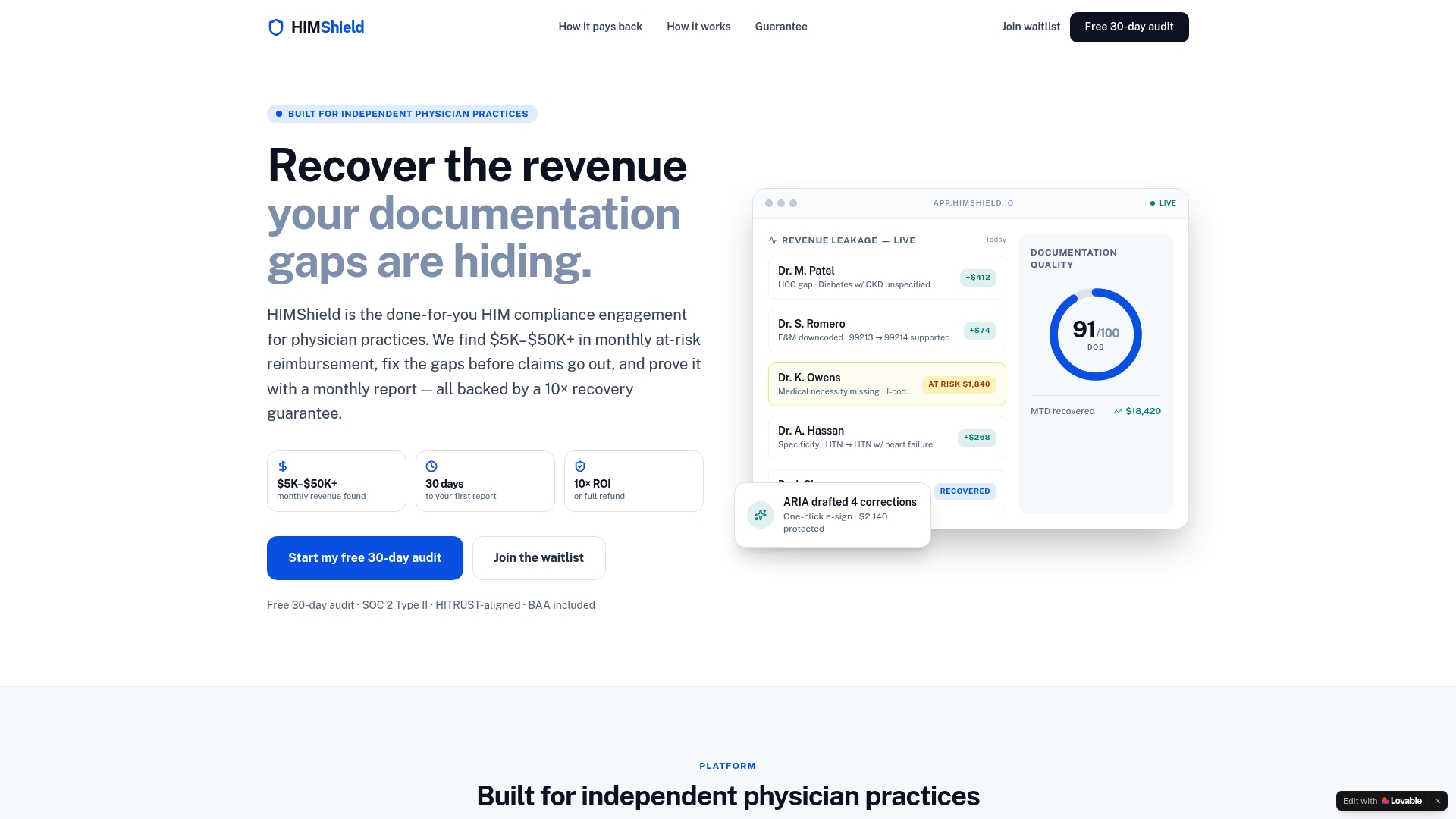
Himshield connects to your EHR and scans claims for coding, documentation, and charge-capture risks before submission. The platform identifies underpayments on "paid" claims, flags E/M downcoding patterns, and delivers physician-friendly guidance that your team can act on immediately. Practices using Himshield typically recover $5K–$50K+ in hidden revenue within the first 30 days. If you want to see exactly how the platform fits your workflow, the Himshield how-it-works page walks through the full process from EHR connection to revenue recovery.
FAQ
What is the most common reason practices lose reimbursement?
Administrative errors, including incorrect patient demographics, eligibility failures, and prior authorization lapses, are the most common cause of lost reimbursement. These failures occur before clinical documentation is a factor and are entirely preventable with upstream workflow controls.
What is E/M downcoding and why does it matter?
E/M downcoding occurs when a payer's automated algorithm assigns a lower Evaluation and Management code level than the physician documented, reducing the payment without issuing a denial. Because no denial is generated, the revenue loss goes undetected unless the practice actively audits payment rates against contracted amounts.
How do underpayments differ from denials?
A denial is a claim rejected by the payer and returned for correction or appeal. An underpayment is a claim paid at a rate below the contracted amount, with no alert or denial code. Underpayments are harder to detect because they appear as accepted payments in the practice's AR system.
Can tracking underpayments improve payer contracts?
Tracking underpayment data systematically gives practices documented evidence of payer shortfalls, which is a direct negotiation tool in contract renegotiations. Practices that approach underpayment as a strategic data asset consistently achieve better contract terms than those that treat it as a billing correction task.
How often should practices audit their coding for revenue leakage?
Quarterly coding audits are the standard recommendation for independent practices. Telehealth coding denials rose 84% from 2024 to 2025, which means practices that audit annually are already a full year behind on the most active denial category in 2026.