
Encounter data integrity means every patient visit record in your EHR is complete, accurate, consistent, and timely, and that nobody can change it without a trace. For an independent practice, that is what keeps claims clean, risk-adjusted payments correct, and audit responses defensible. This guide covers what the term means, where integrity breaks down, which checks catch problems before submission, and how to keep quality steady over time.
TL;DR
- Encounter data is high quality when it is complete, accurate, consistent, and timely. Test your records against those four criteria.
- Most integrity failures start at the chart: missing specificity, copied text, unsigned notes, and conflicting entries.
- Prevent errors at workflow checkpoints instead of fixing them after submission. Audit trails and routine, random chart audits make this work.
- During a payer audit, records cannot be changed or amended, so timely completion and authentication are your best defense.
- Track a few internal metrics, trend them, and feed the findings back to providers and staff.
Table of Contents
- What encounter data integrity means in a physician practice
- Why it matters to an independent practice
- The most common integrity problems
- Checks that confirm records are accurate, complete, consistent, and timely
- Fix errors before claims go out
- What changes when payers or CMS validate your data
- Monitor quality over time
- See your own encounter data gaps in 30 days
- FAQ
- Sources
What encounter data integrity means in a physician practice
An encounter record is the data behind one patient visit: who was seen, by whom, when, what was done, and why. That data feeds your claims, your quality reporting, and, if you see Medicare Advantage or Medicaid managed care patients, the encounter submissions plans send to CMS.
CMS and Mathematica's validation toolkit for Medicaid managed care defines high-quality encounter data with four traits:
- Complete: all services are captured and transfers succeed.
- Accurate: the record reflects the correct service, date, enrollee, provider, and payment.
- Consistent: related elements align and common formats are used.
- Timely: data meet submission deadlines.
That toolkit is written for state Medicaid programs, but the four traits translate directly to a practice. They give you a plain test for any chart: is anything missing, is anything wrong, does anything contradict itself, and was it finished on time?
Integrity also has a second meaning that HIM professionals know well: the record is trustworthy as a record. AHIMA treats auditability as part of that. Without a reliable audit trail, an organization may not know who changed a record, when, or what changed. Both meanings matter to your revenue.
Why it matters to an independent practice
Weak encounter data shows up in three places:
- Denials and rework. Missing or conflicting elements cause rejected claims. Staff time goes into resubmission instead of collections.
- Under-capture. If a diagnosis is nonspecific or a service is undocumented, it never reaches the claim. That is revenue leakage: money earned and never billed. Our guide to EHR documentation gaps that drain independent practices shows where it tends to hide.
- Audit exposure. When a payer asks for records, the chart has to stand on its own. Gaps found at that point are very hard to repair.
CMS states the purpose plainly for Medicare Advantage: encounter data is meant to give complete and accurate data so CMS can measure risk and set payments accurately. If your documentation does not support the diagnoses and services submitted on your behalf, both your payer relationships and your payments carry the risk.
The most common integrity problems
The research from CMS and AHIMA points to a short list of recurring failures.
Gaps in clinical documentation
AHIMA's physician-office query guidance lists the situations that most often need clarification. They are missing or nonspecific diagnoses, insufficient specificity or severity, conflicting or incomplete documentation, unsupported treatment diagnoses, unclear acuity, unclear medical decision-making, and missing follow-up instructions.
Every item on that list changes what can be coded, and therefore what can be billed or reported. A "diabetes" note without type or complication, for example, tells a coder very little. For a deeper look at how this plays out in risk adjustment, see our 90-day HCC documentation plan.
Basic record elements left out
CMS's E/M documentation guidelines say the medical record should be complete and legible. Each encounter should include the reason for the encounter, relevant history, exam findings and prior test results, assessment or diagnosis, a care plan, the date, and a legible identity of the observer. Those are the 1997 guidelines, but they remain the baseline checklist many auditors still refer to.
If you bill 99214 regularly, the same logic applies at the code level. Our 9-point documentation checklist for 99214 and our medical necessity documentation examples show what complete looks like in practice.
Uncontrolled copy-and-paste
CMS's EHR decision table flags copy-and-paste as an integrity risk because it can remove original-source information. The same document says each encounter should be treated as a stand-alone record. Documentation should reflect the service actually delivered and the payer's billing requirements. Entries not solely authored by the user should be validated with name, date, time, and source.
Practically, that means a note should never look identical to last month's note unless the patient's situation truly is identical, and anything imported from another author should be identifiable.
Unexplained swings in the numbers
At the population level, CMS's Protocol 4 says large unexplained utilization swings or departures from benchmarks may indicate incomplete or erroneous encounter data rather than a real change in practice patterns. You can use the same instinct internally. If one provider's visit mix, diagnosis counts, or service volume jumps for no clinical reason, look at the charts before assuming the change is real.
Checks that confirm records are accurate, complete, consistent, and timely
CMS's validation protocol for managed care encounter data analyzes service and processing dates, provider types, utilization relationships, age- and sex-appropriate diagnoses and services, and fluctuations against benchmarks. It also recommends medical-record review to confirm what the analytics find. In other words, validation is not one pre-submission edit. It combines automated checks, benchmark comparisons, and targeted chart review.
You can apply that model at practice scale:
| Criterion | Question to ask | Example check |
|---|---|---|
| Complete | Is every service captured and every required element present? | Compare scheduled visits, charted notes, and billed charges for the same day |
| Accurate | Do the date, patient, provider, and service match what happened? | Spot-check rendering provider and date of service against the note |
| Consistent | Do related elements agree? | Flag diagnoses that conflict with age, sex, or the stated treatment |
| Timely | Was the note finished and signed when it should have been? | Report unsigned or late notes by provider |
AHIMA adds a documentation-focused lens. Its query guidance names seven criteria for reviewing documentation: legibility, completeness, clarity, consistency, precision, reliability, and timeliness. Use them as the rubric for chart audits. For a way to turn the rubric into a number per provider, see our documentation quality scoring playbook.
AHIMA also recommends that practices audit key indicators, progress notes, signatures, medications, and whether documentation is true to the diagnosis and treatment actually provided.
Fix errors before claims go out
The cheapest correction happens before submission. AHIMA's data-quality model recommends concurrent checkpoints throughout documentation, starting with registration and continuing across each documentation component. The emphasis is on prevention at the workflow step, not correction after claims, reports, or quality measures are out the door.
A workable pre-submission flow looks like this:
- Verify at registration. The Integrated Healthcare Association's encounter-data guide recommends automating eligibility and benefits verification where possible to cut manual-entry errors that lead to rejected or denied claims. Front-desk errors travel downstream, and patients' own coverage confusion adds to them, as described in this overview of common health insurance mistakes.
- Check the note against the claim. Confirm that diagnoses are supported, specificity is present, and the service billed matches the service documented.
- Query when the chart is ambiguous. AHIMA's guidance says compliant queries resolve genuine ambiguity while protecting the encounter's clinical integrity. They should be non-leading and tied to the current encounter. Never suggest the answer you want.
- Keep code sets current. AHIMA recommends keeping coded data elements up to date and testing EHR systems, updates, workflows, and documentation processes. IHA suggests reviewing code-set, mapping, and template updates at least annually.
- Release the claim only when the note is signed. An unsigned note is an incomplete record, whatever the claim says.
Keep an audit trail you can read
AHIMA's record-integrity guidance says an audit trail should identify the user, application, workstation, document, event type such as amendment or deletion, and date and time, including what changed. Ask your EHR vendor how to pull that report, and test it once on a sample chart. Our physician's guide to the healthcare compliance audit trail explains what to look for.
What changes when payers or CMS validate your data
Requirements differ depending on who is asking.
Medicaid managed care. States use encounter-data validation to improve the quality of information they receive from plans and report to CMS, including periodic audits under 42 CFR 438.602(e). CMS's T-MSIS guidance tells states to submit all applicable encounter data, follow file-integrity specifications, and pass business-rule validation. Those duties fall on states and plans, but your records are what they are built from. Plans that contract with you will often ask you for clean, timely encounter data.
Medicare Advantage risk adjustment (RADV). When CMS reviews records submitted for a diagnosis, its coder guidance requires that the record identify the correct beneficiary, an acceptable provider type and specialty, dates within the review period, valid signatures and credentials, and coding consistent with official instructions.
The same guidance carries a warning that matters most to practices: documentation may not be changed or amended during an audit. Records should be completed and authenticated in a timely way, at or near the encounter. That is why integrity work belongs upstream. By the time a request letter arrives, the chart is what it is. If you want a ready process for that moment, use our physician practice audit survival checklist, and see how EHR artifacts defend incident-to billing where that applies.

Monitor quality over time
One cleanup does not hold. Integrity drifts as providers, templates, and payer rules change. The research recommends a steady routine:
- Define "complete." AHIMA recommends defining when a record is complete, setting documentation turnaround expectations, and auditing routinely and randomly for completeness, accuracy, and consistency.
- Set permitted methods. AHIMA also recommends policies stating which data-capture methods are allowed, who may use them, and when.
- Track and trend. IHA's trainer guide advises monitoring and trending key internal metrics, sharing audit findings and staff feedback, and using results to improve workflows, training, and processes.
- Standardize. The same guide recommends documentation checklists or templates, documented workflows, job aids built from audit findings, cross-training, and regular team huddles.
- Close the loop with providers. Feedback only works if physicians see their own results. Our piece on why physician documentation education matters covers how to make it short and useful.
Good starter metrics: percentage of notes signed within your turnaround window, share of charts with nonspecific diagnoses, query rate and response time per provider, and claim rejection rate by reason.
Our perspective
Most practices we talk with do not have a data problem so much as a visibility problem. The EHR holds everything, but no one has time to compare what was documented with what was coded and what was billed, provider by provider and payer by payer.
That is the gap we built HIMShield to close. Our platform scans EHR data before claims are submitted, identifies and quantifies coding, documentation, and charge-capture gaps, and produces per-provider, per-payer Revenue Leakage Reports. It scores documentation quality in real time and drafts corrections that a physician can approve with one e-signature. We designed it to work without new staff or software training, because independent practices cannot spare either.
We also believe integrity and revenue are the same project. A chart that is complete, specific, and signed on time is a chart that gets paid and survives an audit. When a payer does ask, our platform assembles a submission-ready response, so your team is not rebuilding evidence from scratch.
Elena
See your own encounter data gaps in 30 days
If you want to know where your records stand, we start with a free 30-day Revenue Leakage Audit. It looks at your EHR data for coding, documentation, and charge-capture risks and quantifies what is at stake by provider and payer. Our offer is backed by a performance guarantee, and a paid subscription only follows once you have seen the report.
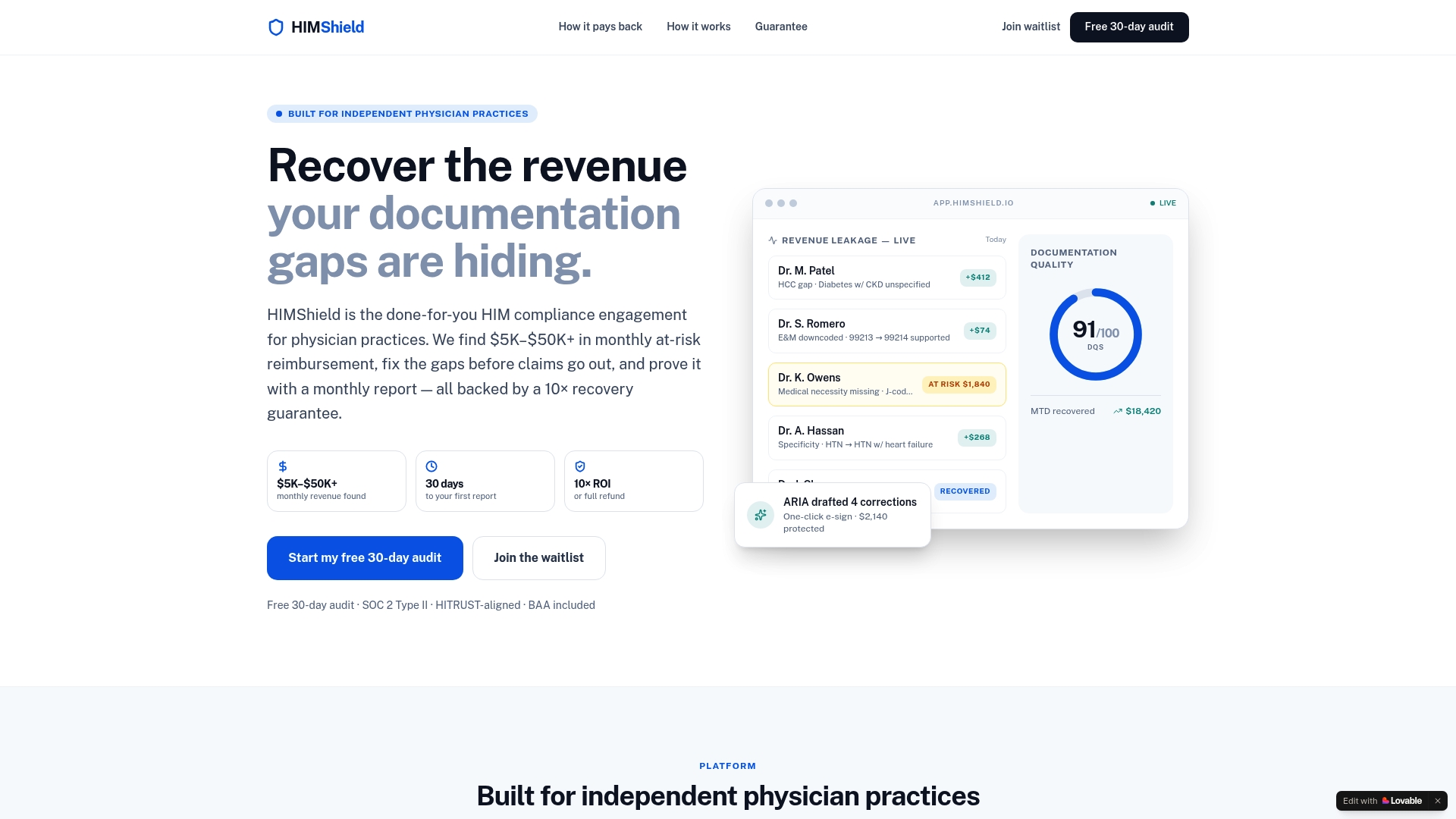
Request your free 30-day Revenue Leakage Audit, or learn more about our HIM compliance engagement.
FAQ
How can a physician practice ensure encounter data integrity?
Define which data-capture methods are allowed and who may use them, test your EHR workflows, and audit charts on an ongoing basis for completeness, consistency, and accuracy. AHIMA's physician-practice guidance recommends this approach. Pair it with a clear definition of a complete record and a turnaround standard for signing notes.
What is encounter data validation?
It is the process of checking that submitted encounter records are complete, accurate, and consistent. CMS's protocol combines automated and analytic checks, benchmark comparisons, and targeted medical-record review. Within a practice, the equivalent is comparing charts, claims, and provider trends, then reviewing a sample of notes to confirm what the numbers suggest.
What are common data integrity problems in an EHR?
The usual causes are nonspecific or missing diagnoses, conflicting entries, unsigned or late notes, and uncontrolled copy-and-paste. Missing audit trails also make it hard to show who changed what. Regular audits and system controls over copied text address most of these.
Can we correct a chart after a payer audit starts?
No. CMS's RADV guidance says documentation may not be changed or amended during an audit. Complete and authenticate records at or near the encounter, and use compliant queries before the claim goes out.
Sources
- State Toolkit for Validating Medicaid Managed Care Encounter Data
- Integrity of the Healthcare Record: Best Practices for EHR Documentation, AHIMA
- Guidelines for Physician Office Query Practice, AHIMA
- 1997 Documentation Guidelines for Evaluation and Management Services, CMS
- Ensuring Proper Use of Electronic Health Record Features, CMS
- EQR Protocol 4: Validation of Encounter Data Reported by the MCO
- Quality Data and Documentation for EHRs in Physician Practice, AHIMA
- Assessing and Improving EHR Data Quality, AHIMA
- Encounter Data Best Practices and Interventions, Integrated Healthcare Association
- Improving Encounter Data and Revenue, Trainer Guide, Integrated Healthcare Association
- Encounter Data, Medicaid.gov
- Submitting Accurate and Complete Encounter Data, T-MSIS
- CON12 RADV Intake Process and Guidance to Coders, CMS
- Common health insurance mistakes