
The most reliable way to score documentation quality is to pair a validated instrument, like the nine-item PDQI-9, with operational metrics such as coding accuracy and completeness, then apply consistent weighting. Anchor findability and accuracy checks to that base score. A 30-day pilot with inter-rater reliability testing turns this from a one-time audit into a repeatable measurement system you can defend to auditors, payers, and physicians.
TL;DR:
- Validated tools like PDQI-9 evaluate clinical note quality but should be combined with operational metrics such as coding accuracy and completeness for a balanced score.
- Different document types require tailored weighting, with clinical notes emphasizing accuracy and clarity, while quick triage notes focus more on timeliness and usability.
- Building a reliable composite score involves defining scope, selecting validated metrics, assigning risk-based weights, and establishing minimum safety and compliance thresholds.
- Continuous, automated monitoring through pre-submission checks and NLP-assisted flagging improves documentation quality and helps prevent revenue loss.
- Conducting inter-rater reliability testing and maintaining detailed methodology records are essential to ensure the scoring system's trustworthiness and defendability.
Table of Contents
- What Dimensions Belong in a Documentation Quality Score?
- Which Validated Instruments Should You Use to Score Notes?
- How Do You Build a Composite Documentation Quality Score?
- [How Should Documentation Scoring Fit Into Daily Workflows?](#how-should-documentation-scoring-fit-into-daily-workflowshttpsblogsparkmednetblogpatient-intake-workflow)
- How Do You Validate That Your Scoring Is Reliable?
- What Do Documentation Scores Look Like in Practice?
- How HIMShield Applies Scoring Principles to Revenue Protection
- Why Validation Beats Convenience in Documentation Scoring
- Get a Free Revenue Leakage Audit Before You Build a Scoring Program
- Sources
- FAQ
What Dimensions Belong in a Documentation Quality Score?
A defensible documentation quality score never rests on one number. It breaks into distinct, measurable dimensions, and each one answers a different question about the record.
Accuracy asks whether the note reflects what actually happened during the encounter. You measure this through audit error rates, comparing coded diagnoses against supporting documentation, or flagging mismatches between E/M level and documented complexity. Completeness or coverage asks whether required elements are present at all: chief complaint, history of present illness, review of systems, assessment, plan. Missing elements here are what trigger downcoding and payer denials.
Clarity and readability measure whether a note communicates efficiently to the next reader, whether that's a specialist, a coder, or an AI model parsing structured fields. Tools apply readability formulas like Flesch-Kincaid to flag notes that bury clinical reasoning in dense, run-on prose. Findability and navigation ask a more operational question: can a reviewer locate the information they need without hunting through unstructured text? Time-to-first-call, meaning how long it takes a coder or auditor to locate the supporting detail for a code, is a useful proxy here.
Timeliness or freshness tracks whether documentation was completed close to the encounter or backfilled days later, which correlates with recall errors and compliance risk. Usability and task-success measure whether someone acting on the note, a nurse pulling orders, a biller submitting a claim, actually completes the task correctly on the first try. Repeated ticket counts (the same clarification question asked over and over) are a strong signal that a document genre has a systemic usability problem.
Finally, coding and compliance metrics track whether the documentation actually supports the billed codes: specificity of ICD-10 codes, presence of medical necessity language, and alignment with CMS documentation guidelines. This dimension deserves its own weight because it carries direct revenue and audit exposure, unlike a readability score that mostly affects internal efficiency.
Here's how these dimensions typically get operationalized:
- Accuracy: internal audit sampling, error rate per 100 charts, comparison against coding guidelines
- Completeness: checklist coverage of required note elements by document type
- Clarity/readability: automated readability scoring (Flesch-Kincaid, sentence length, structure checks)
- Findability: time-to-locate-key-data, structured field completion rate
- Timeliness: average hours between encounter and note finalization
- Usability: repeated clarification requests, downstream task-completion rate
- Coding/compliance: specificity rate, medical necessity language presence, denial-linked error tracking
Do not apply every dimension to every document genre with equal weight. A discharge summary lives or dies on completeness and clarity for the next care team. A quick nurse triage note cares far more about timeliness than about narrative readability. Forcing a uniform rubric across genres that serve different purposes produces scores that look precise but measure the wrong thing. Segmenting metrics by document type, an approach ACM research on documentation quality supports by decomposing quality into structure, content, and style rather than one blended figure, keeps the score honest.
Which Validated Instruments Should You Use to Score Notes?
The Physician Documentation Quality Instrument, known as PDQI-9, is the closest thing clinical documentation has to a peer-reviewed gold standard. It scores notes across nine items, including up-to-date accuracy, thoroughness, useful comprehensiveness, organization, and clarity, on a scale that produces a total score between 9 and 45, where higher scores mean higher quality. Because it was developed and validated through peer-reviewed research rather than internal vendor testing, PDQI-9 carries a credibility that homegrown checklists cannot match when you need to defend a scoring methodology to a compliance committee or a payer auditor.
PDQI-9's strength is also its limit: it evaluates the note as a piece of clinical writing, not as a coding or revenue artifact. A note can score well on organization and clarity while still missing the specificity needed to support a billed HCC code. That's why most mature documentation programs treat PDQI-9 as the clinical-quality layer of a composite score, then layer coding accuracy and completeness metrics on top rather than relying on it alone.
The Document Quality Index, or DQI, takes a different, more engineering-oriented approach. Rather than nine qualitative items rated by a human reviewer, DQI organizes quality into three weighted categories on a 0 to 100 scale, with an example weighting of structure at 40%, content at 30%, and style at 30%, plus threshold bands that classify a score as excellent, adequate, or failing. DQI wasn't built for clinical charts, but its weighted-category structure translates well: a HIM team can substitute clinical dimensions (accuracy, completeness, coding compliance) into the same weighted framework and get a reproducible number instead of a subjective impression.
A newer, less familiar framework worth watching is Agent Score, part of the Agent-Friendly Docs Spec. It was built to answer a different question: is this documentation actually usable by an AI agent or large language model, not just a human reader? Agent Score applies 22 checks across 7 categories on a 0 to 100 scale, covering things like clean structure, unambiguous formatting, and machine-parseable organization. As ambient AI scribes and LLM-assisted coding tools become standard in clinical workflows, agent-readiness stops being a software-engineering curiosity and becomes directly relevant to how reliably an AI tool extracts accurate codes from a chart.
For practices building a scoring program, the practical mapping looks like this:
- PDQI-9 for clinician-facing note quality, especially progress notes and consult notes
- DQI-style weighted composites for program-level dashboards that need a single defensible number
- Agent Score or agent-readiness checks for any workflow where notes feed into an ambient scribe, coding assistant, or other LLM tool
- DORA's documentation-quality capability as a conceptual model for treating documentation as a measurable engineering asset rather than an afterthought
None of these instruments was designed to stand alone in a healthcare setting. Each fills a different gap, and the strongest programs borrow structure from all three rather than picking one and calling it complete.
How Do You Build a Composite Documentation Quality Score?
Building a composite score is a sequencing problem before it's a math problem. Get the sequence wrong and you end up with a number that looks authoritative but hides exactly the failures you built the score to catch.
- Define scope and document types first. Decide whether you're scoring progress notes, discharge summaries, telehealth encounters, or all of them separately. A single practice-wide score across mixed document types almost always averages away genre-specific problems.
- Select base metrics from validated instruments and operational data. Pull clinical-quality items from PDQI-9, pull coding-specificity and completeness data from your existing audit workflow, and pull readability or structure data from automated text analysis.
- Assign weights that reflect real risk, not convenience. Coding accuracy and medical necessity language should carry more weight than stylistic clarity if audit exposure is your primary concern; readability may deserve more weight for patient-facing summaries.
- Set minimum passing floors on safety-critical and compliance-critical items. A note that scores 95 overall but fails medical necessity documentation should not pass just because other categories pulled the average up.
- Normalize scores to a common scale, typically 0 to 100, so dimensions measured on different original scales (PDQI-9's 9 to 45, a percentage-based completeness check) can combine without one dimension silently dominating the total.
- Run a 30-day baseline pilot on a representative sample before rolling the score out program-wide.
The floor requirement in step 4 matters more than it looks. Averaging is the most common way documentation scoring programs quietly fail: a chart with excellent narrative flow and one missing medical-necessity statement can still average to a passing grade, even though that single gap is the one an auditor will flag first. Segmenting by document genre and imposing hard floors on the highest-risk items, rather than letting a single blended average smooth over them, keeps the score honest about where real risk sits.
Pro Tip: Run your first 30-day baseline on a random sample rather than your best or worst providers. A baseline built from cherry-picked charts will not hold up when you try to compare future scores against it.
How Should Documentation Scoring Fit Into Daily Workflows?
A score that only exists in periodic audit reports is a score that arrives too late to change behavior. The teams that get the most value from documentation quality scoring build it into a regular cadence: starting with a pilot, setting a baseline, then moving to continuous monitoring.
Start with a focused 30-day pilot on one document type or one department. Use that window to test your metric definitions, catch obvious scoring inconsistencies, and set a realistic baseline before scaling. Once the baseline holds, move to continuous or rolling-sample monitoring rather than annual snapshots, so drift gets caught in weeks, not months.
Automation is where this stops being a manual audit exercise and starts being an operational system. Three points in the workflow are worth automating first:
- Pre-submission style and completeness gates, similar to a pre-merge code check in software engineering, that flag missing required fields before a note is finalized
- EHR-integrated audit sampling that pulls a rolling sample of charts automatically instead of relying on manual quarterly pulls
- NLP-assisted triage that flags likely problem notes (low readability, missing specificity language, unusual length) for human review rather than reviewing every chart with equal effort
DORA's research on documentation quality found that teams with above-average documentation performed dramatically better on continuous delivery and continuous integration capabilities than teams with below-average documentation, a finding built around software teams, but the underlying lesson translates directly: documentation that's checked continuously and early behaves like an asset, while documentation checked only after the fact behaves like a liability you discover too late.
Track a small set of program KPIs rather than a sprawling dashboard nobody reads: documentation drift rate (how fast scores decay between pilots), repeated ticket or clarification counts, time-to-first-call for coders locating supporting detail, and, where AI tools are in the loop, AI answer accuracy against source notes. A practical guide to documentation quality scoring recommends exactly this kind of short, metrics-first pilot before scaling a scoring program organization-wide, and the same logic holds for a HIM department piloting its first composite score.
How Do You Validate That Your Scoring Is Reliable?
A documentation quality score only holds up under scrutiny if two different reviewers scoring the same chart land on roughly the same number. Without that check, the score is an opinion wearing a spreadsheet.
Inter-rater reliability is measured most commonly with Cohen's kappa or simple percent agreement between reviewers scoring the same sample independently. Run this exercise before you trust any score enough to act on it, and rerun it after any significant change to your rubric, your reviewer team, or your document types.
- Have two or more reviewers independently score a shared sample of 20 to 30 charts
- Calculate agreement (kappa or percent agreement) before comparing notes
- Discuss discrepancies as a calibration exercise, not a scoring fix
- Rescore a fresh sample after calibration to confirm agreement improved
- Revalidate any time you change weights, add a new document type, or onboard new reviewers
Sample size matters more than most programs assume going in. A pilot built on five charts tells you almost nothing about whether your rubric generalizes; a rolling sample in the range of dozens of charts per document type gives reviewers enough exposure to edge cases to calibrate meaningfully.
The reliability signal to watch: peer-reviewed instruments like PDQI-9 were built and validated specifically to survive inter-rater testing across multiple reviewers and settings. A homegrown rubric that skips this step is asking readers to trust a number that has never been tested for consistency.
Document your methodology as you go, not after an auditor asks for it. Keep a written record of item definitions, weight rationale, and any rubric changes with dates attached. When a score drifts over time, that record is what lets you tell the difference between a real quality decline and a scoring definition that quietly shifted underneath you.
What Do Documentation Scores Look Like in Practice?
Consider a mid-size internal medicine group scoring clinician progress notes with PDQI-9, supplemented by a coding-accuracy audit layer. The clinical-quality items score well across the board, organization and clarity both land in the high range, but the coding-accuracy layer flags a recurring gap: assessment and plan sections consistently lack the specificity needed to support HCC coding for chronic conditions. The composite score looks respectable overall, but the floor on coding specificity catches what the blended average would have hidden. That single finding becomes the basis for a targeted physician education session rather than a generic "improve your documentation" memo, which is a far more useful outcome than the score itself.

AI-generated, or ambient scribe, notes need their own evaluation lens. A 2025 study comparing AI-generated notes against physician-authored reference notes using PDQI-derived measures found small but measurable differences between the two, a reminder that ambient scribe output deserves the same validated scrutiny as human-written notes, not a pass on the assumption that AI-generated means consistent. A small average gap can still mask individual notes with meaningful accuracy problems, especially in complex encounters where the model may summarize confidently but imprecisely.
Program dashboards earn their keep by turning individual chart scores into prioritized action lists rather than static report cards:
- Flag document types or providers scoring below the compliance floor for targeted review, not universal retraining
- Link low coding-specificity scores directly to denial and revenue-leakage data so remediation has a dollar figure attached
- Route repeated low-readability flags to documentation education rather than one-off corrections
- Track score trends by provider over time to catch drift before it becomes an audit finding
The value isn't the score itself. It's the remediation path the score points to, and how quickly that path closes the gap between a documentation problem and a denied claim.
How HIMShield Applies Scoring Principles to Revenue Protection
Some platforms build documentation quality scoring directly into revenue protection workflows rather than treating it as a separate compliance exercise. Some platforms scan EHR data before claims go out the door, applying objective accuracy and completeness checks with real-time scoring rather than waiting for a payer to flag the problem after the fact.
In practice, that looks like:
- Per-provider, per-payer Revenue Leakage Reports that quantify where documentation gaps are costing a practice money, tying quality scores directly to dollars rather than an abstract grade
- Automated compliance alerts that flag coding and documentation risks tied to specific charts before submission, functioning as the pre-submission gate described in the workflow section above
- Real-time documentation quality scoring that gives physicians and administrators a running view instead of a quarterly surprise
- One-click physician e-signature on drafted corrections, so a flagged documentation gap gets fixed in the same workflow, not routed to a separate task queue that never gets worked
- Audit defense assembly that packages submission-ready responses when a payer does come asking
For a practice, this means scoring dimensions such as accuracy, completeness, and coding compliance function as a live monitoring layer tied to actual claims rather than remaining academic frameworks. Practices exploring how a structured education program supports these scores can review why physician documentation education matters as a next step alongside any pilot scoring effort.
Why Validation Beats Convenience in Documentation Scoring
Most documentation quality conversations in healthcare skip straight to the score and skip the validation step entirely. That's backwards, and it's the single biggest weakness in how practices approach this problem. A rubric nobody has tested for inter-rater agreement is a rubric that will fall apart the first time a compliance officer or payer auditor asks why two reviewers scored the same chart differently.
The conventional advice, "pick a checklist and start scoring," treats measurement as the finish line. It's the starting point. PDQI-9 earned its credibility through peer review and reproducibility testing, not because nine items happened to sound comprehensive. Engineering fields learned this lesson before healthcare did: DORA's own research ties documentation quality to measurable delivery outcomes precisely because it built measurement into a continuous, validated cycle rather than a one-time grade.
If you're starting from zero, prioritize the pilot and the calibration exercise before you touch weighting. A perfectly weighted score built on an unreliable rubric is precision aimed at the wrong target. Get reviewers agreeing first. The math can wait.
— Elena
Get a Free Revenue Leakage Audit Before You Build a Scoring Program
Building a documentation quality scoring system from scratch takes time most independent practices don't have to spare, and every month spent designing a rubric is a month of claims going out with the same unquantified gaps. HIMShield's free 30-day Revenue Leakage Audit does the quantification work first: it scans your EHR data, identifies coding and documentation gaps by provider and payer, and hands you a prioritized remediation roadmap without requiring new staff or software training.
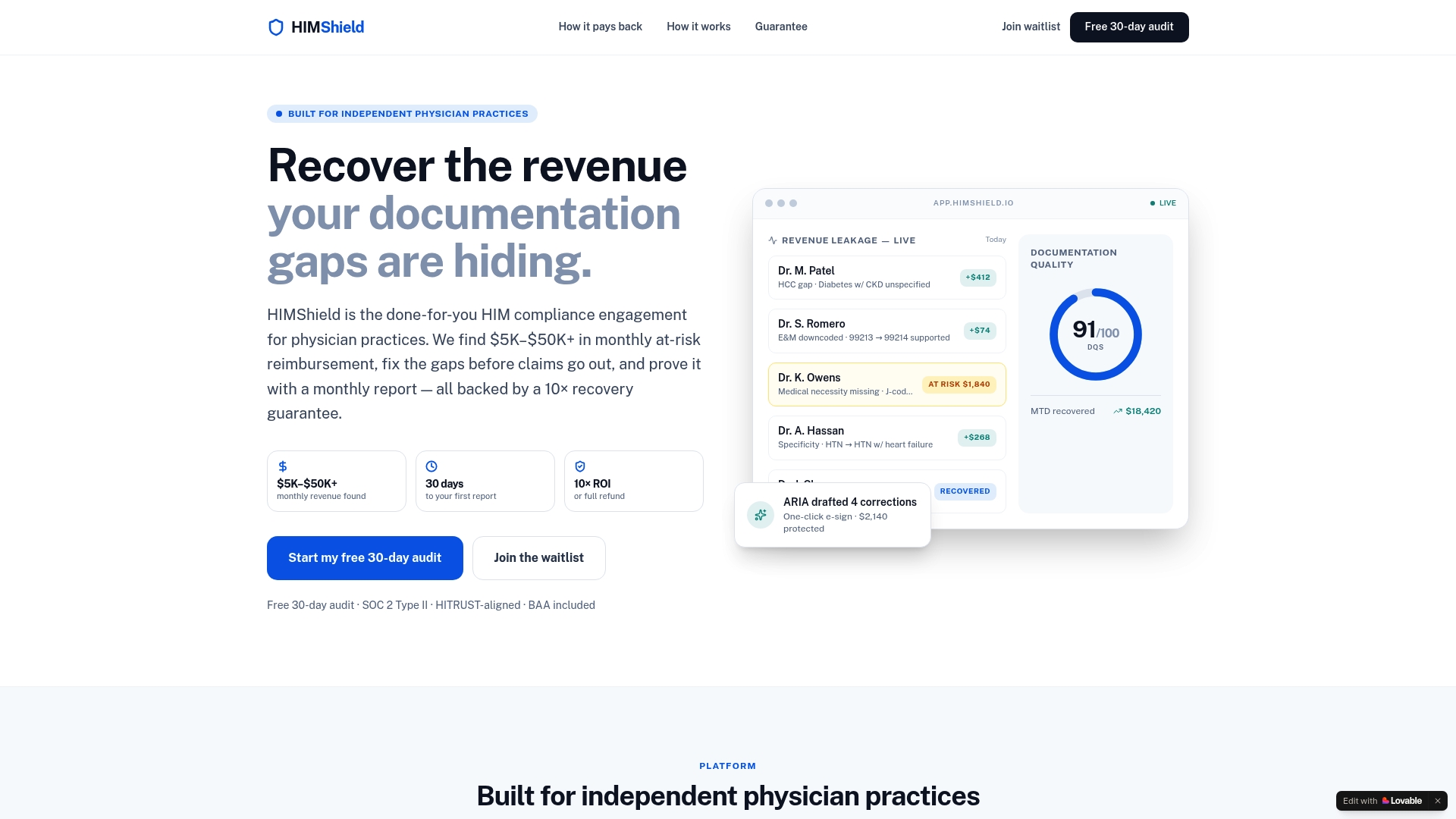
Think of the audit as a baseline pilot, matching a 30-day window recommended for testing scoring systems, with findings tied directly to at-risk reimbursement dollars instead of an abstract score. This provides a clear picture of where documentation stands before committing to building or buying a full scoring program. To see how findings translate into corrected claims and audit-ready responses, review how HIMShield works. Request your free audit today and get a quantified, prioritized starting point instead of guessing where your documentation risk actually lives.
Sources
- DORA | Capabilities: Documentation quality
- Assessing Electronic Note Quality Using the Physician Documentation Quality Instrument (PDQI-9)
- Assessing the quality of AI-generated clinical notes: validated evaluation of a large language model ambient scribe
- Beyond accuracy: assessing software documentation quality
- Document Quality Index (DQI) reference (GitHub)
FAQ
What Are the 5 C's of Clinical Documentation?
Definitions vary by source, but a common version covers Clear, Concise, Complete, Correct, and Consistent documentation, the same underlying goals that validated instruments like PDQI-9 translate into scored items.
What Are the 4 C's of Documentation?
A widely used shorthand names Clarity, Completeness, Consistency, and Compliance as the four core documentation goals, each of which maps directly to the metric dimensions covered earlier in coding and completeness scoring.
What Are CMS Guidelines for Documentation?
CMS documentation guidelines require that medical necessity, the services rendered, and the level of care billed are clearly supported in the chart, which is why coding-compliance metrics with a minimum passing floor belong in any composite documentation quality score.
How Does PDQI-9 Scoring Work?
PDQI-9 rates nine note-quality items on a scale that produces a total score from 9 to 45, with higher totals indicating stronger organization, accuracy, and clarity in the note.
Can HIMShield Score My Practice's Documentation?
Yes. HIMShield delivers real-time documentation quality scoring alongside per-provider, per-payer revenue leakage reports, and the free 30-day audit gives you a quantified starting baseline at no cost.