
Medical necessity documentation is defined as the written clinical record that proves a healthcare service is reasonable, necessary, and consistent with accepted medical standards. Without it, payers deny claims, audits escalate, and revenue leaks from your practice. The CMS 2024 MLN Fact Sheet specifies seven core required elements: reason for encounter, relevant history, physical exam findings, prior test results, diagnosis, plan of care, and provider identity. Medical necessity documentation examples give you a concrete model for meeting those requirements on every note, every visit, every claim.
1. Key components of medical necessity documentation examples
Strong medical necessity documentation starts with specificity. Vague notes fail audits. Every compliant note must include the following elements:
- Reason for encounter: State the presenting complaint with clinical detail. "Chest pain, 7/10, radiating to the left arm, onset 48 hours ago" outperforms "chest pain."
- Relevant patient history: Include prior diagnoses, medications, allergies, and social history that directly affect clinical decision making.
- Physical exam findings: Record objective data. Vital signs, auscultation findings, range of motion measurements, and lab values all count. Objective clinical data strengthens medical necessity claims and reduces denials.
- Diagnosis with ICD-10 specificity: A diagnosis code alone is not sufficient. The narrative must link the diagnosis to the service rendered.
- Treatment plan with rationale: Explain why this intervention, at this time, for this patient. Document what alternatives were considered and ruled out.
- Prior treatment outcomes: Show what was tried before and why it failed or was contraindicated.
- Provider identity and signature: CMS requires a legible signature or electronic attestation on every note.
Documentation affects reimbursement directly because payers evaluate the written record, not your clinical intent. Every element above must appear in the note on the date of service.
Pro Tip: Never document "patient appears ill." Instead, write "patient presents with temperature 102.4°F, heart rate 118 bpm, and diffuse abdominal tenderness on palpation." Measurable findings win audits.

2. Documenting high-complexity E/M visits
Level 4 and Level 5 Evaluation and Management codes require documented evidence of medical complexity, not just a long note. Payers increasingly scrutinize documentation that covers only a single stable condition for high-level codes. Your note must demonstrate one or more of the following:
- Management of multiple chronic conditions: Document each active condition separately. "Patient with Type 2 diabetes (A1c 9.2%), hypertension (BP 158/96 today), and stage 3 CKD, each requiring independent assessment and management adjustment."
- New or uncertain diagnosis: Describe your clinical reasoning. "Differential includes pulmonary embolism, pneumonia, and pleuritis. Ordering CT pulmonary angiography based on Wells score of 5."
- High-risk medication management: "Initiating warfarin therapy; discussed bleeding risks, INR monitoring schedule, and drug interactions with patient."
- Uncontrolled or worsening chronic disease: Quantify the change. "HbA1c increased from 7.8% to 9.2% over 90 days despite medication adherence."
- Independent interpretation of test results: "Reviewed today's ECG personally; new ST depression in leads V4-V6 compared to prior tracing from march 2025."
Medical decision making is the engine behind E/M level selection. Document your reasoning, not just your conclusions.
Pro Tip: Avoid copy-pasting prior visit notes for complex E/M visits. Payers flag identical notes across dates as a red flag for upcoding. Each note must reflect the clinical reality of that specific encounter.
3. Sample medical necessity justification letter examples
A medical necessity justification letter is a formal written argument to a payer explaining why a service meets coverage criteria. Effective justification letters must align the patient's condition with payer-specific criteria such as Aetna Clinical Policy Bulletins, InterQual, or Milliman guidelines. Narrative-only descriptions without citing those criteria consistently lead to denials.
The table below shows how documentation requirements differ by specialty:
| Specialty | Key payer criteria to cite | Functional scoring tools to include |
|---|---|---|
| Orthopedics | InterQual surgical thresholds | Oswestry Disability Index (ODI), VAS pain scale |
| Behavioral health | Milliman Care Guidelines | GAF score, PHQ-9, Columbia Suicide Severity Rating |
| Cardiology | Aetna Clinical Policy Bulletins | NYHA class, EF percentage, stress test results |
| Oncology | NCCN guidelines | ECOG performance status, tumor staging |
| Advanced imaging | LCD/NCD criteria | Prior imaging dates, clinical findings that changed |
Every justification letter must include the following elements:
- Patient demographics and diagnosis: Full name, date of birth, ICD-10 code, and date of service.
- Clinical summary: Two to three sentences describing the patient's current condition with objective data.
- Payer criteria mapping: Quote the specific InterQual or Milliman criterion that the patient meets, then show how the clinical data satisfies it.
- Prior treatment history: List treatments tried, with dates and outcomes. Step therapy documentation must detail dates, durations, and outcomes of prior treatments to satisfy insurer requirements.
- Evidence-based functional scores: Include VAS, ODI, FIM, or PHQ-9 scores with comparison to baseline.
- Requested service and expected outcome: State what you are requesting and what clinical improvement you expect.
Linking diagnosis to treatment with a clear clinical narrative is mandatory for specialized or high-cost procedures. A diagnosis code alone will not secure approval.
4. Common documentation pitfalls and how to avoid them
Most claim denials trace back to predictable documentation errors. Recognizing them before submission protects your revenue.
- Vague or non-specific language: Phrases like "rule out condition" or "patient appears ill" give payers no clinical basis for approval. Replace them with objective findings: vital signs, lab values, imaging results, and physical exam data.
- Copy-pasted templates: Identical notes across multiple visits signal to auditors that documentation is not individualized. Each note must reflect the specific clinical encounter on that date.
- Missing link between diagnosis and treatment: A diagnosis code alone is insufficient for specialized procedures. The narrative must explicitly connect the diagnosis to the service with clinical reasoning.
- Inadequate therapy documentation: Therapy services require explicit description of skilled need and professional techniques that cannot be performed by caregivers. "Continue PT" does not justify skilled care. Write "patient requires manual joint mobilization and neuromuscular re-education for post-surgical knee instability, skills beyond caregiver capability."
- Incomplete step therapy records: Insurers deny step therapy exceptions when prior treatment records lack dates and outcomes. Document every trial with start date, end date, dosage, and clinical response.
- Continued-stay documentation errors: Continued-stay records require structured clinical arguments showing patient instability and necessity of current care level. Repeating prior note language does not satisfy this requirement.
- Missing or illegible provider signature: CMS requires a legible signature or electronic attestation. An unsigned note is an undefendable note.
Pro Tip: Build a pre-submission checklist into your EHR workflow. Before signing any note, confirm that objective data, diagnosis-to-treatment linkage, and provider signature are all present. This single habit catches the majority of denial-triggering errors.
Reducing claim denials starts with documentation quality, not appeals volume. Fix the note before it leaves your practice.
Key takeaways
Compliant medical necessity documentation requires specific clinical data, explicit diagnosis-to-treatment linkage, and alignment with payer criteria on every date of service.
| Point | Details |
|---|---|
| Seven core CMS elements | Every note must include reason for encounter, history, exam, diagnosis, plan, prior results, and provider identity. |
| E/M complexity requires proof | Level 4–5 codes need documented evidence of multiple conditions, new diagnoses, or high-risk medication management. |
| Justification letters need payer mapping | Cite InterQual, Milliman, or Aetna criteria explicitly and include functional scores like ODI or PHQ-9. |
| Vague language causes denials | Replace subjective phrases with objective findings: vital signs, lab values, and measurable clinical data. |
| Step therapy records must be complete | Document prior treatment dates, durations, and outcomes to satisfy insurer step therapy requirements. |
What I've learned writing defensible medical necessity notes
The single biggest mistake I see in independent physician practices is treating documentation as a billing task rather than a clinical argument. A note is not a record of what you did. It is a legal and financial defense of why you did it.
The practices that survive payer audits share one habit: they write for the reviewer, not for themselves. That means every note answers three questions without the reader having to search. What is wrong with this patient? Why does this specific service address it? Why now, and not something else? When those three answers appear in the first paragraph of a note, with objective data attached, denials drop.
Medical necessity is strictly evidence-based and must reflect clinical standards and payer policies, not provider preference. That distinction matters more than most physicians realize. You may know the service is necessary. The payer only knows what you wrote.
My practical advice: integrate payer policy language into your documentation templates. Pull the exact InterQual or Milliman criterion that applies to your most common procedures and build it into your note structure. When your documentation mirrors the language the reviewer is checking against, approval rates climb. Continuous internal audits, even quarterly spot checks of ten notes per provider, catch drift before it becomes a denial pattern. Technology that flags documentation gaps before submission, like what Himshield provides, removes the human error factor from that process entirely.
— Elena
Himshield helps you protect every earned dollar
Documentation gaps are the leading source of hidden revenue loss in independent physician practices. Himshield connects directly with your EHR system and scans for coding, documentation, and charge-capture risks before they reach the payer. Practices using Himshield identify $5K–$50K+ in at-risk reimbursement within 30 days of connecting.
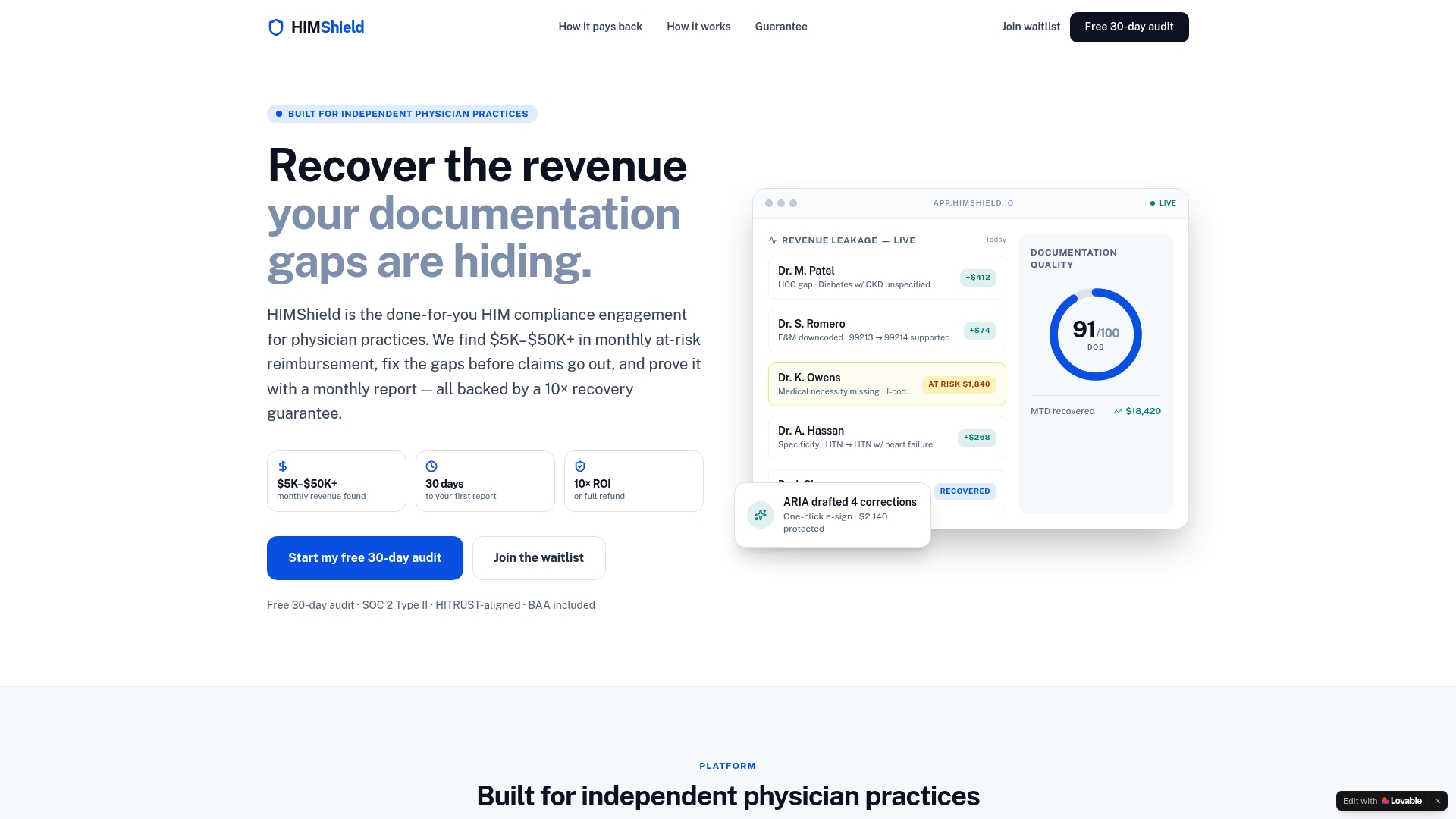
If your notes are missing the clinical linkage, objective data, or payer-aligned language that this guide describes, Himshield's automated risk detection flags those gaps in real time. You get physician-friendly guidance, not a compliance report you have to decode. Recover hidden revenue by addressing medical necessity documentation issues before they become denials. See how Himshield works and connect your EHR in minutes.
FAQ
What is medical necessity documentation?
Medical necessity documentation is the written clinical record that proves a healthcare service meets accepted medical standards and payer coverage criteria. The CMS 2024 MLN Fact Sheet defines seven required elements, including reason for encounter, diagnosis, and plan of care.
What are the most common examples of medical necessity?
Common examples include documentation for high-complexity E/M visits managing multiple chronic conditions, prior authorization letters for advanced imaging citing InterQual criteria, and therapy notes describing skilled interventions that caregivers cannot perform.
How do I document medical necessity for a Level 5 E/M visit?
Document management of multiple chronic conditions with quantified clinical findings, new or uncertain diagnoses with your clinical reasoning, or high-risk medication decisions with documented risks and monitoring plans. Each element must appear in the note on the date of service.
Why do medical necessity justification letters get denied?
Justification letters fail when they use narrative-only descriptions without citing specific payer criteria like InterQual or Milliman, or when they omit functional scoring data and prior treatment history with dates and outcomes.
What is the difference between a diagnosis code and medical necessity documentation?
A diagnosis code identifies the condition. Medical necessity documentation explains why the service is clinically required for that condition, on that date, for that patient. Payer policy requires explicit clinical rationale, not just a code.