
Health Information Management (HIM) is defined as the discipline responsible for the accuracy, completeness, and compliance of clinical documentation and medical coding across the entire revenue cycle. The role of HIM in revenue integrity is not administrative support. It is the primary defense against revenue leakage, audit exposure, and claim denials. Healthcare organizations without formal revenue integrity programs lose 3–8% of net collectible revenue due to preventable errors. For an independent physician practice, that gap represents real dollars that should have been collected. HIM professionals, as defined by the American Health Information Management Association (AHIMA), have evolved from data gatekeepers into strategic partners who protect every dollar a practice earns.
How do HIM professionals ensure accurate clinical documentation and compliant coding?
Clinical documentation improvement (CDI) is the foundation of revenue integrity. When documentation is incomplete or vague, coders cannot assign the correct codes, and payers deny or underpay claims. HIM professionals bridge clinical documentation workflows with billing, reducing charge capture leakage that would otherwise go undetected for months.
HIM's core functions in this area include:
- Documentation audits. HIM teams review physician notes before claims submission to catch missing diagnoses, unsupported procedure codes, and incomplete encounter documentation.
- Coder education. HIM professionals train coders and clinical staff on ICD-10-CM, CPT, and HCPCS coding standards, reducing errors at the source.
- Modifier review. Incorrect or missing modifiers are a leading cause of denials in physician billing. HIM oversight of modifier usage in physician billing catches these errors before they reach the payer.
- Query workflows. When documentation is ambiguous, HIM professionals send physician queries to clarify diagnoses, supporting accurate code assignment and appropriate reimbursement.
- Charge reconciliation. HIM teams compare charges entered against services documented, identifying discrepancies that signal missed revenue or billing errors.
Each of these functions directly reduces the risk of undercoding, overcoding, and compliance violations. A single missed modifier or unsupported diagnosis code can trigger a payer audit that costs far more than the original claim.
Pro Tip: Set up a weekly CDI review cycle focused on your top five denial reasons. Fixing the patterns that repeat is faster and more effective than reviewing every claim individually. Detailed guidance on CDI best practices can help your team build that cycle efficiently.

In what ways does HIM integrate with technology to protect revenue integrity?
Automation is now standard in physician practice revenue cycles. AI-driven coding tools, automated charge capture, and electronic prior authorization systems all speed up workflows. The problem is that automation without oversight creates compliance drift. HIM professionals serve as the human check on every automated system that touches a claim.
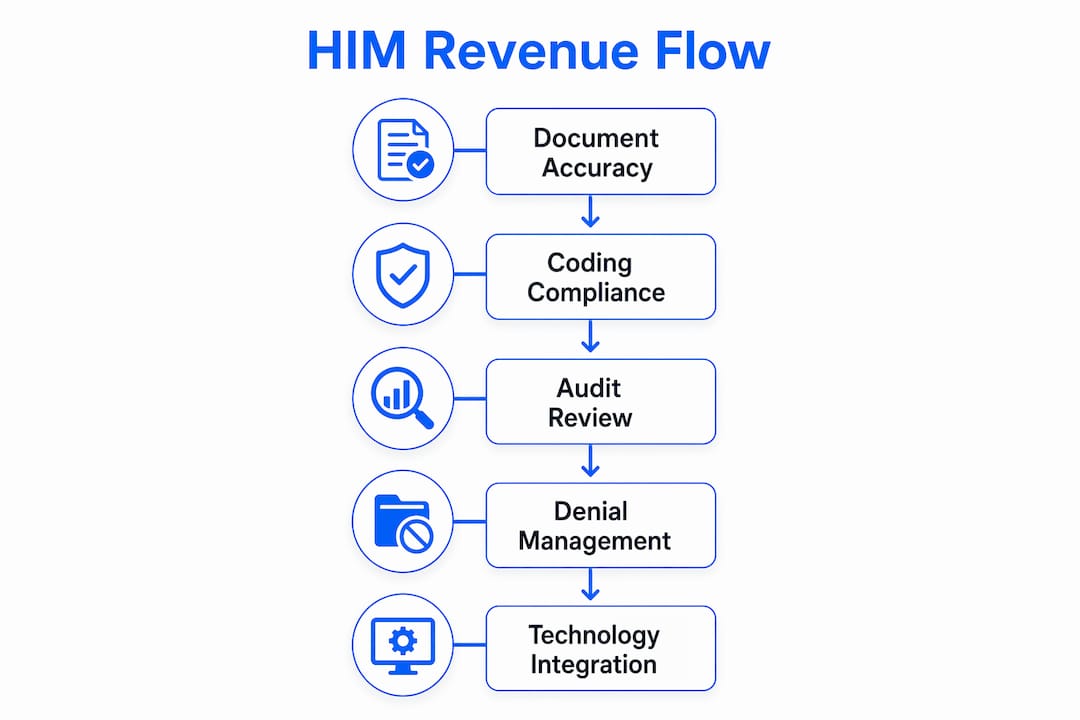
HIM professionals perform human-in-the-loop audits of AI-driven revenue cycle tools to mitigate systemic revenue loss and compliance risks. That function is not optional. Algorithm drift, where an AI model begins producing inaccurate outputs over time, can go undetected for months without regular HIM audits.
A structured HIM governance approach for technology oversight includes four steps:
- Baseline audit before deployment. HIM reviews the AI tool's coding logic against current payer rules and AHIMA standards before the system goes live.
- Ongoing output sampling. HIM teams pull a statistically valid sample of AI-generated codes each month and compare them against the source documentation.
- Drift detection protocols. When error rates in sampled claims exceed a defined threshold, HIM flags the system for recalibration before a payer audit occurs.
- Governance documentation. HIM maintains a written record of all audits, findings, and corrective actions, creating a defensible compliance trail.
"HIM professionals must audit AI coding outputs regularly to detect algorithm drift and prevent compliance penalties." — AHIMA Journal
Only 42% of revenue integrity departments conduct necessary internal audits and compliance checks. That statistic means the majority of practices relying on automated tools are flying without a safety net. HIM oversight closes that gap directly.
What are the best HIM-driven revenue integrity practices?
The most effective revenue integrity programs treat HIM as a cross-functional leader, not a back-office function. Structured revenue integrity departments require clinical, financial, and technical expertise with standardized KPIs and dashboard reporting. That structure is achievable in a physician practice, even without a large dedicated team.
Cross-functional collaboration
HIM professionals must work directly with finance, clinical leadership, and IT. Revenue integrity fails when these groups operate in silos. A denial that originates in a physician's documentation note travels through coding, billing, and finance before anyone catches it. HIM sits at the intersection of all three and can catch the error at the source.
Proactive charge reconciliation
Reactive denial management is less effective than proactive charge reconciliation. Chasing denied claims costs staff time and delays cash flow. HIM-led programs focus on reconciling charges against documentation before submission, not after rejection.
Key revenue integrity practices for physician practices include:
- Monthly internal audits covering a random sample of claims across all payers and service lines.
- KPI dashboards tracking denial rate by code, days in accounts receivable, and charge lag by provider.
- Payer contract review to confirm that reimbursement rates align with contracted amounts and that no underpayments are being accepted without appeal.
- Provider education sessions held quarterly, focused on the top documentation deficiencies identified in audits.
- Escalation protocols that route high-risk findings directly to the practice administrator or compliance officer.
Organizations with dedicated cross-functional revenue integrity departments see a 68% improvement in net collection rates. That improvement does not require a large team. It requires consistent process and clear accountability.
Pro Tip: Build your KPI dashboard around three numbers: denial rate, first-pass resolution rate, and charge lag. If you track only those three weekly, you will catch most revenue integrity problems before they compound.
How does HIM contribute to revenue integrity in physician practices?
Physician practices face a different set of challenges than large health systems. Specialty coding in cardiology, orthopedics, or gastroenterology is more complex than general inpatient coding. A single misapplied CPT code in a procedure-heavy specialty can result in thousands of dollars in lost or at-risk reimbursement.
Physician practices often lack infrastructure for dedicated revenue integrity functions despite these complex coding challenges. That gap creates real financial exposure. The physician group coding workflow in a specialty practice involves multiple providers, varying documentation habits, and payer-specific rules that change frequently.
Practical approaches for physician practices with limited HIM resources include:
- Outsourced HIM auditing. Contracting with a qualified HIM consultant or service for quarterly audits gives practices expert oversight without the cost of a full-time hire.
- Focused review cycles. Rather than auditing everything, prioritize the service lines with the highest denial rates or the largest revenue volume.
- Technology-assisted risk detection. Platforms that scan claims for coding and documentation risks before submission give small practices HIM-level oversight at scale.
- Alignment between HIM and physicians. HIM-physician alignment on documentation expectations reduces query volume and speeds up the billing cycle.
- RADV audit readiness. For practices with Medicare Advantage patients, HIM oversight of RADV audit preparation is a direct financial protection measure.
Without formal internal auditing, organizations can experience undetected compliance drift accumulating over years, posing financial and regulatory risks. In a physician practice, that drift often shows up as a pattern of underpayments or a sudden spike in denials from a single payer.
Key Takeaways
HIM-led revenue integrity programs are the most reliable defense against revenue leakage, coding errors, and compliance penalties in physician practices.
| Point | Details |
|---|---|
| HIM prevents revenue loss | Practices without formal HIM oversight lose 3–8% of net collectible revenue to preventable errors. |
| CDI drives accurate reimbursement | HIM-led documentation improvement and coder education reduce denials at the source before claims are submitted. |
| AI tools require HIM audits | Automated coding systems drift over time; regular HIM audits catch errors before payers do. |
| Cross-functional teams outperform | Practices with HIM integrated across clinical, financial, and IT functions see significantly higher net collection rates. |
| Physician practices need targeted approaches | Specialty coding complexity and limited staff make outsourced HIM auditing and risk-detection technology practical necessities. |
Why HIM is the most underused asset in physician revenue cycles
I have spent years watching physician practices invest in new billing software, new EHR systems, and new denial management workflows. The results are almost always the same. The technology helps at the margins, but the underlying revenue leakage continues because no one is governing the process from a clinical documentation standpoint.
HIM professionals are the only people in a practice who understand both the clinical language in a physician's note and the billing language a payer uses to adjudicate a claim. That dual fluency is rare. When HIM is brought in after a denial spike or an audit notice, the damage is already done. The practices that protect their revenue bring HIM into technology decisions, workflow design, and payer contract reviews from the start.
The transition from operational to strategic is not automatic. It requires practice administrators and financial managers to actively seat HIM at the table where revenue decisions are made. The importance of revenue integrity is well documented. The missing piece in most physician practices is not awareness. It is execution, and HIM is the function that makes execution possible.
— Elena
How Himshield helps physician practices protect earned revenue
Independent physician practices face the same revenue integrity risks as large health systems, with a fraction of the internal resources to manage them. Himshield was built specifically for that gap.
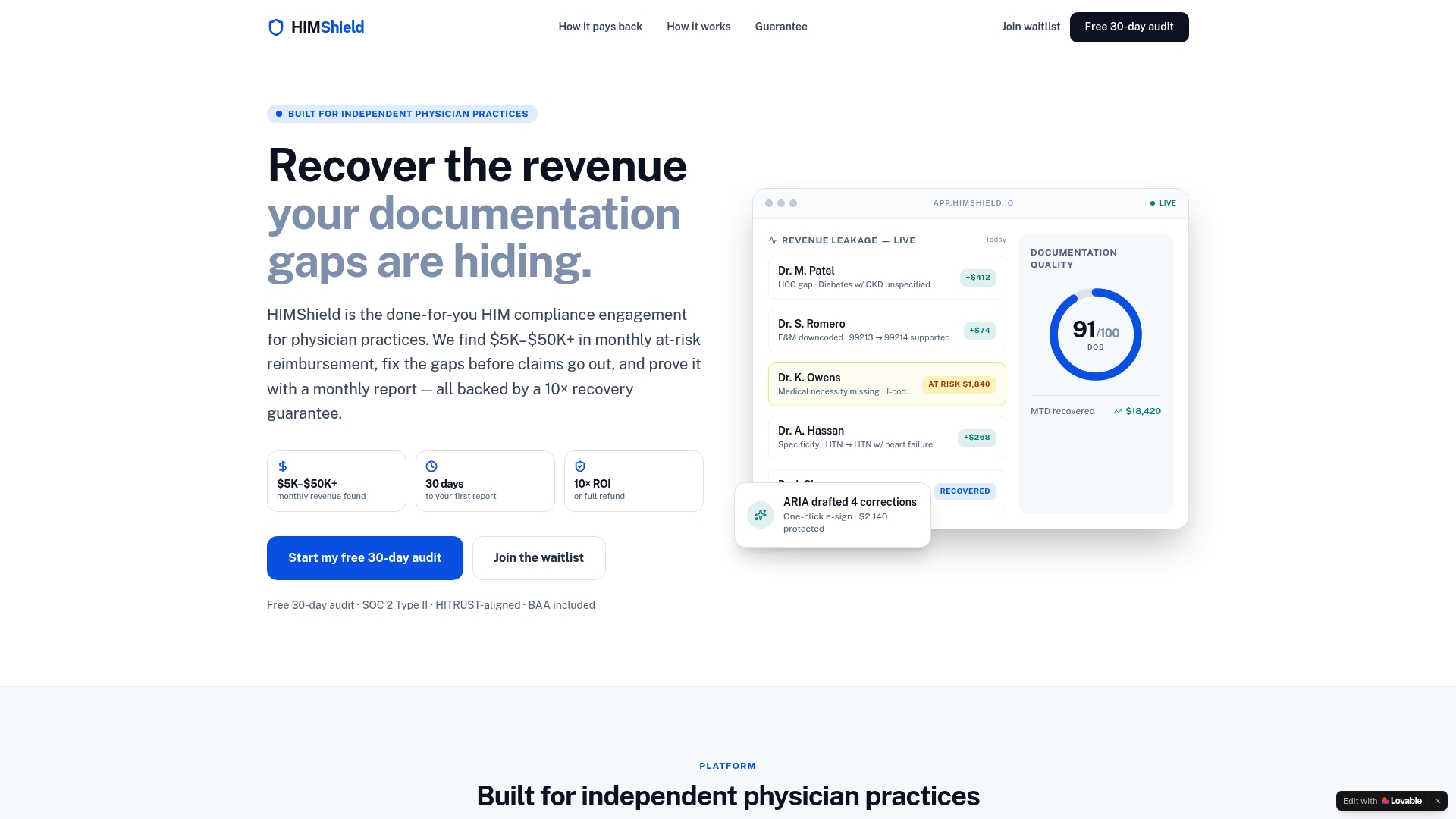
Himshield scans your coding, documentation, and charge capture for risks before they become denials or audits. Practices using Himshield recover $5K–$50K+ in hidden revenue by catching the errors that manual review misses. The platform connects directly to your EHR and delivers clear, physician-friendly findings without requiring a dedicated HIM department on staff. You can see how Himshield works and connect your EHR to start recovering revenue within 30 days. For a no-cost look at where your practice is losing money, request a free revenue leakage report and get a clear picture of your at-risk reimbursement.
FAQ
What is the role of HIM in revenue integrity?
HIM professionals protect revenue integrity by overseeing clinical documentation accuracy, coding compliance, and auditing of automated billing systems before claims reach payers. Their work directly reduces denials, underpayments, and compliance penalties.
How does HIM reduce claim denials in physician practices?
HIM teams audit documentation before submission, review modifier usage, and educate physicians on documentation standards, addressing the root causes of denials rather than reacting after rejection.
Why do physician practices need HIM oversight of AI coding tools?
AI coding tools experience algorithm drift over time, producing inaccurate outputs that can trigger payer audits. HIM professionals perform regular audits of AI outputs to detect and correct errors before they create compliance exposure.
What KPIs should HIM teams track for revenue integrity?
The most effective KPIs are denial rate by code, first-pass resolution rate, charge lag by provider, and days in accounts receivable. Tracking these weekly gives HIM teams early warning of emerging revenue integrity problems.
How can a small physician practice build revenue integrity without a full HIM department?
Outsourced HIM auditing, technology-assisted risk detection platforms like Himshield, and focused quarterly reviews of high-volume service lines give small practices effective revenue integrity coverage without the cost of a full-time HIM hire.