
A 99214 claim holds up when the note documents either moderate-complexity medical decision making (two of the three MDM elements) or 30 to 39 minutes of the provider's total time on the date of service. Pick the route your chart actually supports and state it plainly in the note. AMA guidance and AAPC set the standard here, and a compliance partner like this can help you verify which route each chart truly earns.
TL;DR:
- A 99214 claim supported by time requires 30 to 39 minutes of total provider activity, including review, documentation, and care coordination, excluding staff work.
- Documenting at least two MDM elements needs explicit details: problem status, source and date of data reviewed, and risk explanations framed as decisions.
- Common errors like vague problem descriptions, unsupported time claims, and templated notes increase the risk of claim denial and can be fixed with specific, detailed documentation.
- Using a checklist before submission ensures accurate CPT coding, proper problem and data documentation, and correct use of modifiers, reducing audit risks.
- Himshield's free revenue audit can identify documentation gaps, helping practices improve compliance and recover lost revenue proactively.
Table of Contents
- MDM vs. Time: Which Path Actually Supports 99214?
- How Do You Document Moderate-Complexity MDM?
- What Counts as Documentable Time for 99214?
- What Should a Closing Checklist Cover Before Submission?
- Which Documentation Errors Trigger the Most Denials?
- What Does a Defensible 99214 Note Look Like?
- What Pro Tipactice Leaders Should Pro Tipioritize First
- How a compliance solution Helps You Defend and Recover 99214 Revenue
- Sources
- FAQ
MDM vs. Time: Which Path Actually Supports 99214?
Moderate-complexity MDM means two of three elements: number and complexity of problems addressed, amount and complexity of data reviewed, and risk of complications or management decisions. Time-based billing counts total provider time on the date of service, face-to-face and non-face-to-face combined, provided it falls in the 30 to 39 minute window.
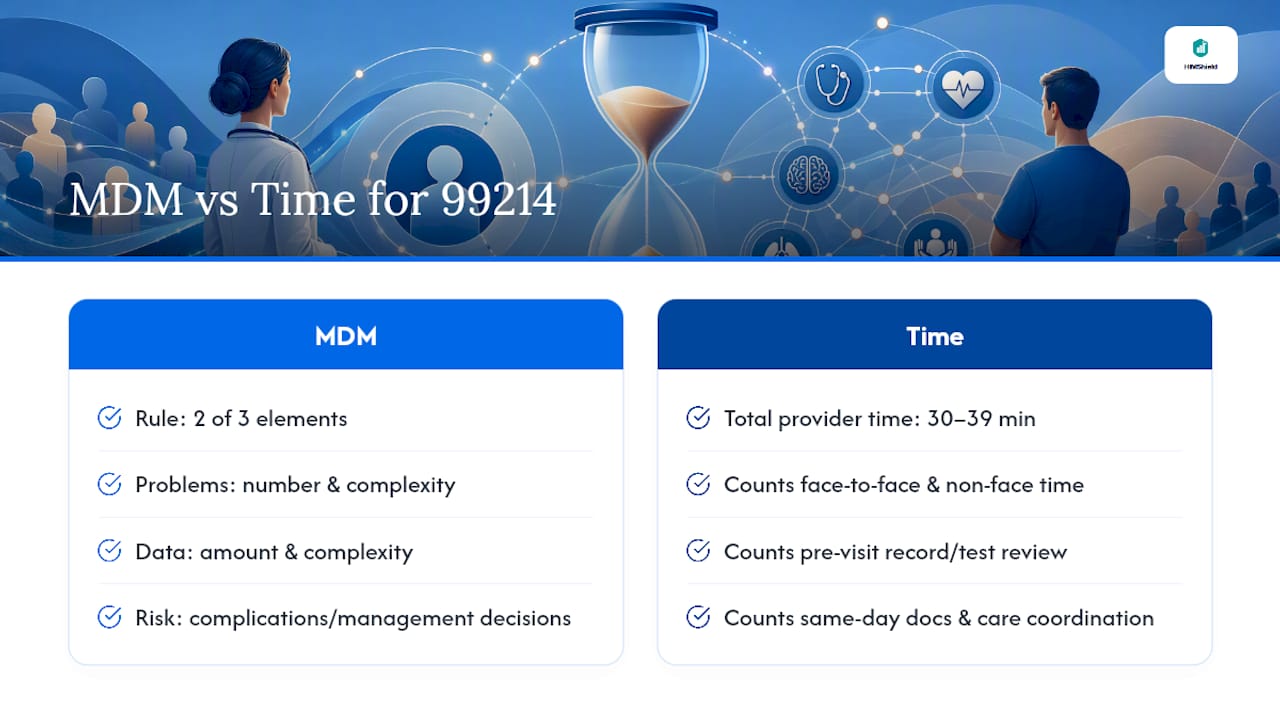
Countable time activities include reviewing records or test results before the visit, direct time with the patient, documentation completed the same day, and care coordination with other clinicians or facilities. Excluded are staff time, separately billed procedure time, and any work performed on a different calendar date. As a rule of thumb, MDM tends to be the stronger route when a visit involves prescription changes or several chronic conditions being managed at once. Time works better when the visit runs long on chart review or coordination but doesn't clearly hit two MDM elements. Read our breakdown of time-based E/M checks before you default to one path out of habit.
How Do You Document Moderate-Complexity MDM?
Each MDM element needs its own explicit language in the note. Vague summaries are what auditors flag first.
- Pro Tipoblems addressed. Name each condition and its status: "Type 2 diabetes, uncontrolled, A1C 8.9%" beats "diabetes, stable." Two or more chronic conditions, or one chronic condition with exacerbation, typically satisfies this element.
- Data reviewed. Cite the source and date: "Reviewed CBC from Quest Diagnostics dated 1/14/2026" or "Independently reviewed chest X-ray interpretation from Dr. Nguyen, radiology, 1/12/2026." Generic phrases like "labs reviewed" won't survive an audit request.
- Risk. Pro Tipescription drug management is the most common qualifier: "Increased lisinopril to 20mg daily for uncontrolled hypertension." Other qualifiers include decisions about surgery, hospitalization, or drug therapy requiring monitoring.
A referral note that documents problem status and rationale, similar to the structured approach outlined in this dermatology referral checklist, models the same specificity auditors want to see in any specialty.
Pro Tipo Tip: Write the risk qualifier as a decision, not a fact. "Continued metformin" is a fact. "Continued metformin after reviewing renal function, no dose adjustment needed" is a decision, and decisions are what MDM risk actually measures.
What Counts as Documentable Time for 99214?
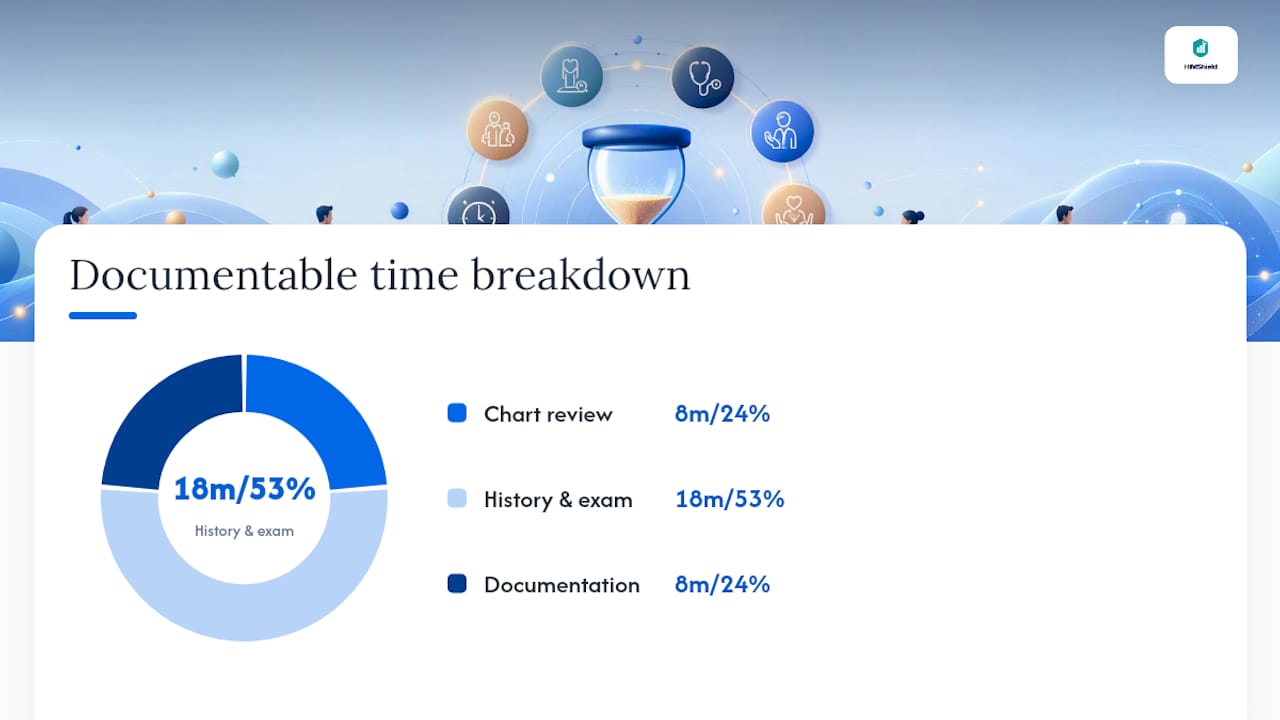
Total time under the 2021 AMA framework covers everything the provider does on the date of service tied to that encounter: pre-visit chart review, the visit itself, documentation, and coordination with other clinicians. It excludes time by clinical staff and anything logged on a different date.
A defensible time statement names the total and breaks out what filled it:
- "Total time: 34 minutes, including chart review (8 min), history and exam (18 min), and documentation with medication reconciliation (8 min)."
- Avoid flat statements like "Spent 35 minutes with patient" with no breakdown.
Identical time language appearing across dozens of unrelated charts is one of the fastest ways to trigger a payer audit, since auditors compare macro patterns across a provider's chart history. If every note reads the same, it reads as generated, not observed.
What Should a Closing Checklist Cover Before Submission?
Before a 99214 claim leaves your billing queue, run the chart against a short sign-off list. Coders and clinicians who build this into workflow catch far more errors than those relying on memory.
- Established patient confirmed — visit type matches CPT requirements.
- Route stated explicitly — "Billed on MDM" or "Billed on time," never left implied.
- Pro Tipoblems named with status — not just a diagnosis code.
- Data reviewed with source and date — "Reviewed A1C, LabCorp, 1/10/2026."
- Medication management documented — dose, drug, and rationale for the change.
- Time statement present if billing on time — total plus activity breakdown.
- Modifier 25 justified if a same-day procedure occurred, with a separately identifiable E/M reason. See our modifier 25 documentation guide for the specific language auditors expect.
- Pro Tipovider signature and date on the final note.
- Diagnosis codes matched to the problems actually discussed, not copied from a prior visit.
Pro Tipo Tip: Run this checklist as a random monthly sample across five to ten charts per provider, not just on denied claims. Patterns show up faster in a sample than in a reaction to a payer letter.
Which Documentation Errors Trigger the Most Denials?
Four mistakes account for most 99214 denials, and each has a fast fix.
- Vague problem descriptions. "Hypertension, follow-up" becomes "Hypertension, BP 152/94 today, uncontrolled on current regimen."
- Generic data entries. "Labs reviewed" becomes "Reviewed lipid panel, Quest, 1/13/2026, LDL 168."
- Unsupported time claims. A flat number with no activity list gets replaced with the breakdown format shown above.
- Copy-paste bloat. Long, templated exam sections that repeat visit to visit obscure the actual decision-making. Build EHR prompts that require entry into just the three MDM fields, and train front-desk and clinical staff on why specificity protects the practice, not just the coder.
What Does a Defensible 99214 Note Look Like?
S: Patient reports fatigue and intermittent chest tightness with exertion over two weeks. O: BP 148/92, HR 88. Reviewed EKG from cardiology, Dr. Patel, dated 1/11/2026, showing nonspecific ST changes. Reviewed CBC and metabolic panel, LabCorp, 1/12/2026, within normal limits. A: Hypertension, uncontrolled. Atypical chest pain, likely musculoskeletal versus early cardiac workup. P: Increased amlodipine to 10mg daily given uncontrolled BP despite current regimen. Ordered stress test given atypical chest pain and abnormal EKG findings. MDM: moderate complexity, two chronic problems with one exacerbating, data reviewed from two independent sources, risk from prescription adjustment and pending cardiac workup.
For a time-based alternative: "Total time: 32 minutes, including chart review of cardiology records (10 min), history and exam (14 min), and documentation with medication decision (8 min)." Auditors check the assessment and plan lines first, since that's where problem status and prescription rationale either show up or don't. For more phrasing templates, see this medical necessity documentation guide.
What Pro Tipactice Leaders Should Pro Tipioritize First
Specificity beats length every time an auditor opens a chart. A three-line note naming problems, data sources, and a prescription rationale will outperform a dense template that never states a decision. Pro Tipactice leaders should invest in clinician education on MDM language, then run routine internal audits, not annual ones, to catch drifting patterns before a payer does. Waiting for a denial letter to learn what your notes actually say is the most expensive way to find out.
— Elena
How a compliance solution Helps You Defend and Recover 99214 Revenue
Himshield is built for the exact gap this article covers: the space between a chart that should support 99214 and one that actually does. The Free 30-day Revenue Leakage Audit scans your EHR data and quantifies where documentation, coding, or charge-capture gaps are costing you reimbursement, before a payer finds them first.
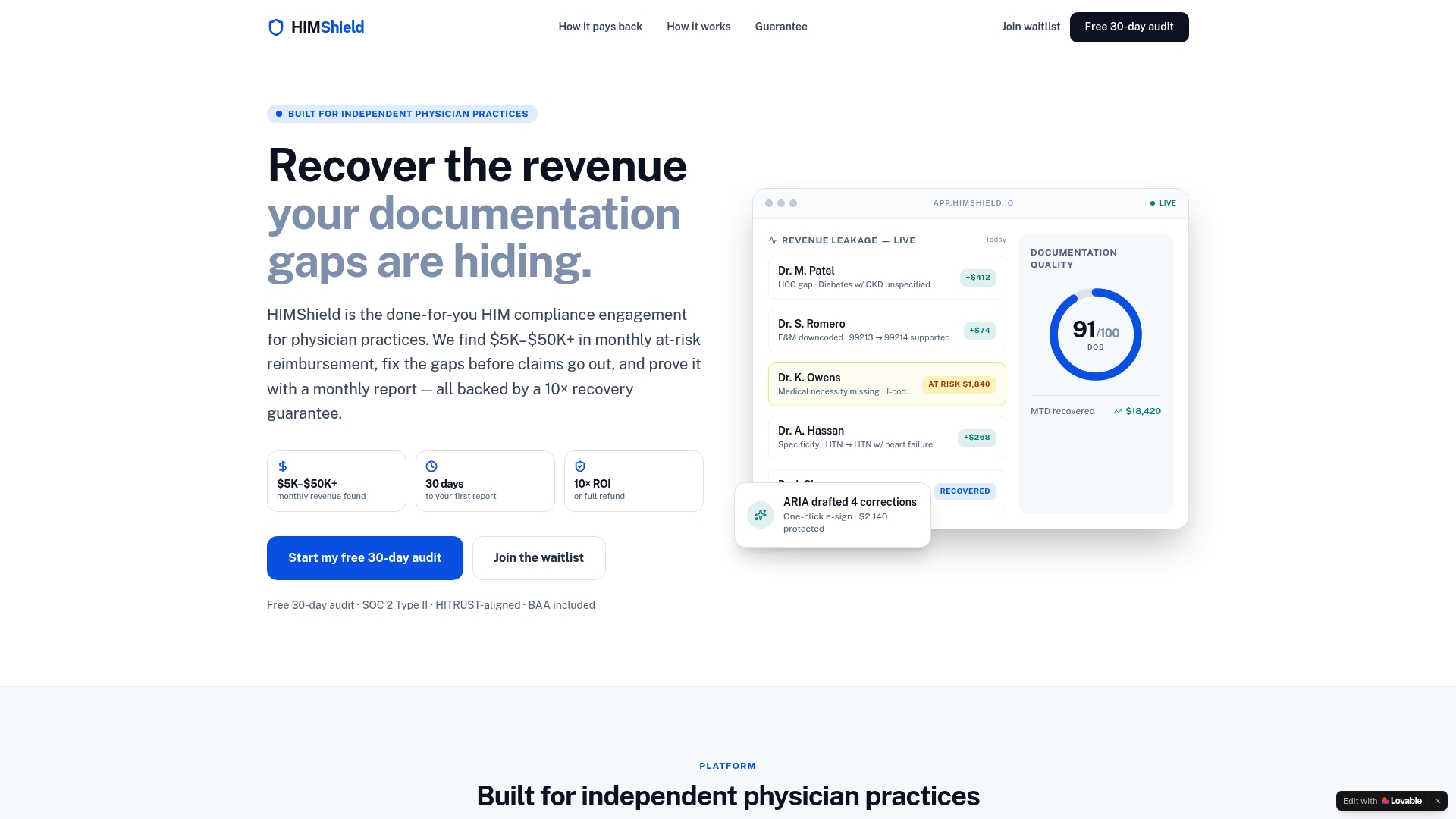
The audit delivers a prioritized list of chart-level fixes ranked by dollar impact, plus specific education points your clinicians can act on immediately rather than a generic compliance report nobody reads. From there, practices that want ongoing protection move into a full HIM compliance engagement, which pairs automated risk detection with physician-friendly correction workflows so your team isn't relearning MDM language from scratch every quarter. Run the free audit, fix the highest-impact charts it flags, and decide from there whether ongoing compliance support makes sense for your practice.
Sources
The rules covered here trace back to the 2021 AMA E/M guidance, AAPC's CPT 99214 code detail, and time-window specifics from Pabau's coding reference. Auditors and payer review teams reference these same sources routinely, which makes them worth bookmarking alongside your practice's internal coding checklist.
This article is general information, not a substitute for advice from a qualified financial advisor. Consult a qualified financial professional about your own circumstances before acting on anything here.
FAQ
What Two Routes Qualify a Visit for 99214?
A visit qualifies through moderate-complexity MDM, meeting two of three elements, or through 30 to 39 minutes of total provider time on the date of service, per AMA guidance.
How Many MDM Elements Does 99214 Require?
Two of the three elements: number and complexity of problems, amount and complexity of data reviewed, and risk of complications, must reach moderate complexity.
Does Pro Tipescription Management Alone Support 99214?
Pro Tipescription drug management is a recognized risk qualifier, but it typically needs to pair with problem complexity or data review to reach two full MDM elements.
What Time Counts Toward the 30 to 39 Minute Window?
Chart review, face-to-face time, documentation, and care coordination on the date of service all count; staff time and work done on other dates do not.
Can Himshield Help Identify 99214 Documentation Gaps?
Yes. Himshield's Free 30-day Revenue Leakage Audit reviews your EHR data to flag charts missing the documentation elements payers require before claims go out.