
Clinical Documentation Improvement (CDI) is defined as the process of reviewing and refining clinical records to ensure documentation accurately reflects patient severity, supports correct coding, and protects reimbursement. For medical groups, CDI best practices are the difference between revenue captured and revenue lost to denials, downcoding, and compliance risk. The most effective CDI programs in physician groups combine physician engagement, focused audits, upstream workflow integration, and cross-functional governance. Tools like ambient AI scribes, structured EHR templates, and real-time query systems now support these programs, but human oversight and physician ownership remain non-negotiable.
1. What are the top CDI best practices for medical groups?
The six practices below are the foundation of any high-performing CDI program in a medical group setting. Each one is specific, testable, and built for the resource constraints independent practices actually face.

Start with a focused pilot program
Pilot CDI programs should target a single service line or provider subset for 60–90 days before scaling. This window gives you measurable data without overextending your team. A cardiology or orthopedics service line, for example, generates high-dollar encounters with predictable documentation failure patterns, making it an ideal starting point.
Limit audit volume to what your team can act on
Ongoing audits reviewing 5–10 charts per provider per month give smaller practices enough data to identify gaps without creating reviewer burnout. That number sounds modest, but it produces 60–120 reviewed charts per year per provider. That volume is sufficient to spot patterns, drive education, and track improvement over time.
Focus on 3–5 high-impact documentation failure areas
Limiting CDI scope to 3–5 high-impact areas such as high-dollar specialties or common denial themes maximizes revenue protection without overwhelming staff. Chasing every documentation gap simultaneously produces noise. Prioritizing by denial frequency and revenue impact produces results.
Embed CDI upstream in the clinical encounter
Starting CDI upstream in the encounter workflow rather than relying on retrospective cleanup avoids rework and captures documentation while clinical reasoning is still fresh. EHR template improvements, smart phrases, and pre-visit checklists are practical tools for this. Upstream embedding is the single biggest structural shift a medical group can make to improve documentation quality at scale.
Engage physician champions for peer-driven education
Physician champions provide peer-to-peer education that administrative mandates cannot replicate. A physician champion who reviews a colleague's chart and explains a specific documentation gap in clinical terms drives behavior change far more effectively than a compliance memo. Identify one or two physicians per service line who understand coding implications and give them structured time to lead feedback sessions.
Build a cross-functional CDI steering committee
High-performing CDI programs involve finance, coding, compliance, and clinical operations as a unified team. Each stakeholder brings a different lens. Finance tracks revenue impact. Coding identifies specificity gaps. Compliance monitors regulatory risk. Clinical operations manages workflow friction. Without all four at the table, CDI programs tend to solve one problem while creating another.
Pro Tip: Create a shared CDI dashboard visible to all steering committee members. When finance, coding, and clinical leads see the same denial data in real time, alignment happens faster and education becomes more targeted.
2. How can integrating technology enhance CDI programs in medical groups?
Technology does not replace physician judgment in CDI. It reduces the cognitive load that causes documentation gaps in the first place.
Ambient AI scribes and structured EHR templates
Ambient AI documentation tools capture clinical conversations and generate draft notes, reducing the time physicians spend on post-visit documentation. AI documentation tools enhance note specificity and reduce clinician documentation burden but require human governance for compliance and final content acceptance. The treating clinician must review, edit, and sign every note. AI-generated content that goes unchecked creates compliance exposure, not protection.
Well-designed EHR templates with prompts for diagnosis specificity reduce vague documentation and improve coding accuracy. A template that prompts a physician to specify "type 2 diabetes with diabetic chronic kidney disease, stage 3" instead of "diabetes with kidney disease" directly affects HCC capture and risk-adjusted reimbursement.
Real-time documentation queries and concurrent review
Concurrent CDI review during patient care catches documentation gaps while case details are fresh and minimizes rework. Real-time query systems embedded in the EHR allow CDI specialists to flag incomplete or vague entries at the point of care rather than days later. This approach reduces the back-and-forth that slows note closure and frustrates physicians.
- Ambient AI scribes: Commure Scribe and similar tools auto-draft notes from clinical conversations, reducing post-visit documentation time.
- Smart phrases: EHR-native shortcuts that auto-populate condition-specific language and prompt for required specificity fields.
- Real-time query tools: Embedded alerts that notify physicians of documentation gaps before note finalization.
- Concurrent review workflows: CDI specialist review during active encounters rather than retrospective chart pulls.
Pro Tip: Pilot one technology tool at a time. Deploying ambient AI and a new query system simultaneously makes it impossible to isolate which change is driving documentation improvement.
3. What auditing strategies and metrics best sustain CDI success?
Auditing without measurement is activity without direction. The metrics below tell you whether your CDI program is working and where to focus next.
| Metric | What it measures | Why it matters |
|---|---|---|
| Query rate | Frequency of documentation queries per encounter | Indicates how often documentation is incomplete at the point of care |
| Agreement rate | Percentage of queries accepted by physicians | Reflects query quality and physician engagement |
| Denial rate by code | Claim denials linked to specific diagnosis or procedure codes | Maps documentation gaps to revenue loss |
| Revenue impact | Dollar value recovered or at risk from documentation changes | Quantifies CDI program return on investment |
| Response rate | Speed and completeness of physician query responses | Signals workflow friction or physician buy-in gaps |
Audit metrics including query rate, response rate, denial mapping, and revenue impact provide the data needed to drive continuous CDI improvements. Denial mapping is particularly valuable because it connects a specific documentation failure to a specific payer rejection. That connection makes physician education concrete and credible.
Closed-loop feedback is the mechanism that turns audit data into behavior change. Monthly education sessions built around actual denial cases from your own practice are more persuasive than generic coding guidelines. Building an appeal letter library from resolved denials gives your team a reusable resource and reinforces what correct documentation looks like.
4. How does physician engagement influence CDI effectiveness?
Physician engagement is not a soft factor in CDI. It is the primary driver of whether documentation actually improves.
Most CDI failures stem from unclear ownership of query resolution and feedback. When no one is accountable for responding to a documentation query, queries pile up, coders make assumptions, and denials follow. Physician champions solve this by creating a named, respected point of accountability within the clinical team.
"Effective CDI programs treat documentation as evidence and clinical reasoning, not just a memory aid." — AHIMA Journal
Peer-to-peer education works because physicians respond to clinical arguments, not administrative pressure. A physician champion who explains that a vague diagnosis code triggered a denial and cost the practice $800 on a single claim gets attention. A compliance officer sending a policy reminder does not.
Practical steps to build physician engagement in your CDI program:
- Assign physician champions per service line with protected time for CDI feedback and education.
- Use case-specific examples from your own denial data in every education session.
- Embed CDI prompts in existing workflows so documentation improvement requires minimal extra steps.
- Track and share individual provider metrics in a non-punitive format that shows trends over time.
- Recognize improvement publicly in team meetings to reinforce positive behavior change.
The goal is to make good documentation the path of least resistance, not an additional burden layered on top of an already full clinical day.
5. How to structure and govern a scalable CDI program
CDI governance determines whether your program survives beyond the pilot phase. Without clear structure, even well-designed programs collapse under competing priorities.
-
Assign a CDI program lead. This person does not need to be full-time, but they need defined accountability for program performance, audit schedules, and reporting. A part-time CDI coordinator with coding credentials and clinical experience is a realistic starting point for most medical groups.
-
Form a cross-functional steering committee. Include representatives from finance, clinical operations, coding, and compliance. Meet monthly at minimum. Quarterly reviews of denial trends and revenue impact keep the committee focused on outcomes rather than process.
-
Phase your rollout deliberately. Start with one service line for 60–90 days. Measure query rates, denial rates, and revenue impact. Use that data to build the business case for expanding to additional service lines or provider groups.
-
Align CDI scope with value-based care contracts. HCC capture, quality reporting, and risk adjustment all depend on documentation accuracy. A CDI program that improves specificity for chronic conditions simultaneously supports value-based care performance metrics.
-
Treat CDI as an operating model, not a repair function. Transitioning CDI from a siloed, reactive function to an integrated operating model with cross-functional input improves documentation, billing, compliance, and quality reporting outcomes. Retrospective cleanup is expensive and demoralizing. Upstream integration is sustainable.
Pro Tip: Schedule your first steering committee meeting before your pilot launches. Waiting until you have data to share means losing three months of stakeholder alignment time.
Key takeaways
Effective CDI programs in medical groups succeed through focused governance, upstream workflow integration, and physician-led education rather than high-volume auditing or technology alone.
| Point | Details |
|---|---|
| Pilot before scaling | Test CDI in one service line for 60–90 days to build a data-driven case for expansion. |
| Audit at the right volume | Review 5–10 charts per provider monthly to identify gaps without burning out your team. |
| Focus on high-impact areas | Limit CDI scope to 3–5 documentation failure areas tied to your highest denial rates. |
| Embed technology upstream | Use EHR templates and AI scribes to catch gaps at the point of care, not after the fact. |
| Physician champions drive change | Peer-to-peer education from a physician champion outperforms any administrative mandate. |
What I've learned about CDI that most guides won't tell you
The most common mistake I see medical groups make is importing a hospital-based CDI model without adapting it. Full-time dedicated CDI reviewers pulling 50 charts a day made sense in a 400-bed inpatient setting. In a 12-physician multispecialty group, that model burns through budget and goodwill in under six months.
Hospital-based CDI staffing models with full-time dedicated reviewers often fail financially in smaller medical groups. The sustainable alternative is embedding documentation prompts and AI scribes upstream, then auditing a focused set of high-impact encounters. Governance over volume is the principle that separates programs that last from programs that get quietly abandoned.
I also want to be direct about AI tools. Ambient scribes from platforms like Commure Scribe are genuinely useful. They reduce post-visit documentation time and improve note completeness. But the treating clinician retains legal and compliance ownership of final documentation regardless of AI or scribe involvement. Every AI-generated note needs physician review and sign-off. A CDI program that treats AI output as final documentation is creating audit risk, not reducing it.
The practices that sustain CDI culture over time are the unglamorous ones: consistent monthly feedback, physician champions with real protected time, and a steering committee that actually reviews denial data together. Those habits compound. After 12 months, a medical group with those habits in place looks fundamentally different from one that ran a one-time audit and called it a program.
— Elena
How Himshield helps medical groups protect earned revenue
Medical groups that implement CDI best practices still leave revenue at risk if they lack the tools to detect documentation and coding gaps before claims go out the door.
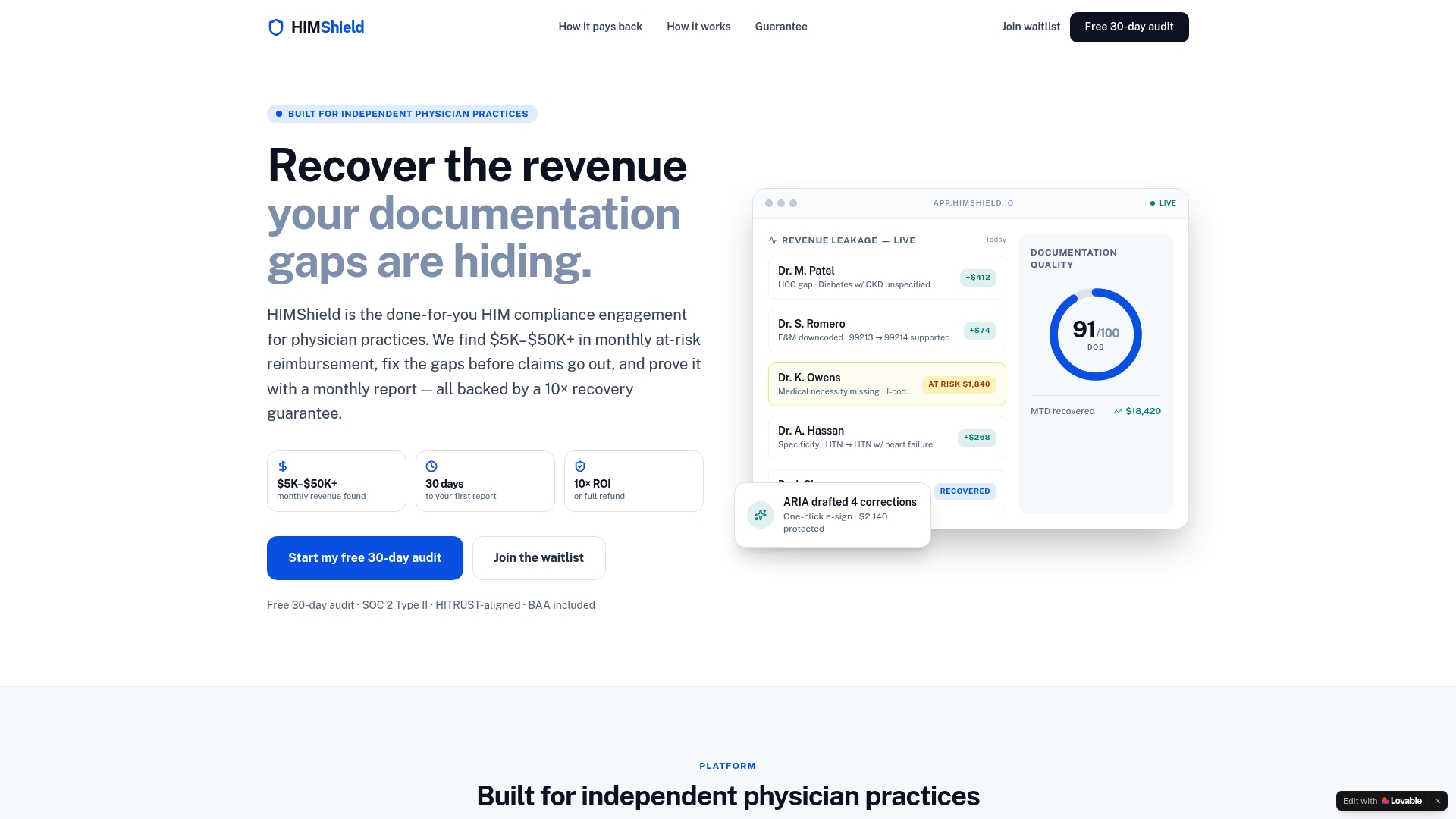
Himshield scans your charts for coding, documentation, and charge-capture risks before they become denials or audits. The platform identifies HCC gaps, specificity failures, and billing inconsistencies across your encounters and delivers physician-friendly guidance your team can act on immediately. For medical groups serious about protecting $5K–$50K or more in at-risk reimbursement, Himshield's revenue recovery platform provides the automated risk detection and compliance defense your practice needs to keep every earned dollar.
FAQ
What is CDI in a medical group context?
CDI, or Clinical Documentation Improvement, is the process of reviewing and refining clinical records so they accurately reflect patient severity, support correct coding, and protect reimbursement. In medical groups, CDI programs focus on physician engagement, focused audits, and workflow integration to reduce denials and improve revenue cycle performance.
How many charts should a medical group audit per month?
Expert consensus recommends reviewing 5–10 charts per provider per month for ongoing CDI audits. This volume is sufficient to identify documentation patterns and drive education without overwhelming reviewers or physicians.
How long should a CDI pilot program run?
A CDI pilot program should run for 60–90 days focused on a single service line or provider subset. That window generates enough data to measure query rates, denial impact, and revenue changes before committing to a full rollout.
Do AI scribes replace CDI specialists in medical groups?
No. AI documentation tools support documentation quality but require human governance for compliance and final content acceptance. The treating physician retains legal ownership of every note regardless of how it was drafted.
What metrics should a medical group track for CDI success?
Track query rate, physician agreement rate, denial rate by code, and revenue impact. Denial mapping connects specific documentation failures to payer rejections, making physician education concrete and measurable.