
A physician practice audit survival checklist is a systematic tool that helps independent physician practices prepare for, respond to, and sustain compliance through ongoing financial and clinical documentation scrutiny. Medical practices lose 3–5% of net revenue annually due to preventable billing errors and denials. On a $2M practice, that translates to up to $100,000 in recoverable losses. The OIG Compliance Program Guidance identifies internal auditing as a primary mechanism for reducing penalties and demonstrating good faith. When you treat audit readiness as a daily operational standard rather than a crisis response, audits become routine administrative tasks instead of financial emergencies.
1. What are the critical components of a physician practice audit survival checklist?
Every effective audit checklist covers four core areas: coding accuracy, documentation integrity, denial management, and response protocols. Missing any one of these creates a gap that payers and regulators will find before you do.
Coding and claim review
- Conduct quarterly internal audits reviewing 20–50 charts per provider. Focus on evaluation and management (E/M) coding, modifier usage, and high-dollar procedures.
- Run monthly spot-checks of 10–15 claims targeting high-risk billing areas. This frequency catches drift before it becomes a pattern.
- Review modifier usage against payer-specific policies. Incorrect modifiers are one of the most common triggers for claim denials.
Documentation standards
- Require providers to sign off on all clinical notes before submission. Unsigned or auto-populated notes are a top audit flag.
- Retain all financial and clinical records for a minimum of seven years. Medicare and CMS retention rules apply to billing records, not just medical charts.
- Avoid overusing automated EMR note templates without provider review. Documentation inconsistencies from template overuse are flagged regularly in Medicare audits.
Denial management
- Monitor your denial rate monthly. If it exceeds 5%, trigger a focused audit of the claim types driving that rate.
- Track denial reasons by category: coding errors, missing documentation, eligibility issues. Each category points to a different root cause.
Response protocols
- Designate one audit coordinator for all external communications. A single point of contact prevents contradictory disclosures and controls the information flow.
- Submit only the documents specifically requested by the auditor. Over-submitting records can trigger expanded reviews and increase your risk exposure.
Pro Tip: Build your checklist inside your practice management system as a recurring task, not a paper form. Digital checklists create an automatic audit trail that proves your compliance program is active.
2. How often should physician practices conduct audits and reviews?

Audit frequency is not a preference. It is a compliance requirement that protects your revenue and your license.
The standard cadence for independent practices follows three tiers:
- Quarterly internal audits. Review 20–50 charts per provider each quarter. Focus on E/M coding accuracy, procedure documentation, and modifier compliance. Use a chart audit workflow to standardize what you review and how you score findings.
- Monthly spot-checks. Pull 10–15 claims from high-risk billing categories. This keeps your team calibrated between full quarterly reviews.
- Annual external audits. Engage an independent certified coder to review 100–200 charts. Independent auditors eliminate the blind spots that billing staff self-audits consistently miss. Their reports carry more weight with regulators than internal reviews alone.
- Trigger-based audits. Launch an unscheduled audit when denial rates spike, a new provider joins the practice, or a payer sends a notification. These events signal a change in billing patterns that warrants immediate review.
Track these three KPI benchmarks continuously to know when a trigger audit is warranted:
- Clean claim rate: 96% or higher
- Denial rate: below 5%
- Days in accounts receivable: below 35
KPI benchmarks are most useful as trend indicators, not one-time snapshots. A clean claim rate that drops from 98% to 96% over three months signals a problem even if it still meets the threshold.
3. What documentation and record-keeping practices support audit success?
Precise documentation is your primary defense in any audit. Disorganized or incomplete records force auditors to draw their own conclusions, and those conclusions rarely favor the practice.
Core documentation requirements
- Align every patient bill with the corresponding submitted claim and supporting clinical note. Mismatches between billing records and clinical documentation are the most common audit finding.
- Maintain source documents including receipts, invoices, and payment statements for all financial transactions. These records substantiate your charge-capture process.
- Reconcile your ledger across all payment channels monthly. Unreconciled accounts signal internal control failures to auditors.
Record retention and system design
- Store records in a cloud-based system with a built-in audit trail. Audit-trail-enabled systems log every access, edit, and deletion, which protects you from allegations of record tampering.
- Apply CMS retention standards: billing records must be kept for a minimum of seven years, and longer in states with stricter requirements.
- Require provider certification on all records before submission to an auditor. Provider sign-off confirms accuracy and completeness, and it shifts accountability appropriately.
Pro Tip: Run a quarterly reconciliation between your EHR clinical notes and your billing system claims. Gaps in that reconciliation are exactly what a Medicare RAC auditor looks for first.
| Documentation area | Minimum standard | Risk if missed |
|---|---|---|
| Clinical notes | Provider-signed, visit-specific | Claim denial, repayment demand |
| Billing records | 7-year retention, source documents | Regulatory penalty |
| Ledger reconciliation | Monthly, all payment channels | Internal control finding |
| Audit trail | Cloud-based, access-logged | Tampering allegation |
4. What are best practices for managing audit responses and minimizing risk?
How you respond to an audit request matters as much as what your records contain. A disorganized or over-eager response can turn a routine review into an expanded investigation.
Follow these steps when an audit request arrives:
- Assign your audit coordinator immediately. This person manages all communications with the auditor. No other staff member responds to audit inquiries directly. Centralizing communication prevents contradictory disclosures and keeps your response consistent.
- Read the request carefully. Identify exactly which records are requested, the date range, and the response deadline. For Medicare RAC audits, the response window is 45 days. Missing that deadline results in automatic claim denials and repayment demands.
- Gather only what is requested. Do not include additional records, explanatory letters, or unsolicited context. Submitting beyond the request scope signals that you have more to hide or explain.
- Require provider sign-off before submission. Every document in your response package needs a provider review confirming its accuracy and completeness.
- Log everything you submit. Keep a complete copy of your response package with submission timestamps. This record protects you if the auditor claims records were missing.
- Prepare your appeal strategy in advance. Understand the multilayered Medicare appeal process before you need it. Practices that prepare appeal templates in advance respond faster and more accurately.
"Voluntary self-disclosure to the OIG, when appropriate, demonstrates good faith and can significantly reduce penalties compared to waiting for a formal investigation. The key is knowing when disclosure helps versus when it escalates scrutiny. Consult healthcare legal counsel before making that decision."
5. How can practices use audit data and technology to stay audit-ready?
AI-enabled payer audits use advanced analytics to flag irregular billing patterns in real time. That means your practice needs daily operational audit readiness, not just quarterly reviews.
The shift to data-driven auditing by payers changes what "prepared" means. A practice that only reviews charts quarterly will always be behind a payer that scans claims daily. Closing that gap requires building continuous monitoring into your operations.
Technology and monitoring practices
- Implement a cloud-based billing system with real-time audit trail logging. Every claim edit, denial, and resubmission should be timestamped and attributed to a specific user.
- Set automated alerts for KPI threshold breaches. When your denial rate crosses 5% or your clean claim rate drops below 96%, the system should notify your billing manager the same day.
- Use a concurrent audit program to review documentation at the point of care rather than weeks after service. Concurrent audits catch errors before claims are submitted.
- Review the OIG Work Plan quarterly. The Work Plan identifies federal audit targets for the coming year. Practices that align internal audits with OIG priorities catch the same risks federal auditors will target.
- Train providers and billing staff on documentation standards at least twice per year. Training records serve as evidence of your compliance program's activity.
Pro Tip: Integrate your audit findings into your next training session. Specific examples from your own claims data are more effective than generic compliance training modules.
| Monitoring method | Frequency | Primary benefit |
|---|---|---|
| KPI dashboard review | Daily | Early detection of billing drift |
| Concurrent documentation audit | At point of care | Prevents claim errors before submission |
| OIG Work Plan review | Quarterly | Proactive federal risk alignment |
| Provider compliance training | Twice per year | Reduces documentation errors |
Key Takeaways
A physician practice audit survival checklist works because it converts reactive crisis management into a structured, daily compliance standard that protects both revenue and regulatory standing.
| Point | Details |
|---|---|
| Audit frequency matters | Quarterly internal audits, monthly spot-checks, and annual external reviews form the minimum compliance cadence. |
| KPI benchmarks trigger action | A clean claim rate below 96% or a denial rate above 5% signals an immediate need for a focused audit. |
| Documentation is your defense | Provider-signed, reconciled, and cloud-stored records are the foundation of every successful audit response. |
| Response discipline reduces risk | Submit only requested documents within the 45-day RAC window and require provider sign-off before submission. |
| Technology closes the gap | Concurrent audits and real-time KPI alerts keep practices ahead of AI-driven payer scrutiny. |
What I have learned from years of watching practices get audited
The practices that survive audits without financial damage are not the ones with perfect billing records. They are the ones with a system. I have watched well-run practices get rattled by a RAC audit simply because no one had a clear role when the request arrived. The coordinator was not designated, the records were not organized by date range, and the first response included three times the requested documentation. That single mistake extended a routine review into a six-month investigation.
The most common mistake I see is treating the audit coordinator role as an afterthought. Designating that person before an audit arrives, and training them on response protocols, is the single highest-return compliance investment a practice can make. The second most common mistake is over-relying on EMR auto-populated notes. Providers who review and certify their notes before submission rarely face documentation-based denials. Providers who trust the template almost always do.
Audit readiness is not a project you complete. It is an operational standard you maintain. The practices that build quarterly audits, monthly spot-checks, and KPI monitoring into their regular workflow treat a payer audit request the same way they treat a routine insurance verification. It is a task, not a threat. That mindset shift is the real survival strategy.
— Elena
Himshield helps practices protect every earned dollar
Independent physician practices face real financial risk from billing errors and audit exposure. Himshield identifies coding, documentation, and charge-capture risks before they become denials or formal audits.
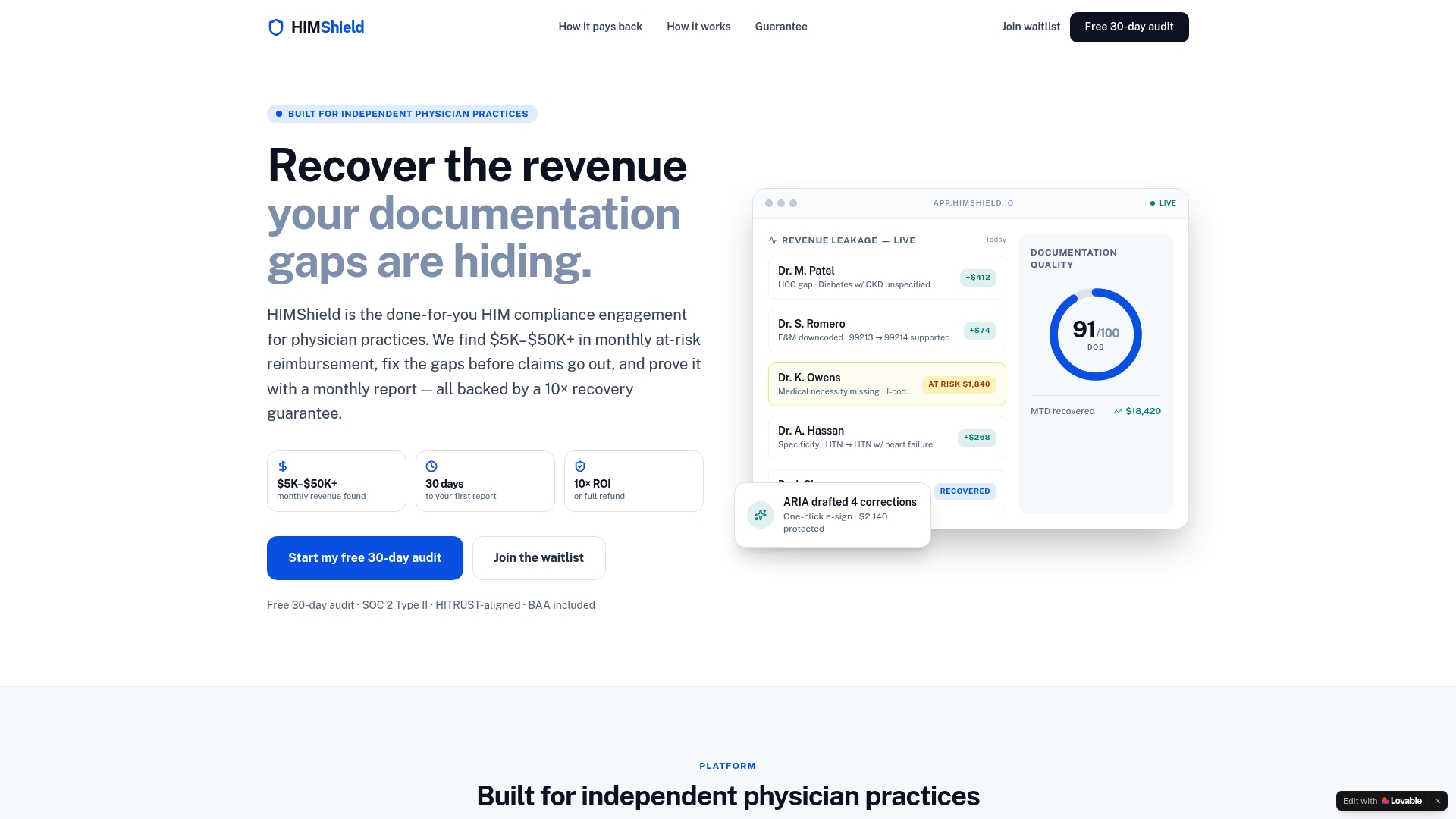
Himshield connects directly with your EHR and delivers clear, automated risk detection within 30 days. Practices using Himshield recover $5K–$50K+ in hidden revenue by catching errors that manual reviews miss. The platform flags high-risk claims, surfaces documentation gaps, and gives your team physician-friendly guidance to fix issues before submission. If you are ready to protect your practice's financial health, see how Himshield works and get started with a revenue recovery review.
FAQ
What is a physician practice audit survival checklist?
A physician practice audit survival checklist is a structured tool that guides independent practices through proactive audit preparation, documentation standards, and compliant response protocols. It converts audit readiness from a reactive crisis into a daily operational standard.
How many charts should a practice review in a quarterly internal audit?
Quarterly internal audits should review 20–50 charts per provider, focusing on E/M coding, modifier usage, and high-dollar procedures. Monthly spot-checks of 10–15 claims supplement the quarterly review.
What is the response deadline for a Medicare RAC audit?
Medicare Recovery Audit Contractor audits require a response within 45 days. Missing that deadline results in automatic claim denials and repayment demands.
Why should practices avoid submitting extra documents in an audit response?
Submitting beyond the requested records can trigger expanded reviews, increasing both administrative burden and financial risk. Provide only what the auditor specifically requested.
What KPIs signal that a practice needs an immediate audit?
A clean claim rate below 96%, a denial rate above 5%, or days in accounts receivable above 35 are the three benchmarks that signal a focused audit is needed. Track these metrics as trends, not one-time readings.