
Charge capture reconciliation is the routine of matching every service your providers delivered against the charges that actually reached a claim, then resolving each gap. In an independent practice, it means comparing the schedule, the visit documentation, the posted charges and the claim, finding what is missing, duplicated or unsupported, and fixing the cause. Done daily or weekly, it is one of the most direct ways to stop leaving money on the table.
This guide covers what to compare, the steps, what the report should hold, how to work exceptions, and what to look for if you add software.
TL;DR
- Reconciliation compares what happened (schedule, notes, orders) with what was billed (charges, claims, remittances) and flags every mismatch.
- Follow each service through the whole chain: scheduled visit, documentation, charge entry, claim, payment and explanation of benefits.
- Every exception needs a root cause, an owner, an action and a follow-up, not just a corrected charge.
- Report by provider and payer, and track time from note closure to claim creation.
- Software helps most when it checks charges before claims go out and leaves your staff able to override it.
Table of Contents
- What charge capture reconciliation is, and why it matters
- The records to compare
- The charge reconciliation process, step by step
- What a reconciliation report should include
- Working exceptions: common causes and fixes
- Auditing for missed, duplicate and inaccurate charges
- Who owns reconciliation in a small practice
- Choosing charge capture audit software
- See your own numbers first
- A practical starting plan
- FAQ
- Sources
What charge capture reconciliation is, and why it matters
Charge capture is the process of turning each service a patient receives into a billable line item. Reconciliation is the control that proves it worked. You start from an independent record of care, such as the appointment schedule or a procedure log, and confirm every item has a matching charge. You also confirm that each charge has documentation behind it.
The work runs in two directions:
- Missed charges: services performed but never billed, such as an in-office injection documented in the note and never coded.
- Unsupported charges: charges with no documentation behind them. The control principle in one revenue integrity audit guide is simple: undocumented services should not be billed.
For an independent practice, both directions carry cost. Missed charges are revenue you earned and never collected. Unsupported or inaccurate charges are denial and audit exposure. Reconciliation tackles both before the claim leaves your building, which is cheaper than appealing a denial or answering a payer records request later.
If you want a deeper look at how much revenue typically slips through, our piece on revenue loss from charge capture errors walks through where leakage starts.
The records to compare
The strongest reconciliation follows a service across the whole chain. The American Academy of Family Physicians describes a chart audit that compares the appointment schedule, superbill, patient-account detail, medical record, claim, and explanation of benefits. Each record answers a different question.
| Record | Question it answers | Typical gap it exposes |
|---|---|---|
| Appointment schedule or census | Who was seen, by whom, when? | Visits with no charge at all |
| Superbill or encounter form | What did the provider intend to bill? | Missing add-on services, unchecked procedures |
| Medical record (note, orders, results) | What was actually done and documented? | Services not supported by the note |
| Charge detail in the billing system | What was posted? | Duplicates, wrong codes, wrong units |
| Claim | What went to the payer? | Charges dropped between entry and submission |
| Remittance advice and EOB | What did the payer do with it? | Underpayments, repeated denials, unpaid claims |
The schedule is the anchor. A sample charge capture reconciliation policy asks departments to keep a detailed service record such as a schedule or census and reconcile charges daily against the appropriate system reports. Starting from the schedule is what lets you catch a visit that never produced a charge, because a charge-only review cannot see what is absent.
The charge reconciliation process, step by step
A small practice can run this with one biller and a few reports. Larger medical groups split the steps across roles. The sequence is the same.
1. Pull the service record
Export the day's or week's completed visits from the scheduling system. Include provider, patient, date of service, visit type and status. Remove cancellations and no-shows so they do not clutter the exceptions list.
2. Pull the charges posted for the same period
Run the charge entry report for the same dates of service, not the same posting dates. Mixing the two is the most common reason a reconciliation shows false gaps.
3. Match visits to charges
Match by patient, date and provider. Sort the results into three buckets: matched, visits with no charge, and charges with no visit. The first bucket needs only a spot check. The other two are your exceptions.
4. Check documentation for each exception
Open the note. Was the service performed and documented? If yes and no charge exists, you have a missed charge. If a charge exists and the note does not support it, you have an unsupported charge that must not go out as is.
5. Check the charge against the note
On a sample of matched visits, confirm the codes, units, modifiers and diagnoses reflect the documentation. AAFP's audit looks for unbilled services, incorrect procedure codes, charges for services not performed, and diagnosis-code discrepancies.
6. Resolve each exception with a root cause
Fix the charge, then record why it happened. The sample policy expects staff to review encounter documentation and assign a root cause, action plan, and follow-up whenever charges are missing, inaccurate or incorrect. Without that step you fix the same error every week.

7. Follow the claim through payment
Confirm the corrected charge reached a claim, was accepted, and was paid. Compare payments with the remittance advice and EOB. Repeated denials and unpaid claims are part of the same audit trail.
8. Report and repeat
Summarize the findings and review them with providers. Then run it again on the next cycle. Frequency matters more than perfection: a small daily check finds problems while the encounter is still fresh.
What a reconciliation report should include
A useful report is short enough to read in a staff meeting and specific enough to assign work. Build it around these elements:
- Period and scope: dates of service, providers and locations covered.
- Volume match: visits scheduled and completed, charges posted, and the count in each exception bucket.
- Exception list: patient or encounter ID, provider, issue type (missed, duplicate, inaccurate, unsupported), dollar impact and status.
- Root cause and action: the reason (open note, missing superbill item, templating gap, front-desk handoff) and who owns the fix.
- Timing metrics: the AMA's 2025 private-practice guidance suggests accounts-receivable reporting that includes time from note closure to claim creation, claim creation to sending, and sending to payer acceptance, plus aging buckets, denial rates and denial trends.
- Provider and practice views: the AMA also advises physician-level and practice-level reports showing paid and denied claims, so physicians can see what works and what does not.
Slicing by provider and by payer is where patterns appear. One provider whose notes stay open for days, or one payer that denies a particular code, will hide inside a practice-wide average.
Working exceptions: common causes and fixes
Most exceptions trace back to a short list of causes. Sorting them this way turns a long list into a few process changes.
| Exception | Likely cause | Fix |
|---|---|---|
| Visit, no charge | Note left open, superbill not turned in | Daily open-note report; charge-entry deadline |
| Procedure documented, not billed | Provider did not select it, coder did not see it | Procedure checklist in the encounter template |
| Duplicate charge | Manual entry plus interface import | Interface rules; duplicate check on date, code and patient |
| Wrong code or units | Template defaults, outdated charge master | Charge master review; targeted education |
| Charge without support | Copied-forward text, vague note | Hold the claim; query the provider; do not bill without documentation |
| Denied or unpaid after billing | Coding, eligibility or payer rule issue | Trend by payer; correct and resubmit; fix upstream |
When a correction needs a provider's input, speed matters. Queries that sit for a week become denials or timely-filing risks. Our walkthrough of a four-step coding correction process shows how to route corrections to providers with minimal friction.
Auditing for missed, duplicate and inaccurate charges
Daily reconciliation catches operational slips. A periodic audit tests whether the process itself is sound. CMS guidance for large practices recommends that practices emphasize clinician documentation, periodically audit records for completeness and consistency, audit claims before and after payment, and address incorrect coding.
A revenue integrity audit guide frames the test in three words: completeness, appropriateness and accuracy. It does this by reviewing chart documentation, charge capture, claim or itemized charges, and third-party remittance advice. Supporting documentation such as orders, test results, progress notes, interpretations and medical-necessity details should be there for each billed service.
Some specialties need extra checks. A peer-reviewed case report from an oncology practice describes reconciling drug inventory movement with J-code billing reports and using wastage logs to investigate variances. If your practice administers injectables or infusions, the same idea applies: compare what left the shelf with what was billed.
For a repeatable method, see our five-step missed charges audit and our guide to setting up an internal billing audit. If you are new to the terminology, what a coding audit is covers the basics.

Who owns reconciliation in a small practice
Independent practices rarely have a dedicated revenue integrity team. Ownership still needs a name. A workable split:
- Providers close notes on time and select every service performed.
- Front desk keeps the schedule accurate, because the schedule is the control record.
- Biller or coder runs the match, works exceptions and logs root causes.
- Practice administrator reviews the report, sets deadlines and follows trends by provider and payer.
Health information management professionals bridge documentation and billing. How that role supports accuracy is covered in the role of HIM in revenue integrity. Keep the audit trail: who found the issue, what changed, and when.
Choosing charge capture audit software
Manual reconciliation works until volume grows or staff turn over. Software can take over the matching and flag exceptions sooner. The AMA's Steps Forward module advises practices to evaluate revenue cycle systems for fit with practice needs, EHR and clearinghouse integration, usability, AI, compliance and security, pricing, and customer support. It also says to understand software limitations and keep the ability to override automation to correct errors.
Use that as your checklist:
- EHR fit: does it read your EHR data without manual exports?
- Timing: does it check before claims are submitted, not only after denials?
- Coverage: does it catch coding, documentation and charge-capture gaps, not just one?
- Provider workflow: can a physician review and approve a correction quickly?
- Audit trail: the AMA notes software can pre-audit claim fields and create an electronic audit trail showing claim acceptance or rejection.
- Security and support: how is patient data protected, and who helps your staff?
- Pricing: is it scaled to your provider count and chart volume?
If you are weighing AI-assisted review, a time-boxed trial limits risk. Our guide to testing an AI coding audit in a 30 to 90 day pilot shows how to set success measures up front.
Our perspective
Most practices we talk to already reconcile something. A biller checks the schedule against charges when time allows, and a provider catches a missed injection now and then. The problem is that this work depends on memory and spare hours, and the leaks that cost the most are the quiet ones: a note closed late, a code that is slightly off, a pattern with one payer.
We built HIMShield to make reconciliation continuous rather than occasional. It scans EHR data before claims go out, quantifies coding, documentation and charge-capture gaps, and shows them per provider and per payer in a Revenue Leakage Report. Corrections are drafted for you and go to the physician for a one-click e-signature, so fixing a gap takes minutes, not a chain of emails.
We designed it to work without new staff or software training, because independent practices do not have spare capacity. Our free 30-day audit comes with a performance guarantee, so you see the numbers from your own data before you commit to anything. We would rather you judge us on your results than on our claims.
Elena
See your own numbers first
If you would like to know what your reconciliation is missing, start with data rather than a guess. Our free 30-day Revenue Leakage Audit analyzes your EHR data and quantifies coding, documentation and charge-capture gaps by provider and payer. You can also read how our HIM compliance engagement works for independent practices.
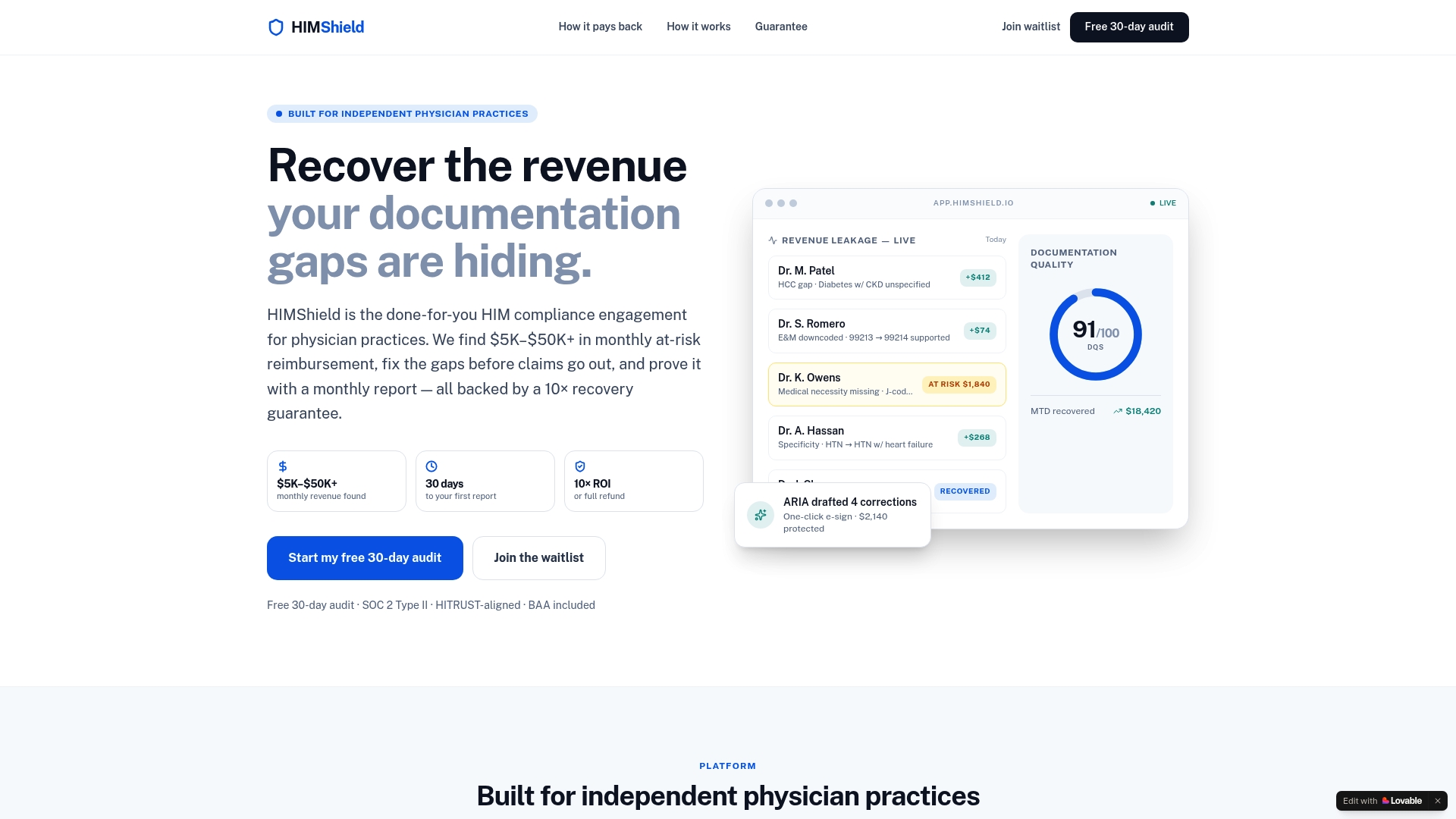
The audit is designed to show where earned revenue is at risk, so your team can decide what to fix first.
A practical starting plan
You do not need a new system to begin. In your first month:
- Week 1: run a one-week reconciliation from the schedule. Count visits with no charge and charges with no visit.
- Week 2: open the notes behind every exception and sort by cause.
- Week 3: set two rules: a note-closure deadline and a charge-entry deadline. Start the open-note report.
- Week 4: build the report by provider and payer, and review it with your physicians.
Then compare your findings with the wider picture of why practices lose reimbursement. Keep upstream quality in view too: specific coding reduces audits and denials, and a practice that tests for upcoding risk protects both sides of the ledger, missed revenue and overbilling.
FAQ
How often should we reconcile charges?
Daily is the standard in the sample policy we reviewed, which asks departments to reconcile charges daily against appropriate system reports. A small practice can start weekly and move to daily as the routine settles. Shorter cycles mean fresher notes and faster fixes.
What is the difference between charge capture and charge reconciliation?
Charge capture is recording each billable service so it reaches a claim. Reconciliation is the check that confirms nothing was missed, duplicated or unsupported. Think of capture as the process and reconciliation as its control.
What should we do with a charge that has no documentation?
Hold it. The control principle is that undocumented services should not be billed. Ask the provider whether the service was performed. If it was, the provider documents it properly and the charge goes out. If not, the charge is removed.
Can a small practice do this without software?
Yes. A schedule export, a charge report and a spreadsheet are enough to start. Software becomes valuable as volume grows, because it can check charges before submission and keep an audit trail. Whatever you choose, keep the ability to override automated results.
Sources
- Chart Audit: Is Your Practice Billing What It Should? (AAFP, Family Practice Management)
- Sample Charge Capture Reconciliation Policy (NAHRI)
- Revenue Integrity Audits (MAPAM)
- Keep a close watch on your private practice's third-party biller (AMA)
- Engage physicians to get your private practice's claims paid (AMA)
- ICD-10 Implementation Guide for Large Practices (CMS)
- Charge Capture: Does Your Process Ensure Accuracy of the Revenue Stream? (PMC)
- Revenue Cycle Management Considerations (AMA Steps Forward)
- The benefits of electronic claims submission (AMA)