
Charge capture errors happen when a service, drug, or supply a clinician delivers never makes it onto a claim, or makes it on incorrectly. The fastest way to stop the bleeding is to run a high-value exception report today, one that flags encounters with documentation but no matching charge. That single report often surfaces the biggest dollar losses before you touch anything else.
TL;DR:
- Running a high-value exception report that flags encounters with documentation but no matching charge can recover a significant portion of revenue leakage.
- Most charge capture errors are caused by missed charges, incorrect coding, or timing issues, which require targeted fixes rather than generic solutions.
- Charge capture failures frequently stem from human errors, process silos, or outdated technology, especially in infusion, operating room, and radiology departments.
- An estimated 0.25% to 1% of net charges are lost annually to charge capture leakage, with government audits revealing substantial improper payments due to coding and documentation gaps.
- Implementing a structured, four-step process of ownership, automation, focused audits, and ongoing measurement can significantly improve charge accuracy and revenue recovery.
Table of Contents
- What charge capture means and why it matters to practice revenue
- Most common charge capture error types and examples
- Root causes and hotspots: where charge capture breaks down
- Financial impact and audit evidence you can cite
- How to detect and measure charge capture errors
- A practical prevention framework: people, process, technology
- Implementation checklist: a 30/90/180 day plan to recover revenue
- Client playbooks and proof points worth knowing
- Why prioritizing exception reports first matters
- Get a free 30-day revenue leakage audit
- Sources
- FAQ
What charge capture means and why it matters to practice revenue
Charge capture is the process that turns clinical work into billable claims. It covers office visits and their evaluation and management (E/M) levels, injections, infusions, drugs, devices, supplies, and any procedure a provider performs during an encounter. When this process works, every unit of care documented in the chart shows up, correctly coded, on the claim that goes to the payer.
When it breaks, the damage spreads in a specific direction: from documentation, to coding, to the claim itself. A missed charge is not just lost revenue, it is a signal that your coding and documentation systems are not talking to each other. Practices that treat charge capture as a billing afterthought, rather than a clinical-financial handoff, tend to see the same errors recur month after month.
The consequences show up in three places:
- Denials. Claims get rejected or delayed because charges do not match documented services.
- Delayed payments. Manual rework and resubmission cycles slow cash flow for weeks.
- Audit exposure. Overpayments and unsupported codes draw payer and government scrutiny, sometimes years after the claim was paid.
Coding specificity plays a direct role here too. A vague or generic code invites denial or downcoding, while a precise, well-supported code protects the revenue you already earned. Coding specificity reduces both the denial rate and the odds of a payer flagging the claim for review.
Most common charge capture error types and examples
Charge capture errors tend to fall into a handful of repeatable categories. Recognizing which one you are dealing with is the first step toward fixing it.
- Missed charges. A nurse administers a contrast agent during imaging, or a physician uses a disposable splint or injects a medication during a visit, and none of it gets entered because the charge never left the clinical workflow.
- Incorrect coding or undercoding. A provider documents a level 4 established patient visit but the claim goes out as a level 3, often because staff default to a lower, safer code rather than verify the higher one is supported. E/M coding errors are among the most frequent and costly mistakes in outpatient billing.
- Duplicate charges and unit errors. Infusion and injection services billed in J-code units are especially prone to this: a nurse enters the same drug administration twice, or bills 10 units when the chart supports 5, inflating or deflating the claim.
- Late capture and timely filing problems. A charge sits in a queue past the payer's filing deadline, often because it was flagged for review and never resolved before the window closed.
- False positives from poor rule logic. Automated charge rules built on an outdated chargemaster can flag legitimate charges as errors, or worse, suppress charges that should have gone out, creating extra manual work without protecting revenue.
Each of these has a distinct fix. Missed charges usually need a reconciliation step between clinical documentation and the billing queue. Coding errors need documentation review paired with coder feedback. Duplicate and unit errors need automated logic checks at the point of entry. Timely filing problems need a queue with aging alerts. False positives need a chargemaster audit. Treating all five as one generic "billing error" problem is why many practices never close the gap.
Root causes and hotspots: where charge capture breaks down
Most charge capture failures trace back to one of three sources: people, process, or technology, and they rarely act alone.
On the human side, end-of-shift documentation catches up hours after the encounter, and details get lost. Ownership is often unclear: nobody is quite sure whether the clinician, the medical assistant, or the billing coordinator is responsible for entering a given charge. Training gaps compound this, especially when staff turnover outpaces onboarding.
Process gaps show up when clinical and billing teams work in silos, each trusting the other to catch mistakes. Charging policies that vary by provider or department make consistent audits nearly impossible.
Technology gaps are just as common. EHR systems that do not map cleanly to the chargemaster generate charges that look correct in the chart but fail on the claim. An outdated chargemaster, one that has not been reconciled against current CPT and HCPCS codes, quietly creates errors that no amount of staff training will fix.
Certain clinical areas generate a disproportionate share of these errors:
- Infusion and drug inventory, where unit conversions and J-code mapping are easy to get wrong.
- Operating room supplies, where high-cost disposables get missed during fast turnover.
- Radiology, where contrast and technical components are billed separately and often inconsistently.
- Therapy services, where time-based codes require precise documentation of minutes delivered.
Pro Tip: Start your root-cause review in infusion and OR supply areas first. They carry the highest dollar-per-error ratio of any hotspot.
Financial impact and audit evidence you can cite
Charge capture leakage can run about 1% of net charges in some organizations, a figure drawn from HFMA reporting that also describes a large health system reducing false positives and recovering meaningful revenue after fixing its charge logic and workflows. For a practice billing several million dollars a year, even a fraction of that percentage represents real, recoverable money.

Government audits back this up. A 2024 OIG audit found diagnosis codes frequently lacked supporting documentation, with 183 of 250 sampled enrollee-years missing the records needed to justify the code, producing an estimated $46.9 million in overpayments in that sample. On the E/M side, CMS reported a 10.3% improper payment rate for E/M codes in 2024, projecting $3.9 billion in improper payments nationally, with incorrect coding responsible for 49.1% of those errors and insufficient documentation for another 34.1%.
Translating these figures into your own numbers is straightforward:
- Take your annual net charges.
- Apply a conservative leakage estimate, somewhere between 0.25% and 1%, to set a realistic expectation range.
- Present that dollar range to leadership as the floor for what a focused audit could recover.
This framing works because it does not require a perfect audit to be useful. It gives leadership a number to act on before the detailed review even starts, and it turns an abstract compliance concern into a revenue conversation.
How to detect and measure charge capture errors
Detection depends on running the right reports consistently, not on catching problems by accident.
- Charge versus encounter reconciliation. Compare every scheduled or completed encounter against the charges generated for it, and investigate every gap.
- J-code inventory roll-forward. This method, documented in practitioner literature on charge capture, compares drug purchases plus beginning inventory minus ending inventory against billed units to surface missed drug charges.
- Missing-charge exception report. Flag any documented service, procedure, or supply with no corresponding charge line within a set number of days.
Alongside these reports, track a small set of KPIs on a recurring basis:
| KPI | What it measures |
|---|---|
| Charge lag days | Time between service date and charge entry |
| Charge hit rate | Percentage of documented services that generate a matching charge |
| Documentation support rate | Percentage of billed codes with documentation that justifies the level billed |
| Denial reasons by volume and value | Which denial categories cost the most, not just which occur most often |
Focused exception audits, targeting the highest-dollar or highest-volume anomalies, deliver more return than a full manual chart review for most teams. CERT-style indicators, the same signals CMS uses to flag insufficient documentation, missing signatures, or incomplete notes, are worth building into your own internal checks before a payer ever asks for records.
Once you have a list of issues, rank them by revenue impact multiplied by ease of fix. A high-dollar, easy-to-correct issue, like a missing infusion charge, should always be addressed before a low-dollar, complex one.
A practical prevention framework: people, process, technology
Closing the charge capture gap for good takes a structured, four-step approach rather than a single fix.
Step 1: Establish ownership and charging policy clarity. Assign a named owner for charge entry at each point of care, whether that is the clinician, a designated coordinator, or a shared responsibility with a clear handoff. Write the policy down so every provider follows the same rule.
Step 2: Apply automation and correct EHR charge logic. Manual charge entry carries meaningful error risk, and practitioner evidence on inventory reconciliation shows that even small manual error rates translate into substantial underbilling in high-volume settings. Automated rules that catch mismatches between documentation and charges, and a chargemaster that stays current with CPT and HCPCS updates, remove much of that risk.
Step 3: Run focused audits and correct quickly. Use exception-based audits rather than full manual reviews, and fix what you find immediately: reconcile the charge, correct the documentation gap, and resubmit before the filing deadline closes.
Step 4: Measure, educate, and govern on a cadence. Track your KPIs monthly, share findings with clinicians in plain terms, and revisit your charging policies at least once a year.
- Assign a single owner for every charge entry point.
- Automate the checks that manual review consistently misses.
- Audit the highest-dollar exceptions first, every time.
- Report results back to clinicians so fixes stick.
Pro Tip: Bring clinicians into the KPI review, not just the billing team. Providers correct documentation habits faster when they see the dollar impact directly.
This is the same structure behind HIMShield's 4-step coding correction process, and it works because each step closes a different kind of gap: ownership fixes the human problem, automation fixes the technical one, audits catch what slips through, and governance keeps it from recurring.
Implementation checklist: a 30/90/180 day plan to recover revenue
Recovering lost charge revenue works best in phases, starting with the fastest wins.
In the first 30 days:
- Run your top exception reports and correct the highest-value missed charges first.
- Fix quick documentation gaps that are blocking otherwise-clean claims.
- Resubmit any claims still inside their timely filing window.
Between 30 and 90 days:
- Build automated charge logic rules based on the patterns your exception reports revealed.
- Correct chargemaster entries tied to your most frequent error types.
- Train staff on the specific errors your audits found, not generic billing education.
Between 90 and 180 days:
- Establish a recurring audit cadence, monthly or quarterly depending on claim volume.
- Track recovered revenue against your original leakage estimate to measure ROI.
- Report progress to leadership using dollar figures, not error counts.
A structured coding audit at the 90-day mark helps confirm which fixes held and which need another pass. Reporting recovered revenue in dollar terms, tied back to the leakage estimate from your financial impact review, keeps leadership engaged and makes the case for sustaining the program past the first year.
Client playbooks and proof points worth knowing
HIMShield built its correction process around the same detection and prevention steps outlined above, formalized into a repeatable sequence for independent practices.
- The 4-step coding correction process identifies the gap, quantifies the dollar impact, drafts the correction, and routes it for physician e-signature.
- The platform claims to deliver a guaranteed 10x return on revenue recovery, quantified within 30 days of onboarding.
- The correction workflow is designed to operate without requiring practices to hire new staff or retrain existing teams on new software.
These claims map directly onto the detection and prevention framework covered earlier: the exception reporting from the detection section becomes the input for HIMShield's gap identification, and the governance cadence from the prevention framework becomes the ongoing monitoring layer once corrections are in place.
Why prioritizing exception reports first matters
If you take one thing from this, run your high-value exception report before you touch anything else. The pitfall I see most often is practices auditing everything at once and burning weeks on low-dollar issues while a five-figure infusion charge sits unbilled. Start with the report, fix the biggest gap, then build out from there. A free audit can show you exactly where that gap sits before you commit to a bigger fix.
— Elena
Get a free 30-day revenue leakage audit
Running your own exception reports gets you partway there, but a dedicated audit finds what internal reviews typically miss, especially across multiple providers and payers at once. HIMShield's Free 30-day Revenue Leakage Audit quantifies exactly how much your practice is leaving on the table before you commit to any subscription.
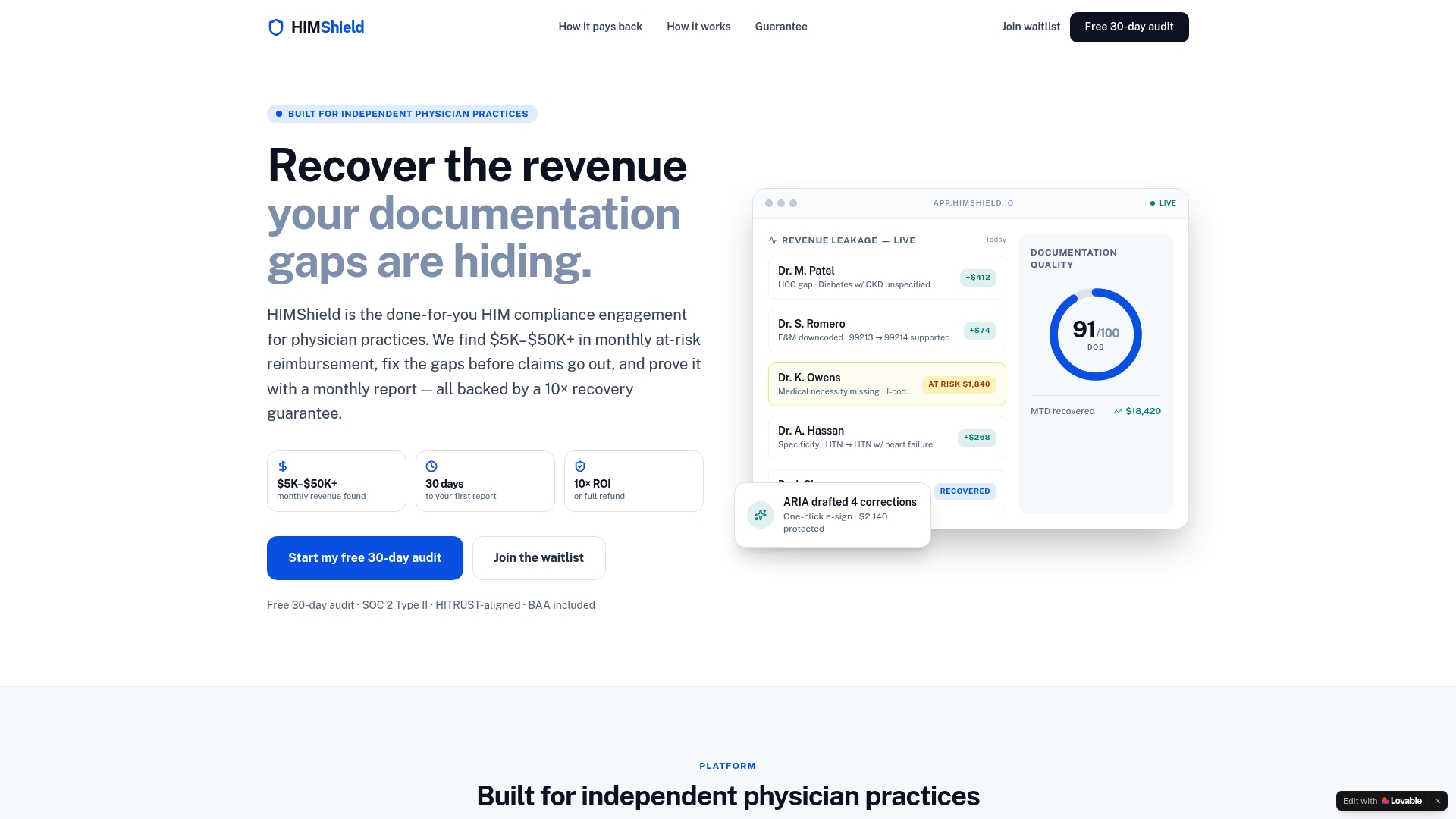
The audit is built for independent practices that cannot afford to add headcount or retrain staff just to find a billing problem.
- A quantified revenue leakage report broken down by provider and payer.
- Prioritized fixes ranked by dollar impact, so you know what to correct first.
- Compliance risk flags that show where documentation would not hold up under audit.
No new staff, no new software to learn. Start your free revenue leakage audit and see the number before you decide anything else.
Sources
The findings cited throughout this article come from primary and industry sources billing teams can consult directly.
- OIG audit: diagnosis code documentation failures (2024)
- Evaluation & Management services — Medicare improper payment data (2024)
- HFMA — Avoiding the high cost of charge capture leakage (Novant Health case study)
- Charge capture practitioner article — inventory roll‑forward method (PMC)
This article is general information, not a substitute for advice from a qualified doctor. Consult a qualified healthcare professional about your own circumstances before acting on anything here.
FAQ
What are common RCM mistakes billing teams should watch for?
Common revenue cycle mistakes include missed charge entries, undercoding or overcoding E/M visits, duplicate charges, and claims that miss timely filing deadlines. Most stem from unclear ownership between clinical and billing staff or from EHR charge logic that does not match the current chargemaster.
What are the most common billing errors in practice?
The most frequent billing errors are missed charges for drugs, supplies, or injections, incorrect E/M coding levels, and duplicate or incorrect unit counts on J-code billing. CMS data shows incorrect coding accounts for 49.1% of E/M improper payments, with insufficient documentation close behind at 34.1%.
Can you give an example of a charge capture billing error?
A common example is a nurse administering an infusion drug that never gets entered as a charge because the documentation happened in the clinical note but never crossed into the billing queue. This kind of missed charge is exactly what a charge versus encounter reconciliation report is designed to catch.
What does charge capture mean in healthcare billing?
Charge capture is the process of converting a clinical service, drug, device, or supply into an accurate billable charge on a claim. It connects clinical documentation, coding, and claims submission, and when any link in that chain breaks, the practice loses revenue it already earned.
How do I calculate potential revenue lost to charge capture errors?
Running a focused exception report against actual encounters gives a far more precise number than the estimate alone.