
A coding audit is a systematic review of medical coding records to verify accuracy, compliance, and documentation integrity across a healthcare organization. The process checks that diagnosis codes (ICD-10), procedure codes (CPT), and supply codes (HCPCS) align with clinical documentation, payer requirements, and regulatory standards set by CMS and HIPAA. For independent physician practices, a coding compliance audit is not optional maintenance. It is the primary defense against claim denials, overpayments, and federal audits that can cost far more than the review itself. Coding errors directly drive reimbursement loss, and catching them early is the difference between revenue protected and revenue lost.
What is a coding audit and why does it matter for revenue integrity?
A coding audit serves three core objectives: confirming code accuracy, verifying documentation supports every code submitted, and identifying patterns of risk before a payer or regulator does. Proactive internal audits reduce the risk of costly payer denials and compliance penalties. That means the audit is not just an accuracy task. It is foundational to protecting organizational revenue and patient trust.
The connection to revenue cycle management is direct. A single miscoded evaluation and management (E/M) visit, repeated across hundreds of claims, creates a pattern that triggers payer audits. CMS Recovery Audit Contractors (RACs) specifically target high-frequency coding errors. A well-run audit finds those patterns first and gives your practice time to correct them before external scrutiny arrives.

Healthcare administrators often underestimate how much revenue integrity depends on HIM discipline at the point of coding. The audit creates the feedback loop that keeps coding aligned with clinical reality and payer expectations.
What are the main types of coding audits and how do they differ?
Coding audits fall into several distinct categories, each serving a different purpose and timeline.
| Audit type | Objective | Timing | Typical stakeholders |
|---|---|---|---|
| Internal audit | Ongoing compliance monitoring | Continuous or scheduled | Coding staff, compliance officer |
| External audit | Independent validation, pre-survey prep | Periodic or triggered | Third-party auditors, leadership |
| Retrospective audit | Review of already-submitted claims | Post-submission | HIM professionals, billing team |
| Concurrent audit | Real-time review before claim submission | During or just after encounter | Coders, clinical staff |
| Focused audit | Targeted review of a specific code set or provider | As needed | Compliance officer, auditor |
| Education audit | Identifies training gaps, not punitive | Scheduled | Coders, supervisors |
Internal audits give your team continuous visibility into coding performance. Concurrent audit programs catch errors before claims go out the door, which is the most cost-effective point of intervention. Retrospective audits are useful after a payer denial spike or a change in coding guidelines.
External audits add a layer of independence that internal teams cannot provide. External audit firms should be independent from the original coding team to avoid conflicts of interest and missed systemic issues. Self-audits frequently overlook documentation gaps that an outside reviewer catches immediately.
Focused audits are particularly valuable when a practice introduces a new service line, hires a new provider, or receives a payer denial trend on a specific code. Education audits reframe the process as a learning tool, which reduces coder defensiveness and produces better long-term results.
What is the coding audit process, step by step?
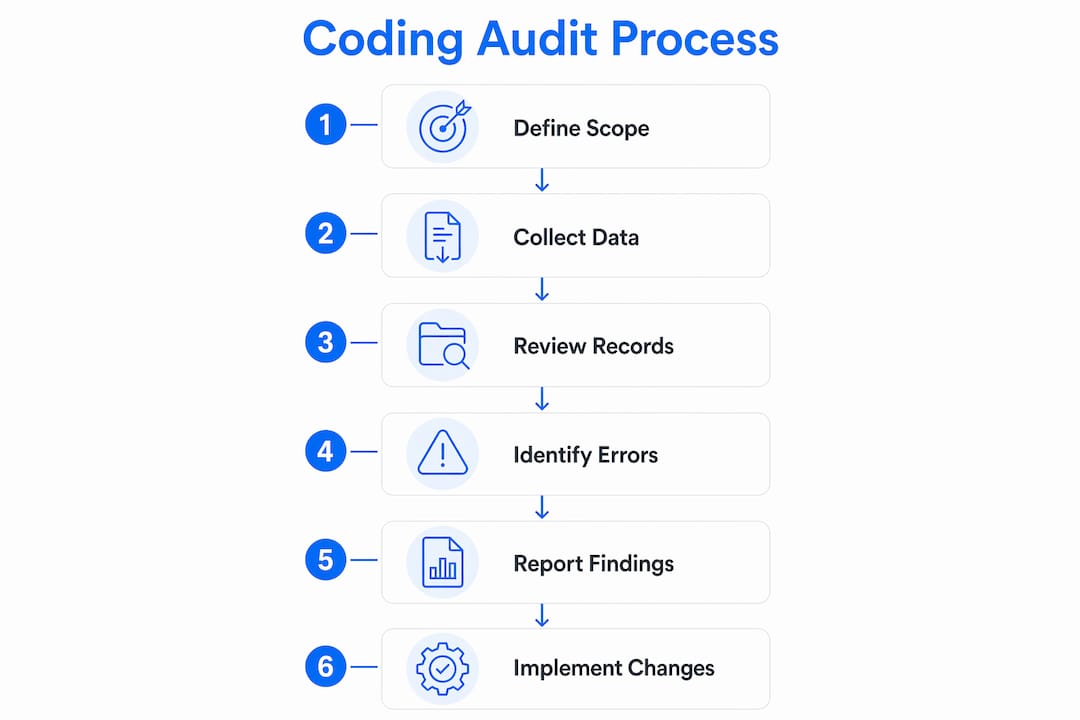
A well-structured coding audit process follows a defined sequence. Skipping steps, especially documentation, creates audits that cannot withstand regulatory scrutiny.
- Define scope and objectives. Decide which providers, date ranges, payer types, or code categories the audit will cover. A focused scope produces more actionable findings than a broad sweep.
- Select the sample. Pull a statistically meaningful sample of claims. For a standard compliance audit, 10–30 records per provider is a common starting point, though focused audits may require more.
- Acquire documentation. Gather the corresponding clinical notes, operative reports, and charge capture records for every claim in the sample.
- Apply coding standards. Review each claim against ICD-10, CPT, and HCPCS guidelines, as well as payer-specific rules. Check that documentation supports the level of service billed.
- Calculate error rates. Quantify the percentage of claims with coding discrepancies. Separate overcoding from undercoding, as both carry compliance risk.
- Report findings. Produce a written report with error rates by provider, code category, and error type. Include specific examples with documentation references.
- Develop a corrective action plan. Assign responsibility for each finding. Set timelines for retraining, rebilling, or process changes.
- Retain audit evidence. Audit evidence must be timestamped with a clear chain of custody to be accepted by HIPAA or other regulators. Without proper documentation, an audit may be rejected despite its technical soundness.
Pro Tip: Build your audit checklist around the chart audit workflow your HIM team already uses. Aligning audit steps with existing workflows reduces friction and increases the consistency of your findings.
A thorough audit typically requires 10–15 days for a comprehensive assessment and delivers a 2–3x return on investment through reduced remediation costs down the line.
How do automated coding audit tools enhance accuracy and efficiency?
Automation changes the economics of coding audits. Automated code review tools reduce defect density by 15–30% and increase throughput by up to 40%. That means your team reviews more claims, catches more errors, and spends less time on manual record pulls.
The core functions automated tools perform in a coding audit include:
- Pattern recognition. Flags recurring code combinations that deviate from payer norms or clinical documentation patterns.
- Compliance checks. Validates codes against current ICD-10, CPT, and HCPCS guidelines automatically.
- Modifier validation. Identifies missing or incorrect modifiers that trigger denials. Modifier accuracy is one of the most common sources of avoidable claim rejections.
- Risk scoring. Prioritizes high-risk claims for human review, so your auditors focus where it matters most.
The benefits of automated coding audits are real, but automation alone is not sufficient. Shifting to a hybrid approach improves throughput by 20–65% but risks a decline in human oversight depth by 20–30% without proper configuration. The tool surfaces the issue. A credentialed auditor interprets it.
Pro Tip: Configure your automated audit alerts with specificity thresholds before going live. Broad alert rules generate noise that leads to alert fatigue, causing auditors to dismiss flags that actually matter.
The top medical coding compliance platforms available in 2026 combine automated risk detection with physician-friendly reporting, making it practical for smaller practices to run continuous audits without dedicated full-time audit staff.
What roles and expertise are essential in a coding audit?
A coding audit requires a defined team with clear responsibilities. No single person should own the entire process without oversight.
- Certified Professional Medical Auditor (CPMA). The CPMA credential, issued by the American Academy of Professional Coders (AAPC), is the recognized standard for coding auditors. A CPMA-credentialed auditor brings both coding knowledge and audit methodology expertise.
- Compliance officer. Owns the audit program, sets policy, and reports findings to leadership. The compliance officer ensures the audit aligns with the organization's broader risk management strategy.
- HIM professionals. Manage documentation integrity, record retrieval, and coding standards adherence. Their role is especially critical in retrospective audits where documentation gaps are common.
- Revenue cycle team. Translates audit findings into billing corrections, appeals, and process changes. Without revenue cycle involvement, audit findings sit in a report and produce no financial improvement.
- External auditors. Provide independent validation. Independence is not just best practice. It is a structural requirement for audits intended to demonstrate compliance to CMS or HIPAA regulators.
Continuous education is non-negotiable for every role on this list. ICD-10 updates, CPT revisions, and payer policy changes occur annually. An auditor working from last year's guidelines produces findings that do not reflect current compliance risk.
What are best practices for applying coding audit findings?
Finding errors is the easy part. Turning findings into lasting improvement is where most audit programs fall short.
- Build a corrective action plan (CAP) for every finding. A CAP assigns a responsible party, a remediation method, and a deadline. Findings without assigned owners do not get resolved.
- Track resolution, not just completion. Verify that the corrective action actually changed coding behavior. Re-audit the same code categories 60–90 days after the CAP closes to confirm improvement.
- Involve clinical staff early. Coders cannot fix documentation problems alone. Physicians and advanced practice providers need to understand what documentation gaps create compliance risk. Frame the conversation around patient care accuracy, not billing.
- Adopt a non-punitive audit culture. Audits conducted in a punitive environment produce defensive behavior, not better coding. Practices that treat audit findings as education data see faster and more durable improvement.
- Integrate audit insights into your compliance program. A single audit is a snapshot. An annual coding review creates a trend line that shows whether your compliance posture is improving or deteriorating over time.
Pro Tip: Share de-identified audit findings in monthly coding team meetings. When coders see aggregate error patterns across the practice, they self-correct faster than they do after individual feedback alone.
Reducing claim denials requires this kind of systematic follow-through. The audit creates the data. The corrective action plan and monitoring cycle create the results.
Key Takeaways
A coding audit is the most direct tool a physician practice has to protect revenue, maintain compliance, and reduce the risk of external scrutiny before it arrives.
| Point | Details |
|---|---|
| Define audit scope first | Narrow scope produces specific, actionable findings rather than broad, hard-to-prioritize reports. |
| Use a hybrid audit model | Combine automated tools with credentialed human review to maximize both speed and accuracy. |
| Document with chain of custody | Timestamped audit evidence is required for HIPAA and CMS compliance validation. |
| Apply findings through a CAP | Every finding needs an assigned owner, a remediation method, and a re-audit date. |
| Build a non-punitive culture | Practices that treat audits as education tools see faster, more durable coding improvement. |
Why I think most practices are auditing too late
After years of working in healthcare compliance, the pattern I see most often is this: a practice runs its first serious coding audit after a payer denial spike or an RAC letter arrives. By that point, the error pattern has already been submitted across hundreds of claims, and the remediation cost is multiples of what an earlier audit would have cost.
The argument I hear against proactive auditing is resource constraint. Small and independent practices genuinely do not have a full-time auditor on staff. That is a real limitation. But it is not a reason to skip audits. It is a reason to use automation intelligently and to run focused audits on your highest-volume code categories rather than attempting comprehensive reviews with insufficient staff.
The other thing I have observed is that AI-generated coding suggestions are creating a new category of audit risk. One in five organizations experienced serious security incidents tied to AI-generated code outputs by mid-2026. In healthcare coding, AI suggestions that go unreviewed can introduce systematic errors that look correct on the surface but fail under payer scrutiny. The audit process is the check on that risk.
My practical advice: start with a focused annual coding review on your top five CPT codes by volume. That single exercise will surface the most financially significant risks in your practice with a manageable investment of time and resources.
— Elena
How Himshield helps practices protect revenue through coding compliance
Independent physician practices recover $5K–$50K+ in hidden revenue when they identify coding, documentation, and charge-capture risks before they become denials or audits.
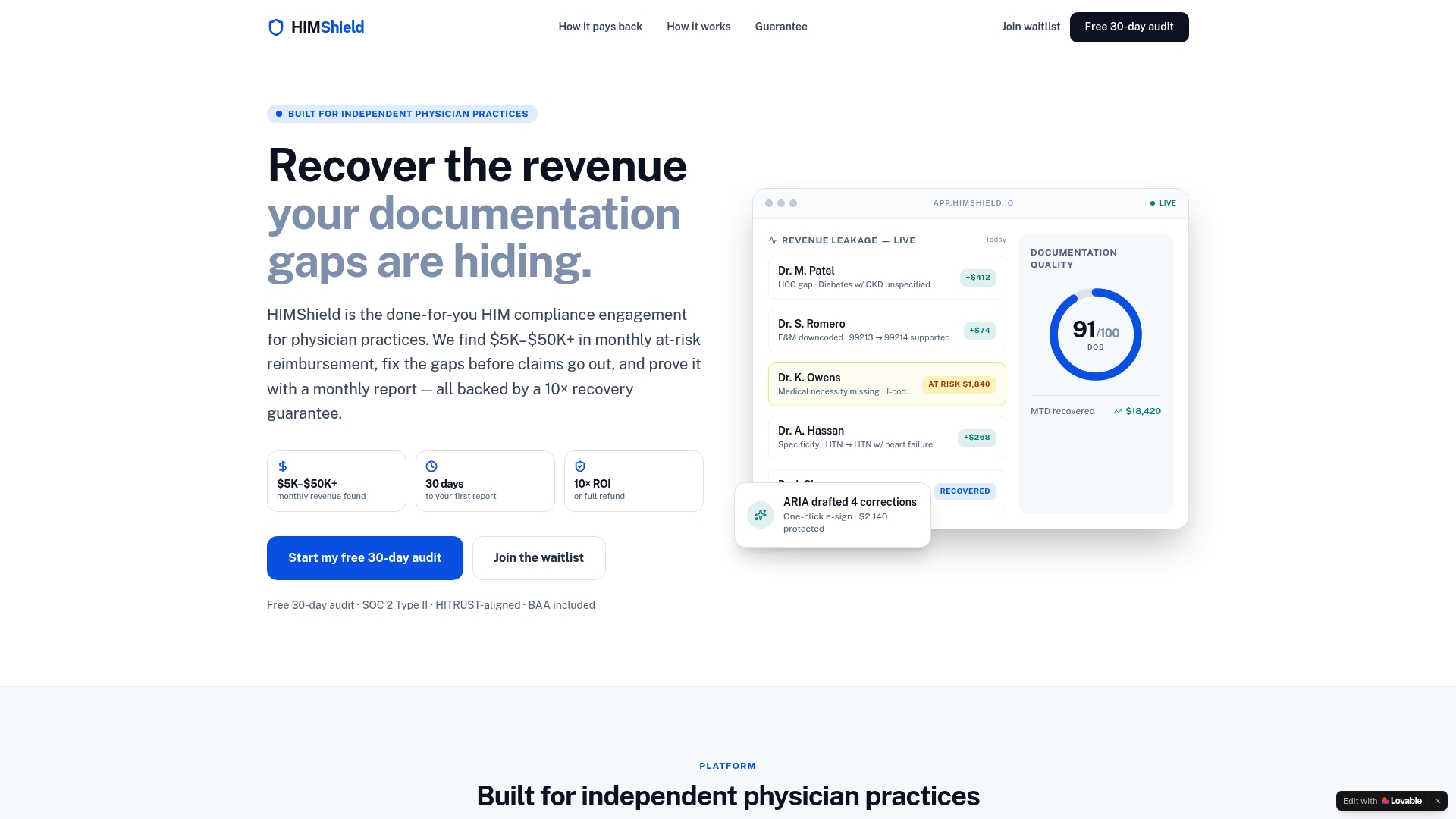
Himshield connects directly to your EHR via FHIR API and begins scanning for coding risks within 30 days of implementation. The platform delivers automated risk detection, HCC gap identification, and physician-friendly guidance that your team can act on without a dedicated compliance department. You get clear findings, not raw data. If you are ready to see where your practice stands, visit Himshield to learn how the platform works and what revenue recovery looks like for practices your size. For a closer look at the implementation process, see how it works and what the first 30 days deliver.
FAQ
What is a coding audit in healthcare?
A coding audit is a systematic review of medical coding records that verifies ICD-10, CPT, and HCPCS codes align with clinical documentation, payer rules, and CMS or HIPAA requirements. Its primary purpose is to identify errors before they result in claim denials or regulatory penalties.
How often should a physician practice conduct a coding audit?
Most compliance programs recommend at least an annual audit for all providers, with focused audits triggered by denial spikes, new service lines, or provider onboarding. High-risk specialties benefit from quarterly or concurrent review cycles.
What is the difference between an internal and external coding audit?
An internal audit is conducted by your own compliance or HIM team for ongoing monitoring, while an external audit uses an independent third party to validate compliance and avoid conflicts of interest that internal teams may miss.
What credentials should a coding auditor hold?
The Certified Professional Medical Auditor (CPMA) credential from the AAPC is the recognized standard for healthcare coding auditors. Auditors should also hold active coding credentials such as CPC or CCS relevant to the specialty being reviewed.
What are the main benefits of automated coding audits?
Automated tools reduce defect density by 15–30% and increase review throughput by up to 40%, allowing practices to cover more claims with fewer manual resources. The greatest benefit comes from pairing automation with credentialed human review in a hybrid model.