
Charge capture automation uses AI-driven recommendations and rules-based logic to convert clinical documentation into billable charges, then reconciles what actually got billed against what was performed. The primary payoff is straightforward: practices recover missed revenue, cut charge lag, and give providers back time they currently spend chasing charges. The right first move isn't buying a platform. It's running a focused audit or pilot to measure your baseline and size the expected lift before you commit.
TL;DR:
- Automated charge capture tools should be tested with a small pilot that measures baseline missed-charge rates and recovery potential before full implementation.
- Integration delays often stem from non-standard data feeds or outdated charge master codes, making pre-pilot validation essential.
- Real-time suggestions and reconciliation dashboards improve the chances of catching errors early, but accountability across departments remains critical.
- Converting audit findings into conservative recovery estimates ensures more accurate ROI projections, typically recovering 60 to 80 percent of identified gaps.
- Practices should prioritize a structured 12-week pilot involving stratified sampling, root-cause analysis, and clear governance to maximize revenue recovery.
Table of Contents
- What Does Charge Capture Automation Actually Do?
- Which Metrics Prove Automation Is Working?
- How Do You Test EHR Integration Before Committing?
- What Does a 12-Week Pilot and Audit Roadmap Look Like?
- What Results Can Independent Practices Expect?
- Automation Doesn't Replace Judgment. It Redirects It.
- How Himshield Fits Into Your Pilot
- Where to Read Further
- Sources
- FAQ
What Does Charge Capture Automation Actually Do?
Vendors build charge capture automation around two engines, and they solve different problems. NLP and AI models scan clinical notes and flag likely codes based on documented findings, which helps in high-volume, template-heavy specialties where patterns repeat. Rules-based mapping applies fixed logic, such as "if procedure X is documented, charge code Y," and works best where coding rules are stable and unambiguous. Most credible platforms blend both.
The second layer is reconciliation. Some systems flag gaps in real time, at the point of documentation, so a provider can correct an entry before the encounter closes. Others run retrospectively, comparing scheduled services or order data against posted charges after the fact. Automated charge capture platforms commonly pair NLP-driven code suggestions with reconciliation dashboards and EHR integration to catch what manual review misses.
Underneath both approaches sits order-to-charge mapping and charge master linkage, plus document scanning across notes, orders, and ancillary logs.
- Real-time suggestion tools sit inside the provider's workflow at the point of documentation.
- Reconciliation dashboards run after the fact, comparing orders and notes to posted charges.
- Ownership varies: some practices route flagged discrepancies to the provider for a quick edit, others to a coder queue, and many use a hybrid model where low-confidence flags go to coders and high-confidence ones go straight to providers.
Which Metrics Prove Automation Is Working?
Missed-charge rate is the number that matters most, and it's also the one most practices have never measured. Track it alongside average recovered revenue per affected encounter, minutes saved per provider per day, clean-claim rate improvement, and reduction in charge lag (the gap between service date and charge submission).
Benchmark reality: The Healthcare Financial Management Association reports that the average medical practice loses roughly $125,000 a year to poor charge capture, and hospitals lose close to 1% of net charges to leakage. That's the number a pilot should be measured against, not a vendor's best-case demo.
When you convert audit findings into an ROI projection, resist the urge to assume every dollar of undercharge is recoverable. A more conservative framework treats only 60% to 80% of audited undercharges as realistically recoverable, since some will involve documentation that can't be retroactively fixed.
Before trusting a vendor's stated recovery rate, verify:
- Whether the sample size behind the claim covers multiple payer types and service lines, or just one.
- Whether "time saved" figures reflect actual provider logs or self-reported estimates.
- Whether clean-claim improvements are measured pre- and post-implementation on the same payer mix.
How Do You Test EHR Integration Before Committing?
Integration effort is usually the single biggest variable in how fast a pilot delivers results. Native connectors for Epic or Cerner tend to move fastest because they tap existing data structures; HL7/ADT feeds and custom APIs take longer to configure and usually require dedicated IT hours plus SSO setup for security compliance.
During a pilot, test these in order:
- Confirm which documents the platform actually scans: progress notes, orders, ancillary logs, or all three.
- Audit your charge master for outdated or duplicate codes before automation goes live. Automation built on a messy charge master just automates the mess.
- Map how flagged discrepancies route: point-of-care provider prompts, a coder review queue, or both, and set an SLA for how fast each queue clears.
- Build a reconciliation dashboard view finance and coding leads can check weekly, not just at month-end.
The most common failure isn't the software. It's decentralized charge ownership, where no one department is accountable for closing flagged gaps, plus documentation templates that don't capture the detail the AI model needs.
Pro Tip: Run your mapping validation against last quarter's actual claims data, not a demo dataset. Vendor demos are built to succeed; your charge master has years of drift they've never seen.
What Does a 12-Week Pilot and Audit Roadmap Look Like?
Start with a stratified sample. Pull encounters across payer mix, site of service, and CPT families, oversampling the combinations you suspect carry the highest risk. Sampling methodology research confirms that stratified, risk-weighted samples produce statistically actionable results without requiring a full-volume audit.
A 12-week pilot cadence that other revenue cycle teams have used successfully breaks down like this:
- Weeks 1 to 2: Scope the pilot to one or two service lines with measurable missed-charge history.
- Weeks 3 to 6: Run the stratified audit and root-cause analysis on discrepancies found.
- Weeks 7 to 9: Quantify recoverable revenue and design the specific interventions (template fixes, mapping corrections, workflow changes).
- Weeks 10 to 12: Present ROI findings and secure sponsorship for a broader rollout.
Governance needs real teeth, not a committee in name only.
- Finance owns the ROI model and conservative recovery assumptions.
- Coding and HIM own root-cause analysis and code mapping accuracy.
- IT owns integration timelines and data feed reliability.
- A named clinical champion addresses documentation and template gaps directly with providers, since pilots without clinician buy-in often see recovered revenue decline after the initial rollout.
What Results Can Independent Practices Expect?
Independent physician practices face a specific version of this problem: thin administrative staffing means coding, documentation, and charge-capture gaps often go unnoticed until a payer audit forces the issue. Himshield was built to close that gap before it becomes a denial.
The platform scans EHR data to identify and quantify coding and documentation risks before claims go out, then generates per-provider, per-payer Revenue Leakage Reports that show exactly where money is at risk. From there, it drafts corrections for one-click physician e-signature and scores documentation quality in real time.
- Automated compliance alerts flag risk before submission, not after denial.
- One-click correction drafts cut the provider's edit time to seconds, not minutes.
- Practices using Himshield's remediation model have reached a 95% clean claim rate with fixes completed inside 30 days.
- Submission-ready audit response packages help practices defend findings when payers do come calling.
That combination fits naturally into the pilot and governance model above: the audit finds the gaps, and the platform's automated alerts keep them from reopening.
Automation Doesn't Replace Judgment. It Redirects It.
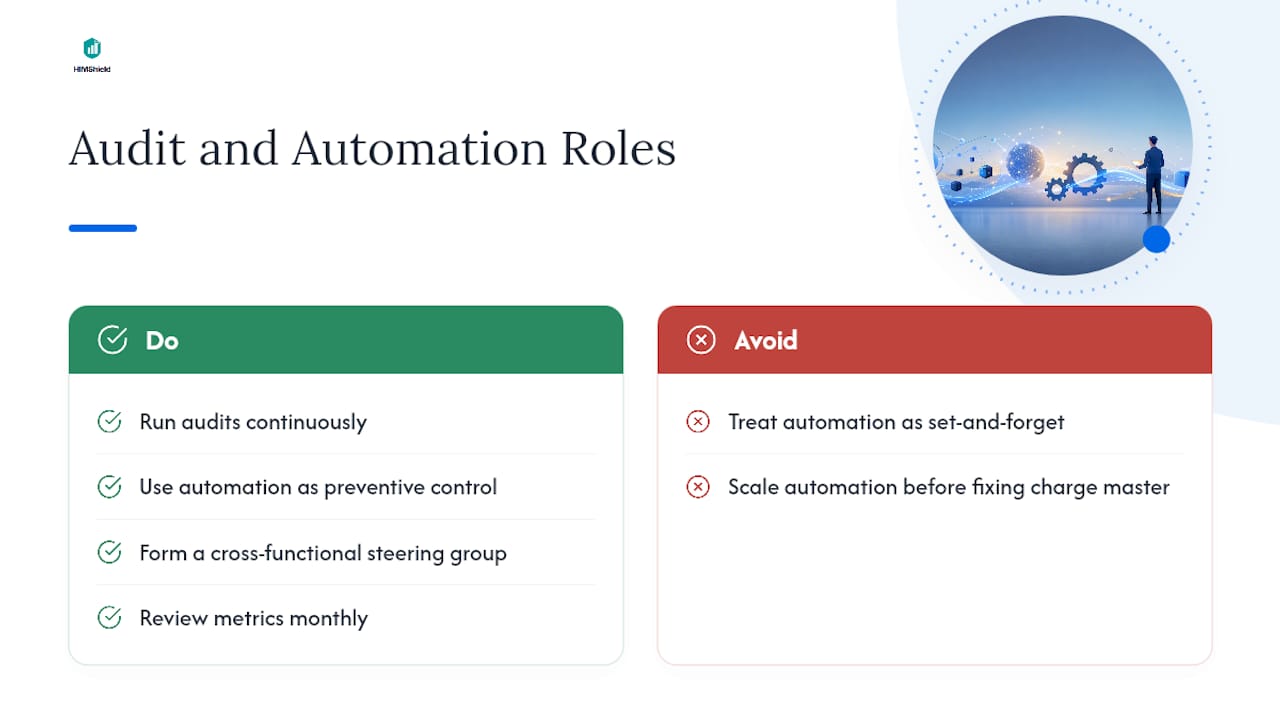
The industry sells charge capture automation as a set-and-forget fix. It isn't. Treat audits as your continuous diagnostic control and automation as your preventive control, running side by side, not one replacing the other.
Form a revenue integrity steering group with finance, coding, IT, and a clinical champion, and commit to reviewing metrics monthly, not annually. Only scale automation after your charge master is clean and providers are actually engaged. Skip that step, and you'll automate a process that was broken to begin with.
— Elena
How Himshield Fits Into Your Pilot
If you're an independent physician practice weighing whether to build this internally or bring in a platform already built for your exact problem, here's the practical case for skipping the build. Himshield identifies revenue leakage before claims go out, not after a payer flags them, and it does it without requiring you to hire a dedicated analytics team.
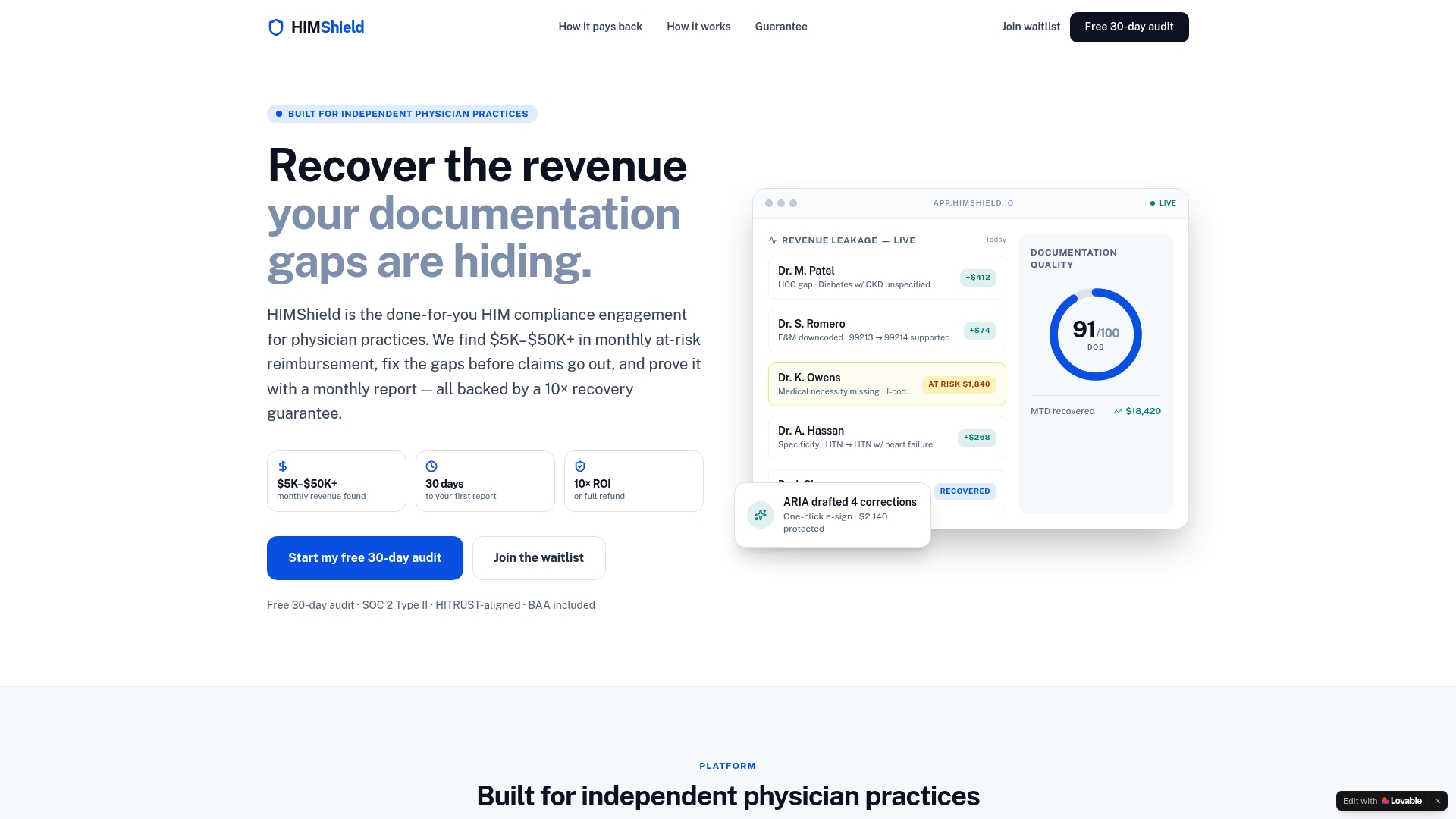
The offer that matters most for a practice testing the waters: a free 30-day audit with a performance guarantee runs before you pay anything, so you see the actual Revenue Leakage Report for your practice before committing to a subscription. Pricing then scales to your provider count and chart volume, not a flat enterprise fee built for a hospital system. Review the step-by-step process to see exactly how EHR data connects to your first report, then request a scoped ROI estimate to see what your practice's specific numbers look like.
Where to Read Further
- AAPC's charge capture audit findings on average annual revenue loss from poor charge capture.
- RevenueCycleBlog's audit framework for pilot cadence and conservative ROI modeling.
- Himshield's guide to medical coding compliance for the fundamentals behind accurate charge capture.
Sources
- Discover the Benefits of Charge Capture Audits - AAPC Knowledge Center
- Sampling and audit methodology guidance (PubMed)
- Charge capture audit: frameworks to protect revenue - RevenueCycleBlog
FAQ
How much does a charge capture analyst make?
Salary depends heavily on region, credentials, and whether the role includes audit or coding certification, but it typically falls in the mid range for healthcare revenue cycle analyst positions nationally; check current listings for your market rather than relying on a single national average.
What are the top RCM companies in the USA?
The revenue cycle management market includes large national vendors alongside specialized platforms built for specific practice sizes and specialties; the right fit depends more on your practice type and EHR than on brand recognition alone.
Is AI replacing medical billing?
No. AI handles pattern recognition, code suggestion, and reconciliation faster than manual review, but coders and billing staff still own judgment calls, payer appeals, and exception handling that automation flags rather than resolves.
What are the steps of the revenue cycle?
The revenue cycle spans everything from patient scheduling and eligibility verification through charge capture, coding, claims submission, payment posting, denial management, and reporting; charge capture automation specifically targets the steps between documentation and claim submission where leakage happens most.
How does Himshield help with charge capture automation specifically?
Himshield scans EHR documentation to flag coding and charge-capture gaps before submission, drafts one-click corrections for physician sign-off, and has helped practices reach a 95% clean claim rate within 30 days of implementation.