
A missed charges audit finds the revenue your practice earned, but never billed, quantifies exactly how much is recoverable, and builds the controls that stop it from happening again. Revenue cycle managers, billing teams, and revenue integrity staff should run one now, starting with a prioritized three-way reconciliation that compares schedules, documentation, and posted charges.
TL;DR:
- Missed charges typically amount to about 1% of net revenue for large hospitals, translating into millions depending on organization size, and often remain undetected without reconciliation.
- The core process compares appointment schedules, clinical documentation, and posted charges to identify services performed but never billed, requiring regular, timely audits within payer filing limits.
- Root causes include EHR charge-capture failures, incorrect charge mapping, modifier mistakes, and documentation gaps, each needing specific governance or training solutions.
- Automation tools such as real-time analytics, EHR workqueues, and coding suggest engines can significantly reduce false positives and improve detection efficiency.
- Effective remediation involves assigning ownership, updating rules, documenting changes, and scheduling re-audits within 60 to 90 days to ensure fixes are durable and prevent recurring revenue leaks.
Table of Contents
- What a missed charges audit is and why it matters
- Step-by-step missed charges audit methodology
- Prioritization and sampling: targeting the highest-yield opportunities
- Common root causes and examples of missed charges
- Tools and automation categories that reduce missed charges
- Turning audit findings into controls: governance and re-audit
- Metrics, benchmarks, and what to expect
- Applied example and practitioner checklist
- Prioritizing prevention over recovery alone
- How HIMShield can help
- Authoritative sources and guidance to consult
- FAQ
What a missed charges audit is and why it matters
A missed charges audit is a structured comparison of three data sources: the appointment schedule or encounter log, the clinical documentation, and the charges actually posted to claims. When a service appears in the first two but not the third, you have a missed charge, and that gap is revenue you earned but never billed.
Missed charges behave differently from denials. A denial shows up in your aging report and demands attention because a payer rejected it. A missed charge never gets submitted at all, so it never appears in a denial queue, an aging bucket, or a rejection report. It simply disappears, which is what makes it dangerous: nobody is chasing it because nobody knows it exists.
This is where three-way reconciliation earns its place as standard practice rather than optional diligence. Comparing encounters, documentation, and posted charges surfaces actionable exceptions instead of guesswork.
One widely cited estimate puts missed-charge losses at roughly 1% of net annual revenue for large hospitals, a figure that translates into millions of dollars depending on the organization's size. For independent practices, the percentage may differ, but the mechanism is identical: revenue leaks silently until someone reconciles the three data sources.
CMS reinforces this with its own controls. The Outpatient Code Editor includes an OPPS verification edit that flags claims where expected payment exceeds the billed charge, prompting contractors to suspend and investigate. That edit exists because under-billing is a recognized, systemic problem, not an isolated clerical slip.

Step-by-step missed charges audit methodology
A missed charges audit works best as a repeatable process, not a one-time scramble. The core method is three-way reconciliation, and it breaks into five stages.
- Pull your data sources. Extract the appointment schedule or encounter log, the clinical documentation from the EHR, and the posted charges or claims file for the same date range.
- Align records by patient and date of service. Match each scheduled or documented encounter to its corresponding charge line, flagging any encounter with no matching charge.
- Apply matching rules to separate real exceptions from noise. A true missed charge has supporting documentation for a billable service with no corresponding charge; a false positive is often a canceled visit, a bundled service, or a charge posted under a different code.
- Route exceptions through a triage flow. An automated flag goes to a coder or HIM reviewer first; anything ambiguous goes back to the clinician for clarification before a charge is corrected or excluded.
- Correct and re-post, or exclude and document why. Supported charges get corrected and resubmitted; unsupported ones are documented as excluded, never billed on the strength of the audit alone.
Timing matters. Most payers set timely filing windows that range from 90 days to a year depending on the contract, so a missed charges audit needs to run on a cadence tight enough to catch gaps before the filing clock runs out. Reopening a claim to add a missed charge is appropriate only when documentation fully supports the service; CMS program-integrity guidance is explicit that corrective action must follow provider notification and reevaluation, not a one-sided billing push.
Pro Tip: Build your exception rules before your first audit cycle, not during it. Teams that define what counts as a true missed charge up front spend far less time arguing about edge cases later.
The hardest part of this workflow is not finding gaps, it is deciding which ones are real. A missed appointment fee, for example, is never a billable Medicare service and should never enter your recovery pipeline no matter how it looks in the schedule.
Prioritization and sampling: targeting the highest-yield opportunities
Auditing every chart in your system wastes time your staff doesn't have. A risk-based approach concentrates effort where the dollars and the compliance exposure are largest.
- Rank CPT codes by dollar value and volume so high-reimbursement, high-frequency services get reviewed first.
- Target clinics or providers with recurring exception patterns rather than spreading review evenly across every location.
- Weight opportunities by payer yield and contract terms, since the same missed charge can mean very different recovery amounts depending on the payer.
- Use exception-based monitoring for stable areas and reserve full audits for departments with a history of charge-capture problems.
This mirrors the logic behind most modern revenue cycle management strategies, which favor targeted analytics over blanket reviews. CMS program-integrity guidance backs this approach directly: targeted, risk-based reviews are more defensible than indiscriminate audits and use resources more efficiently.
Frequency depends on what the first audit finds. A practice with significant gaps should re-audit the affected service lines within 60 to 90 days of implementing fixes, confirming the correction actually worked before stretching the interval out to quarterly or semiannual reviews.

Common root causes and examples of missed charges
Most missed charges trace back to a small number of recurring problems, and knowing which one you're looking at shapes the fix.
- EHR charge-capture logic that misfires, either suppressing a charge that should have triggered or generating so many false flags that real exceptions get buried in noise.
- Charge description master mapping errors, where a service is linked to the wrong code or an outdated price, causing charges to post incorrectly or not at all.
- Modifier and bundling mistakes tied to NCCI edits, where a missing or incorrect modifier causes a legitimate second service to be dropped instead of billed separately.
- Documentation gaps from unstructured notes or incident-to arrangements, where the service was performed but the note doesn't clearly support billing it.
Each of these has a different fix. CDM errors need governance and periodic reconciliation. Modifier issues need coder training and rule updates. Documentation gaps need clinician feedback loops, not just coder corrections after the fact.
Tools and automation categories that reduce missed charges
Manual chart-by-chart review does not scale once a practice grows past a handful of providers. Several categories of tools address the problem, each with a different strength.
- Analytics and rules engines that continuously compare schedules, documentation, and charges, flagging mismatches in near real time instead of weeks later.
- EHR-integrated reconciliation workqueues that route exceptions directly to the right reviewer without exporting data to spreadsheets.
- Autonomous coding suggestion engines that read clinical notes and propose codes a human then confirms or corrects.
- Charge description master management tools that keep code-to-price mapping current and flag stale or inconsistent entries.
When evaluating any of these, prioritize EHR integration depth, how well the tool handles false positives, and whether it gives clinicians a workflow they can act on in seconds rather than minutes. A tool that floods staff with noise defeats its own purpose: one hospital system reduced weekly false positives from over 1,200 to under 100 only after deliberately tuning rules and involving clinical staff in the refinement process.
Pro Tip: Ask any vendor for their false-positive rate before you ask about detection volume. A high catch rate paired with a high noise rate just moves the bottleneck from missed charges to reviewer fatigue.
The real operational shift automation enables is moving staff away from bulk chart review and toward resolving a shorter, higher-confidence list of exceptions.
Turning audit findings into controls: governance and re-audit
An audit that ends with a spreadsheet of recovered dollars and no process change will produce the same gaps next quarter. Findings need to become owned, time-bound fixes.
- Assign a root-cause owner for each pattern, whether that's HIM, IT, or a clinical department lead, with a deadline for the fix.
- Standardize charge description master governance so mapping and pricing follow one documented methodology instead of ad hoc updates, a foundation HFMA identifies as core to a durable charge-reconciliation program.
- Update detection rules and document the change, reducing the false positives that caused the original gap or that the fix might introduce.
- Train the affected clinicians or staff and schedule a re-audit 60 to 90 days out to confirm the fix held.
Every step here matters more than the recovery number from the first audit. Setting up an internal audit only pays off long term when it includes this loop back to prevention.
Metrics, benchmarks, and what to expect
A missed charges audit should produce a short list of numbers you track over time: recovered dollars, the missed-charge rate as a percentage of total charges, the false-positive rate from your detection rules, clean claim rate, and movement in discharged-not-final-billed days.
Missed-charge losses run as high as roughly 1% of net annual revenue for large hospitals, giving you a rough ceiling to model against when sizing a pilot audit. A practice modeling ROI should weigh the recovered dollar amount against the hours spent reviewing exceptions, since the real payoff includes fewer future denials and faster cash flow, not just the one-time recovery figure.
Applied example and practitioner checklist
A typical automated workflow runs like this: detection software flags a mismatch, the exception lands in a priority queue ranked by dollar value, a coder or HIM reviewer confirms it, the clinician reviews and e-signs the correction, and the corrected charge is re-posted and tracked to resolution.
Revenue cycle managers can run this 8-item checklist over 30 days:
- Pull 90 days of schedule, documentation, and claims data.
- Reconcile all three sources by patient and date.
- Rank exceptions by dollar value and payer.
- Route high-value exceptions to coders first.
- Confirm documentation before correcting any charge.
- Resubmit only claims within timely filing limits.
- Assign an owner to each recurring root cause.
- Schedule a 60-day re-audit on corrected service lines.
Prioritizing prevention over recovery alone
A recovered dollar figure feels like the win, but it's the weaker half of the job. The audits that hold up under scrutiny assign a root-cause owner, change a rule or a workflow, and schedule a re-audit to prove the fix stuck. Without that loop, you're back where you started in two quarters.
Getting there takes more than a coder running reports. It needs clinical, IT, and revenue teams aligned on the same exception definitions, which is exactly the kind of targeted, documented approach CMS program-integrity guidance treats as defensible.
— Elena
How HIMShield can help
Running a thorough missed charges audit takes time most independent practices don't have lying around between patient visits. HIMShield's free 30-day Revenue Leakage Audit does the three-way reconciliation for you and delivers a quantified leak report with prioritized fixes, so you see the recoverable dollars without pulling staff off billing work.
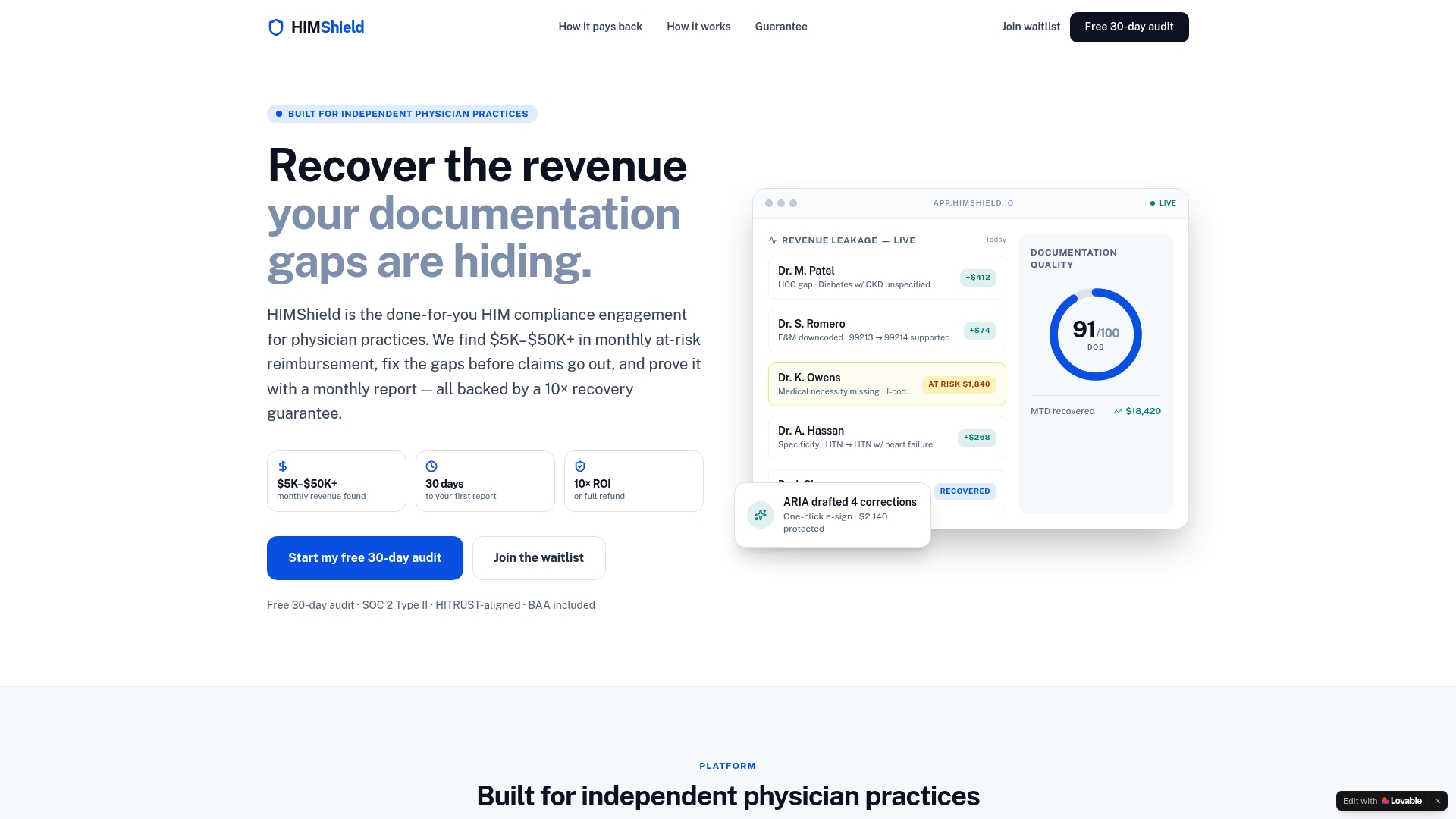
For practices that want the controls to stick, our HIM compliance engagement implements the rule updates, documentation workflows, and audit defense support that turn a one-time recovery into a lasting process. Start with the free audit and see what's recoverable before committing to anything further.
Authoritative sources and guidance to consult
For ongoing reference, consult CMS program-integrity guidance, HFMA charge-reconciliation strategies, and AMA CPT coding resources.
This article is general information, not a substitute for advice from a qualified financial advisor. Consult a qualified financial professional about your own circumstances before acting on anything here.
FAQ
What does a missed charges audit actually recover?
It recovers revenue for services that were performed and documented but never billed, which never shows up in denial or aging reports. The audit quantifies the gap through three-way reconciliation of schedules, documentation, and posted charges.
Can you bill for a charge found during an audit with weak documentation?
No. A missed charge is only billable when the clinical documentation fully supports the service performed; unsupported findings should be excluded and corrected going forward rather than billed. CMS program-integrity guidance ties any corrective billing to proper documentation and provider notification.
How far back can you reopen a claim for a missed charge?
It depends on the payer's timely filing limit, which commonly ranges from 90 days to a year from the date of service. Check the specific payer contract before resubmitting, since filing outside the window typically forfeits the recovery regardless of how clear the documentation is.
How often should a practice run a missed charges audit?
A full audit on high-risk service lines every 60 to 90 days after corrective action is a reasonable cadence, shifting to quarterly or semiannual reviews once exception rates stabilize. Areas with a history of charge-capture problems warrant more frequent review than stable, low-volume services.
What's the difference between a missed charges audit and a coding audit?
A coding audit checks whether the codes billed match the documentation and coding rules, while a missed charges audit checks whether a service was billed at all. They often run together, but a missed charges audit specifically targets the gap between what was done and what reached a claim.