
A repeatable six-step plan lets you set up an internal billing audit that protects revenue, satisfies OIG/CMS expectations, and gives your practice a defensible compliance record. The steps are: (1) define scope and objectives; (2) assemble the team and assign duties; (3) choose a sampling methodology and set sample sizes; (4) perform documentation-to-claim reviews; (5) analyze root causes and quantify financial impact; and (6) implement and track corrective actions. Run this cycle quarterly with monthly spot-checks, and you convert a reactive billing review into a continuous revenue-protection function.
Your printable next-steps checklist:
- Pull AR aging, denial rate by reason code, and first-pass acceptance rate before you touch a single chart
- Set a written scope statement naming providers, payer types, service categories, and date range
- Assign a named audit owner, clinical reviewer, and executive sponsor before kickoff
- Use 5–10 records per physician as your floor for federal payer sampling; escalate to 20–50 charts per provider for quarterly comprehensive reviews
- Complete a documentation-to-claim checklist for every sampled chart (CPT/ICD-10 accuracy, modifier validity, medical necessity, signatures)
- Log every finding in a corrective action plan (CAPA) with owner, due date, and verification method
- Re-audit the corrected areas within 90 days
Table of Contents
- How do you define audit scope, objectives, and success criteria?
- Who should be on your audit team, and what are their roles?
- What sampling approach gives you the most useful audit results?
- What does a documentation-to-claim review checklist cover?
- Which reports and metrics should you pull before and during the audit?
- How do you turn audit findings into a corrective action plan?
- What audit frequency and governance structure actually work?
- What tools and templates do you need to run audits efficiently?
- What U.S. benchmarks and OIG/CMS guidance should you reference?
- Key Takeaways
- Why internal audits are your practice's strongest strategic asset
- Himshield puts your internal audit program on autopilot
- Authoritative sources, templates, and downloads to support your audit
How do you define audit scope, objectives, and success criteria?
Scope creep is the fastest way to produce an audit that finds nothing useful. Before pulling a single chart, write a one-page scope statement that names the providers included, the payer types covered (Medicare, Medicaid, commercial), the service categories or CPT families in scope, and the date range. That document becomes your audit charter and your first line of defense if a payer or regulator later questions your process.
Four scope models fit most independent practices:
- Full-cycle (charge-to-cash): Traces a claim from charge entry through payment posting. Use this for a baseline audit when you have no recent internal review on record.
- Documentation-to-claim: Compares the medical record to the billed claim. Best for E/M upcoding risk or when a payer audit notice arrives.
- Denial-triage: Focuses on denied claims by reason code. Use when your denial rate spikes above 10%.
- Prospective pre-submission review: Catches errors before claims go out. Highest ROI for high-volume, high-dollar service lines.
Translate your scope into measurable success criteria. Target coding accuracy at or above 95%, a denial rate below 10% (best-in-class is under 5%), a first-pass payment rate above 90%, and a net collection rate at or above 96%. Set a remediation timeline in the scope statement, typically 60–90 days for corrective actions.
Trigger events that should expand your scope immediately: a spike in denials for a specific reason code, a new provider joining the practice, receipt of a payer audit notice, or a significant change in your E/M distribution. Scope expansion after a trigger is not a sign of failure; it is exactly what a well-governed audit program does.
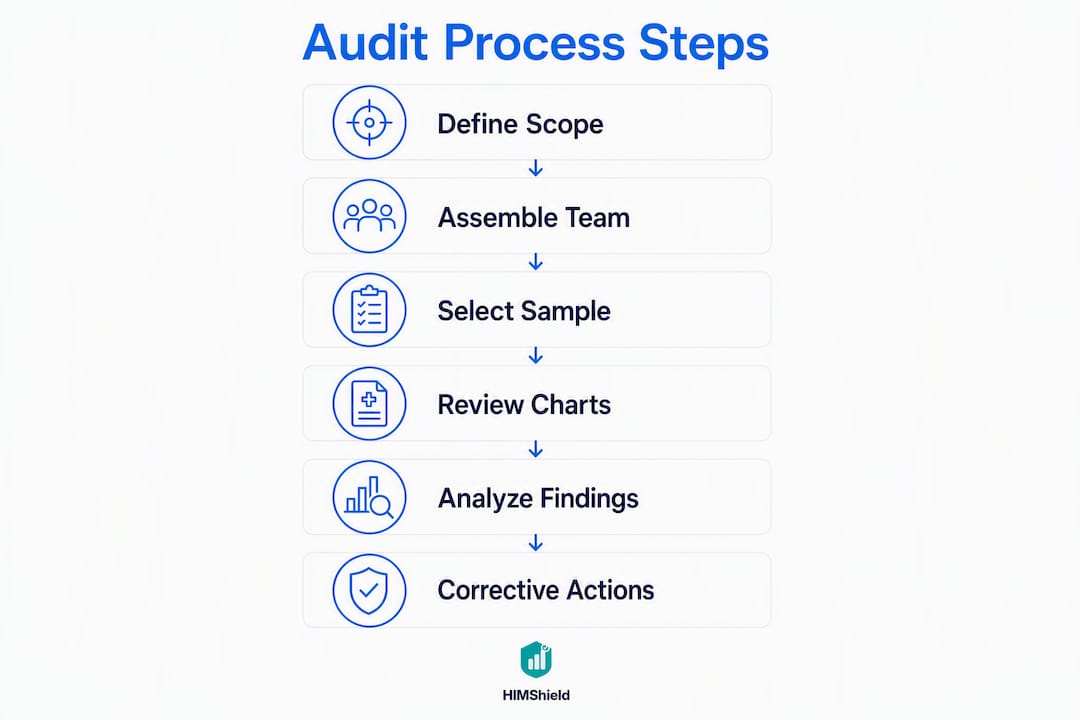
Pro Tip: A formal audit preparation checklist completed before fieldwork begins is the single biggest predictor of whether your audit produces root-cause findings or just a list of surface errors. Rushing past preparation is the most common reason audits fail to drive real change.
Who should be on your audit team, and what are their roles?
Objectivity is the core requirement. The person who submitted the claims should not be the person reviewing them. That one rule, called segregation of duties, shapes the entire team structure.
Core roles for an independent practice audit:
- Audit owner (practice manager or compliance officer): Sets the scope, manages the timeline, owns the final report, and presents findings to leadership.
- Clinical reviewer (physician or certified coder): Reviews medical records against billed claims. Should hold an AAPC credential (CPC, COC) or AHIMA credential (RHIA, CCS) and have direct experience with the practice's specialty codes.
- Data analyst or billing lead: Pulls and validates source reports (AR aging, denial data, ERA/EOB files) and builds the sampling frame. Must have EHR access and billing system familiarity.
- Executive sponsor (physician owner or managing partner): Receives the final report, authorizes corrective actions, and signs off on escalation decisions.
- Escalation path: Legal counsel or an external compliance consultant should be named in advance for findings that may trigger mandatory reporting under the 60-Day Rule for Medicare overpayments.
When to bring in an external reviewer: if your internal coding accuracy rate falls below 90%, if the audit covers a provider who is also the audit owner, or if the practice has received a formal payer or OIG audit notice. External reviewers provide independence and carry more weight with regulators. External audits typically review 100–200 charts compared with the 20–50 charts per provider typical of internal reviews, so reserve them for high-stakes situations.
Document reviewer qualifications in writing. Store credentials, training records, and conflict-of-interest attestations with the audit file. That documentation demonstrates good faith if the audit is ever scrutinized.

What sampling approach gives you the most useful audit results?
Sample composition often matters more than raw sample size. A 10-chart sample that overrepresents your highest-risk codes will find more costly errors than a 30-chart random sample spread evenly across all services.
Three sampling methods and when to use each:
- Random sampling: Every chart in the population has an equal chance of selection. Best for baseline audits and annual compliance reviews where you want an unbiased picture of overall accuracy.
- Targeted sampling: Selects charts based on a known risk signal (a specific CPT code, a denial reason code, a single provider). Use when a trigger event narrows your focus.
- Stratified sampling: Divides the population into risk strata (high-level E/M codes, frequently used modifiers, high-dollar procedures) and samples each stratum separately. The most efficient method for quarterly audits because it concentrates reviewer time where revenue leakage is highest.
Sample-size guidance: OIG guidance and common practice recommend at least 5–10 random records per physician as a floor for federal payer sampling. For quarterly comprehensive reviews, industry best practice targets 20–50 charts per provider depending on practice size and risk profile. Monthly spot-checks typically run 10–15 charts per provider on a rotating high-risk area.
High-risk strata to overrepresent in every sample: high-level E/M codes (99214, 99215, 99205), modifier 25 and modifier 59 claims, high-dollar procedures, and any CPT family that has generated denials in the prior 90 days. These areas produce the largest revenue leakage and are the most frequent targets of payer audits.
Document your sampling method in writing before you pull charts. Record the sampling frame (population definition, date range, total count), the method used, the random seed or selection criteria, and the reviewer who executed the pull. That documentation supports extrapolation calculations and protects the practice if the methodology is later questioned.
What does a documentation-to-claim review checklist cover?
Every sampled chart needs a structured review that traces the medical record to the billed claim, line by line. The checklist below covers the full scope of what reviewers should verify.
| Review Category | Items to Validate |
|---|---|
| Patient & eligibility | Demographics match, insurance eligibility confirmed for date of service, correct payer on claim |
| Medical necessity | Diagnosis supports the service billed; clinical documentation justifies the level of care |
| CPT/HCPCS accuracy | Code matches the documented service; no unbundling, upcoding, or downcoding |
| ICD-10 specificity | Diagnosis coded to highest specificity; principal diagnosis sequenced correctly |
| Modifier validity | Modifier supported by documentation (e.g., modifier 25 requires a separate, significant E/M) |
| E/M level documentation | History, exam, and medical decision-making (or time) documented per applicable CMS guidelines |
| Place of service | POS code on claim matches where service was actually rendered |
| Provider NPI & credentialing | Billing and rendering NPI correct; provider enrolled with the billed payer |
| Signatures & authorizations | Physician signature present; prior authorization obtained when required |
| Charge capture | All services rendered are billed; no missed charges or duplicate line items |
| Payment posting | Payment posted correctly; contractual adjustments applied per payer contract |
| Timely filing | Claim submitted within the payer's filing window |
E/M-specific checks deserve extra attention. CMS updated E/M documentation guidelines, and not all payers have adopted the same version (1995, 1997, or current CMS rules). Confirm which guidelines the payer follows before scoring E/M levels. For time-based billing, verify that total time is documented and that the note specifies time spent on date of service.
Charge capture errors are frequently missed in manual reviews. Check for services documented in the note that do not appear on the claim, and for claim lines with no corresponding documentation. Both directions of mismatch represent revenue leakage. For a deeper look at where practices lose reimbursement, common revenue leakage patterns often trace back to these exact charge-capture gaps.
Which reports and metrics should you pull before and during the audit?
Data quality determines audit quality. If your source reports are incomplete or misaligned, your chart-review findings will not connect to financial impact. Pull and validate these six reports before fieldwork begins, as recommended practice for billing audits:

| Report | What It Tells You | Segment By |
|---|---|---|
| AR aging by payer/provider | Where revenue is stalled and at risk of write-off | Payer, provider, date of service buckets |
| Denial rate by reason code | Which denial categories are driving volume | Payer, CPT family, provider |
| First-pass acceptance rate | How often claims pay without rework | Payer, provider, month |
| Provider CPT/E/M distribution | Whether a provider's code mix is an outlier | Compared to specialty benchmarks |
| ERA/EOB payment posting detail | Whether payments are posted correctly and adjustments are accurate | Payer, date range |
| Credentialing/enrollment status | Whether all rendering providers are enrolled with all billed payers | Provider, payer |
Data-prep checklist before chart work begins:
- Confirm the report date range matches the audit scope period
- Verify that all providers in scope appear in the reports
- Cross-check total billed charges against the practice management system for the same period
- Confirm denial data includes both initial denials and resubmission outcomes
- Flag any payer with a first-pass acceptance rate below 85% for targeted sampling
Benchmark reference: Industry average denial rates run 10–15%; best-in-class practices achieve below 5%. A best-in-class net collection rate is approximately 96% or higher. Use these as your acceptance thresholds when setting audit success criteria.
For a structured view of how benchmark audits use these KPIs to identify systemic gaps, the methodology translates directly to your internal review process.
How do you turn audit findings into a corrective action plan?
Raw findings are only useful when they connect to a financial number and a fix. Start by quantifying the error rate: divide the number of incorrect claims by the total charts reviewed, then extrapolate across your total claim volume for the audit period to estimate revenue at risk. If the error involves a Medicare overpayment, the False Claims Act and the 60-Day Rule require repayment within 60 days of identifying the overpayment. Consult legal counsel before self-disclosing.
For root-cause analysis, the 5 Whys technique works well for billing errors. Ask why the error occurred, then why that cause exists, and continue until you reach a process or system failure rather than individual mistake. Common root causes: EHR template defaults that auto-populate incorrect codes, missing documentation prompts, credentialing gaps that cause claim rejections, and front-end eligibility checks that are skipped under time pressure.
CAPA template structure (one row per finding):
- Finding: Description of the error and the codes or claims affected
- Root cause: The process or system failure identified through analysis
- Corrective action: The specific fix (EHR template change, training session, workflow edit)
- Owner: Named individual responsible for the fix
- Due date: Specific calendar date, not "ASAP"
- Verification method: How you will confirm the fix worked (re-audit, claim pull, attestation)
- Evidence upload: Supporting documentation stored with the audit file
Re-audit the corrected areas within 90 days. A 90-day recheck confirms the fix held and gives you a second data point for the CAPA record. Preserving the sampling seed, reviewer credentials, checklist results, and CAPA evidence in a single audit file demonstrates good faith to regulators and payers if the practice is ever selected for external review.
Pro Tip: Map each finding to a solution category before writing the CAPA. Training fixes knowledge gaps; EHR template changes fix workflow defaults; front-end edits fix eligibility and authorization misses; escalation to legal fixes compliance exposure. Mixing solution types in a single corrective action usually means the root cause was not fully identified.
What audit frequency and governance structure actually work?
A single annual audit is not a compliance program. It is a snapshot that tells you what was wrong twelve months ago. Effective governance runs on three cadences:
- Monthly spot-checks: 10–15 charts per provider on a rotating high-risk area (one month: modifier 25 claims; next month: high-level E/M; next: a specific payer's denials). Takes one to two days of reviewer time and catches emerging problems before they compound.
- Quarterly comprehensive audits: 20–50 charts per provider, stratified sample, full checklist. This is the primary compliance cycle and the one that produces the CAPA.
- Annual external audit: Commission when internal coding accuracy falls below 90%, when denial rates exceed 10%, or when the practice has not had an independent review in more than two years. External audits review 100–200 charts and carry independent credibility with regulators.
Governance means the findings go somewhere. The audit owner presents results to the executive sponsor within two weeks of completing fieldwork. The CAPA is reviewed at the next leadership meeting. Escalation to legal or an external auditor is triggered automatically when coding accuracy drops below 90% or denial rate exceeds 10%. Document that escalation decision and the rationale in writing.
For practices managing multiple providers, physician group audit methodology provides a structured approach to coordinating reviews across providers while maintaining consistent governance standards.
What tools and templates do you need to run audits efficiently?
Manual spreadsheet-based audits work for a single-provider practice running quarterly spot-checks. They do not scale. As provider count grows, the time required for manual chart pulls, checklist completion, and CAPA tracking grows proportionally, and the risk of reviewer inconsistency increases.
Must-have features in any audit tool:
- Secure EHR integration with read-only access to full chart data
- Automated claim-to-chart linking so reviewers do not manually match records
- Stratified sampling engine that applies your risk criteria and documents the seed
- Configurable checklists that match your specialty and payer mix
- KPI dashboards that update as reviews are completed
- Evidence export for payer appeals and regulator responses
- Role-based access controls and a full audit trail log
AI-assisted review changes the math on audit coverage. Where manual sampling reviews 20–50 charts per provider per quarter, an AI-powered platform can analyze 100% of claims for patterns like modifier misuse, charge-capture gaps, and documentation quality issues. That shift from retrospective sampling to near-continuous detection materially raises error detection rates and reduces the time between a problem occurring and a practice manager knowing about it.
Templates every practice should have on file:
- Sampling plan template (population definition, method, seed, reviewer)
- Chart-review checklist (specialty-specific, payer-specific where needed)
- CAPA tracker (finding, cause, action, owner, due date, verification)
- Leadership reporting slide deck (KPI summary, top findings, CAPA status)
Pro Tip: Store all audit artifacts in a single, access-controlled folder with a consistent naming convention (practice name, audit period, version). When a payer audit notice arrives, you want to produce a complete, organized audit file in hours, not days. Disorganized documentation is almost as damaging as no documentation.
What U.S. benchmarks and OIG/CMS guidance should you reference?
The OIG's compliance guidance for physician practices recommends internal audits as a core element of any compliance program, with sampling floors of 5–10 records per physician for federal payer claims. The OIG does not mandate a specific sample size for every audit type, but it does expect practices to document their methodology and apply it consistently.
"Internal auditing is a strategic advisory function that evaluates risk, controls, and governance — auditors should focus on operational effectiveness and not only fault-finding." The Institute of Internal Auditors
RAC (Recovery Audit Contractor) and MAC (Medicare Administrative Contractor) programs use statistical outlier analysis to select practices for external review. Practices whose E/M distribution, modifier usage, or denial rates fall outside specialty norms are more likely to be selected. A regular internal audit that catches and corrects outlier patterns before claims are submitted lowers your selection risk. For a detailed breakdown of why practices face OIG audits, the triggers map directly to the gaps a well-run internal audit program catches first.
Documents to store with every audit file to demonstrate good faith:
- Written audit plan with scope statement and objectives
- Sampling plan with population definition, method, and seed value
- Reviewer names, credentials, and conflict-of-interest attestations
- Completed checklists for every sampled chart
- CAPA tracker with verification evidence
- Re-audit results at the 90-day mark
CMS place-of-service codes and E/M documentation guidelines are primary references for checklist items. Healthcare billing compliance also intersects with HIPAA data access requirements and, for Medicare claims, the False Claims Act. This article provides general operational guidance; confirm current regulatory requirements with qualified legal or compliance counsel for your specific situation.
Key Takeaways
A well-governed internal billing audit follows a six-step cycle, uses stratified sampling to concentrate review time on high-risk codes, and converts every finding into a time-bound corrective action with a named owner and a 90-day recheck.
| Point | Details |
|---|---|
| Six-step audit cycle | Scope, team, sampling, chart review, root-cause analysis, and CAPA form the repeatable framework. |
| Sample size floors | Use 5 to 10 records per physician as the OIG-aligned floor; target 20–50 charts per provider for quarterly comprehensive reviews. |
| KPI thresholds that trigger action | Coding accuracy below 90% or denial rate above 10% requires immediate escalation, not a wait for the next scheduled cycle. |
| Documentation protects the practice | Store the sampling seed, reviewer credentials, completed checklists, and CAPA evidence in a single audit file for every cycle. |
| Himshield for continuous coverage | Himshield automates claim-to-chart linking, stratified sampling, KPI dashboards, and CAPA tracking so practices move from quarterly spot-checks to near-continuous risk detection. |
Why internal audits are your practice's strongest strategic asset
Most practice managers treat internal audits as a compliance obligation, something to complete before a payer asks questions. That framing leaves significant value on the table. The most useful audits surface systemic process failures that no one in the practice can see from inside the daily workflow: an EHR template that auto-populates a code the physician never intended to bill, a credentialing gap that has been silently generating claim rejections for months, a modifier applied by habit rather than documentation.
Those findings do not come from fault-finding. They come from a structured, advisory review that asks why a pattern exists, not just whether a claim was correct. The Institute of Internal Auditors frames internal auditing as a strategic function that evaluates risk, controls, and governance. That framing applies directly to physician billing. When your audit program operates that way, the findings become leadership intelligence, not a list of errors to apologize for.
Documented internal audits also change your relationship with regulators. A practice that can produce a complete audit file, with a written scope, a defensible sampling method, reviewer credentials, and a CAPA with verification evidence, is a fundamentally different target than one that cannot. Regulators and payers apply scrutiny proportionally. The practices that face the most aggressive external review are usually the ones with no internal audit record at all.
The cadence matters as much as the methodology. A quarterly comprehensive audit plus monthly spot-checks is not a heavy lift for most independent practices. It is a few days of structured reviewer time per cycle. The return, in recovered revenue, reduced denials, and lower regulatory risk, is measurable within the first two quarters.
Himshield puts your internal audit program on autopilot
Running a complete internal billing audit manually takes days of reviewer time per cycle. Himshield compresses that timeline by automating the steps that consume the most effort: claim-to-chart linking, stratified sampling by risk criteria, real-time KPI dashboards, and CAPA tracking with one-click physician e-signature for corrections.
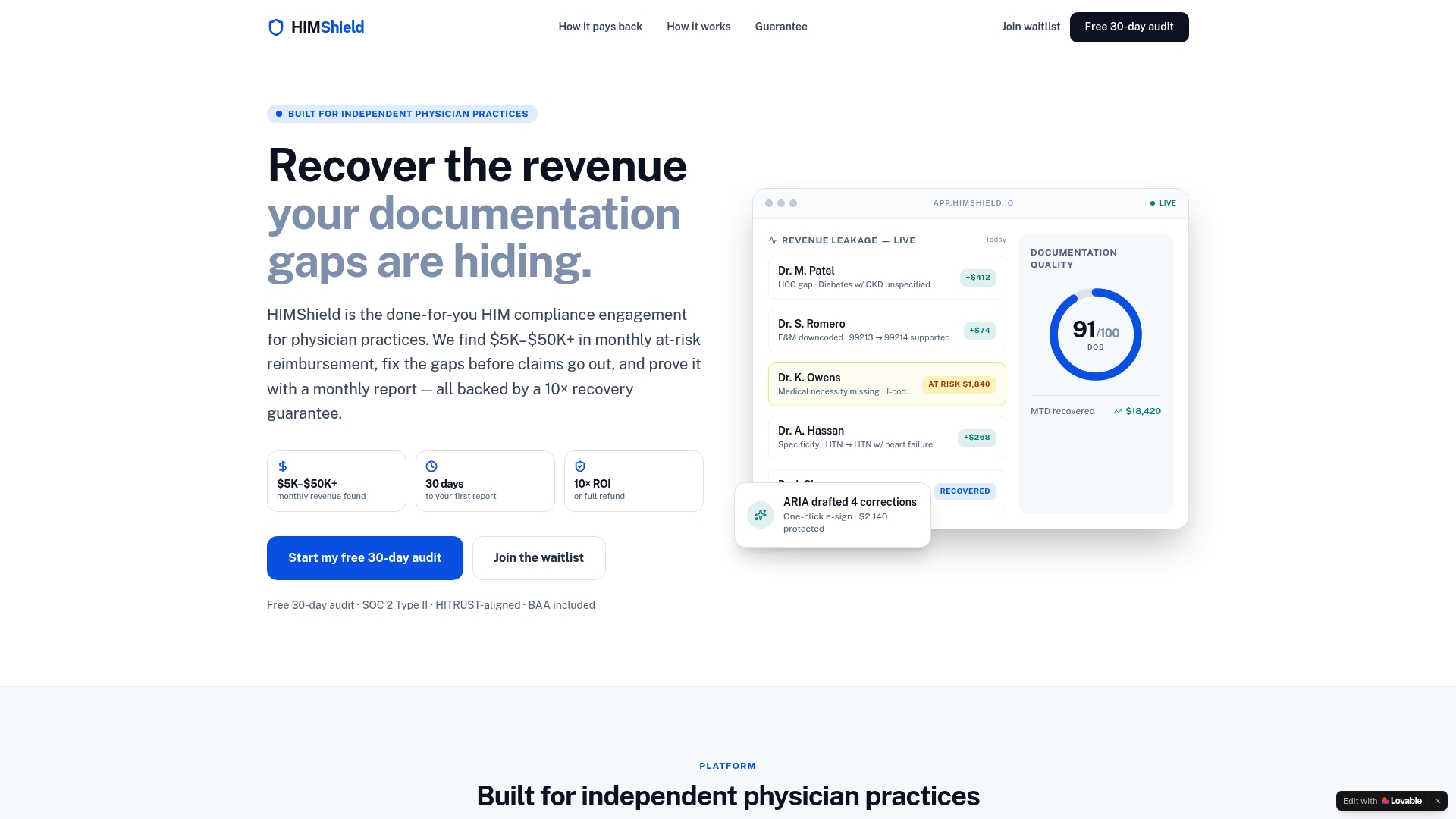
Every practice that starts with Himshield receives a free 30-day audit that delivers a Revenue Leakage Report showing exactly where coding, documentation, and charge-capture gaps are costing the practice money. The report includes a remediation roadmap so your team knows which findings to address first and what the financial recovery looks like. For independent practices that want to move from quarterly retrospective reviews to near-continuous risk detection, Himshield's AI-powered platform identifies and quantifies revenue leakage across 100% of claims, not just the sampled charts. Start your free 30-day audit at himshield.com and see your Revenue Leakage Report within days.
Authoritative sources, templates, and downloads to support your audit
Use these resources in the sequence that matches the audit workflow: prepare first, then sample, then review, then remediate.
Regulatory references (review before planning):
- OIG Physician Practice Compliance Guidance (AAN summary): Sampling floors, scope guidance, and compliance program expectations for physician practices. Read before writing your audit scope statement.
- CMS Place-of-Service Code Sets: Primary reference for POS accuracy checks in the documentation-to-claim review.
- U.S. Department of Justice: False Claims Act: Governs mandatory reporting of Medicare overpayments; review before finalizing your escalation path.
- FAU Billing Compliance Audit Handbook: Detailed governance structure for billing compliance programs, including role definitions and oversight functions.
Operational checklists and templates (use during fieldwork):
- Medical Billing Audit Checklist (Practice Help): Quarterly cadence guidance, sample sizes, and a downloadable checklist framework.
- Step-by-Step Billing Audit Review (Accountable HQ): Six-step audit sequence with data-pull and CAPA guidance.
- Physician Practice Audit Survival Checklist: Practical templates for practices preparing for payer or regulator review.
- How to Self-Audit Physician Billing Records: Step-by-step internal audit methodology aligned to OIG guidance.
Documentation retention: Keep all audit artifacts (scope statement, sampling plan with seed, completed checklists, reviewer credentials, CAPA tracker, re-audit results) for a minimum of seven years. Store them in an access-controlled location with a consistent naming convention. If your practice operates under a corporate integrity agreement or has received a payer audit notice, consult legal counsel on extended retention requirements before setting a shorter policy.