
No record is audit-proof in the sense of never being questioned. A record is audit-proof when it tells the full story of the visit, supports every code billed, and can be produced quickly and completely when a payer or federal reviewer asks. For an independent practice, that comes down to three habits: document each encounter completely, check claims against the record before they go out, and keep a clean trail of every correction.
This guide covers what auditors look for, which records to keep, how to run a documentation variance analysis, and how to respond when a request letter arrives.
TL;DR
- Audit-proof documentation is a record that supports the service, the code and the payment, with clear authorship, dates and signatures.
- Medicare, Medicaid and commercial payers can all review your charts, and insufficient documentation is a recognized reason claims are found in error.
- A documentation variance analysis compares the note, the codes and the claim, then sorts every gap by root cause.
- Fix the biggest and most repeatable gaps first, document the change, then re-audit.
- When a request arrives, assign one owner, calendar the deadline, have the treating clinician review the record, and keep a copy of what you send.
Table of Contents
- What audit-proof documentation means
- Who can audit your documentation
- The documentation errors reviewers flag most
- What every encounter note should contain
- Retention: how long to keep records
- How to run a documentation variance analysis
- Prioritize, correct and re-audit
- What to do when an audit request arrives
- Our perspective
- See your own variances in 30 days
- FAQ
- Sources
What audit-proof documentation means
The HHS Office of Inspector General says timely, accurate and complete documentation matters for patient care and also verifies that a bill is accurate as submitted. It names documentation of diagnosis and treatment among the most important compliance issues for physician practices.
The same guidance explains that a properly documented record shows exactly which services were provided. It can be used to validate the site of service, the appropriateness of the services, the accuracy of the billing and the identity of the caregiver.
So "audit-proof" is not about volume. Longer notes do not defend a claim. What defends it is a record where a reviewer who has never met the patient can see why the service was needed, what was done, who did it and when.
CMS puts the same idea this way: CMS's fact sheet for medical professionals says clinicians must ensure that claims are true and accurate and that the medical record supports and justifies what was billed. It also notes that documentation is open to review by employers, federal and state reviewers, and auditors.

Who can audit your documentation
Small practices tend to think of audits as a single event. In reality, reviews arrive from several directions:
- Medicare error-rate testing. The CERT program reviews a random sample of Medicare fee-for-service claims to see whether they were paid correctly. Reviewers count a claim as an error when the submitted documentation is insufficient to support payment.
- Medicaid reviewers. Federal and state reviewers can request records to check that services billed match services documented.
- Commercial and Medicare Advantage payers. These plans request records under their own contracts and provider manuals, and set their own record standards.
- Internal reviews. Your own self-audits are the only reviews you control, and they are the cheapest place to find problems.
The common thread is that every one of these reviews starts with the chart. If the chart is strong, the audit is usually short.
The documentation errors reviewers flag most
CMS lists the kinds of insufficient documentation that lead to errors in MLN909160. They include:
- Incomplete progress notes.
- Records that fail to show authenticity or do not meet a signature requirement for payment.
- No documentation of an order, or of the intent to order, services and procedures when Medicare policy requires it.
Add to that the EHR habits CMS warns about. Its guidance says to turn off auto-fill and keyword features, watch for cloned notes that look identical across different visits, make sure every note has a date and time stamp, and make sure edits are initialed or identified by the person who made them. If cloned notes are a concern in your practice, our HIM audit playbook for cloned notes walks through how to find them.
Signatures deserve their own attention. Missing or late signatures are among the most fixable problems, and our guide on the physician signature attestation process explains how to handle them.
What every encounter note should contain
The OIG recommends internal guidelines that make sure each patient encounter records:
- The reason for the encounter.
- Relevant history.
- Physical examination findings.
- Prior diagnostic test results.
- Assessment, clinical impression or diagnosis.
- Plan of care.
- The date and legible identity of the observer.
The OIG guidance also says the record should be complete and legible and that the codes used on claims should be supported by the documentation.
For medical necessity, CMS spells out a minimum in MLN909340. Documentation must be complete and legible and include:
- The name of the person providing services.
- The date of service.
- The patient's signs and symptoms supporting the need for the service.
- Details of the services provided.
- Where the services were provided.
- Signed orders and the clinical rationale.
- The rationale for the level of care given.
A practical way to use these lists is to turn them into a one-page checklist for your providers. For one high-volume code, see our documentation checklist for 99214. For connecting notes to payment more broadly, read why documentation affects reimbursement.
Retention: how long to keep records
Retention is set by several layers at once, so the safe answer is the longest period that applies to you.
| Source | Retention requirement |
|---|---|
| New Jersey Division of Consumer Affairs | At least 7 years from the last office visit, longer recommended for obstetric and pediatric patients |
| OSMA | 10 years for Medicare managed care records, 7 years for billing records under IRS rules |
| Blue Cross Blue Shield of Rhode Island | At least 10 years for its records, including Medicare Advantage, with date and time on every entry |
| Capital Blue Cross | Providers must follow CMS's 10-year retention requirement for Medicare plans |
State rules differ, so check your state medical board and your payer contracts. The North Carolina Medical Board states, for example, that licensees have a legal and ethical duty to retain records under their control, that every entry carries the author's identification and date, and that records should be retained and destroyed in a HIPAA-compliant manner.
One warning about corrections. New Jersey's guidance says records must be properly corrected and signed, and that altering a record, including adding late entries without proper identification and dating, can constitute a criminal offense. Never overwrite. Add a clearly dated and attributed addendum. The audit trail guide explains how your EHR can show who changed what and when.

How to run a documentation variance analysis
A documentation variance is any gap between what the record says, what was coded and what was billed. A variance analysis finds those gaps systematically instead of waiting for a payer to find them.
Step 1: Pick a defensible sample
CMS's self-audit rules say to have a staff member who understands documentation and coding principles select a random sample of records, and to avoid auditing your own charts so bias stays out. Use a standard audit tool that covers your documentation policy and coding standards. If you are new to the process, start with our guide to the medical record audit.
Step 2: Test six attributes
CMS's self-audit fact sheet identifies six attributes to test on each claim:
- Availability of documentation.
- Adequacy of documentation.
- Acceptability of documentation.
- Allowability of the service.
- Appropriateness of the service.
- Accuracy of payment.
The fact sheet suggests tallying each criterion for individual records, claims or details with a simple checklist. A spreadsheet is enough to start.
Step 3: Sort variances by root cause
The total error rate tells you little. The cause tells you what to fix. An AHIMA article on root cause says coding variance can be classified into six categories, and that the value is in reporting by root cause. Its example splits a total variance into portions caused by coder misapplication of a guideline, physician documentation, administrative issues and a system issue.
For a practice, a workable set of buckets looks like this:
| Root cause | Typical example | Usual fix |
|---|---|---|
| Provider documentation | Note does not support the level billed | Targeted provider education |
| Coding | Correct note, wrong code | Coder feedback, annual coding review |
| Administrative | Missing signature or order | Workflow change, attestation process |
| System | Template or auto-fill creating cloned text | EHR configuration |
AHIMA's article also makes a point worth repeating internally: the work is not only the coders' job but also that of HIM professionals and the physician community. Everyone needs to understand what is reported and how the record captures it.
Step 4: Compare note, code and claim
For each sampled encounter, ask three questions in order. Does the note support the service? Does the code match the note? Does the claim match the code, including diagnoses and modifiers? A variance at any step gets logged with its root cause and dollar effect.
If your practice has risk-adjusted patients, add a check on diagnoses. Our 90-day HCC documentation plan shows how to sequence that work.
Prioritize, correct and re-audit
A list of findings is not a fix. CMS's self-audit guidance says to review and prioritize results, revise risk assessments, processes, policies and controls as needed, document the changes, and train the affected people. It also says to track corrective actions with both numbers and percentages, covering error counts, error rates and dollars paid in error.
A simple order of priority:
- Repeatable errors with dollars attached. A template flaw affecting every visit outranks a one-off typo.
- Errors that create repayment exposure. Overpayments tied to unsupported services come before underbilling.
- Errors that are easy to fix. Missing signatures and dates can often be closed in days.
- Provider-specific patterns. These go to focused education, not a practice-wide memo.
CMS also advises educating staff, holding them accountable for changes, and auditing again after corrective action to confirm compliance improved. Good audit documentation, per CMS, gives an accurate, complete record of efforts to collect risk data, address risks and prevent or remedy improper payments, with enough detail to convince an informed outsider that the conclusions are reasonable.
One useful format comes from a Colorado Department of Public Health and Environment quality program, which describes one or two page improvement tools. Each records the problem, the planned corrective action and the follow-up that confirms it worked. The same one-pager works for a practice. Keep these with your audit files, because they show you found and fixed problems.
Education is what makes corrections last. See why physician documentation education matters and our annual coding review guide for how to build a repeating cycle.
What to do when an audit request arrives
The AMA Payor Audit Checklist gives a clear sequence:
- Read the request carefully.
- Assign a senior staff member as the single point person.
- Review the payor contract and provider manual.
- Put the deadline on the calendar.
- Assemble the complete requested record.
- Have the clinicians review it.
- Consider an explanatory letter if the record is incomplete.
- Keep a separate copy of the submission package.
The clinician review matters most. The AMA says only the treating clinician can know whether the materials form an accurate and complete record of the care, and that many appeals can be avoided by producing a record that tells the patient's full story.
Two more points. Capital Blue Cross notes that providers must either promptly provide requested records or tell the plan immediately if they are not available, so silence is never an option. And if you bill under incident-to rules, assemble the supporting EHR evidence in advance; our guide on EHR artifacts for an incident-to audit lists what to gather.
Our perspective
Most practices we talk to do not have a documentation problem so much as a visibility problem. The notes exist, the codes exist, and nobody has compared them across every provider and every payer until a denial or a request letter forces the issue.
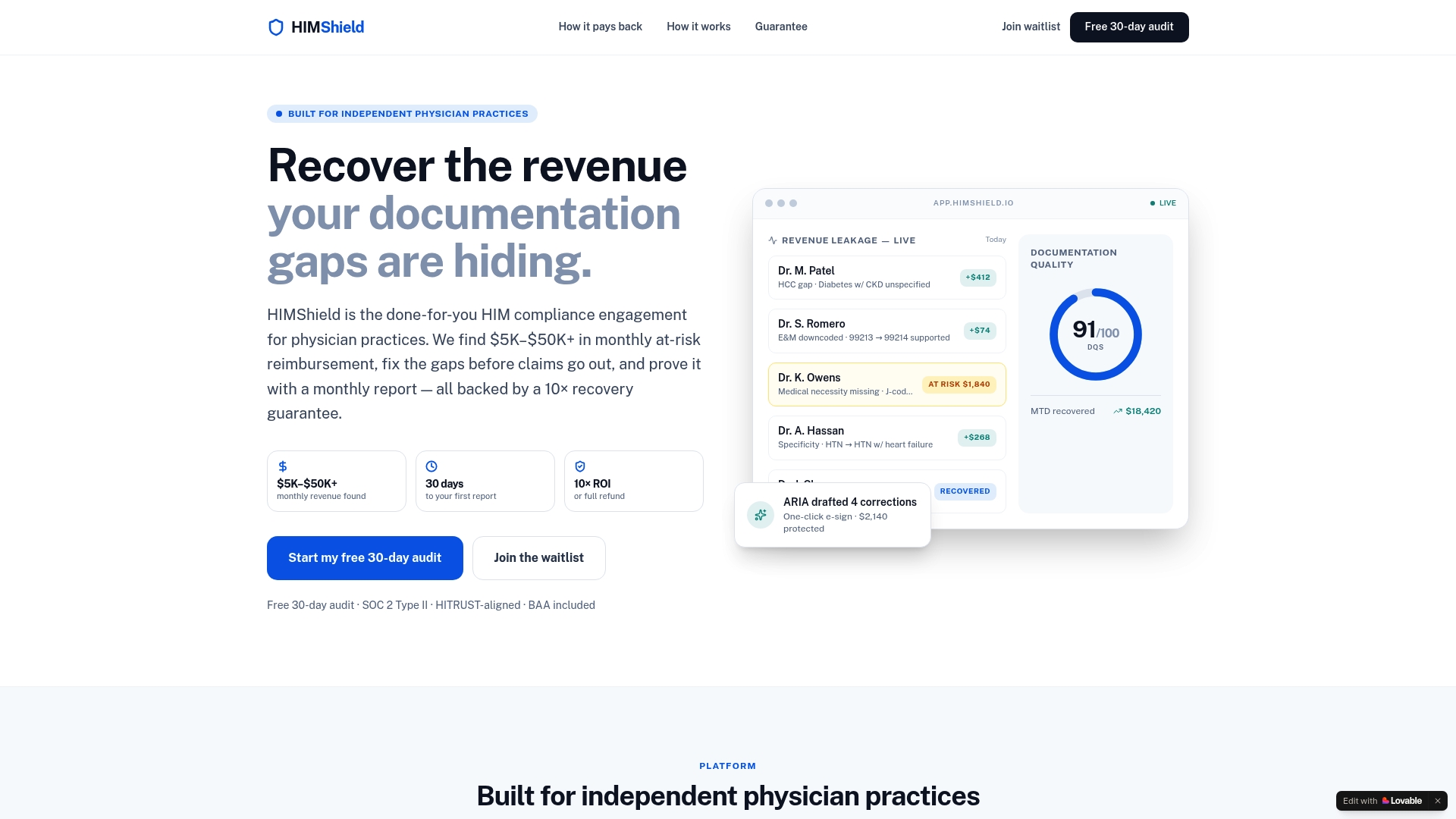
That is why we built HIMShield to scan EHR data before claims are submitted. It quantifies coding, documentation and charge-capture gaps, shows them per provider and per payer in a Revenue Leakage Report, and drafts corrections that a physician can approve with one e-signature. We designed it so your team does not need new staff or software training to get there.
The same data that finds leakage also builds your defense. When a payer asks for records, the work of assembling a submission-ready response should not fall on your administrator at the end of a long day. Our approach is to make audit readiness a routine output of the work you already do, not a scramble.
Elena
See your own variances in 30 days
If you would like a variance analysis without building the spreadsheet yourself, our free 30-day Revenue Leakage Audit reviews your EHR data for coding, documentation and charge-capture gaps and delivers a quantified report. Our offer is backed by a performance guarantee. You can also see how our HIM compliance engagement works for independent practices.
Pricing for the subscription that follows scales with provider count and chart volume.
FAQ
What does audit-proof documentation mean in a physician practice?
It means each encounter note supports the service billed, the code assigned and the payment received. It is complete, legible, dated, signed and attributable to a named clinician. No chart is immune from review, but a strong one resolves the review quickly.
How is documentation variance analysis different from a regular chart audit?
A chart audit asks whether a record is acceptable. A variance analysis compares the note, the codes and the claim, then classifies each gap by root cause. That second step shows you whether to fix a template, retrain a provider or change a workflow.
How often should we audit our own documentation?
CMS describes a cycle: audit, correct, educate, then audit again after corrective action. The exact frequency depends on your size and risk, so set a recurring schedule and re-audit whenever you change a template, a payer mix or a coding practice.
Can we fix a note after a request arrives?
Never alter the original. Proper corrections are dated, attributed and clearly marked as late entries. New Jersey's board guidance warns that unmarked late additions can constitute a criminal offense, so ask your compliance advisor or healthcare attorney before touching any record that is under review.
Sources
- OIG Compliance Program Guidance for Individual and Small Group Physician Practices
- CMS: Medicaid Documentation for Medical Professionals
- CMS MLN909160: Complying with Medical Record Documentation Requirements
- CMS MLN909340: Collaborative Patient Care is a Provider Partnership
- New Jersey Division of Consumer Affairs: Patient Records
- North Carolina Medical Board: Medical Records Position Statement
- Blue Cross Blue Shield of Rhode Island: Medical Record Standards
- OSMA: Medical Record Issues FAQ
- Capital Blue Cross: 2026-05-002 Medicare only
- CMS: Self-Audit Fact Sheet
- AHIMA: Collecting Root Cause to Improve Coding Quality Measurement
- Colorado Department of Public Health and Environment: Quality Management Program
- AMA Payor Audit Checklist