
A medical record audit is a systematic review of patient charts that assesses documentation quality, coding accuracy, billing integrity, and compliance with federal, state, and payer requirements. According to the AAPC, audits reduce claim denials, protect revenue, and keep practices legally aligned with CMS and HIPAA standards. For independent physician practices, this process is the front line of revenue protection. Done right, it catches problems before a Recovery Audit Contractor (RAC) or commercial payer does.
Every medical record audit covers a core set of elements:
- Documentation quality: Are clinical notes complete, legible, and timely?
- Coding accuracy: Do diagnosis and procedure codes reflect the documented level of care?
- Billing integrity: Do submitted claims match what was actually documented and delivered?
- Regulatory compliance: Do records satisfy CMS, HIPAA, and payer-specific requirements?
- Audit cycle stages: Planning, data collection, analysis, provider feedback, corrective action, and re-audit.
What are the main types of medical record audits?
Not all audits come from the same direction. Knowing the type you are facing, or initiating, shapes how you prepare.
- Government audits: CMS-driven reviews conducted by Medicare Administrative Contractors (MACs) or RAC auditors. These target billing patterns that deviate from national averages and can trigger recoupment demands.
- Medicaid audits: State-level reviews that mirror Medicare audit logic but apply state-specific coverage rules and billing requirements.
- Recovery Audit Contractor (RAC) reviews: Contingency-fee auditors contracted by CMS to identify improper Medicare payments. RAC audits are retrospective and can reach back multiple years.
- Commercial payer audits: Private insurers conduct their own post-payment reviews, often triggered by high-volume billing or unusual coding patterns. Preparing for a payer audit requires the same documentation discipline as a government review.
- Internal quality improvement audits: Practice-initiated reviews designed to catch errors before external auditors do. These are the most controllable and the most valuable for ongoing compliance.
- Compliance audits: Focused specifically on adherence to regulatory standards, including HIPAA privacy rules, informed consent documentation, and fraud and abuse statutes.
- Billing and coding audits: Narrow-scope reviews targeting E/M level selection, modifier use, and charge capture accuracy. These often surface undercoding that leaves revenue on the table.
Why medical record audits matter for your practice
The American Medical Association frames regular audits as a preventive measure, much like a flu vaccine. You do not wait until you are sick to protect yourself. The same logic applies here: audits catch billing errors and documentation gaps before they escalate into legal or financial problems.
The core purposes of a medical record audit include:
- Ensuring accurate documentation: Confirms that clinical notes support the codes billed, reducing the risk of payer disputes.
- Detecting billing errors: Surfaces both overcoding and undercoding before a payer review does it for you.
- Protecting reimbursement integrity: Physicians often underestimate patient complexity, leading to undercoding that costs revenue that could have been legitimately recovered.
- Maintaining regulatory compliance: Keeps your practice aligned with the National Correct Coding Initiative and payer-specific coverage policies.
- Supporting quality assurance: Audits are one of the seven pillars of clinical governance, giving organizations a structured way to measure and improve care delivery.
- Reducing external audit risk: Regular internal reviews shield practices from RAC and MAC scrutiny by identifying variations from national billing averages before they attract attention.
Key benefits of regular medical record audits
Consistent auditing produces measurable returns across compliance, revenue, and clinical quality. The benefits extend well beyond avoiding penalties.
- Revenue protection: Audits recover dollars lost to undercoding and charge-capture gaps. When documentation does not reflect the full complexity of care delivered, you are leaving earned reimbursement uncollected.
- Reduced claim denials: Correct modifier use and accurate E/M level selection, both surfaced through audits, directly cut denial rates. The AMA notes that targeted provider education on common billing mistakes improves reimbursement and minimizes denials.
- Improved coding accuracy: Audits train providers to document at the level of care they actually deliver, closing the gap between clinical reality and coded claims.
- Early detection of compliance risk: Finding an overcoding pattern internally is far less costly than having a RAC auditor find it first.
- Stronger clinical documentation: Feedback from audits motivates clinicians to improve recordkeeping. Research shows audit and feedback cycles drive consistent monthly gains in documentation quality scores.
- Legal and regulatory protection: Documented audit activity demonstrates good-faith compliance efforts, which matters significantly in any OIG or payer investigation.
- Operational efficiency: Identifying recurring documentation gaps allows practices to fix workflows rather than correct individual claims one at a time.
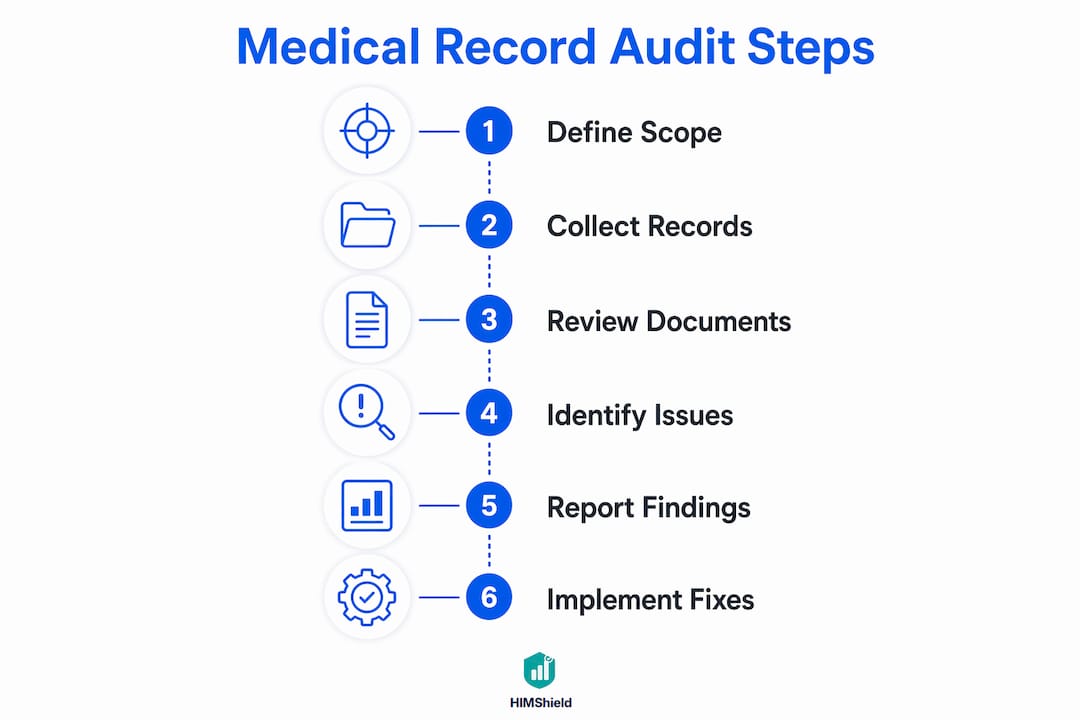
How to conduct an effective medical record audit
The clinical audit cycle gives you a repeatable framework. Each stage builds on the last, and skipping one typically undermines the whole effort.
- Define your audit focus. Choose a specific service line, provider, or coding category. Trying to audit everything at once produces shallow results. A focused scope produces findings you can act on.
- Set your criteria and standards. Establish what "correct" looks like before you pull a single chart. Reference CMS guidelines, payer contracts, and the National Correct Coding Initiative.
- Select your records. Pull a representative sample across the providers and service types in scope. Reviewing a manageable percentage of eligible records keeps the process sustainable without sacrificing statistical meaning.
- Collect and review data. Assess each record against your criteria. Use a structured chart audit workflow to keep reviewers consistent and findings comparable across providers.
- Analyze findings. Identify patterns, not just individual errors. If coding errors in one-third of sampled records trigger a formal improvement plan and a 60-day follow-up audit.
- Deliver feedback to providers. Share results directly with the clinicians involved. Non-punitive, specific feedback tied to real examples is what changes behavior.
- Build a corrective action plan. Address root causes, not symptoms. If underdocumented E/M levels keep appearing, the fix is a documentation training, not a one-time correction.
- Re-audit to confirm improvement. The North Carolina DPH auditing standard specifies that if the same error rate persists at the 60-day follow-up, the improvement plan extends for another 60 days. Multiple cycles may be needed before scores stabilize.
Pro Tip: Keep your initial audit scope narrow. A tightly defined first audit produces clearer findings and faster corrective action than a broad review that tries to assess every service type simultaneously.
Best practices that make audits actually work
Executing the steps is one thing. Getting lasting improvement is another. These principles separate audits that drive change from audits that produce reports no one reads.
- Adopt a continuous quality improvement mindset. Research confirms that sustained improvement depends on a quality improvement culture, not fear-based compliance. Providers who understand the "why" behind audit criteria document better over time.
- Keep feedback non-punitive. Punitive audit frameworks cause providers to disengage. Specific, constructive feedback paired with targeted action plans is what actually moves documentation scores.
- Audit at least annually, ideally quarterly. AAPC guidance recommends quarterly reviews for ongoing adherence to standards like the National Correct Coding Initiative. Annual audits catch problems; quarterly audits prevent them.
- Use a structured checklist. A consistent evaluation grid covering documentation completeness, code selection, modifier use, and billing accuracy keeps reviewers aligned and results comparable across audit cycles.
- Involve clinicians actively. Presenting audit results in small group discussions, where providers can identify root causes themselves, produces stronger buy-in than distributing a written report. Internal audit research shows consistent monthly improvement when clinicians are engaged directly in the process.
- Track KPIs across cycles. Measure coding accuracy rate, denial rate by code category, documentation completeness score, and time to corrective action. These metrics tell you whether your audit program is working or just running.
- Address legal and ethical obligations. Medical records are legal documents. Audits must respect HIPAA privacy requirements, and findings must be handled with appropriate confidentiality. Document your audit methodology and results; that paper trail protects you if your compliance program is ever questioned.
- Use technology to scale your effort. EHR-integrated audit tools, automated risk detection platforms, and coding compliance software reduce manual review time and flag high-risk records before they become claims. Practices using medical coding compliance software can run continuous monitoring rather than relying solely on periodic manual reviews.
Pro Tip: Pair your audit program with secure, compliant communication tools when sharing findings with providers. Audit results contain protected health information and must be transmitted through HIPAA-compliant channels.

Himshield helps independent physician practices run exactly this kind of proactive audit program. The platform scans your documentation and coding for revenue leakage, flags at-risk claims before submission, and delivers physician-friendly guidance your team can act on immediately.

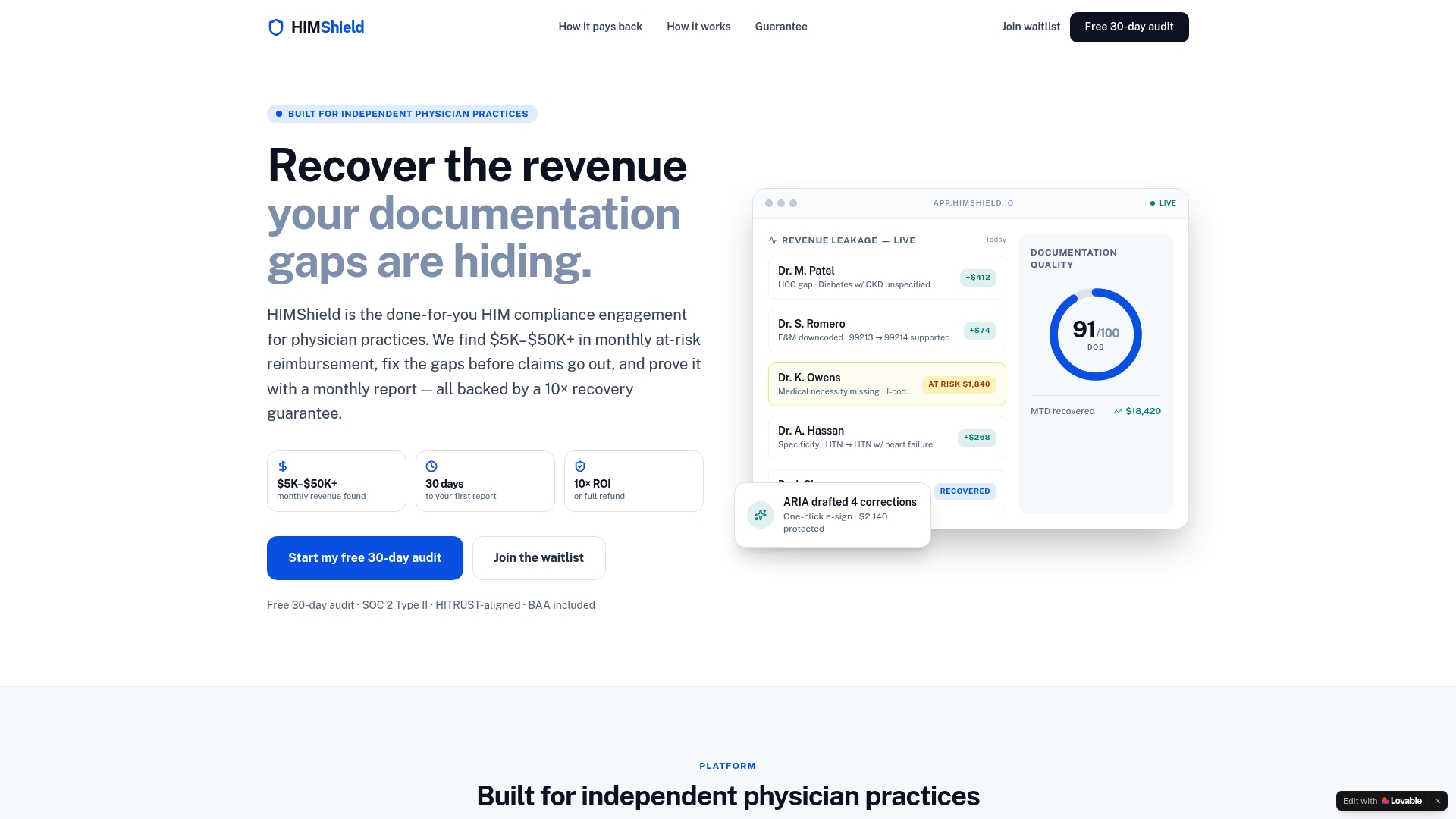
If your practice has not audited its records recently, you are likely leaving earned revenue uncollected. Recover $5K–$50K+ in hidden practice revenue with Himshield's automated risk detection, or explore how the platform works and connect your EHR in under 30 days.
Key Takeaways
Medical record audits protect revenue, reduce denials, and keep your practice compliant by catching documentation and coding errors before external auditors do.
| Point | Details |
|---|---|
| Core audit purpose | Audits assess documentation quality, coding accuracy, billing integrity, and regulatory compliance. |
| Audit frequency | Internal audits should occur at least annually; quarterly reviews provide stronger ongoing protection. |
| Error threshold rule | Coding errors in one-third of sampled records trigger a formal improvement plan and a 60-day follow-up audit. |
| Non-punitive feedback | Sustained improvement depends on a quality improvement culture, not fear-based compliance responses. |
| Technology advantage | Automated risk detection platforms catch high-risk records continuously, not just during periodic manual reviews. |