
Cloned notes create real audit exposure the moment they stop reflecting what actually happened at a specific encounter. Payers and program integrity contractors treat identical or near-identical documentation across visits as a red flag, not a technicality. If you suspect cloning in your charts, the priority order is simple: preserve your audit logs before anything gets overwritten, run a probe sample of 20 to 40 claims to see how deep the problem goes, and loop in compliance or legal counsel the moment findings suggest a pattern rather than a one-off mistake.
TL;DR:
- Copy/paste and template overuse can lead to identical notes across multiple visits, raising flags for auditors and risking invalidating clinical support.
- Audit logs are essential for evidence; hospitals often fail to preserve or review them properly, making detection of cloning difficult and increasing exposure.
- Payer probes typically sample 20 to 40 claims, and a high error rate in these samples can lead to widespread recoupment and potential extrapolation of violations.
- Cloning issues are most costly in risk-adjusted, high-volume, or high-risk codes, creating significant financial liability if patterns go unnoticed.
- Conducting early, targeted audits with preserved logs and remedial corrections helps prevent the escalation of cloned notes into serious compliance and billing problems.
Table of Contents
- What Are Cloned Notes and Why Do Auditors Care?
- What Do CMS, RADV, and HHS-OIG Expect From Documentation?
- How Do Auditors Detect Cloned Notes in a Chart?
- What Happens After a Payer Finds Cloned Notes?
- How Should a Practice Audit and Remediate Cloned Notes?
- Which EHR Settings and Policies Actually Cut Cloning Risk?
- Cloned Notes Are a Revenue Problem Before They're a Legal One
- How Himshield Helps You Quantify and Fix Cloned-Note Exposure
- Where to Read the Original Regulatory Guidance
- Sources
- FAQ
What Are Cloned Notes and Why Do Auditors Care?
Cloning covers a range of behaviors, not one single act. It includes straight copy/paste between visit notes, "copy‑forward" of an entire prior note into today's encounter, template and macro overuse, and auto-population features that pull data forward without a clinician actively reviewing it.
Auditors care because every note carries an implicit claim: this reflects what happened, with this patient, on this date, verified by this provider. When language is identical across encounters, that claim breaks down. Reviewers look at three things:
- Authorship — who actually wrote or approved the content, and when.
- Provenance — whether the entry can be traced to a specific encounter rather than lifted wholesale from another.
- Encounter specificity — whether the note reflects today's exam findings, not last month's.
CMS does not ban copy/paste outright. Its decision table on EHR features makes clear that copied content is acceptable when it's modified for the current visit and properly attributed. The problem isn't the tool. It's using the tool without updating what it produces.
What Do CMS, RADV, and HHS-OIG Expect From Documentation?
Regulatory guidance converges on one theme: authentication is not the same as accuracy. RADV medical record reviewer guidance requires entries to be attributable, dated, and authenticated, and it specifically states that a signature does not substitute for encounter-specific clinical support. The guidance also applies a 180-day window for acceptable signature timing, meaning stale or late authentication can itself invalidate a record for risk-adjustment purposes.
HHS-OIG has flagged copy-paste functionality and overdocumentation as EHR fraud vulnerabilities, noting they can produce inaccurate records, duplicate charges, or fraudulent claims when left unchecked. A separate OIG review found that many hospitals lacked policies governing copy/paste use at all, leaving the practice entirely to individual habit.
Auditors typically flag charts using a short list of triggers:
- Identical or near-identical notes across multiple dates of service.
- Missing patient-specific findings, vitals, or history that should vary visit to visit.
- Metadata anomalies, like a note "written" faster than a real exam could occur.
- Notes that are unusually long for the visit type, often a byproduct of unfiltered copy-forward.
Any one of these can trigger a closer look. Several together tend to trigger a formal review.
How Do Auditors Detect Cloned Notes in a Chart?
Detection rarely starts with a human reading every chart line by line. It starts with the audit log and a handful of automated checks.
Audit logs record who opened a record, what they edited, and when. They're what turns a suspicion into evidence. HHS-OIG treats preserved and analyzed audit logs as key investigative material for separating harmless template reuse from cloning that actually undermines encounter support. That distinction only works if the logs exist and haven't been altered, which is exactly the gap an earlier OIG review flagged: many hospitals could delete or disable their own audit trails.
Beyond logs, reviewers and increasingly their own software rely on:
- Text-matching algorithms that flag identical or near-identical passages across dates.
- Copy-paste ratio flags built into some EHR analytics modules.
- Note-length outlier detection, since abnormally long notes often signal unfiltered copy-forward rather than genuine documentation depth.
Payers rarely audit every claim. They pull a probe sample, usually 20 to 40 claims, and if the error rate is high enough, they extrapolate that rate across the full claim population. A handful of bad charts in a probe sample can translate into a repayment demand covering thousands of claims you never individually reviewed.
What Happens After a Payer Finds Cloned Notes?

Consequences escalate in stages, and they rarely stop at a single denied claim. Payers typically start with denials and requests for records, then move to recoupment demands once a pattern emerges. Medicare contractors can place a provider into Targeted Probe and Educate or prepayment review, which slows cash flow on every future claim until the provider demonstrates corrected practice.
Program integrity outcomes go further. A probe sample with a high error rate can lead to full extrapolation, and in risk-adjustment programs, unsupported diagnosis codes carry outsized financial weight because they affect payment calculations beyond the single claim.
By the Numbers: An OIG audit of Medicare Advantage risk-adjustment submissions at Keystone Health Plan East found a large share of sampled diagnosis codes were unsupported by the medical record, resulting in a substantial estimated overpayment and a formal recommendation for refund.
That's the pattern worth internalizing: small, chart-level documentation defects compound into program-level financial exposure once extrapolation and risk-adjustment math get applied. A single copy-forward habit, multiplied across a panel of patients and a year of visits, is how a documentation shortcut becomes a six-figure repayment letter.
How Should a Practice Audit and Remediate Cloned Notes?
A defensible internal audit follows a sequence, not a scramble. Skipping steps, especially preservation, is what turns a fixable documentation gap into a harder compliance problem.
- Define the sample population. Pull charts by provider, payer, code set, and date range, prioritizing where cloning risk is highest.
- Preserve audit logs immediately. Lock down access logs before running any analysis so the record of who edited what stays intact.
- Locate copy/paste events. Use text-matching or EHR analytics to find identical passages across dates of service.
- Classify each finding. Separate harmless reusable structure (standard phrasing that doesn't change clinical meaning) from inaccurate copied content, unsupported coding, and potential false documentation that needs escalation to compliance or legal counsel.
- Remediate prospectively. Correct records going forward. Never backdate an entry to make it look contemporaneous.
- Quantify exposure. Break findings out by provider, payer, date, and code to calculate real repayment risk and prioritize fixes accordingly.
- Prepare a response. Draft an audit response letter with a quantified summary, the corrective actions taken, and the date corrections began.
Pro Tip: An audit response letter carries more weight when it shows preserved audit logs alongside your corrective timeline. A quantified exposure summary with a clear "corrections began on X date" line signals a controlled process, not a cover-up attempt.
This sequence mirrors the workflow HIM teams already use for broader chart audit programs, and it applies just as well to a narrow cloning investigation as to a full compliance review.
Which EHR Settings and Policies Actually Cut Cloning Risk?
Prevention lives in three places: the system configuration, the written policy, and the ongoing monitoring that makes the policy real instead of aspirational.
On the system side, CMS recommends enabling audit logs that can't be edited or disabled, limiting or flagging indiscriminate copy/paste, and recording the method of data entry, such as whether a field was typed, copied, or auto-populated. A gestionale or EHR platform with configurable scheduling and clinical documentation modules can support these controls if they are actually turned on, which many practices never do by default.
On the policy side, a written copy/paste policy should define what can be reused, what must be rewritten for each visit, and how signature timing works against the 180-day RADV window.
- Require modification and attribution for any copied clinical content.
- Set note-quality standards that specify what "encounter-specific" means in practice.
- Run spot audits and track copy/paste rates monthly, not annually.
Pro Tip: Feed audit findings back to individual providers within weeks, not at year-end review. A physician who sees their own copy/paste rate trending up will usually correct the habit faster than a policy memo ever will.
Cloned Notes Are a Revenue Problem Before They're a Legal One
Most practices treat cloned notes as a documentation nuisance, something HIM flags and providers roll their eyes at. That framing misses the actual risk. A cloned note isn't just sloppy. It's a claim that may not survive a payer's probe sample, and probe samples extrapolate.
The prioritization heuristic is straightforward: start with high-risk codes (anything tied to risk adjustment or medical necessity scrutiny), high-volume providers (where a single bad habit touches the most claims), and payers already running Targeted Probe and Educate activity in your specialty. That's where a cloning problem does the most financial damage the fastest.
If you need a place to start quantifying this today, HIMShield's resources on medical necessity denials and upcoding audit risk walk through the same exposure math this article describes, applied to real claim data.
— Elena
How Himshield Helps You Quantify and Fix Cloned-Note Exposure
There are services and solutions available as alternatives to hiring an outside consultant or running a manual chart pull for cloning risk. It is designed to provide a quantified assessment in a timely manner, rather than a multi-month engagement.
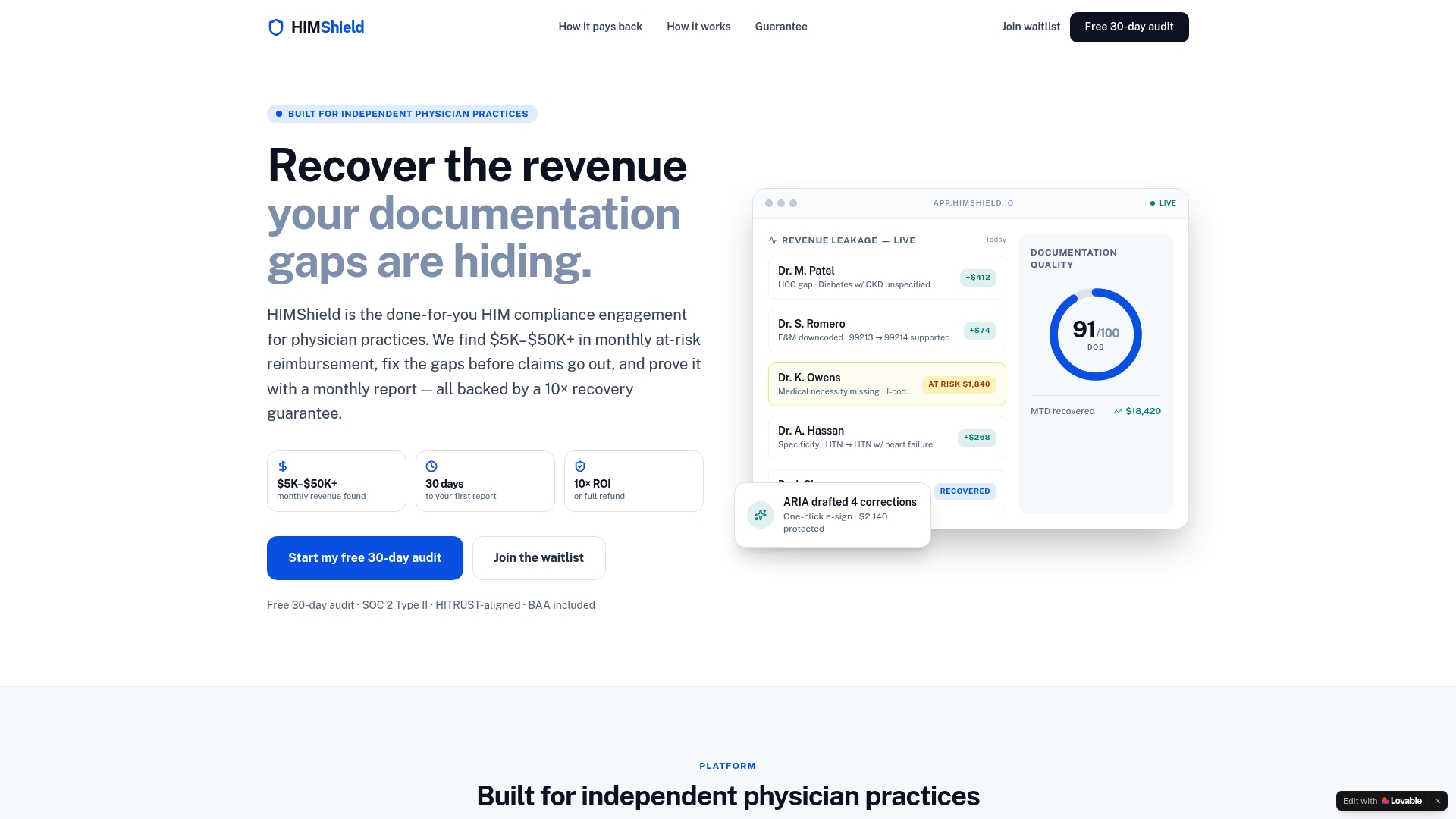
The free 30-day Revenue Leakage Audit scans your EHR data for exactly the patterns covered here: identical note text, unsupported coding, and documentation gaps by provider and payer. The service provides a Revenue Leakage Report quantifying financial risk, along with prioritized fixes and tools to support physician sign-off for corrections. The service also assists with assembling submission-ready audit response documentation to support practices during audits.
If cloned notes are showing up in your charts, the smarter move is finding out how much exposure they've created before a payer does it for you. Visit Himshield to start your free audit.
Where to Read the Original Regulatory Guidance
For the primary source language behind every claim above, go directly to the regulators:
- CMS documentation integrity fact sheet on EHR audit logs and administrative controls.
- RADV medical record reviewer guidance on authentication and dating requirements.
- HHS-OIG podcast on EHR fraud safeguards covering copy/paste vulnerabilities.
This article is general information, not a substitute for advice from a qualified doctor. Consult a qualified healthcare professional about your own circumstances before acting on anything here.
Sources
- Fraud safeguards in electronic health records | HHS‑OIG podcast
- RADV medical record reviewer guidance (CMS)
- Ensuring proper use of electronic health record features and capabilities (CMS decision table)
- Documentation integrity in electronic health records (CMS fact sheet)
FAQ
What Danger Comes From Cloning Documentation in the EHR?
Cloning risks producing an inaccurate or unsupported medical record, which can lead to duplicate or inflated claims. HHS-OIG identifies this as a specific EHR fraud vulnerability, separate from ordinary billing errors.
Can a Doctor Get in Trouble for Falsifying Medical Records?
Yes. Falsified or unsupported records can trigger claim denials, recoupment demands, prepayment review, and in serious cases, civil or criminal referral. The severity depends on whether the finding looks like an isolated error or a systematic pattern across many charts.
What Happens When a Note Is Cloned From a Prior Visit?
If the cloned note lacks encounter-specific findings, it may fail to support the billed service for that date. Under RADV guidance, a signature alone doesn't fix that gap, since authentication is not the same as clinical support.
What Are the 5 C's of Medical Record Entries?
Definitions of this framework vary by organization and specialty, and no single version is universally standardized. Rather than rely on an unverified list, focus on what regulators actually require: accurate, attributable, dated, authenticated, and encounter-specific documentation.
Does Himshield Help With Cloned-Note Audit Risk Specifically?
Yes. The free 30-day Revenue Leakage Audit scans for copy/paste patterns and unsupported coding tied to cloned documentation, then quantifies the exposure by provider and payer. Pricing for the paid HIM compliance engagement is available directly through Himshield.