
There is no single national list of non-billable services. A service is nonbillable for one of four reasons: Medicare excludes it, a coding rule bundles it into another service, a payer's own policy bundles it, or the practice gives it without charge. The practical job is knowing which reason applies to each service, so you stop billing what will be denied and stop giving away what you can legitimately bill. Practices that scan their EHR data before claims go out, as we do in the free 30-day Revenue Leakage Audit, find that line quickly.
TL;DR
- CMS sorts noncovered Medicare services into four groups: not reasonable and necessary, statutorily noncovered, bundled into another service, and items paid by others or furnished free.
- Many everyday tasks (ECG interpretation inside critical care, same-day preoperative visits in a global period, chart review) are included in another service, not billable on their own.
- Payer lists differ. Codes with Medicare status B are bundled and not payable, and commercial payers publish their own code lists.
- A non-covered service can sometimes be billed to the patient, but only with the right notice, modifier and documentation.
- Documentation decides everything: insufficient or missing notes drive most improper E/M payments.
Table of Contents
- What nonbillable means in a physician practice
- A working non-billable services list
- Services bundled into other services
- Payer-specific lists: status B and beyond
- Incident-to services and who gets paid
- Nonbillable time versus time you can count
- When the patient can be billed: fees and notices
- Documentation checks that protect both sides
- Find what you are giving away: the 30-day audit
- Our perspective
- FAQ
- Sources
What nonbillable means in a physician practice
"Nonbillable" is used loosely. In a practice it can mean three different things, and each calls for a different fix.
Not covered. The payer will not pay for the service at all. Bundled. The payer pays for it, but inside another service's payment, so there is no separate claim line. Unbilled by choice or by habit. The service is performed, nothing is charged, and no rule required that.
The third type is where revenue disappears. The first two are about compliance: billing them separately invites denials, recoupments and audit attention.
For Medicare, CMS groups noncoverage into four categories: services that are medically unreasonable and unnecessary; noncovered items and services; services bundled into another service's allowance; and items reimbursable by other organizations or furnished without charge. Use those four buckets as the skeleton of your own internal list.

A working non-billable services list
The table below turns the CMS categories and payer policies into a list a billing team can use. It is a starting point, not a code-by-code authority. Always confirm against the current Medicare Physician Fee Schedule and each payer's policy.
| Category | Examples | Why it is not billed separately |
|---|---|---|
| Statutory exclusions (Medicare) | Eyeglasses and contact lenses, hearing aids and hearing exams, eye exams for fitting or changing glasses, most routine checkups | Excluded by law, so no benefit exists |
| Chiropractic beyond the benefit | Chiropractic services other than manual spinal manipulation to correct a subluxation | Outside the Medicare benefit |
| Components of critical care | ECG, blood pressure and hematologic data interpretation, temporary transcutaneous pacing, ventilator management, vascular access | Bundled by CPT into 99291 and 99292 |
| Included pre- and post-procedure work | Other preoperative E/M on the same date as major surgery | Included in the global surgical payment |
| Incident-to supplies and routine items | Gauze, ointments, bandages, oxygen | Part of the professional service in the office |
| Status B codes | Codes CMS marks status B on the fee schedule | Payment is subsumed by the service they accompany |
| Administrative contacts | Brief calls, no-show handling, record preparation | No billable code fits |
The first two rows come from the CMS list of items and services not covered under Medicare. Routine checkups carry exceptions, such as the preventive visits Medicare does cover, so check the benefit before writing a service off.
Services bundled into other services
Bundling is the largest source of confusion. The service is real, the work is clinical, and still it has no claim line.
Critical care. CMS MLN006764 lists services that CPT bundles into critical care codes 99291 and 99292, including collection and interpretation of ECGs, blood pressures and hematologic data, temporary transcutaneous pacing, ventilator management and vascular access procedures. The same document states that 30 to 74 minutes of critical care on a given day is reported as 99291. Billing the bundled items on top is a classic unbundling error.
Procedure-included work. The 2026 NCCI Coding Policy Manual, Chapter 12 explains that codes include services usually performed as a standard part of a procedure. A physician should not report those separately just because a code exists for them, and should not unbundle a service described by one code. It also notes that other preoperative E/M on the same date as major surgery is included in the global payment. If NCCI edits keep hitting your claims, our guide on fixing the NCCI edits behind batch denials walks through the pattern.
The same logic applies to the daily visit work physicians do without a patient in the room. Anthem's bundled-services policy states that services without direct face-to-face patient contact are generally integral to overall medical management. It also says modifiers will not override denial of codes that are always bundled. A modifier is not a workaround for a code that is bundled by definition.
When a patient asks why they cannot be charged the difference on a bundled or covered service, the answer sits in the rules on Medicare balance billing limits and their exceptions. Bundled services are part of the allowed amount, not an invitation to bill the patient more.
Payer-specific lists: status B and beyond
Medicare is the baseline, but your commercial payers each publish their own lists. Three patterns recur.
Status B codes. Codes CMS designates status B on the Medicare Physician Fee Schedule are bundled. Highmark's RP-041 policy (issued April 2026) says its listed codes are rejected if submitted and are non-billable to the member, and that overhead supplies are included in the professional service allowance. UnitedHealthcare's commercial B Bundle Codes policy (January 2026) applies the same idea whether the code is billed alone or with other services. Its list includes 99024, 99070 through 99072, 99080, 99288, 99366 through 99368, 99485 and 99486, and 77417.
Not separately reimbursed (NSR) codes. Blue Cross and Blue Shield of Rhode Island defines NSR as a code that is covered but not separately reimbursable, and not billable to the member. Its policy also says Category II codes, which track performance measures, are not intended for reimbursement. Its code status is updated quarterly, which is the point: these lists move.
Payer-by-payer rules. Anthem sorts items into three groups: never separately reimbursable, reimbursable only in certain code pairs, and reimbursable only when stand-alone. A code that pays alone on one plan can be bundled on another.
The lesson for your team: keep one list per major payer, tied to the policy's issue date, and review it when the payer updates. Our Physician Fee Schedule database guide shows how administrators can use CMS status indicators as the first check.
Incident-to services and who gets paid
Supplies and staff work provided in the office often fall into the incident-to rules. CMS describes incident-to services as covered services and supplies that auxiliary personnel provide as an integral, though incidental, part of a physician's or non-physician practitioner's professional services. Billed under an NPP's supervision they are paid at 85% of the fee schedule, while services billed by the supervising physician or NPP are paid at 100%.
MLN Matters SE0441 adds the test: the service must be an integral part of the patient's course of treatment, commonly furnished without a separate charge, of a type commonly furnished in an office or clinic, and an expense to the physician. Examples include non-self-administered drugs and supplies such as gauze, bandages and oxygen. In hospital settings and skilled nursing facility Part A stays, bundling provisions mean incident-to services are not separately billable to the Part B contractor.
If your practice uses split or shared visits, the billing rules differ again. See who bills a split/shared visit and how to prove it.
Nonbillable time versus time you can count
The most common internal use of a nonbillable list is time. Physicians spend hours on chart review, documentation and coordination that never reaches a claim. A 2018 study of nurse practitioners found all providers spend time on non-reimbursable activities, and that the time varied significantly by workplace setting, number of support staff and role.
Some of that time is recoverable. The AMA explains that office and outpatient E/M visits can be coded on medical decision making or total time on the date of the encounter. Total time may include face-to-face and non-face-to-face physician activity, such as preparing, reviewing history, documenting and coordinating care that is not reported separately. The same-day work before and after a visit is counted inside the visit level, not billed as a separate service.
A documentation guide from a California managed care body classifies time without the patient (chart, lab and medication review, writing the note) as nonbillable and tells staff to record it, while still pointing to specific codes such as 99368 for team conferences that meet its conditions (CalMHSA, 2023). Note that UnitedHealthcare lists 99368 as bundled in its commercial policy above, so the same code can be payable in one program and not in another.
For time-based visits and prolonged services, review five checks before any time-based E/M claim and what prolonged services notes must show.
When the patient can be billed: fees and notices
Some services are nonbillable to the payer but chargeable to the patient. There are two routes, and each has its own conditions.
Non-covered Medicare services
AAFP's guidance says Medicare separates services that are not reasonable and necessary from statutorily noncovered services, and in some cases lets a physician bill the patient directly if the notice and modifier rules are followed. For statutory exclusions such as hearing aids, most dental services and most fee-for-service prescription drugs, no ABN (Advance Beneficiary Notice of Noncoverage) is required, but CMS transmittal R25CP3 advises alerting the beneficiary to possible liability and documenting any voluntary notice.
Since May 15, 2024, CMS instructs providers to bill the Initial Preventive Physical Exam and Annual Wellness Visit with HCPCS codes G0402, G0438 and G0439 rather than CPT 99381 through 99397. A written ABN is not required for the routine preventive portion Medicare does not cover, but CMS strongly encourages one.
The ABN steps
Where an ABN is used, the Mississippi Optometric Association's June 2025 guide lays out the routine:
- Use the current official CMS-R-131 form.
- Present it before the service, not after.
- Have the patient choose one of three options: pay and let Medicare be billed, pay and not bill Medicare, or decline the service.
- Have the patient sign and date it.
- Put the matching modifier (GA, GK, GL, GY, GZ or GX) on the claim.
The same guide notes the ABN applies to Medicare fee-for-service only, not Medicare Advantage or Part D, and that other insurers have their own notice requirements. Check each plan before relying on a Medicare-style form.
Administrative fees
The AMA Code of Medical Ethics directs physicians to tell patients in advance about fees for nonclinical or administrative services. Fees should reflect reasonable practice costs for items such as special documentation on request, missed or late-cancelled appointments under a published policy, and record copying or processing. Publish the policy, tell patients before the fee applies, and keep the notice on file. Payer contracts may restrict what you can charge their members, so read them first.
Documentation checks that protect both sides
Two errors cost practices money: billing something that is bundled or excluded, and failing to bill something that is payable because the note cannot support it. The same habits address both.

CMS data shows the scale. In its E/M compliance tips, CMS reports that for the 2024 reporting period, incorrect coding accounted for 49.1% of improper payments for overall E/M codes, insufficient documentation 34.1%, no documentation 13.1%, and non-covered or unallowable services 3.7%. CMS also states that medical necessity is the main payment criterion beyond a code's own requirements, and that billing a higher E/M level than warranted is not medically necessary.
A practical checklist for each encounter:
- Does a benefit exist? Check the Medicare exclusions and the payer's policy for the date of service.
- Is the code bundled? Check the status indicator and the payer's bundled-code policy.
- Does the note support the level? Medical decision making or total time, documented on the date.
- Is the signature complete? Teaching physician notes, for example, need the physician's signed and dated record showing presence, and CMS MLN006347 says macros alone are not sufficient.
- Was notice given? If the patient may owe, the ABN or financial notice is on file before the service.
- Is the record retained? Maryland Medicaid, for example, requires six years of retention, and missing documentation can lead to denial, repayment or sanctions. State and payer rules vary.
For medical necessity problems specifically, see our 30-day audit approach to Medicare medical necessity denials and why practices lose reimbursement.
Find what you are giving away: the 30-day audit
A static list tells you what you cannot bill. It does not tell you what your own practice is failing to bill. That takes your claims data, provider by provider and payer by payer.
HIMShield scans EHR data for coding, documentation and charge-capture gaps before claims are submitted. The free 30-day Revenue Leakage Audit produces a per-provider, per-payer Revenue Leakage Report that quantifies what is at risk, and the audit comes with a performance guarantee. The platform also drafts corrections for one-click physician e-signature, so fixes do not wait in an inbox.
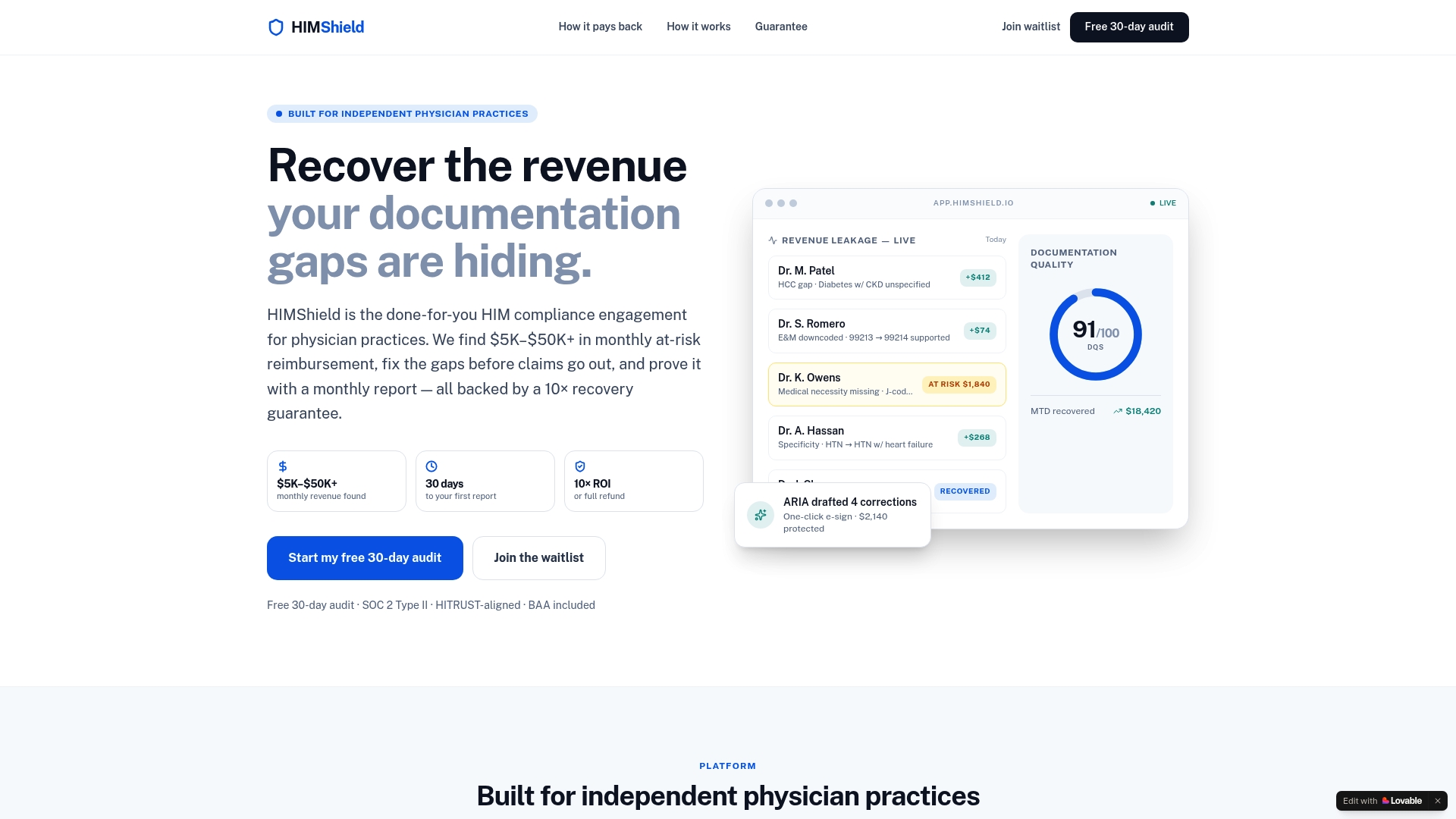
Start your free 30-day Revenue Leakage Audit to see where your charges are slipping out, or learn more about our HIM compliance engagement.
Our perspective
Most practices keep a list of what they cannot bill. Few keep a list of what they could bill and do not. The second list is where the money is.
A nonbillable list is only useful when it is tied to a payer, a code and a date. A code bundled by one plan pays on another, and a policy reissued in April can change what a claim does in May. That is too much to track by hand across every provider, so we built HIMShield to compare charts against the rules before a claim leaves your office.
We also think physicians should not have to chase the paperwork. Our platform scores documentation quality in real time and drafts the correction, so the physician reviews and signs once. When a payer audits, we assemble a submission-ready response. Our aim is that your practice keeps every earned dollar and defends it when asked.
Elena
FAQ
What are non-covered services in Medicare?
They are services Medicare will not pay for, either because they are not reasonable and necessary or because the law excludes them, such as hearing aids and eyeglasses. CMS publishes the full list of categories. In some cases you may bill the patient directly if the notice and modifier rules are met.
Is a bundled service the same as a non-covered service?
No. A bundled service is paid inside another service's payment, so it has no separate claim line. A non-covered service has no benefit at all. Both are generally not billable to the patient when the payer's rules make them part of the allowed amount, so check the policy before charging.
Do I need an ABN for every service Medicare does not cover?
No. An ABN is required only when medical necessity of a recognized benefit is in doubt or previously covered care is being reduced or ended, for Part B and hospice services. For statutory exclusions it is not required, though CMS advises alerting the patient and AAFP recommends a voluntary ABN.
Can the same code be billable with one payer and not another?
Yes. Payers publish their own bundled and not-separately-reimbursed code lists, and they update them. A code such as 99368 appears on UnitedHealthcare's commercial bundled list, for example, while other programs treat it as payable in defined scenarios. Verify each payer's current policy.
Sources
- Items & Services Not Covered Under Medicare (CMS)
- MLN006764 Evaluation and Management Services (CMS)
- Medicare NCCI 2026 Coding Policy Manual, Chapter 12 (CMS)
- Anthem Bundled Services reimbursement policy
- Medicare balance billing limits and their exceptions
- Highmark RP-041 Services Not Separately Reimbursed
- UnitedHealthcare B Bundle Codes Policy
- BCBSRI Non-Reimbursable Health Service Codes Policy
- Incident To Services & Supplies (CMS)
- MLN Matters SE0441, Incident to Services (CMS)
- Nurse practitioners' time on nonbillable activities (JAANP)
- AMA: documenting time spent on E/M
- CalMHSA MD and Nurses Documentation Quick Guide
- AAFP: Understanding Medicare Non-covered Services
- CMS transmittal R25CP3
- CMS MM13548
- Advance Beneficiary Notice of Non-Coverage guide
- AMA Code of Medical Ethics: Fees for Nonclinical and Administrative Services
- CMS Evaluation & Management Services compliance tips
- CMS MLN006347 Guidelines for Teaching Physicians
- Maryland Professional Services Provider Manual 2026