
To avoid unlisted code denials, report an unlisted code only when no specific code describes the service. Then give the payer what its reviewer needs: a concise claim-line description, a comparable code with a proposed charge, and clinical records that show what you did and why. Unlisted claims are reviewed by hand, so a gap in any one of those three pieces is usually what gets the claim denied.
This guide covers when an unlisted code is appropriate, how to build the claim, what documentation to attach, which payer rules to check first and what to do after a denial.
TL;DR
- Use an unlisted CPT or HCPCS code only when no specific Category I, Category III or HCPCS code accurately describes the service.
- Put a short, specific description on the claim line (CMS-1500 Item 19 or the electronic equivalent), and attach more detail when it does not fit.
- Name a comparable code for the same body area and tie your requested charge to that code's normal fee.
- Attach legible, patient-specific records. A correct code does not prove medical necessity.
- Check each payer's rules before submission. Some require paper claims, and appeal windows can be as short as 90 days.
Table of Contents
- Why unlisted code claims get denied
- When an unlisted code is the right choice
- Build the claim: description, comparable code and charge
- Documentation that supports an unlisted code claim
- Check payer rules before you submit
- What to do when an unlisted code claim is denied
- Our perspective
- See where your practice is leaking revenue
- FAQ
- Sources
Why unlisted code claims get denied
An unlisted code has no fixed fee and no built-in description. The payer cannot price it or judge it from the code alone, so the claim goes to manual review. Johns Hopkins Health Plans states that unlisted-code claims are manually reviewed, may require additional documentation, and can be denied or paid incorrectly when the narrative or supporting records are insufficient.
Payer policies point to the same handful of causes. PacificSource lists these triggers for denial:
- The documentation shows that a specific code exists.
- Documentation is missing or insufficient.
- The service is considered experimental, investigational or unproven.
It also says its Medicare and Medicaid claims are denied when they arrive without a description or a comparable code.
So most unlisted denials are not mysteries. They come from one of four problems: the wrong code choice, a thin description, no pricing rationale, or records that do not support the service. Each is fixable before the claim leaves your practice.
When an unlisted code is the right choice
The first defense against a denial is not using an unlisted code when a specific one exists. Cigna's unlisted code guideline, effective May 1, 2026, says to use one only when no Category I, Category III or HCPCS code exists. Its examples include a new procedure, a different method or approach, a different device, or a different anatomical location.
Johns Hopkins Health Plans takes the same position. An unlisted code may be reported only when no more specific CPT, HCPCS or revenue code accurately describes the service, procedure, drug, item or supply. It also expects the provider to verify whether a specific code applies before reporting an unlisted or miscellaneous one.
A quick pre-check before you pick an unlisted code:
- Search the current CPT, Category III and HCPCS Level II code sets for the service, device or drug by its clinical description.
- Read the code descriptors and parentheticals, not just the titles. A code that fits the work closely may exist under another heading.
- Choose the most specific unlisted code. BCBS Illinois' 2026 policy says to use the most specific unlisted code and to report one unit.
- Write down why no specific code fits. Keep that note with the claim file in case a reviewer asks.
If your coder cannot explain in one sentence why no existing code applies, hold the claim. A payer reviewer will ask the same question.
Notice what an unlisted code does not do. Cigna's guideline separates coding appropriateness from medical necessity: choosing an unlisted code does not by itself show the service was necessary. Your documentation has to carry that argument.
Build the claim: description, comparable code and charge
A reviewer should be able to understand the service from the claim alone. Three elements do most of the work.
Write a concise claim-line description
For Medicare Part A, Noridian's unlisted code billing page says to give a concise description on the CMS-1450 or electronic equivalent covering how the service was performed, the body area treated and why. If the description is longer than 80 characters, it points to an attachment or the PWK method as applicable.
For professional claims, BCBS Illinois says the description belongs in CMS-1500 Item 19 or the electronic equivalent, with an attachment if it does not fit.
A useful pattern is: what was done, where, by what method, and why a listed code does not apply. Compare these:
| Weak description | Stronger description |
|---|---|
| Procedure, unlisted | Ultrasound-guided injection, left sacroiliac joint, new device approach, no specific code |
| Misc supply | Single-use device for wound closure, left forearm, no HCPCS code for this item |
| Special service | Extended in-office service for [condition], different method from listed code, see attached note |
The weak examples tell a reviewer nothing they can price or approve. The stronger ones name the body area, method and reason.
Pick a comparable code and explain the difference
The American College of Surgeons' guidance on unlisted procedures recommends a four-part approach:
- Choose a comparable code for the same body area.
- Identify the factors that make your procedure more or less difficult.
- Express the difference in work as a percentage.
- Relate your requested fee to the normal fee of the comparable code.
For example, if the comparable code has a normal fee of a given amount and your procedure took meaningfully more work, say so in numbers, such as the added work expressed as a percentage, and show the arithmetic. Reviewers are far more willing to approve a charge that follows a visible method than a charge with no explanation.
Support the charge with effort and time
The same College of Surgeons guidance says supporting documentation should describe the nature, extent and need for the procedure, along with the time, effort and equipment required. Put the time and equipment in the operative or procedure note, where the reviewer expects to find them, and echo the key points in your cover letter.

Documentation that supports an unlisted code claim
Cigna requires legible medical records that pertain to the requested service and are detailed enough to show the patient's current clinical status. Without them, the guideline says medical necessity cannot be established. A technically correct unlisted code can still fail on this point.
BCBS Illinois lists supporting documentation that includes:
- A complete description of the service or drug.
- Administration information.
- DME or supply invoices.
- The NDC qualifier, NDC number and units, and the NDC unit of measure, when a drug is involved.
- Information showing whether the service was separate from another service billed.
The last item matters more than it looks. Reviewers often suspect an unlisted code is a way to bill separately for work already included in another code. A line in the note stating what was distinct, and why, answers that suspicion up front.
Assemble a standard packet for every unlisted claim:
- Cover letter with the description, comparable code and charge rationale.
- Procedure or visit note signed and dated, with time, method, body area and any device.
- Supporting clinical records: history, exam findings, prior treatment and results that show why the service was needed.
- Invoices or product details for devices and supplies.
- Literature or payer policy references, if the service is new and the payer may question whether it is experimental.
If your notes are the weak link, our guides on medical necessity documentation examples and how to reclaim revenue from medical necessity denials show what strong support looks like. Our related post on unspecified code denials covers the sibling problem of codes that are too vague.
Finally, make the packet easy to read. A billing team that keeps an itemized, payer-ready summary for each claim, like the one described in this out-of-network superbill checklist, tends to answer record requests faster.
Check payer rules before you submit
Two payers can treat the same unlisted code differently. Read the policy for each payer on the claim before you submit, and note three things: how the claim must be sent, what attachments are required, and whether prior authorization applies.
| Payer example | What its policy says | What to do |
|---|---|---|
| Medicare Part A (Noridian) | Use the code that accurately identifies the service; if none exists, use the appropriate unlisted code with a concise description | Put how, where and why in the description; attach if over 80 characters |
| BCBS Illinois (2026) | One unit, most specific unlisted code, description in Item 19 or electronic equivalent | Attach the listed records, including NDC details for drugs |
| CarePartners of Connecticut | Requires paper submission for unlisted codes; electronic ones are denied and returned for paper submission with documentation | Send paper with documentation the first time |
| Johns Hopkins Health Plans | Manual review; verify no specific code applies | Keep your code search notes |
The CarePartners row comes from a policy dated January 2019, so confirm current rules with the payer. It still shows how a rule like that can turn a clean electronic claim into an automatic denial.
CMS's Medicare framework, set out in a hospital outpatient update transmittal, treats two questions separately: whether the unlisted code is technically correct, and whether the documentation supports payment under the applicable Medicare method. Build your claim to pass both tests.
If your practice bills an unlisted code often, consider raising it with the payer. Coding forum discussions of frequently performed unlisted procedures suggest that a contract or fee-schedule arrangement can be easier than repeated manual review. That is a conversation for your contracting lead. Our post on UnitedHealthcare denial reasons is a good example of how payer-specific rules change the fix.
What to do when an unlisted code claim is denied
Read the remittance advice first. The CARC and RARC codes tell you whether the payer wants more information, says a specific code exists, considers the service not medically necessary, or rejected the claim for a format problem. Each calls for a different response.
- Format or submission denial (for example, electronic submission where paper is required). Correct the submission method and resubmit with documentation. This is usually a corrected claim, not an appeal.
- Missing description or comparable code. Resubmit with the narrative, comparable code and charge rationale added.
- Specific code exists. Review your code search. If the payer is right, correct the claim. If you are right, appeal with the clinical reason the listed code does not describe the work.
- Medical necessity or investigational. Appeal with the full clinical record and any supporting literature or policy references.
Watch the clock. As one example, Harvard Pilgrim's appeal process for requests for additional information sets a first appeal within 180 days of the original EOP date, and a second appeal within 90 days of the original appeal resolution letter. It asks for the appeal form, the original EOP, claim detail and supporting records such as operative notes, office notes, pathology notes, medical record entries or invoices. Your payers will have their own deadlines, so log them the day the denial arrives.
Track every unlisted denial by payer, code and reason. Patterns show up fast: one payer that always wants paper, one service line with thin notes. Fixing the pattern prevents the next ten denials.
Our perspective
Most unlisted code denials we see are not coding disputes. They are documentation and description gaps that were visible before the claim went out.
A coder picks a reasonable unlisted code, the claim line carries a few vague words, and the note in the chart does not say why the service was different or how much work it took. The payer's reviewer sees an unpriceable claim with no support and denies it.
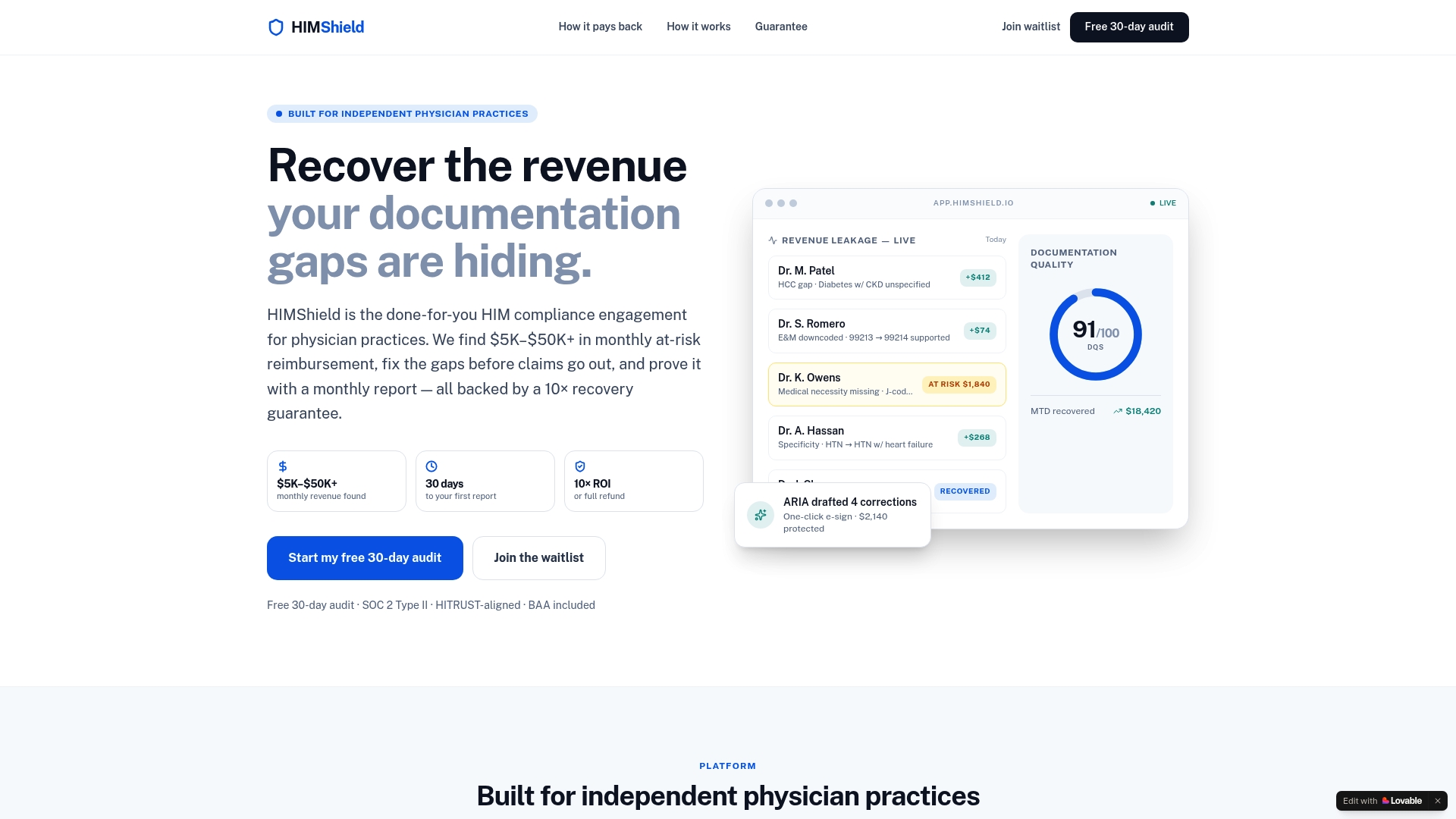
We built HIMShield to find those gaps early. It scans EHR data for coding, documentation and charge-capture risks before claims are submitted, scores documentation quality in real time, and drafts corrections that a physician can approve with one-click e-signature. For unlisted services, that means the narrative, the comparable code reasoning and the clinical support get checked while the physician still remembers the case.
If a denial does arrive, our platform assembles submission-ready responses so your team is not building an appeal packet from scratch under a deadline. Our approach is designed for independent practices that do not have a dedicated compliance team.
Elena
See where your practice is leaking revenue
If unlisted codes, vague documentation or repeat denials are costing your practice money, we can quantify it. HIMShield's free 30-day Revenue Leakage Audit reviews your EHR data for coding, documentation and charge-capture gaps and delivers per-provider, per-payer Revenue Leakage Reports. The audit comes with a performance guarantee, and it works without new staff or software training for your team.
Learn more about our HIM compliance engagement and how it supports independent physician practices.
FAQ
Is an unlisted code more likely to be denied than a regular code?
It faces more scrutiny because it is manually reviewed and has no standard description or fee. Payer policies such as Johns Hopkins Health Plans' say insufficient narrative or records can lead to denial. A complete description, comparable code and clinical record greatly reduce that risk.
How long can the claim description be?
For Medicare Part A claims, Noridian says descriptions over 80 characters should go in an attachment or be sent by the PWK method, as applicable. For professional claims, BCBS Illinois says to use Item 19 or the electronic equivalent and attach more if it does not fit. Keep the line short and put detail in the attachment.
Does a correct unlisted code guarantee payment?
No. Cigna's guideline states that using an unlisted code does not establish medical necessity. The claim also needs detailed, legible, patient-specific records that show why the service was needed.
Should I send unlisted code claims electronically or on paper?
That depends on the payer. Some accept electronic claims with a description and attachments. At least one plan, CarePartners of Connecticut, has required paper submission and denied electronic ones. Check each payer's current policy before you submit.
Sources
- Cigna Management of Unlisted Codes, effective May 1, 2026
- Johns Hopkins Health Plans, unlisted codes policy
- BCBS Illinois RP035, Unlisted/NOC Coding
- Noridian JF Part A, Unlisted Code Billing
- American College of Surgeons, Unlisted procedures: Strategies for successful reimbursement
- PacificSource, Unlisted and Unspecified Procedure Codes
- CarePartners of Connecticut, Unlisted and NOC Codes Policy
- CMS transmittal R1657CP
- Harvard Pilgrim, Request for Additional Information Appeals
- Out-of-network superbill checklist