
A physician fee schedule database is the official CMS system listing Medicare payment rates for more than 10,000 professional health care services, identified by CPT and HCPCS codes. Every rate in that database is calculated using Relative Value Units (RVUs), an annual conversion factor, and geographic cost adjustments. For healthcare administrators and practice managers, this database is the foundation of Medicare Part B revenue management. Miss an update, misread a rate, or skip a geographic adjustment, and your practice absorbs the loss silently through underpayments and denied claims.
What is a physician fee schedule database and how does it work?
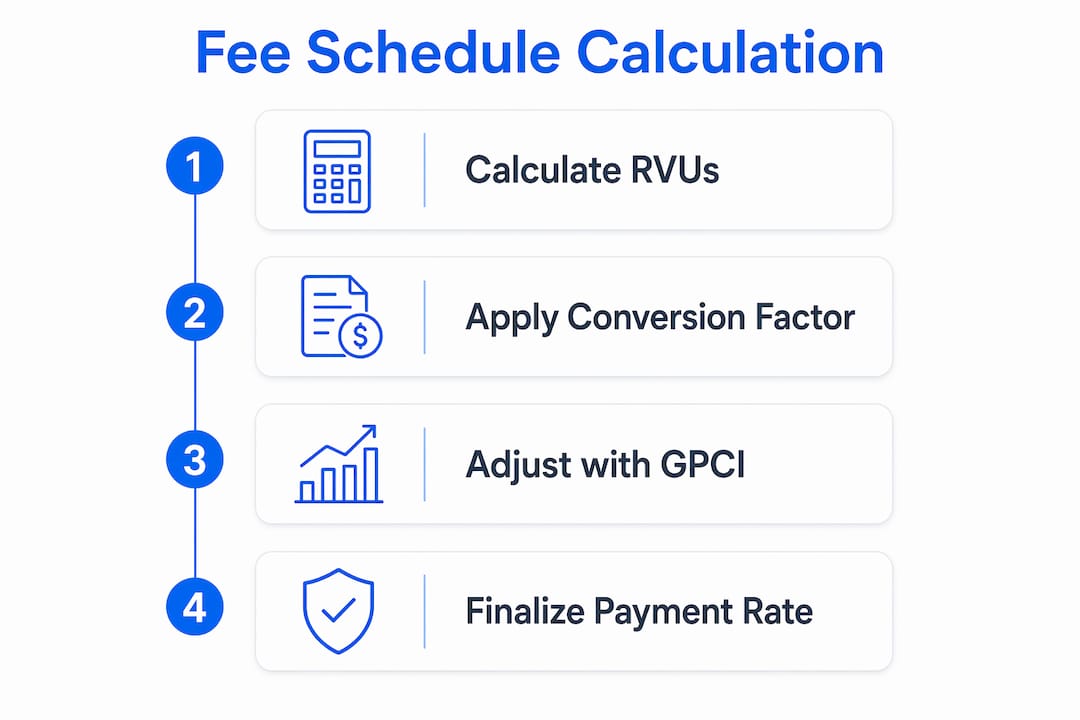
The Medicare Physician Fee Schedule (PFS) database is the authoritative national reference for Medicare Part B payment rates. CMS publishes and maintains it, updating rates every year through a formal federal rulemaking process. The database assigns a dollar value to each covered service by combining three inputs: RVUs, a conversion factor, and Geographic Practice Cost Indices (GPCIs).
RVUs measure the relative resources a service requires across three categories:
- Work RVUs: Physician time, skill, and clinical judgment required for the service
- Practice expense RVUs: Overhead costs including staff, supplies, and equipment
- Malpractice RVUs: The liability risk associated with the service
CMS multiplies the sum of these three RVU components by the annual conversion factor and then adjusts the result using GPCIs. GPCIs reflect local cost differences across more than 80 geographic localities in the United States. A service performed in Manhattan carries a higher GPCI than the same service performed in rural Mississippi. That geographic layer is what makes the database a healthcare pricing database rather than a flat national rate card.
The PFS payment formula multiplies the sum of all three RVU categories by the conversion factor and then applies the GPCI adjustment for the practice's locality. Understanding this formula lets you forecast revenue accurately before claims are submitted, not after they are denied.
Pro Tip: Run your top 20 billed CPT codes through the CMS PFS Look-Up Tool each january to catch rate changes before they affect your first quarter revenue.
How are physician payment rates calculated in 2026?

The conversion factor is the single number that translates RVUs into dollars. For 2026, CMS finalized two separate conversion factors. Qualifying Alternative Payment Model (APM) participants receive $33.57 per RVU, while non-qualifying participants receive $33.40. Both figures represent increases compared to 2025 rates, with the qualifying APM factor rising 3.77% and the non-qualifying factor rising 3.26%.
Those increases sound positive, but they do not tell the full story. The 2026 PFS final rule also included a 2.5% decrease in work RVUs for existing services as a budget-neutrality adjustment. That reduction was not tied to any clinical data change. It reflects how Congress and CMS balance total Medicare spending, and it directly offsets some of the conversion factor gains for many practices.
The net effect on your practice depends on your specialty's RVU mix. A practice heavy in evaluation and management codes may see a different outcome than one focused on procedures with high practice expense RVUs. Running your actual payer mix through the updated formula is the only way to know your real 2026 reimbursement position.
What changed in the 2026 Medicare fee schedule update?
CMS updates the physician fee schedule annually through the federal rulemaking process. A proposed rule publishes each summer, a public comment period follows, and CMS finalizes the rule in november for the following calendar year. The 2026 final rule carried several significant changes that practice managers need to track.
- Conversion factor increases: Both qualifying APM and non-qualifying conversion factors rose, providing a modest revenue lift for most practices.
- Work RVU reduction: The 2.5% budget-neutrality cut to work RVUs partially offsets the conversion factor gains, particularly for services with high work RVU weights.
- Telehealth policy changes: CMS extended and modified telehealth coverage rules, affecting which services qualify for remote billing and at what rate.
- New and revised service codes: CMS added and revised codes for services including caregiver training, advanced primary care management, and certain behavioral health services.
The AMA's 2026 fee schedule analysis confirms that the PFS is not static. It reflects ongoing regulatory and policy shifts that directly affect practice revenue. Practices that treat the fee schedule as a one-time reference rather than an annual management task consistently leave money on the table. An annual coding review aligned with each year's final rule is the most direct way to protect your revenue cycle from policy drift.
How do you access and use the physician fee schedule database?
CMS provides the PFS Look-Up Tool as the primary online access point for fee schedule data. The tool supports both single code searches and bulk queries, and it allows you to filter by geographic locality. Administrators use it to verify payment rates before submitting claims, check reimbursement for new service lines, and audit posted charges against Medicare allowables.
The CMS PFS Look-Up Tool carries an important limitation: CMS states explicitly that it is informational only and carries no warranty for errors or omissions. For legal validation, billing audits, or dispute resolution, you must contact your local Medicare Administrative Contractor (MAC) directly. The online tool is a starting point, not a final authority.
For high-volume billing operations, bulk data downloads from MAC websites are the more practical option. MACs publish text-only fee schedule files that you can import directly into practice management systems. That integration supports automated rate verification, flags billing discrepancies before claims go out, and reduces manual lookup time significantly.
Key use cases for the PFS database in daily practice management include:
- Fee verification: Confirm that your posted charges align with current Medicare allowables for each CPT code
- Patient cost-share estimates: Calculate expected patient responsibility based on the Medicare-allowed amount before the appointment
- Reimbursement audits: Compare paid amounts against the fee schedule to identify systematic underpayments
- New service pricing: Set internal prices for newly added services using the published RVU and conversion factor data
- Non-physician practitioner billing: Verify rates for nurse practitioners and physician assistants, whose reimbursement is capped at 85% of physician rates under the PFS
Pro Tip: Download the MAC text file for your locality each january and load it into your practice management system before processing the first claims of the year. That single step prevents a full quarter of rate mismatches.
How does the fee schedule database affect practice revenue and compliance?
The physician fee schedule database is the reference point for every Medicare billing decision your practice makes. When your internal charge master does not reflect current RVUs and GPCIs, you either overbill (triggering audit risk) or underbill (absorbing a loss). Both outcomes are preventable with disciplined annual updates.
Practice managers often underestimate the need to realign billing systems annually to reflect changes in RVUs and geographic adjustments. A GPCI shift in your locality can change your effective reimbursement rate without any change to the national conversion factor. Practices that skip this step discover the gap only when a payer audit surfaces it.
Non-physician practitioner billing carries a specific compliance risk tied directly to the fee schedule. Nurse practitioners, physician assistants, and clinical nurse specialists bill at 85% of the physician rate for most services. That cap is embedded in the PFS database. Billing at the full physician rate for these practitioners triggers overpayment liability. Verifying rates through the database before billing is the compliance control that prevents that exposure. How you document those services also matters. Documentation quality directly determines which code level is supported, and the fee schedule only pays what the documentation justifies.
Modifier use is the third variable that intersects with fee schedule compliance. Modifiers like 25, 59, and 51 change how CMS processes and pays a claim. Using the wrong modifier on a service with a specific fee schedule payment rule can result in a denial or a reduced payment that does not match the database rate. A solid understanding of modifier usage paired with current fee schedule data is what keeps your claims paying at the correct rate the first time.
Key Takeaways
A physician fee schedule database is the single most important pricing reference for Medicare Part B revenue management, and practices that update their systems to it annually protect significantly more revenue than those that do not.
| Point | Details |
|---|---|
| Database scope | The PFS covers more than 10,000 services, each priced using RVUs, a conversion factor, and GPCIs. |
| 2026 conversion factors | Qualifying APM participants receive $33.57 per RVU; non-qualifying participants receive $33.40. |
| Work RVU reduction | CMS cut work RVUs by 2.5% for 2026 as a budget-neutrality adjustment, partially offsetting rate increases. |
| Access tools | Use the CMS PFS Look-Up Tool for quick checks; download MAC text files for system integration and audits. |
| Non-physician billing cap | Nurse practitioners and physician assistants bill at 85% of physician rates; verify before submitting claims. |
The fee schedule is a management tool, not a reference document
Most practice managers treat the physician fee schedule database as something to consult when a claim gets denied. That is the wrong frame entirely. The fee schedule is a forward-looking management instrument. Every rate in it tells you what Medicare will pay before you submit a single claim. The practices that use it that way, pulling updated data in january, loading it into their systems, and running their charge master against it, catch revenue problems before they become denials.
The 2026 work RVU reduction is a good example of why passive monitoring fails. That 2.5% cut had nothing to do with clinical changes. It was a regulatory budget adjustment. A practice that did not actively track the final rule would not know their effective reimbursement dropped on dozens of services until months of underpayments had already accumulated. By then, the recovery window is narrow and the administrative burden is high.
The other thing I have seen consistently is that practices underinvest in understanding GPCIs. Administrators often focus on the conversion factor because it is a single, visible number. But GPCI shifts in high-cost localities can move reimbursement more than the conversion factor change does. If your practice is in a locality that CMS reclassified in the 2026 rule, your effective rate changed even if you never looked at the conversion factor at all.
Proactive internal audits tied to each annual update are the most reliable defense. Pair that with clean documentation and correct modifier use, and the fee schedule stops being a source of surprise denials and starts being a revenue planning tool.
— Elena
How Himshield supports fee schedule compliance and revenue recovery
Keeping your billing aligned with the physician fee schedule takes more than an annual spreadsheet check. Himshield scans your coding, documentation, and charge-capture data to identify revenue risks before they reach the payer.

Himshield connects to your EHR and flags discrepancies between your posted charges and current Medicare allowables, including RVU changes, GPCI shifts, and non-physician practitioner rate caps. The platform quantifies at-risk reimbursement and delivers physician-friendly guidance so your team can act fast. Independent practices using Himshield recover $5K–$50K+ in hidden revenue by catching what manual reviews miss. See exactly how the platform works and connect your EHR in under 30 days.
FAQ
What is a physician fee schedule database?
A physician fee schedule database is the official CMS system listing Medicare Part B payment rates for more than 10,000 health care services, calculated using RVUs, a conversion factor, and geographic cost adjustments.
How often does CMS update the physician fee schedule?
CMS updates the physician fee schedule annually through the federal rulemaking process, publishing a proposed rule each summer and finalizing it in november for the following calendar year.
What are the 2026 Medicare physician fee schedule conversion factors?
For 2026, CMS finalized a conversion factor of $33.57 for qualifying APM participants and $33.40 for non-qualifying participants, both representing increases from 2025.
Where can administrators access physician fee schedule data?
Administrators can use the CMS PFS Look-Up Tool for single or bulk code searches, or download text-only fee schedule files from their regional Medicare Administrative Contractor for system integration.
Why do non-physician practitioner rates matter for fee schedule compliance?
Nurse practitioners and physician assistants bill at 85% of physician rates under the PFS. Billing at the full physician rate for these practitioners creates overpayment liability and audit exposure.