
A medical necessity denial happens when a payer decides the documentation in your chart doesn't justify the service you billed, even though the care itself may have been appropriate. The moment you see one, check whether prior authorization was required and on file, then pull every chart note tied to the date of service before you touch the appeal. Everything else, causes, prevention, appeals, and templates, builds from that first move.
TL;DR:
- Over 80% of Medicare Advantage denial appeals are partially or fully overturned, highlighting the importance of persistent appeals efforts.
- Most denials are caused by missing or insufficient documentation that fails to clearly demonstrate clinical reasoning and support coverage criteria.
- Prior authorization requirements, especially for Medicare Advantage plans, generate the largest administrative burden and can trigger denials if not properly managed.
- Targeted, payer-specific documentation improvements and regular chart audits are the most effective prevention tactics to reduce denial volume.
- Regular monitoring of denial rates and appeal success metrics helps practices assess whether their denial mitigation strategies are effective.
Table of Contents
- What Are Medical Necessity Denials Costing Independent Practices?
- What Actually Causes a Medical Necessity Denial?
- How Do Payers Decide What's Medically Necessary?
- What Does Your Chart Need to Prove Medical Necessity?
- How Do You Appeal a Medical Necessity Denial?
- Which Prevention Tactics Actually Reduce Denial Volume?
- What KPIs Show You're Actually Improving?
- What Does a Revenue Audit Actually Find?
- Where Should a Small Practice Actually Start?
- How Himshield Helps You Close the Documentation Gap
- Sources
What Are Medical Necessity Denials Costing Independent Practices?
Denials aren't a rounding error. CMS estimated a 6.55% improper payment rate for Medicare fee-for-service in FY2025, totaling $28.83 billion in payments that shouldn't have gone out as billed, largely tied to documentation and coverage-rule mismatches. Peer-reviewed research on Medicare claims found denial rates for medical necessity climbed from 0.59% of spending in 2014 to 0.85% in 2019, with government coverage rules accounting for the majority of those denials in the sample studied.
The scale is bigger than most practices assume: Medicare Advantage insurers alone processed nearly 53 million prior authorization determinations in 2024.
For a small practice, each denial means delayed cash flow, staff hours diverted to appeals instead of new claims, and patients stuck waiting on care or facing surprise bills. Medicare Advantage, commercial plans, and Medicaid managed care all drive volume, but MA plans' prior authorization requirements generate the heaviest administrative load for independent physicians.
What Actually Causes a Medical Necessity Denial?
Not every denial is the same animal. A medical necessity denial means the payer's clinical reviewers looked at your documentation and decided the service doesn't meet coverage criteria. That's different from a coding edit, like a Medical Unit of Edit (MUE) or bundling rule, which flags a billing pattern rather than questioning whether the care was warranted. Medical necessity edits run automatically inside payer claims systems, scanning for clinical justification before a claim ever reaches a human reviewer.
The usual suspects behind a denial:
- Documentation that describes the visit but never states the clinical reasoning for the chosen treatment
- A diagnosis code that doesn't support the billed procedure or level of service
- Missing or expired prior authorization for a service the plan requires it for
- Chart findings that conflict with the payer's Local Coverage Determination (LCD) or National Coverage Determination (NCD)
When you see a CO 50 denial code, that's your signal the payer specifically flagged medical necessity, not a coding technicality. Check prior authorization status first, then compare your documented diagnosis against the applicable LCD before assuming the claim needs a full appeal.
How Do Payers Decide What's Medically Necessary?
Payers rank evidence in a fairly predictable order: their own LCDs and NCDs first, then specialty society guidelines (think American College of Cardiology or NCCN), then peer-reviewed literature when policy is silent. If your documentation doesn't speak that language, a reviewer has nothing to match against your claim.
CMS reshaped a good chunk of this landscape with CMS-4201-F, the 2024 Medicare Advantage final rule. It requires MA plans to base coverage decisions on individual patient circumstances rather than blanket internal criteria, and it tightened transparency requirements around prior authorization decisions. A separate CMS rule is phasing in faster turnaround times, standardized denial reasons, and a requirement that payers implement FHIR-based APIs for electronic prior authorization by 2027.
Two mechanisms matter operationally:
- Prior authorization requires approval before the service, and CMS protects those approvals once granted, so a Medicare Administrative Contractor (MAC) can't simply relitigate medical necessity after the fact.
- Pre-claim review submits documentation before final claim adjudication, often for services with historically high improper payment rates.
Know which one applies to the service before you schedule it, not after the denial arrives.
What Does Your Chart Need to Prove Medical Necessity?
Reviewers aren't reading for narrative quality. They're checking whether specific elements exist, and if one is missing, the claim gets flagged regardless of how good the care was.
- A clearly stated presenting problem, in the patient's own clinical terms
- Objective findings, exam results, vitals, imaging, or lab values that support the diagnosis
- Diagnostic test results tied directly to the treatment decision
- Documentation of prior conservative therapy attempted, and why it failed or wasn't sufficient
- Explicit clinical rationale for the specific intervention chosen, not just that "treatment was indicated"
- A note on the risk of not treating, especially for higher-cost interventions
Map each of these to the payer's own criteria, InterQual, MCG, or the applicable LCD, and cite the guideline by name in the note. "Patient continues to have pain" invites a denial. "Patient reports 7/10 lumbar pain after eight weeks of physical therapy, unresponsive to NSAIDs, meeting LCD criteria for MRI" gives a reviewer nothing to argue with. Himshield's documentation examples library has sample phrasing for common specialties if you want a starting template.
Pro Tip: Have your top three referring diagnoses ready with pre-built phrase templates in your EHR. It takes ten minutes to build and saves hours of chart rework later.
How Do You Appeal a Medical Necessity Denial?
Every appeal starts with triage, not paperwork. Confirm the denial type, verify whether prior authorization was on file, and pull the plan's own policy language before you draft a single sentence.
- Triage the denial. Identify whether it's a medical necessity dispute or something administrative, gather the chart, the denial letter, and the payer's specific policy citation.
- Request a peer-to-peer review if the plan offers one. Bring the exact diagnostic values, a timeline of prior treatment, and the specific LCD or guideline language the reviewer cited. Have the treating physician on the call, not just billing staff, since clinical credibility moves reviewers faster than administrative explanation.
- File the internal appeal within the plan's deadline, typically 30 to 180 days depending on payer and plan type, and document every submission date and reviewer name.
- Escalate to external review if the internal appeal fails. Self-funded ERISA plans and state-regulated plans have different external review pathways, so confirm which applies before you file.
The appeal odds favor persistence: among Medicare Advantage prior authorization denials that were appealed, 80.7% were partially or fully overturned. Most practices that give up after the first denial are walking away from money they were likely to recover.
Which Prevention Tactics Actually Reduce Denial Volume?
Industry guidance from HFMA points to four levers that consistently move the needle: tighter documentation and coding accuracy, ongoing physician education, automation for prior authorization and claim scrubbing, and regular chart audits.
For an independent practice, that translates into specifics:
- Build payer-specific playbooks instead of one generic denial-prevention policy
- Assign one staff member to own your highest-volume payer relationship and track its denial patterns weekly
- Run monthly chart audits focused narrowly on your top five denial codes, not a broad compliance sweep
- Use claim scrubbers and EHR documentation templates that flag missing medical necessity elements before submission
On the technology side, real-time documentation scoring and denial-analytics dashboards catch problems before the claim goes out the door, which is cheaper than fixing them after a denial lands. Smaller practices often don't have the staff to build this internally, which is where a platform doing the scanning becomes more cost-effective than a full-time hire. Once your process discipline is solid, layer automation on top, not before. Read more on the common denial patterns practices face for a deeper breakdown of recurring issues.
Pro Tip: Track denials by CPT code and payer combination, not just by denial reason. The same reason code often has a completely different root cause depending on which payer sent it.
What KPIs Show You're Actually Improving?
Four numbers tell you whether your prevention work is paying off:
- Initial medical necessity denial rate: denials as a percentage of claims submitted, tracked monthly
- Appeal overturn rate: how many appealed denials get reversed, benchmarked against the 80.7% MA overturn rate as a reference point
- Days in denial: how long a claim sits unresolved before payment or write-off
- Denial-to-write-off ratio: how much denied revenue you're actually recovering versus abandoning
To calculate ROI on any remediation effort, compare recovered dollars against the staff hours spent chasing them. If your billing team spends 20 hours a month on appeals recovering $8,000, that's a defensible investment. If it's the same 20 hours recovering $800, the process needs redesign, not more staff time. More on quantifying where reimbursement leaks out of independent practices.
What Does a Revenue Audit Actually Find?
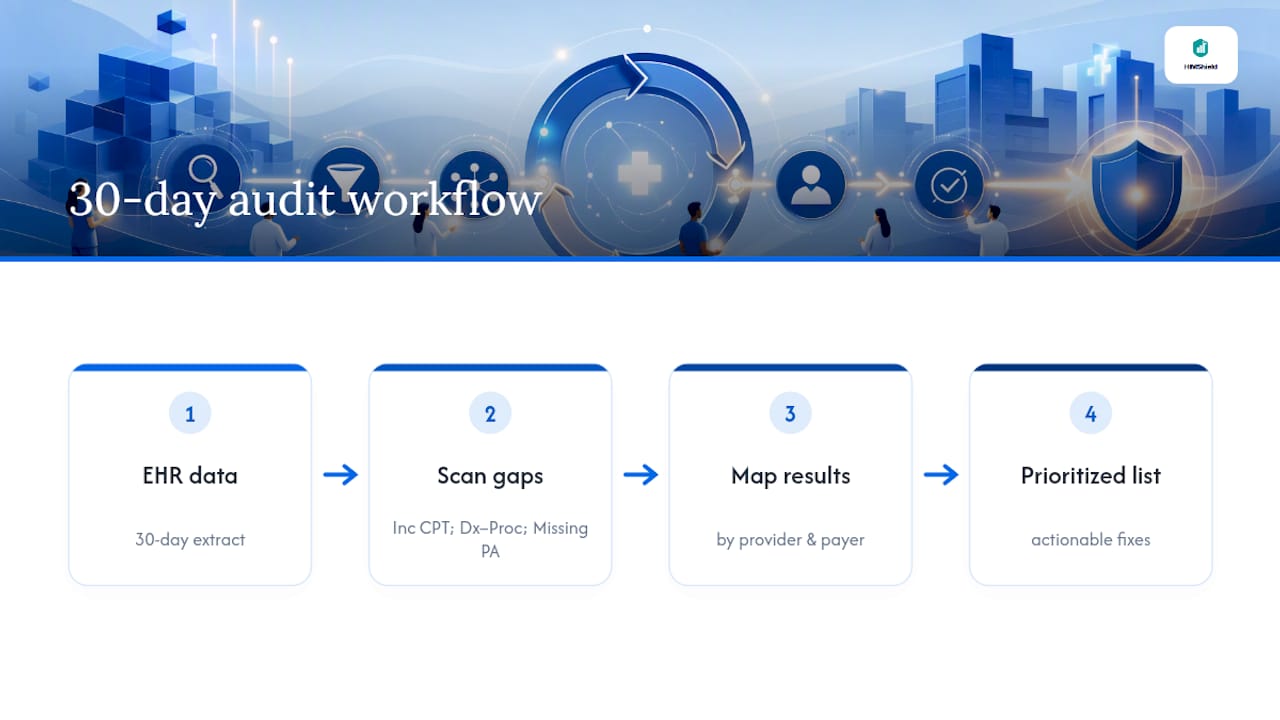
Himshield's platform scans EHR data for the same gaps that trigger denials before they ever reach a payer: incomplete documentation tied to specific CPT codes, diagnosis-to-procedure mismatches, and missing prior authorization flags on services that require it. Practices typically see recurring patterns concentrated in three or four payers rather than spread evenly across their book. A 30-day audit maps those gaps by provider and payer, giving you a prioritized list instead of a vague compliance warning. Elena's documentation breakdowns on the Himshield blog walk through specific chart language fixes tied to real denial patterns.
Where Should a Small Practice Actually Start?
Fix the top five denial codes from your two highest-volume payers first. Broad training programs feel productive but move slower than a targeted weekly spot check on your worst offenders. Give physicians short point-of-care prompts tied to documentation scoring, not another mandatory training module. Once that discipline holds for a quarter, then automate. Skipping straight to software without fixing the underlying documentation habit just automates the same mistakes faster.
— Elena
How Himshield Helps You Close the Documentation Gap
Himshield gives independent practices the specific advantage of catching medical necessity gaps before claims go out, not after the denial letter arrives. The platform connects to your EHR, quantifies coding and documentation risk per provider and per payer, and drafts corrections physicians can e-sign in one click instead of rewriting notes from scratch.
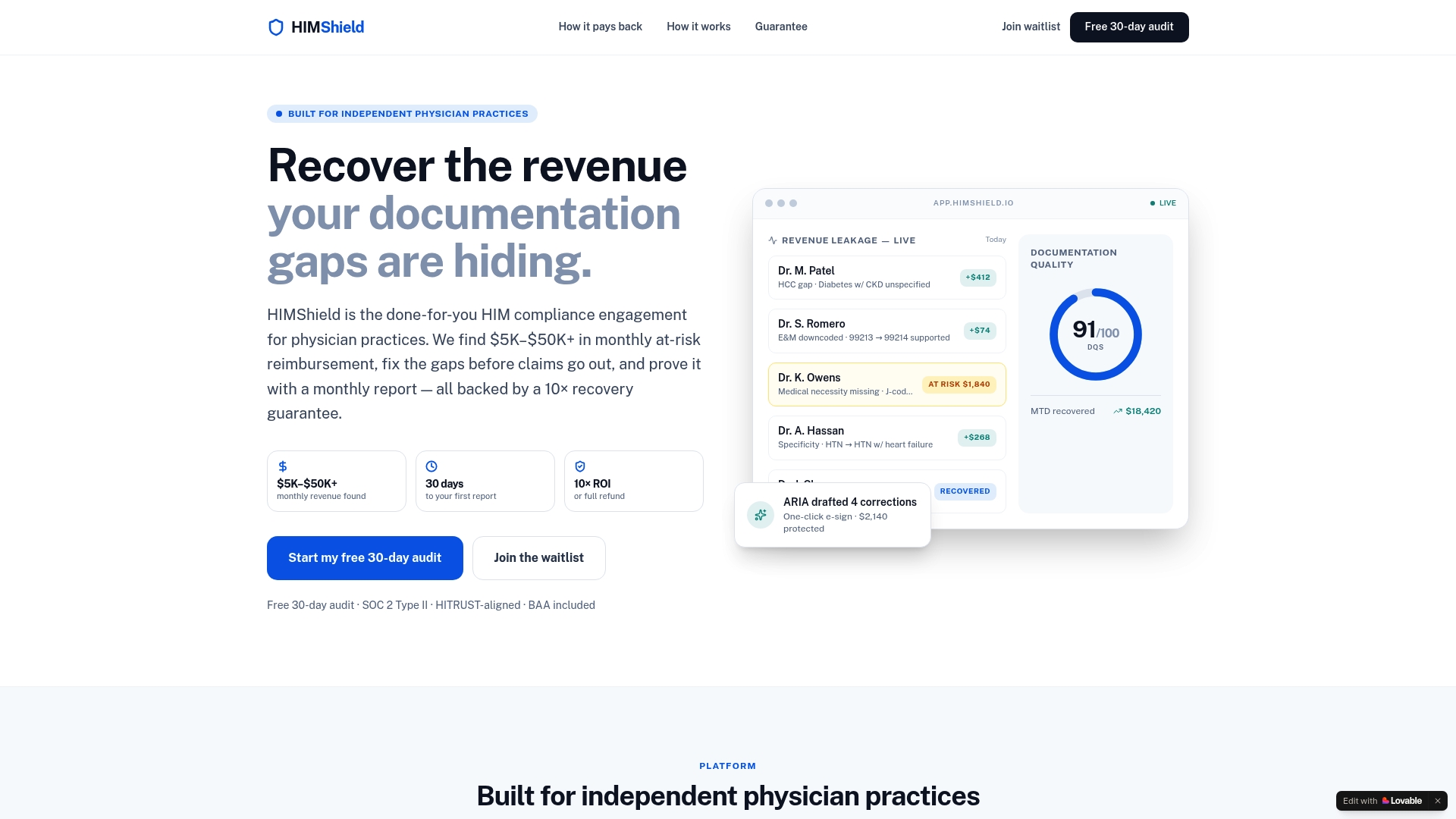
Instead of hiring another biller to chase appeals, you get automated compliance alerts and a Revenue Leakage Report that shows exactly where your practice is losing reimbursement, before it turns into a denial. The 30-day audit connects to your EHR and delivers findings without disrupting your current workflow. If your denial rate has been climbing and you're not sure why, start with the audit and see what it surfaces.
Sources
- KFF — Medicare Advantage insurers made nearly 53 million prior authorization determinations in 2024
- Coverage denials for medical necessity rules in Medicare — PMC
- HFMA — Navigating medical necessity denials: Strategies for successful resolution
- LegalClarity — Medical necessity edits: how they work and why claims get denied