
Medicare covers a service only when it is "reasonable and necessary" for diagnosing or treating an illness or injury and fits within a defined Medicare benefit category. The single highest-leverage action a practice can take is documenting the specific sign, symptom, or diagnosis that justifies each billed service before the claim ever leaves the building. Everything else, from Local Coverage Determinations to appeal timelines, exists to test whether that documentation holds up.
TL;DR:
- Most Medicare denials occur when documentation fails to clearly connect signs, symptoms, or diagnostic results to the billed service, highlighting the need for precise clinical notes.
- Checking whether a service is covered requires reviewing both national (NCD) and jurisdiction-specific (LCD) coverage policies and documenting any deviations from these criteria.
- Proper completion of an ABN depends on issuing it before service delivery, including a specific reason and cost estimate, and ensuring the patient understands their options.
- Common causes for medical necessity denials include diagnosis-code mismatch, exceeding frequency limits, and missing clinical rationale, which should be addressed with targeted documentation or appeals.
- Implementing a routine, checklist-based workflow before claim submission, supported by automated tools, significantly reduces the risk of denial related to missing or inadequate medical necessity evidence.
Table of Contents
- What Does Medicare's Medical Necessity Standard Actually Require?
- How Do You Check Whether Medicare Covers a Service?
- What Documentation Proves Medical Necessity to a Reviewer?
- When Do You Need an ABN, and How Do You Complete It Correctly?
- Why Do Most Medical Necessity Denials Happen, and How Do You Fix Them?
- How Long Does a Coverage Determination or Appeal Take?
- What Should Every Practice's Medical Necessity Workflow Include?
- Elena's Practitioner Perspective: Closing the Gap Between Clinical Judgment and Payer Rules
- How HIMShield Helps Practices Prevent Medical Necessity Denials
- Sources
What Does Medicare's Medical Necessity Standard Actually Require?
Medicare's own coverage guidance defines medically necessary services as those that are proper and needed for diagnosis or treatment, meet accepted standards of medical practice, and aren't delivered mainly for the convenience of the patient or the provider, according to Medicare's Part B coverage page. That standard is fleshed out in the Medicare Benefit Policy Manual, particularly Chapters 15 and 16, which walk through covered services and general exclusions in detail.
Two distinct concepts get confused constantly: benefit category limits and medical necessity. A service can sit inside a valid Medicare benefit category (say, physical therapy) and still get denied because the specific visit wasn't medically necessary given the documented clinical picture.
Common exclusions include:
- Custodial care that doesn't require skilled clinical judgment
- Experimental or investigational treatments without an approved coverage pathway
- Services that could reasonably be provided in a lower-cost setting
- Care exceeding accepted frequency or duration limits for the diagnosis
- Items or services not tied to any specific sign, symptom, or diagnosis
The MLN booklet on noncovered items lists dozens of these categories and points providers back to the relevant manual chapters whenever a borderline case comes up.
How Do You Check Whether Medicare Covers a Service?
Coverage decisions flow through a hierarchy, and knowing where you sit in it saves time on every claim. National Coverage Determinations (NCDs) are issued by CMS itself, are evidence-based, and sometimes involve a formal technology assessment or MEDCAC review before they're finalized. When no NCD exists for a service, coverage defaults to Local Coverage Determinations (LCDs) written by your Medicare Administrative Contractor (MAC), and those can vary by jurisdiction.
Here's how to work through it in practice:
- Search the Medicare Coverage Database (MCD) using the CPT/HCPCS code or a keyword tied to the service.
- Check whether an NCD applies nationally; if one exists, it overrides regional LCDs.
- If no NCD covers the service, identify your MAC's jurisdiction and pull the applicable LCD.
- Read the LCD's covered ICD-10 list and frequency limits before scheduling or billing the service.
- Document any deviation from the LCD's stated criteria with a clear clinical rationale.
Pro Tip: Never assume silence means coverage. If the MCD returns no NCD, that's not a green light. It means your MAC's LCD is the governing document, and skipping that check is one of the most preventable causes of a medical necessity denial.
What Documentation Proves Medical Necessity to a Reviewer?
An external reviewer never sees the patient. They see the chart, and the chart has to tell a coherent clinical story on its own. Reviewers commonly deny claims because the record lacks a clear sign or symptom, or a contemporaneous exam, connecting the diagnosis to the billed service, according to Cigna's clinical guidance on establishing medical necessity.
A defensible chart entry includes:
- The presenting sign or symptom in the patient's own words or clinical observation
- History and physical findings that support the diagnosis
- Relevant test results or imaging tied directly to that diagnosis
- Prior conservative treatment attempted, and why it failed or was insufficient
- An explicit treatment plan connecting the diagnosis to the specific CPT or HCPCS code billed
Illegible, vague, or incomplete notes remain among the most frequent documentation failures reviewers cite, and the fix is rarely a full rewrite. A targeted addendum, added promptly and dated correctly, often resolves the gap. Standardized templates for high-volume services (injections, therapy evaluations, chronic care visits) prevent the same gap from repeating across every provider in the practice.
When Do You Need an ABN, and How Do You Complete It Correctly?
The Advance Beneficiary Notice of Non-coverage (Form CMS-R-131) exists for one job: shifting financial liability to the patient when you expect Medicare to deny an otherwise-covered service. Providers must issue an ABN when they anticipate denial for medical necessity reasons, according to CMS's ABN tutorial, and the form has to include a specific reason and a reasonable cost estimate.
A few rules keep the ABN valid:
- Issue it before the service is rendered, never after.
- State the specific reason Medicare may deny the item, not a generic disclaimer.
- Provide a genuine, good-faith cost estimate, not a placeholder figure.
- Confirm the patient understands their options (accept, decline, or request Medicare billing anyway).
- Keep the signed copy in the chart alongside the clinical documentation.
Getting any of these fields wrong can invalidate the notice, and an invalid ABN means the practice absorbs the cost. An ABN also isn't a blanket waiver. Reserve it for services that are usually covered but expected to be denied in this instance, and use a voluntary notice instead for items Medicare never covers at all, per Noridian's ABN guidance.
Why Do Most Medical Necessity Denials Happen, and How Do You Fix Them?
Four issues account for most of the medical necessity denials billing teams see: a missing clinical "why," frequency limits exceeded without justification, a place-of-service mismatch, and a diagnosis code that doesn't logically connect to the procedure billed.
Run these checks before submission:
- Confirm every CPT/HCPCS code has a linked ICD-10 diagnosis that supports it clinically, not just administratively.
- Verify the place of service matches what the LCD or NCD requires for that code.
- Check frequency and duration against the applicable coverage policy, not general assumptions.
- Scan the note for a two-line clinical rationale connecting the visit to the diagnosis.
When a denial does hit, the remediation path depends on the cause. A documentation gap usually calls for a targeted chart addendum and a corrected claim. A policy mismatch calls for an appeal packet built around the LCD's actual criteria. A genuine noncoverage situation calls for the ABN you should have already issued.
Pro Tip: Build your denial checklist around the coverage policy's own language, not general billing intuition. Reviewers deny against specific LCD or NCD criteria, and your appeal has to answer those exact criteria, not a generic argument about medical need.
How Long Does a Coverage Determination or Appeal Take?
Timelines vary by which process you're in, and knowing which one applies keeps a denial from stalling for months.
- NCD requests: CMS generally issues a decision within 6 months when no technology assessment or MEDCAC review is needed, and 9 months when one is required, per CMS's coverage determination process.
- MAC redetermination: the first appeal level after a denial, typically resolved faster than an NCD request but still requiring complete supporting documentation.
- Reconsideration and Administrative Law Judge (ALJ) review: higher appeal levels for claims that fail redetermination, each with its own filing deadline.
- ABN-based patient billing: the fastest resolution when the ABN was issued correctly and the patient already agreed to pay.
Request an NCD only when a service lacks any coverage policy at all. Otherwise, work the MAC appeal ladder or lean on a properly executed ABN.
What Should Every Practice's Medical Necessity Workflow Include?
A workable prevention system doesn't require a compliance department. It requires a short, repeatable checklist run before every high-risk claim leaves the building.
- Confirm a documented sign, symptom, or diagnosis supports every billed CPT/HCPCS code.
- Match the visit's place of service to the governing LCD or NCD.
- Flag services approaching frequency or duration limits before scheduling the next visit.
- Verify an ABN is on file whenever medical necessity is in doubt.
Automated detection tools built for this exact workflow, like HIMShield's documentation examples, catch these gaps before submission instead of after a denial letter arrives. Pairing that automated review with the documentation habits above turns medical necessity from a recurring audit risk into a routine pre-submission check.
Elena's Practitioner Perspective: Closing the Gap Between Clinical Judgment and Payer Rules
Clinicians document for patient care first, and that instinct is correct. But a chart written purely for continuity of care often skips the exact phrase a payer reviewer is scanning for. The fix isn't more documentation. It's a five-minute coaching conversation with each clinician about the two or three phrases their specialty's LCDs actually require.
When a service won't be covered, say so plainly and early. Patients handle a clear ABN conversation, with a real cost estimate, far better than a surprise bill weeks later. Clinical judgment and payer expectations aren't opposing forces. They just need a shared vocabulary in the chart.
— Elena
How HIMShield Helps Practices Prevent Medical Necessity Denials
Himshield is built for exactly the gap this guide walks through: the space between a clinically sound decision and a chart that proves it to a Medicare reviewer. The platform scans EHR data before claims go out, quantifies documentation and charge-capture gaps by provider and by payer, and flags the exact notes missing a clinical "why" before a denial ever happens. Real-time documentation quality scoring catches the pattern; automated compliance alerts and one-click physician e-signature fix it fast.
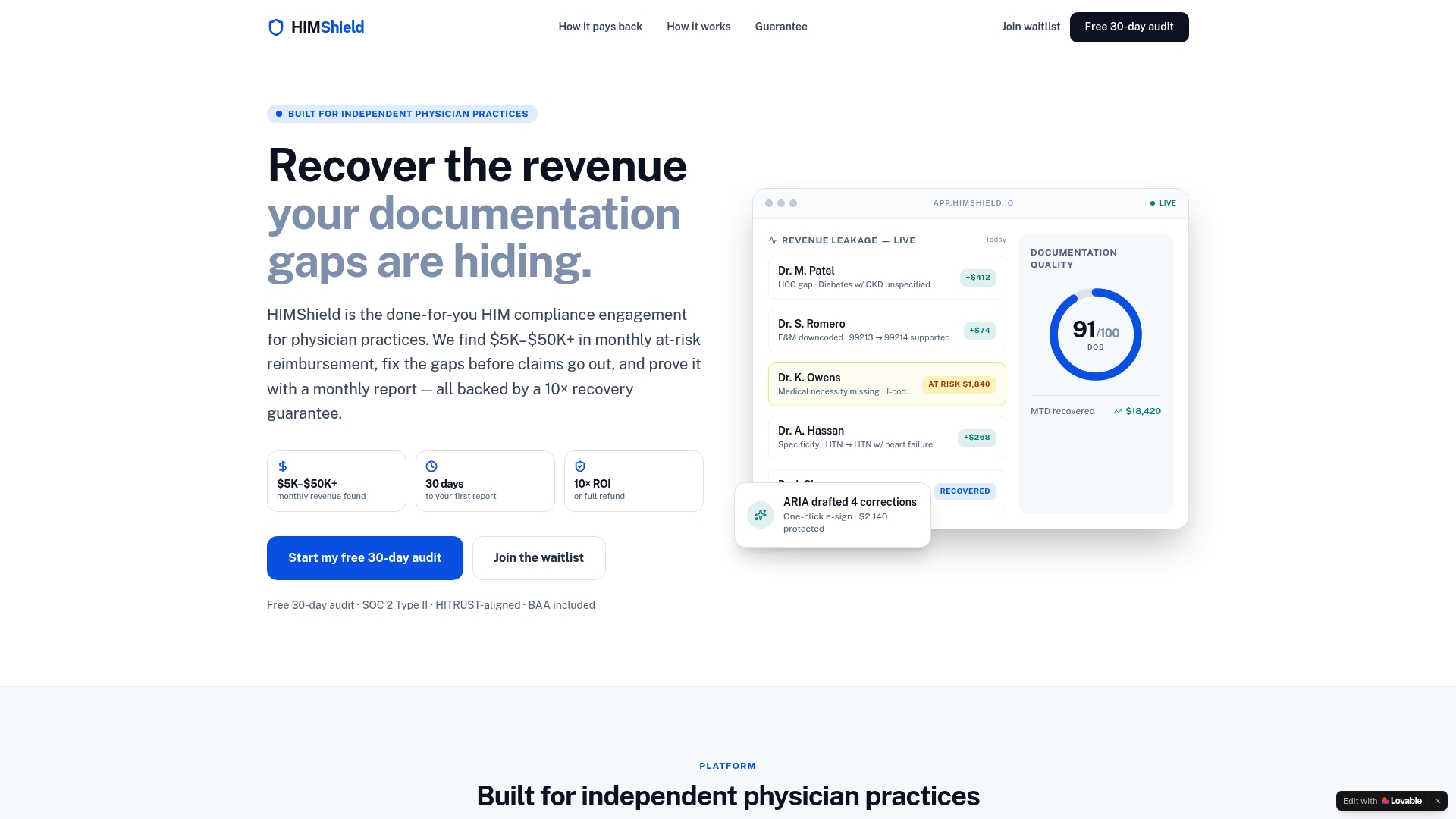
A free 30-day audit shows a practice its actual revenue leakage tied to documentation gaps like these, with a Revenue Leakage Report built around real chart data rather than guesswork. See the mechanics on how HIMShield works, or start the audit directly through HIMShield's practice platform to see what's currently at risk in your own claims.
This article is general information, not a substitute for advice from a qualified lawyer. Consult a qualified legal professional about your own circumstances before acting on anything here.