
Prolonged services documentation comes down to one thing: a note that proves the total time you personally spent on the date of the encounter, shows that the extra time was medically necessary, and clears the right threshold for the payer. Medicare and CPT use different codes and different starting points, so a note that passes one can fail the other. This guide covers both, with a checklist you can hand to your providers.
TL;DR
- Prolonged services are add-on codes. They apply only when total time exceeds the highest level of the primary service by at least 15 minutes, and you select the primary visit by time.
- Medicare uses G2212 (office/outpatient) and G0316, G0317 and G0318 (other E/M settings). Many other payers follow CPT, including 99417.
- Only time the billing practitioner personally spends on the date of service counts, and time for separately reported services is excluded.
- The note must state total time, the activities performed, why the extra time was needed, and who did the work.
- Verify each payer's policy before billing. Do not assume Medicare rules apply to commercial plans, or the reverse.
Table of Contents
- What prolonged services are, and where they apply
- Medicare codes versus CPT codes
- The threshold rule and unit limits
- Whose time counts, and which activities
- What the medical record must include
- Payer rules: verify before you bill
- Common errors that trigger denials and audit findings
- Our perspective: prolonged time is a charge-capture problem first
- How HIMShield fits
- Training providers to document time well
- FAQ
- Sources
What prolonged services are, and where they apply
A prolonged service is an add-on code. It is never billed alone. It sits on top of a primary evaluation and management (E/M) visit when the practitioner spends substantially more time than the top level of that visit assumes.
According to CMS, prolonged-service reporting applies to office and outpatient visits, inpatient and observation visits, nursing facility visits, and home or residence visits. The same CMS guidance says it is not permitted for emergency department visits or critical care services under Medicare.
For an independent practice, the office visit is where most of the volume sits. That is also where most of the confusion lives, because of the Medicare versus CPT split described below.
Medicare codes versus CPT codes
This is the first thing to settle before you write or audit a single note.
| Setting | Medicare code | CPT code |
|---|---|---|
| Office or other outpatient | G2212 | 99417 |
| Other E/M settings (inpatient, observation, nursing facility, home) | G0316, G0317, G0318 | 99418 and related add-ons |
CMS lists G2212 for prolonged office and outpatient services and G0316, G0317 and G0318 for prolonged other E/M services. Coding professionals note that Medicare uses G-codes instead of CPT codes 99417 and 99418.
Medicare Administrative Contractors say the same thing plainly. Noridian states that CMS prolonged service guidelines differ significantly from AMA/CPT guidelines, and that claims are processed under the Medicare Claims Processing Manual.
Why the thresholds differ
The difference is where counting starts. CPT's 99417 begins once you pass the minimum time of the top-level visit by 15 minutes. Medicare's G2212 begins only after you pass the maximum time of the top-level visit by 15 minutes. Noridian describes G2212 as a service beyond the maximum required time of the primary procedure, selected using total time on the date of the service.
A worked example for an established patient visit at the highest level, 99215, whose time range runs from 40 to 54 minutes:
- CPT payer: 99417 is reportable at 55 minutes of total time.
- Medicare: G2212 is reportable at 69 minutes of total time.
That 14-minute gap is why one 62-minute visit can be billable to a commercial plan and not to Medicare. Confirm the exact time ranges against the current code descriptors and your payer's policy before building a template around them.
The threshold rule and unit limits
Two rules govern every prolonged claim, per CMS evaluation and management guidance:
- You can report prolonged services only when total time exceeds the highest level of the primary service by at least 15 minutes.
- Each additional unit represents another 15-minute increment beyond that threshold.
A partial increment does not earn a unit. If the threshold is met and the provider is 10 minutes into the next block, the second unit is not supported. Notes that say "extended visit" without a clock-based total fail this rule on sight.
The primary visit also has to be selected by time. If the provider chose 99215 on medical decision making, there is no time total to measure against, and the prolonged add-on has nothing to stand on. Our guide on time-based E/M coding walks through the checks that belong before any claim goes out.
Whose time counts, and which activities
The AMA states that qualifying time includes face-to-face and non-face-to-face time personally spent by the physician or qualified health care professional on the date of the encounter, excluding separately reported services.
In practice that means:
Counts toward the total
- Reviewing tests, records and outside notes
- Taking or reviewing history, performing the exam
- Counseling and educating the patient, family or caregiver
- Ordering medications, tests or procedures
- Referring and communicating with other health professionals
- Documenting in the record
- Coordinating care, when the practitioner does it personally
Does not count
- Time spent by clinical staff, such as a medical assistant rooming the patient
- Time on a separately reported service, such as a procedure billed on the same day
- Time on a different date, even for the same encounter
- Travel and general waiting time
The AMA's wording matters for audits: prolonged add-ons should capture only effort beyond the primary E/M service. If your provider spends 20 minutes on a separately billed procedure, those minutes come out before you total the visit.
Teaching physician and shared visit settings
Teaching settings add a trap. CMS says that for time-based services, only teaching-physician presence time counts, and resident time is not added when the physician is unavailable. Practices with residents or students rotating through should train on this before they start billing prolonged time.
If an advanced practice provider shares the visit with a physician, the question of who bills and whose minutes are counted also changes the claim. Our piece on split/shared visit rules covers how to prove it.
What the medical record must include
CMS says documentation must show medical necessity, identify the specific encounter, and support the total time spent by the practitioner on the date of service. It should be legible, complete, and explain the prolonged time as reasonable and medically necessary.

Turn that into a checklist your providers can use at the point of note signing.
The prolonged services documentation checklist
- Date of service. The time statement belongs to one date. If work happened the next morning, it does not count for this claim.
- Total practitioner time. A single number in minutes, for example "Total time on date of encounter: 72 minutes." Not a range, not "over an hour."
- Who spent it. State that the time is the billing practitioner's own, and exclude clinical staff time.
- Activities performed. List what the time covered: record review, counseling, coordination, documentation.
- Why it took longer. Name the clinical reason. Multiple active problems, a new complex diagnosis, extensive medication reconciliation, a family conference.
- Separately reported services excluded. A short line confirming that procedure or other billed-service time is not in the total.
- Primary code selected by time. The note should make clear the base visit level was chosen on total time.
- Medical necessity. The prolonged effort must tie to the patient's condition and plan, not to scheduling or convenience.
- Patient identification and signature. The note must clearly belong to that patient and encounter, authenticated by the practitioner.
A note that holds up, and one that does not
Weak: "Prolonged visit, spent extra time with patient and family. 99215 + prolonged."
Stronger: "Established patient with poorly controlled type 2 diabetes, new CKD stage 3 findings and three medication changes. I reviewed 14 months of outside labs and the nephrology letter, performed a focused exam, counseled patient and spouse on renal dosing and diet, ordered repeat labs, and coordinated with the pharmacist by phone. I documented the plan after the visit the same day. Total time personally spent on the date of the encounter: 74 minutes, excluding the separately billed ECG."
The second note gives a reviewer the date, the total, the activities, the reason and the exclusion in one paragraph. Whether 74 minutes clears the threshold then depends on the payer's rule, which is the next question.
Payer rules: verify before you bill
Most payment policies follow CPT, but the American Academy of Pediatrics' coding publication cautions that Medicaid and other health plans may align with CMS, so practices should understand the differences before billing.
Build a one-page payer grid for your top ten payers by volume, and revisit it whenever a contract or policy bulletin changes. Columns to include:
- Which code the payer accepts (99417, G2212, or neither)
- The minute at which the first unit is reportable
- Unit limits per day
- Whether the payer wants a specific modifier or diagnosis linkage
- Where the policy lives, so a biller can cite it in an appeal
Modifier questions come up often on these claims. Our 2026 modifier guide for physician billing is a useful companion, and payer-specific patterns are covered in our look at payer-specific denials.
Common errors that trigger denials and audit findings
- Using 99417 on a Medicare claim. The code is not the Medicare vehicle for office visits. Bill G2212 and apply the Medicare threshold.
- Counting from the wrong starting point. Applying the CPT 55-minute mark to a Medicare claim overstates what is billable by 14 minutes.
- Choosing the base code by medical decision making, then adding time. The add-on requires a time-selected primary service.
- Rounding up. 66 minutes is not 69. Do not round across a threshold.
- Including staff time. A medical assistant's intake minutes are not the practitioner's minutes.
- Cloned time statements. The same "total time 80 minutes" copied into every note is the first thing a reviewer flags.
- Using it in the emergency department or for critical care under Medicare. CMS does not permit it there.
A broader point from CMS: in its CY 2019 fee schedule proposal, the agency recorded complaints that notes written to meet coding requirements do not support patient care and keep doctors away from patients. The fix is not longer notes. It is a short, specific time attestation that carries the claim, plus a clinical narrative that justifies it. For the denial side, see our Medicare medical necessity guidance and these medical necessity documentation examples.
Our perspective: prolonged time is a charge-capture problem first
We see prolonged services as one of the quietest forms of revenue leakage in an independent practice. Providers who spend 70 or 80 minutes on a complex patient usually know it. The note rarely says it. The biller sees a 99215, has no total time to point to, and leaves the add-on off. That is leaving money on the table, and it never shows up as a denial because nothing was submitted.

The opposite failure exists too. A practice that adds prolonged units from a template, without the date, the total and the reason, is exposed in a payer audit. Both problems share a root cause: time is documented inconsistently from provider to provider and payer to payer.
So we look at it as a pattern problem, not a note-by-note problem. When you compare every provider's time statements against what was billed, per payer, the gaps are visible within a chart sample. Under-captured prolonged time shows up as long notes with 99215 and no add-on. Overcaptured time shows up as identical totals, thin activity lists and G2212 or 99417 on payers that do not recognize them. Physicians do not need a new habit for this. They need a short, consistent time line and a quiet check behind it before the claim leaves.
— Elena
How HIMShield fits
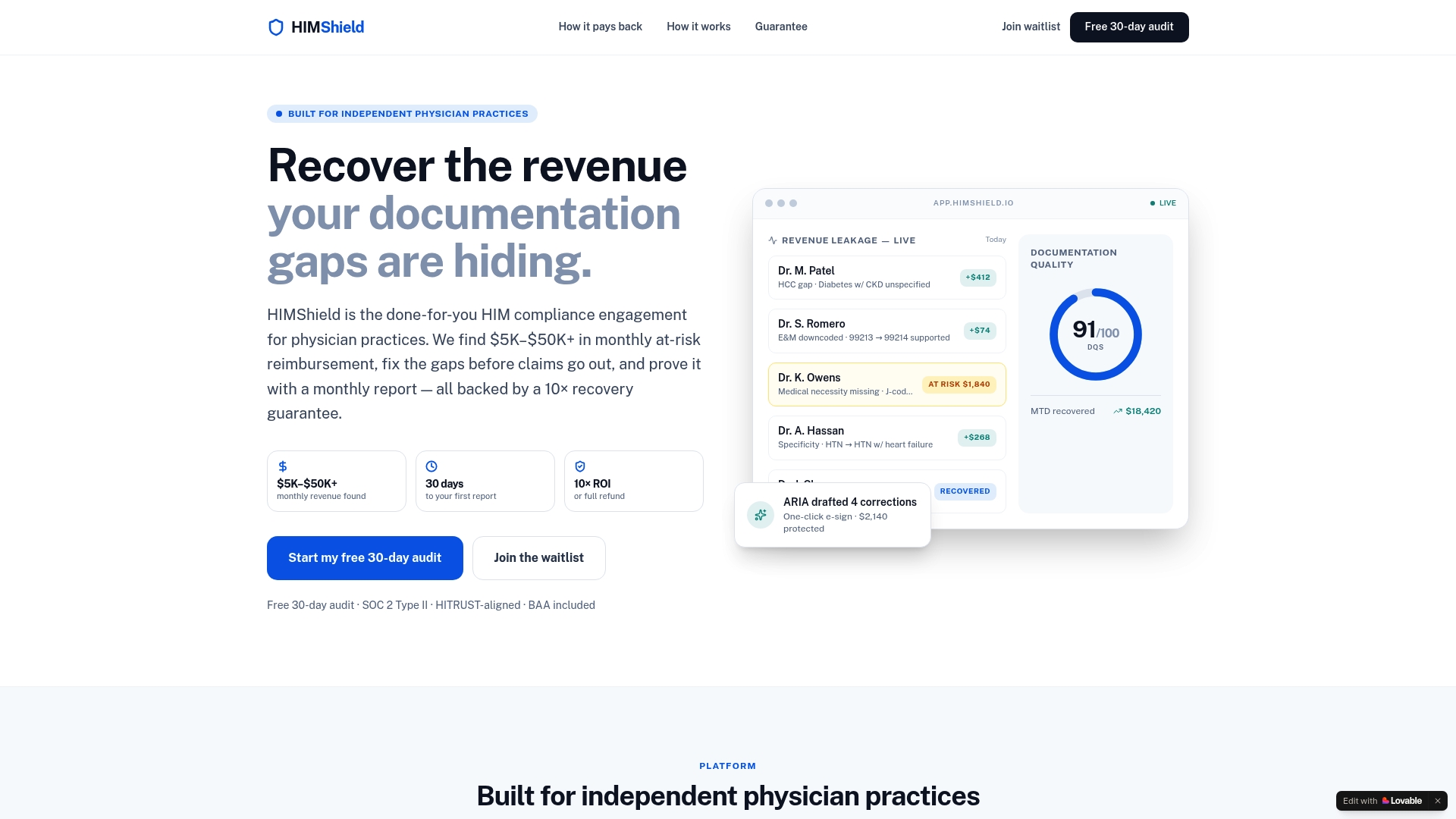
HIMShield scans EHR data for coding, documentation and charge-capture gaps before claims are submitted, and produces per-provider, per-payer Revenue Leakage Reports. For prolonged services, that is the view that matters: which providers document time well, which do not, and where billed units and note content disagree.
The platform also drafts corrections for physician e-signature in one click and assembles submission-ready responses if a payer audits you. It works without new staff or software training for your team.
If you want to see what is sitting in your own charts, start with the free 30-day Revenue Leakage Audit. It quantifies the gaps before you commit to anything.
You can also read how our HIM compliance engagement works for practices that want the whole compliance workload handled for them.
Training providers to document time well
Templates help, but only when providers understand why each line exists. A 15-minute huddle is usually enough to cover:
- The Medicare versus CPT threshold, with the 99215 example above
- The one-line time statement and where it goes in the note
- What staff time and separately billed procedures remove from the total
- The difference between a clinical reason for extra time and a scheduling reason
Follow it with a monthly review of ten prolonged claims per provider. Check each against the checklist. Share the results privately and early, since most gaps are habit rather than intent. Our article on why physician documentation education matters lays out how to make that review stick, and the 99214 documentation checklist shows the same approach applied to a high-volume code.
FAQ
Can I bill prolonged services with 99214?
Not under the rule CMS describes. Prolonged services require total time to exceed the highest level of the primary service by at least 15 minutes, and the add-on attaches to the top-level visit. If the provider spent a long time on a 99214-level visit, the question is whether the visit supports 99215 by time first.
Does Medicare accept CPT 99417?
For office and outpatient visits, Medicare uses G2212 rather than 99417. Noridian and CMS both treat the CMS rules as distinct from CPT. Bill the G-code to Medicare and follow the payer's own policy for others.
Does staff time count toward prolonged services?
No. Qualifying time is the time the physician or qualified health care professional personally spends on the encounter date, per the AMA. Nurse, medical assistant and scribe time stays out of the total, as does time on any separately reported service.
Can prolonged services be billed in the emergency department?
Not to Medicare. CMS does not permit prolonged-service reporting for emergency department visits or critical care services. Check commercial payer policies separately.
How should I document the time?
Write one total in minutes for the date of service, list the activities, state the clinical reason the visit ran long, and note that separately billed services are excluded. Sign it as the practitioner who did the work.
Sources
- MLN006764: Evaluation and Management Services (CMS)
- Prolonged Service Code, JF Part B (Noridian)
- CPT office prolonged services code changes (AMA)
- MLN006347: Guidelines for Teaching Physicians, Interns and Residents (CMS)
- Prolonged Services: CPT Guidelines and Medicare/Medicaid (AAP Coding News)
- CMS vs CPT: Confront Agency Differences for Reporting Prolonged Services (AAPC)
- CY 2019 Medicare Physician Fee Schedule proposed rule, E/M visits (CMS)