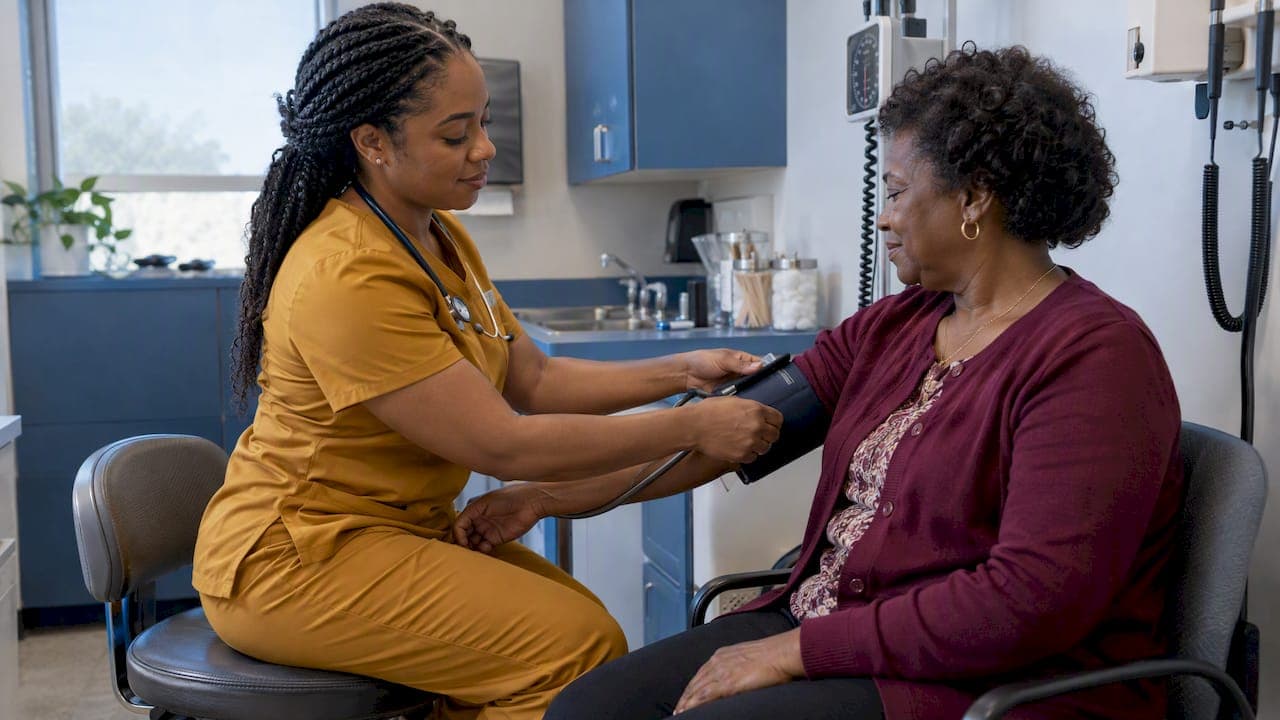
Yes, you can bill a nurse-only visit. For an established patient, the code is CPT 99211, and the claim goes out under the supervising physician or qualified practitioner. It only holds up when the visit is medically necessary, the note proves it, and the incident-to requirements are met. Miss one of the three and the claim is a denial or an audit finding waiting to happen.
This guide covers what 99211 is, who may bill it, what Medicare's supervision rules require, what the documentation must contain, and the same-day combinations that block payment.
TL;DR
- 99211 is the nurse-visit code. It is the lowest-level established-patient E/M service and is reported under the supervising provider's name.
- Medicare requires incident-to compliance. That means an existing plan of care, direct supervision in the office suite, and a service that is an integral part of the provider's care.
- The note carries the claim. Document why the visit was needed, what the nurse did, the result, who performed it and the supervision.
- Do not stack it. Medicare does not pay 99211 with chemotherapy or non-chemotherapy drug administration, and an injection-only visit gets the injection code instead.
- Payer and state rules differ. Medicare is the strictest baseline, but state scope of practice and commercial policies change the details.
Table of Contents
- What a nurse-only visit is, and what 99211 pays for
- Who can bill it: the incident-to requirements
- Why you cannot bill 99213 for a nurse's work
- Nurse visit documentation that survives an audit
- When a nurse visit cannot be billed
- Payer and state differences
- Perspective: where practices actually lose money on nurse visits
- How to check your own nurse-visit claims
- Common mistakes to retire
- FAQ
- Sources
What a nurse-only visit is, and what 99211 pays for
CPT 99211 is defined as a minimal, low-level E/M service for an established patient, and it is commonly called the "nurse visit." Typical examples are a blood pressure check, a medication-monitoring visit or anticoagulation monitoring. Medicare allows these when the service includes a documented, medically necessary decision by the physician, according to the Medicare Part B contractor Noridian.
Three points trip practices up.
It is for established patients only. A new patient cannot be billed with 99211. The nurse visit follows an earlier encounter in which a provider established the problem and the plan.
The performer is not limited to RNs. The code is meant for services by clinical staff other than the billing provider. What matters is that the person is acting within their authorized duties and under the supervising provider, not the license letters after their name. State law decides which tasks a nurse or other auxiliary staff member may perform, and that affects whether 99211 is appropriate.
The old five-minute habit is outdated. Performance or supervision of the service typically takes about five minutes, but time has not been a code-selection criterion since 2021. Do not build a template that says "5 minutes" and call it support. The content of the visit supports the code, not a stopwatch.
For context on how the code is valued, the AMA's RVS Update Committee determined that the work RVU of 0.18 for 99211 appropriately accounts for the physician work needed to supervise the service. It is a low-dollar code, which is exactly why it is billed in volume and why small documentation gaps add up.

Who can bill it: the incident-to requirements
The nurse does not bill. The supervising physician or other qualified provider does. For Medicare, that arrangement is called incident-to billing, and CMS sets the conditions. The service must be an integral, though incidental, part of the provider's professional service. It must be performed under the provider's direct supervision in the office. The provider must have initiated the course of treatment and remain actively involved in the patient's care. CMS spells these out on its incident-to services page.
In practice, that gives you a five-part test before you release a 99211 claim:
- Established patient. The patient has been seen and has a plan of care.
- Provider-initiated plan. A physician or qualified provider set the course of treatment, and the nurse visit follows it.
- Direct supervision. A qualified supervisor was in the office suite during the service.
- Authorized performer. The person who did the work is permitted to do it under state law and your policies.
- Provider remains involved. The note shows the provider's ongoing management, for example an order, a protocol or a review.
What direct supervision means
Direct supervision does not require the physician to be in the exam room. CMS has clarified that the physician must be present in the office suite and ready to assist during the service. That has a scheduling consequence: if the only provider on site is out of the suite, a nurse-only visit that day is not billable incident-to under Medicare. Practices with several providers and staggered hours should build nurse-visit slots around supervision coverage, using the same discipline as their multi-provider scheduling rules.
Who gets paid, and how much
When auxiliary personnel such as a nurse or medical assistant perform the service under a physician's supervision, the supervising physician or practitioner bills at 100 percent of the fee schedule. When the incident-to service is supervised by a nurse practitioner or other non-physician practitioner, Medicare pays 85 percent of the physician fee schedule. Know which of the two applies before you forecast revenue for your nurse-visit volume.
Patient financial liability also follows the billing entity. For incident-to services, the patient is liable to the physician or other legal entity billing and receiving payment, so the claim, the statement and the payment all need to match the supervising provider.
If you want a deeper look at what auditors request when they test these claims, see our guide to the five EHR artifacts that defend incident-to billing. For a related question about who bills when a provider and a nurse practitioner both touch a visit, see our split/shared visit rules.
Why you cannot bill 99213 for a nurse's work
Searchers often ask whether a nurse visit can be billed as a 99213 to capture more revenue. It cannot. Higher-level E/M codes describe work by the billing provider: history, exam, medical decision making, or time spent by that provider. Nurse work does not meet that definition, so the only E/M code that fits is 99211.
The reverse is also true. When a provider does perform an E/M service of higher complexity, 99211 is the wrong code. You bill the level that reflects the actual work. That means no 99211 add-on to a visit with the physician, and no "upcoding" a nurse visit to 99212 or 99213 to make up for a thin fee.
The temptation shows up in two places: templates that default to a higher level, and front-desk workflows that book a nurse visit but charge the provider's visit. A pre-claim review of E/M levels against who actually performed the service catches both. If your team needs to tighten level selection generally, our 99214 documentation checklist and guide to time-based E/M coding show how support is evaluated at higher levels.
Nurse visit documentation that survives an audit
A 99211 claim is only as strong as its note. A Maryland Department of Health Medicare 99211 checklist summarizes what the record should show: medical necessity, a face-to-face service, clinical relevance, effect on care, performer credentials, the date, and the incident-to supervision. Translate that into a note structure your staff can complete in a minute or two.
| Element | What the note should show | Example |
|---|---|---|
| Reason for visit | Why the patient needed this visit, tied to the provider's plan | "Blood pressure recheck after lisinopril dose change ordered at last visit" |
| Clinical findings | What the nurse assessed or measured | Readings, symptoms reported, response to medication |
| Nurse action | What was done or taught | Medication adherence reviewed, instructions reinforced |
| Effect on care | What happened as a result | Readings relayed to the provider, who continued the dose |
| Provider involvement | The standing order or review linking the visit to the plan | Provider name and order reference |
| Performer | Name and credentials of the person who did the work | "J. Smith, LPN" |
| Supervision | Who was supervising in the office suite | Supervising provider's name, on site |
| Date | Date of service | Matches the claim |
The most common gap is the "effect on care" line. A note that records a blood pressure and nothing else looks like a vital-signs check, not an E/M service. The note needs to show that the nurse's assessment fed into management of the patient's condition.
The American Academy of Family Physicians has noted that check-box-driven documentation forms can help ensure nurses capture the clinical data that supports 99211. A structured template does the same job in an EHR. Software built around structured clinical notes makes it easier to require the fields above before a note can be signed.
For wider guidance on proving necessity, see our medical necessity documentation examples. The same principles apply here at a smaller scale.
When a nurse visit cannot be billed
The fastest way to lose a 99211 payment is to bill it next to something it cannot accompany.
Drug administration. Medicare does not allow separate payment for 99211 when it is performed on the same day as a non-chemotherapy drug infusion or a chemotherapy administration code, as stated in the Medicare Claims Processing Manual.
Injection-only visits. If the only thing the patient came in for was an injection, 99211 is generally not billable. Report the injection code only. Vaccines follow their own product and administration code logic, covered in our guide to vaccination administration coding.
Provider visit the same day. If the patient sees the physician for an E/M service that day, the nurse's work is part of that encounter. Bill the provider's level.
Non-incident-to circumstances. No qualified supervisor in the suite, no established plan of care, or a new problem the nurse cannot evaluate. In those cases the visit may be useful clinically, but it is not a billable 99211 under Medicare.
Edit conflicts. Even legitimate combinations can trigger NCCI edits. A pre-submission check saves you from batch denials; our walkthrough on fixing NCCI edit denials shows how to find the pattern.

Payer and state differences
Medicare is the strictest reference point for supervision, not the only one. Some non-Medicare payers may not require the on-site physical presence of a supervising provider for nurse-only visits, according to the Maryland Department of Health billing manual FAQ. That is one state's program guidance, so confirm your own payers' policies instead of assuming it applies to you.
A workable approach for a multi-payer practice:
- Build your workflow to Medicare's direct supervision standard, so one process is compliant everywhere.
- Keep a one-page matrix of commercial and Medicaid plan policies on 99211, covering supervision, covered diagnoses and frequency limits.
- Check your state's scope-of-practice rules for the tasks nurses and medical assistants may perform, and list those tasks in your own policy.
- Review denials by payer. If one payer denies 99211 repeatedly, the policy, not the claim, is probably the issue.
Remember that compliance hinges on performing services within the authorized duties set by state regulations and your organization's requirements. A written policy listing approved nurse-visit services is your first line of defense.
Perspective: where practices actually lose money on nurse visits
We see nurse visits go wrong in two opposite ways. The first is leakage: practices perform legitimate blood pressure checks, medication monitoring and anticoagulation visits, then never charge them, or chart them so thinly that billing staff are afraid to submit. That is revenue left on the table, one small visit at a time.
The second is exposure: practices bill 99211 with no supervision record, next to an injection, or without any evidence the provider directed the plan. Each claim is small, but audits look at patterns, and a pattern of weakly supported 99211 claims is easy to find in claims data.
The fix for both is the same: check the claim against the chart before it leaves the building. A good pre-submission review asks whether the visit was necessary, whether the note shows the effect on care, whether a supervisor was in the suite, and whether a conflicting code is on the same claim. That is the logic our platform applies to EHR data, by provider and by payer, so your team sees gaps while they can still be corrected, with a physician e-signature when a correction is needed.
— Elena
How to check your own nurse-visit claims
You can run a basic review this week without new software.
- Pull the claims. Export 99211 claims for the last quarter, with rendering provider, payer and any same-day codes.
- Remove the conflicts. Flag claims with drug administration, injections or a provider E/M on the same date.
- Sample the notes. Read 20 to 30 charts against the table above. Count how many show reason, findings, effect on care, performer and supervision.
- Test supervision. Compare the date and time of service with provider schedules. Was a qualified supervisor in the suite?
- Look for the unbilled. Search for nurse encounters with a documented assessment and no charge. Those are your leakage candidates.
- Fix the template. Make the missing fields required, then retrain staff on the two or three failures you found most.
If you would rather have it measured for you, our free 30-day Revenue Leakage Audit scans your EHR data for coding, documentation and charge-capture gaps before claims go out. You get a per-provider, per-payer report that quantifies what is at risk, and the audit comes with a performance guarantee. For practices that want ongoing coverage, our HIM compliance engagement adds automated compliance alerts and submission-ready responses if a payer audits you.
Common mistakes to retire
- Billing from a vitals-only note. The record must show an evaluation and its effect on the plan.
- Treating 99211 as a time code. Time is not the selection criterion.
- Assuming any staff member qualifies everywhere. State scope of practice and payer policy decide.
- Letting the nurse's name appear as the billing provider. The claim is under the supervising provider.
- Ignoring Medicare's supervision rule because a commercial payer is looser. One workflow to the stricter standard is safer.
- Skipping the chronic-care angle. Monitoring visits often belong to a longer plan; if the patient is in a care management program, see what chronic care management documentation Medicare requires so the records fit together.
- Treating telehealth nurse contacts as in-office visits. Supervision and site rules differ, so check our telehealth coding compliance guide first.
FAQ
Can you bill for a nurse-only visit?
Yes, with CPT 99211 for an established patient, billed under the supervising provider. The visit must be medically necessary and documented, and for Medicare it must meet incident-to requirements, including direct supervision in the office suite.
Can you bill a 99213 for a nurse visit?
No. Higher-level E/M codes reflect work by the billing provider, and a nurse's work supports only 99211. Billing a higher level for nurse-only work is a coding error that auditors look for.
Does the physician have to be in the room?
No, not for Medicare. CMS has clarified that the supervising physician must be in the office suite and ready to assist, not in the exam room. Other payers may set different rules, so check each policy.
Can I bill 99211 with an injection?
Generally not when the injection is the only service. Report the injection code instead. Medicare also does not pay 99211 on the same day as chemotherapy or non-chemotherapy drug infusion or administration codes.
Sources
- 99211 and Incident To, Noridian JE Part B
- Proper Nurse Visit Billing for Minimal Problems
- RVS Update Committee and Office Visits, AMA
- Incident To Services & Supplies, CMS
- CMS transmittal R1764B3
- When is it Proper to Bill Nurse Visits using 99211
- Medicare 99211 checklist, Maryland Department of Health
- Coding Level-One Office Visits, AAFP
- Medicare Claims Processing Manual, Chapter 12, CMS
- Local Health Department Billing Manual FAQ, Maryland Department of Health