
NCCI edits denials happen when Medicare's automated coding logic flags two codes, a unit count, or an add-on code as improperly billed together on the same claim. The fix depends on the edit type: correct and resubmit if the coding is wrong, or file a redetermination with your Medicare Administrative Contractor if your documentation supports the original claim. Check the remittance advice first for the specific edit reference, then move fast, since you have 120 days from the RA date to appeal.
TL;DR:
- Most NCCI denials are due to procedure-to-procedure relationships, unit count limits, or missing primary codes, requiring specific coding corrections or documentation proof.
- Modifier use, especially modifier 59 or specific X- modifiers, can bypass some denials only if the CCMI indicator permits, with CCMI 0 codes never bypassable regardless of documentation.
- Remittance advice codes like CARC 97, 151, and 4 help quickly identify the edit type behind the denial and guide the appropriate fix or appeal process.
- Correct coding fixes and resubmissions typically resolve denials faster than appeals, which have a 120-day window but take longer to process through Medicare.
- Regular quarterly review of updated NCCI codes, early pre-bill scrubs, and ongoing modifier audits help practices avoid widespread denials and build a safer compliance workflow.
Table of Contents
- Understanding NCCI Edits Denials and Why CMS Uses Them
- The Three NCCI Edit Types Behind Most Denials
- Spotting NCCI Denials on the Remittance Advice
- Modifier Strategy: When You Can Bypass an Edit and When You Can't
- Fixing an NCCI Denial: The Correction, Adjustment, and Appeal Workflow
- Preventing the Next Wave of NCCI Denials
- How HIMShield Turns NCCI Policy Into a Daily Workflow
- Elena's Take: Documentation Beats Modifier Guesswork Every Time
- Get a Clear Picture of Your NCCI Risk Before It Becomes a Denial
- Sources
- FAQ
Understanding NCCI Edits Denials and Why CMS Uses Them
NCCI edits denials aren't random. They're the output of a rules engine CMS built specifically to catch improper code combinations before they turn into improper payments. The National Correct Coding Initiative exists because two providers billing the same encounter differently, or one provider unbundling a procedure into three separate line items, used to slip through unnoticed. CMS closed that gap with automated logic that runs against nearly every Medicare Part B claim.
Here's the part billing teams sometimes miss: an NCCI denial is not a judgment call about medical necessity. It's a coding determination. The Medicare NCCI Policy Manual is explicit that these edits exist to encourage correct coding and stop inappropriate payment, not to second-guess whether a service was clinically warranted. That distinction changes how you respond. A medical necessity denial needs clinical justification. An NCCI denial needs a coding fix or documentation proving the codes were reported correctly in the first place.
NCCI is a national Medicare policy. It applies the same way whether you're billing from Maine or Arizona, and it sits alongside other CMS coding rules rather than replacing them. Local Coverage Determinations, National Coverage Determinations, and CPT guidelines still apply independently.
The core logic behind most NCCI denials is the Column One/Column Two relationship:
- Column One codes represent the more comprehensive or higher-value service and are the ones Medicare pays.
- Column Two codes are considered part of, or mutually exclusive with, the Column One code, so they're denied unless a bypass modifier applies and the edit allows one.
- The pairing isn't arbitrary. CMS builds these relationships from CPT code descriptors, coding conventions, and clinical logic about what services are typically performed together.
- If your claim lists both codes from a pair with no modifier and no bypass eligibility, expect the Column Two line to deny automatically.
Once you know which column your denied code landed in, you already know half of what you need to fix it.
The Three NCCI Edit Types Behind Most Denials
Every NCCI denial traces back to one of three edit categories, and each one has its own logic and its own fix.
- Procedure-to-Procedure (PTP) edits. These compare two codes billed for the same patient, same date of service, same provider, and flag pairs that shouldn't be reported together. A common scenario: a surgeon bills a comprehensive procedure alongside a component procedure that CMS considers part of the larger service. The Column Two code denies unless a modifier like 59 applies and the edit permits one.
- Medically Unlikely Edits (MUEs). MUEs cap the number of units of a single code that are plausible for one patient on one date of service. Bill four units of a code with an MUE limit of two, and the excess units deny. MUEs adjudicate two ways: some at the claim-line level, comparing units on a single line, and others at the date-of-service level, adding up units across multiple lines for the same code on the same day. The MUE Adjudication Indicator, or MAI, tells you which adjudication method applies and whether the edit can ever be overturned.
- Add-on Code (AOC) edits. Add-on codes describe services that are never billed alone, like additional time increments or supplemental procedures performed alongside a primary service. If the primary procedure code isn't present and payable on the same claim, the add-on code denies automatically, regardless of how well documented the add-on service was.
Knowing which of these three categories produced your denial tells you exactly where to look next. A PTP denial sends you to modifier rules. An MUE denial sends you to unit counts and documentation of medical necessity for extra units. An AOC denial sends you back to check whether the primary code was billed, sequenced, and paid correctly on the same claim.
Spotting NCCI Denials on the Remittance Advice
NCCI denials show up on your remittance advice through a combination of claim adjustment reason codes (CARCs) and remittance advice remark codes (RARCs), and learning to read that combination fast saves real appeal time.
- CARC 97 ("The benefit for this service is included in the payment/allowance for another service/procedure that has already been adjudicated") almost always signals a PTP edit denial.
- CARC 151 ("Payment adjusted because the payer deems the information submitted does not support this many/frequency of services") frequently points to an MUE unit-count problem.
- CARC 4 ("The procedure code is inconsistent with the modifier used, or a required modifier is missing") shows up when a bypass modifier was needed but wasn't billed, or was billed incorrectly.
- RARC N19 or similar remark codes often accompany these CARCs, adding detail about why the line was bundled or capped.
Many MAC remittance advices also reference a CLEID, a Correct Coding Line Edit Identifier, in the remark section. The NCCI Policy Manual uses CLEID references to tie a specific denial back to the exact edit rationale behind it. If your RA cites a CLEID and the reason isn't obvious, call your MAC's provider contact line, reference the CLEID number and claim ID, and ask for the specific policy rationale in writing. Have your original claim, the RA, and supporting documentation ready before you call. Do not contact the NCCI contractor itself for a claim-specific question. The NCCI contractor answers general program questions but does not process appeals, so that call wastes time you don't have inside a 120-day window.
Modifier Strategy: When You Can Bypass an Edit and When You Can't
Modifiers are the primary tool for overturning PTP denials, but they only work when the edit itself allows a bypass. That distinction trips up more billing teams than any other part of NCCI edit management.
Modifier 59 signals that two services were separate and distinct: different session, different anatomical site, different lesion, or different patient encounter. The X{EPSU} family, introduced to add precision to modifier 59, breaks that concept into four more specific flags: XE (separate encounter), XS (separate structure), XP (separate practitioner), and XU (unusual, non-overlapping service). CMS and most MACs now prefer the specific X-modifier over the generic 59 whenever one applies, because it documents exactly why the services were distinct instead of leaving that judgment to a reviewer.
Whether a modifier can even attempt a bypass depends on the edit's Correct Coding Modifier Indicator (CCMI), a value buried in the NCCI edit files themselves:
- CCMI 0 means no modifier will ever bypass this edit. The codes are considered mutually exclusive or component parts under all circumstances.
- CCMI 1 means a modifier can bypass the edit if the clinical documentation supports separate and distinct services.
- CCMI 9 means the edit indicator doesn't apply to that pairing at all.
For MUEs, the MUE Adjudication Indicator tells you whether a denial is even worth appealing. MAI 2 marks an absolute policy edit. No modifier, no documentation, and no appeal will overturn it, because CMS has determined the unit limit reflects an anatomic or regulatory impossibility. MAI 1 and MAI 3 edits are different: both can potentially be paid on appeal when the medical record clearly supports the extra units, since these limits are based on clinical guidance rather than hard policy caps.
Pro Tip: Before you attach modifier 59 or an X-modifier to bypass a PTP edit, check the CCMI value in the current NCCI edit file first. If it's a 0, no modifier will ever get that line paid. Save the appeal for a claim where the indicator actually allows a bypass.

Auditors specifically watch for modifier 59 overuse. A practice that appends it reflexively to every denied line, rather than only when the documentation genuinely shows separate and distinct services, builds an audit trail that draws payer attention fast. Use the specific X-modifier when it fits, document the clinical rationale in the note, and reserve modifier 59 for situations the X-modifiers don't cover.
Fixing an NCCI Denial: The Correction, Adjustment, and Appeal Workflow
Every NCCI denial resolves through one of two paths: fix the coding and resubmit, or prove the original coding was right and appeal. The order you work through these steps determines how fast you get paid and how clean your audit trail stays.
- Confirm the edit type from the RA. Pull the CARC/RARC combination and, if present, the CLEID. Determine whether you're dealing with a PTP pair, an MUE unit cap, or an AOC sequencing issue before you touch the claim.
- If the coding was wrong, correct it and resubmit or adjust per your MAC's timely filing and adjustment rules. This is the fastest path back to payment and doesn't require an appeal at all. Most MACs process a straightforward correction faster than a redetermination.
- If your documentation supports the original billing, file a redetermination with your MAC. You have 120 days from the date you received the initial remittance advice to file. Include the claim number, the specific denied line, the CLEID if one was cited, a copy of the relevant medical record documentation, and a short cover letter explaining why the services meet separate-and-distinct criteria or why the extra units were medically necessary.
- Track the MAC's decision window and escalate if needed. MACs generally issue redetermination decisions within about 60 days. If the redetermination is denied and you still believe the documentation supports payment, the next step is a reconsideration through a Qualified Independent Contractor, the second level in the Medicare appeals process.
One nuance that catches teams off guard: edit changes are not automatically retroactive. If CMS removes or revises an edit next quarter, that doesn't mean your MAC will proactively reopen every claim denied under the old version. MACs can reopen and adjust claims when a provider brings them to attention, and CMS occasionally issues mass adjustments after major policy changes, but neither happens automatically. If you suspect a batch of claims was denied under an edit that's since changed, raise it with your MAC directly rather than waiting.
Decide early which path you're on. A coding correction resolves in days. A redetermination can take two months or longer once you count MAC processing time, so don't file an appeal for something a simple resubmission would fix faster, and don't waste a resubmission on a claim where the codes were actually billed correctly the first time.
Preventing the Next Wave of NCCI Denials
NCCI edit files update quarterly, and that update cycle is exactly why practices that got paid cleanly in one quarter suddenly see a stack of denials in the next. A code pair with no restriction in March can carry a brand-new PTP edit by July.
Build the quarterly release into your compliance calendar the same way you'd track a payer fee schedule change. CMS publishes change requests ahead of each effective date, giving billing teams a window to review new and revised edits before they hit live claims.
- Pull the new quarterly PTP, MUE, and AOC files as soon as CMS releases them and cross-reference them against your top billed code combinations.
- Run a pre-bill scrub that flags any code pair, unit count, or add-on sequence that matches a current edit before the claim goes out the door.
- Schedule a recurring modifier-use audit, not just a one-time review, since overuse patterns tend to creep back in once the initial correction fades from memory.
- Retrain coders each quarter on any newly added or revised edits that touch your practice's most common specialties and code sets.
- Sample a batch of claims against the updated test files before the effective date, rather than discovering a mass-denial pattern after a month of live submissions.
Automated monitoring tools can run this comparison continuously instead of relying on a quarterly manual review that's easy to skip during a busy season. Practices that catch a new edit before it hits live claims avoid the multi-week scramble of correcting and resubmitting an entire batch of denied lines after the fact.
How HIMShield Turns NCCI Policy Into a Daily Workflow
Reading CMS policy manuals is one thing. Catching an NCCI risk before it becomes a denial on forty claims is another. HIMShield's platform scans EHR data against current coding and documentation standards before submission, flagging PTP pairs, MUE unit risks, and modifier gaps while there's still time to fix them.
The free 30-day Revenue Leakage Audit quantifies exactly how much of your at-risk reimbursement is tied to coding and documentation gaps, including NCCI-related issues, broken down by provider and by payer. When a denial does slip through, the same automated logic that caught the risk helps assemble the documentation an appeal packet needs: the original note, the relevant modifier rationale, and a clear explanation tied to the specific CCMI or MAI value driving the denial.
Elena's Take: Documentation Beats Modifier Guesswork Every Time
The instinct to slap modifier 59 on every denied line and resubmit is understandable. It's also the fastest way to end up on a payer's audit list. The stronger move is slower but safer: pull the CCMI and MAI values before you touch the claim, and only pursue a bypass or appeal when the documentation genuinely supports it.
Batch denials do more damage than single-claim denials, and they're almost always preventable. A practice that reviews the quarterly NCCI files before the effective date catches the risk once, instead of catching it forty times after the fact on a stack of RAs.
Start next week with three moves: audit your modifier 59 usage rate against your specialty's norm, confirm someone owns the quarterly edit file review, and build a documentation checklist for any code pair your practice bills frequently that carries CCMI 1 status.
— Elena
Get a Clear Picture of Your NCCI Risk Before It Becomes a Denial
Reworking denied claims after the fact costs your staff hours they don't have. An automated solution can flag NCCI risk, documentation gaps, and modifier problems in your EHR data before you submit, so corrections can be made prior to claim denial.
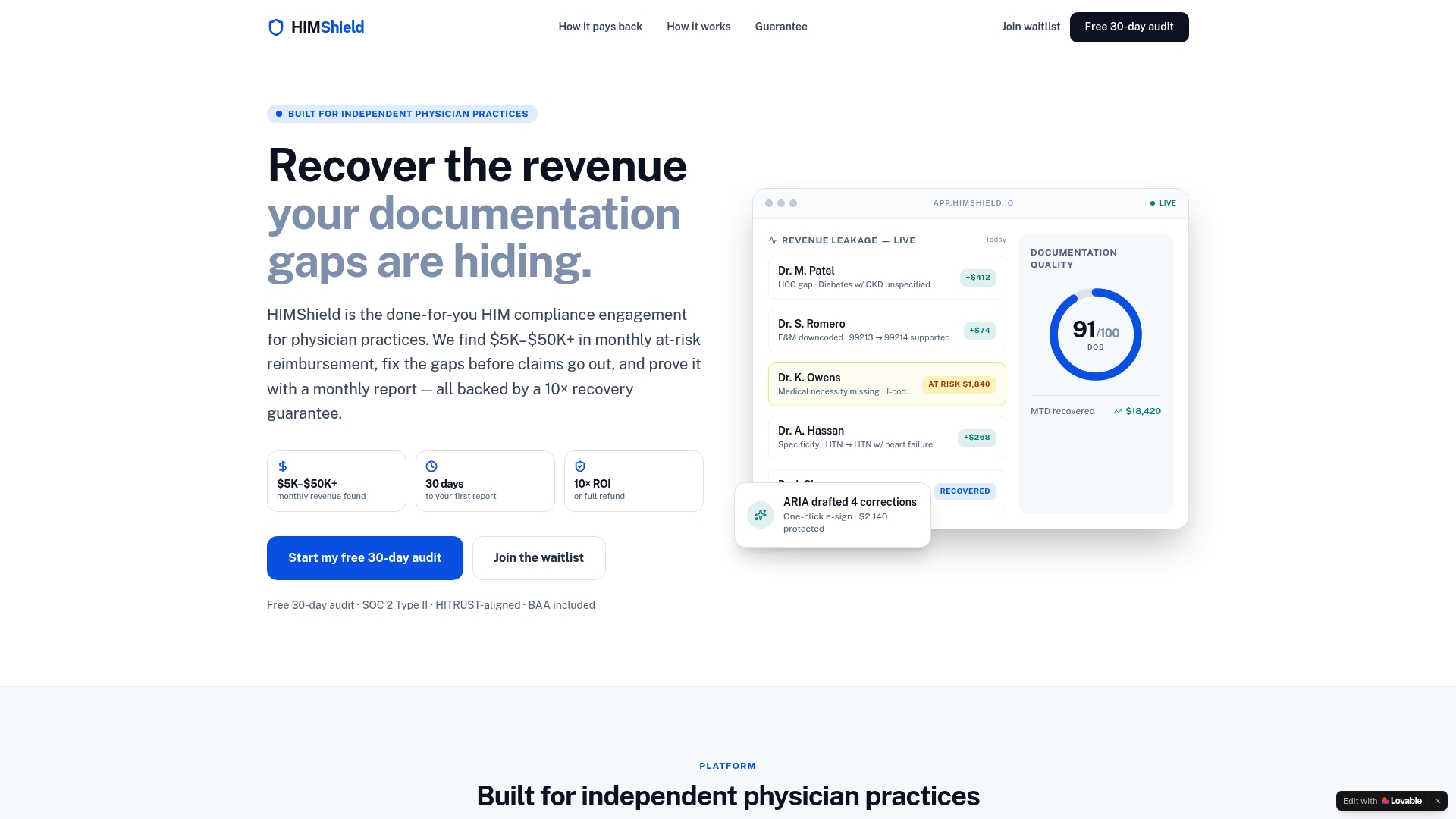
The free 30-day Revenue Leakage Audit shows you, provider by provider and payer by payer, exactly where coding and documentation gaps are putting reimbursement at risk, NCCI edits included, with no new software to learn and no staff hours diverted to run it. From there, the HIM compliance engagement keeps that monitoring running continuously, drafting corrections with one-click physician sign-off and assembling audit-ready responses when a payer comes calling. Request your free audit and see your practice's actual leakage number within 30 days.
FAQ
Can Claims Denied Due to NCCI Edits Be Appealed?
Yes. NCCI denials go through the standard Medicare appeals process, starting with a redetermination filed with your MAC within 120 days of receiving the RA. The exception is any denial tied to an MAI 2 absolute policy edit, which cannot be overturned regardless of documentation.
What Are the Top Denial Codes in Medical Billing?
NCCI-related denials most commonly show up as CARC 97 (service included in another already-adjudicated procedure), CARC 151 (frequency or unit limit exceeded), and CARC 4 (missing or inconsistent modifier). Reading the CARC alongside any RARC or CLEID reference on the remittance advice tells you exactly which edit type triggered the denial.
Which Modifiers Will Not Bypass NCCI Edits?
No modifier bypasses an edit marked with a Correct Coding Modifier Indicator of 0, since CMS classifies those code pairs as mutually exclusive under any circumstance. The same holds for MUEs carrying an MAI value of 2, which represent absolute policy limits that no modifier or appeal can override.
What Is a CARC 4 Denial Code?
CARC 4 means the procedure code billed is inconsistent with the modifier used, or that a required modifier is missing entirely. In an NCCI context, this typically means a PTP edit needed a bypass modifier like 59 or an X{EPSU} code, and either the modifier wasn't submitted or the wrong one was.
Can NCCI Coding Denials Be Billed to the Patient?
No. NCCI denials are coding determinations, not medical necessity decisions, so an Advance Beneficiary Notice cannot shift liability to the patient. The claim has to be corrected, adjusted, or appealed through the MAC instead.
How Is an NCCI Denial Different From an LCD Denial?
An NCCI denial flags a coding combination or unit count problem and applies nationally regardless of diagnosis. An LCD denial questions whether the diagnosis or clinical scenario meets a specific contractor's coverage criteria for that service, which varies by MAC jurisdiction. Fixing one rarely fixes the other, since they're testing entirely different things.