
An EDI rejection means your claim file failed front-end processing and never entered the payer's adjudication system. A denial means the payer received the claim, adjudicated it, and decided not to pay it, or not to pay it in full. The first is usually a data or format problem you correct and resubmit. The second is a payment decision you review, correct, rebill, or appeal. Mixing them up costs practices days of work and, sometimes, money.
TL;DR
- Rejection: the claim fails electronic edits before adjudication. You see it in a TA1, 999, or 277CA acknowledgment, and no remittance advice follows.
- Denial: the claim was adjudicated and not paid (or not paid in full). You see it on the 835 remittance advice, explained by CARC and RARC codes.
- Rejections are fixed and resubmitted fast. Denials need a reason-based review, then a corrected claim or an appeal within the payer's deadline.
- Work both from root cause: most repeat problems trace back to registration data, coding, documentation, and charge capture.
Table of Contents
- The short answer: where the claim stops
- Rejection vs. denial at a glance
- How to tell which one you have
- Common reasons claims are rejected
- Common reasons claims are denied
- What to do after a rejection
- What to do after a denial
- Deadlines: calendar days, not working days
- How to cut repeat rejections and denials
- Our perspective: rejections are a data problem, denials are a revenue problem
- See where your claims are leaking
- FAQ
- Sources
The short answer: where the claim stops
Think of the claim's path in two stages. First, the file moves from your practice management system or clearinghouse to the payer and gets checked for format and required data. Second, if it passes, the payer adjudicates it: checks eligibility, coverage, coding rules, medical necessity, and pricing.

A rejection happens at stage one. Medicare contractor EDISS describes it as a claim that stops before reaching the payer's processing, reported through a TA1, 999, or 277CA acknowledgment rather than a remittance advice. A denial happens at stage two: the claim was processed and found not payable, in whole or in part, and the outcome appears on the remittance advice.
One health plan puts it the same way. Louisiana Healthcare Connections explains that a rejection reflects missing or invalid data and is not entered into its adjudication system, while a denial follows acceptance and processing, and comes with an Explanation of Payment that names the reason.
Indiana Medicaid's billing guidance uses the same line: a rejected claim does not enter the claim-processing system, and a denied claim is processed but found not payable.
Rejection vs. denial at a glance
| EDI rejection | Denial | |
|---|---|---|
| Stage | Before adjudication | After adjudication |
| Entered in payer's claim system? | No | Yes |
| How you find out | TA1, 999, or 277CA acknowledgment | 835 remittance advice (ERA) or paper remit |
| Typical cause | Missing or invalid data, format errors | Coverage, coding, medical necessity, authorization, documentation |
| Appeal rights | Generally none; correct and resubmit | Yes, within the payer's deadline |
| Typical fix | Correct the data, resubmit | Review reason, rebill if allowed, or appeal |
| Speed | Hours to days | Days to months |
The appeal-rights row matters. Because a rejected claim was never adjudicated, there is nothing to appeal. You fix the claim and send it again.
How to tell which one you have
Do not rely on a feeling that "the claim didn't pay." Check the response layer.
Acknowledgments point to a rejection
After you submit, the clearinghouse and payer send back acknowledgments. EDISS identifies TA1, 999, and 277CA responses as the reports of a front-end rejection. In plain terms:
- TA1: the interchange envelope had a problem, so the file could not be read.
- 999: the file was read but failed implementation-level syntax checks.
- 277CA: the payer's claim acknowledgment, reporting claim-level acceptance or rejection with reason details.
If a claim shows up on a rejection report and nothing arrives on the remittance, you have a rejection. Your clearinghouse's rejection report is the first place to look every morning.
The 835 points to a denial
The 835 electronic remittance advice is where denials live. CMS says an ASC X12 835 explains adjustments at the claim or service-line level using group codes, CARCs, and RARCs. HHS adds that HIPAA-covered plans use Claim Adjustment Reason Codes and Remittance Advice Remark Codes to explain those adjustments.
Read the codes as a set:
- Group code: who is responsible for the amount (for example, contractual obligation vs. patient responsibility).
- CARC: why the amount was adjusted.
- RARC: supplemental detail that clarifies the CARC.
Not every unpaid dollar is a denial
The same CMS manual notes an adjustment can be a denial, a zero payment, a partial payment, a reduced payment, or another change. A contractual write-off is not a denial. A partial payment with a reduction for a bundled service is not the same as a full denial. Before you add a line to your denial log, read the group code and CARC. This keeps your denial rate honest and your appeal queue focused on real money.
Medicare status checks
For Medicare, CMS explains that after a MAC accepts a claim, its progress is tracked with Status/Location codes, and a returned or rejected claim is explained through the remittance, including the reason for the return. If a claim is missing, check your clearinghouse reports first, then the claim status tool for the payer.
Common reasons claims are rejected
Rejections are mostly clerical. They come from data that does not match what the payer has on file or what the standard requires. Typical examples:
- Incorrect or missing subscriber ID, name, or date of birth
- Invalid or mismatched NPI, taxonomy code, or billing provider address
- Missing required fields, such as referring provider where required
- Invalid diagnosis or procedure codes for the date of service
- Duplicate submissions
- Payer ID errors
Provider data is a classic trap. Indiana Medicaid notes that claims may be rejected or denied when Box 33 billing information is incorrect or does not match enrollment records, including an invalid provider ID, NPI, taxonomy, or service-location address. Note the "or denied": the same data error can land on either side of the line depending on the payer's edits. That is why you read the response, not the label you expect.
Common reasons claims are denied
Denials reflect a payer's decision about the claim's content. Frequent drivers for physician practices include:
- Coding and bundling: edits that pair codes that should not be billed together. See how to fix the NCCI edits behind batch Medicare denials.
- Specificity: diagnosis codes that are too vague to support the service. Our guide on unspecified code denials covers the pattern.
- Medical necessity: documentation that does not show why the service was needed. We break this down in Medicare medical necessity denials.
- E/M level support: a visit level the note does not justify. The 99214 documentation checklist is a good starting point.
- Payer-specific rules: each payer has its own edits and policies. Look at payer-specific denial patterns and, for one large commercial payer, the common UnitedHealthcare denial reasons.
- Authorization, eligibility, and timely filing: administrative reasons that still arrive as denials because the payer adjudicated the claim.
Notice the difference in who owns the fix. Rejections usually sit with front desk, billing, and clearinghouse setup. Denials often sit upstream with coding, documentation, and the physician.
What to do after a rejection
Speed is the goal, because the claim has not been filed in any meaningful sense until it clears the front end.
- Pull the rejection report from your clearinghouse or the payer's portal each business day.
- Read the reason text and any segment or field reference. A 277CA typically tells you what failed.
- Correct the data at the source. Fix the registration record, provider enrollment data, or code in the system, not just on the claim, or the error will repeat.
- Resubmit as a new claim. A rejected claim was never adjudicated, so it is generally not sent as a corrected or replacement claim. Confirm the payer's rule if you are unsure.
- Track the resubmission to a clean acknowledgment, then to adjudication.
A rejection fixed the same day costs a few minutes. The same rejection found three weeks later can cost a payer's filing window.
What to do after a denial
A denial deserves a short investigation before any action.
- Read the 835. Note the group code, CARC, and RARC at claim and line level.
- Classify the cause: front-end data, coding, documentation, medical necessity, authorization, coverage, or payer error.
- Choose the right path:
- Minor error or omission: the payer can usually be asked to reopen the claim and make the change, or you submit a corrected claim where the payer allows it.
- Payer error or disputed decision: file a formal appeal with supporting documentation.
- Patient responsibility: bill the patient only when the group code and your contract allow it.
- Document and log it by payer, provider, code, and reason so patterns surface.
For Medicare, the appeal path has five levels, as laid out in a state billing manual covering Medicare appeals: redetermination, reconsideration, an administrative law judge hearing, a departmental appeals board review, and federal court judicial review. Most practice-level work happens at the first two. Commercial payers set their own levels, so use the appeal section of your contract and provider manual.
Deadlines: calendar days, not working days
Two clocks matter. One is timely filing, the window to get a claim to the payer. The other is the appeal window after a denial.
On appeals, the same manual states that appeals must be filed within the timeframe the payer specifies, counted in calendar days rather than working days. Weekends and holidays do not stop the clock.
On timely filing, limits differ widely by payer and contract, and so does how each payer treats a claim that was rejected on the way in. Do not assume a rejected submission protects your filing date. Keep the original acknowledgment showing when you first sent a clean file, and confirm each major payer's rule in your contract or provider manual. Build the deadline into your work queue so no one has to remember it.

How to cut repeat rejections and denials
Fixing claims one at a time is the expensive way to work. The cheaper way is to remove the cause. A practical order:
- Scrub earlier. Run claim edits before submission, and review your clearinghouse's most common rejection reasons monthly. Most are a short list of repeat offenders.
- Verify at the front desk. Check eligibility and capture accurate subscriber data at scheduling and check-in.
- Keep provider data clean. Reconcile NPI, taxonomy, and service-location data with each payer's enrollment records, especially after a move or a new hire.
- Separate the two in your reporting. Track rejection rate and denial rate as different measures with different owners. Blending them hides where the problem lives.
- Work denials by root cause. Group denials by CARC, payer, provider, and CPT code. Our guide to reducing claim denials in your physician practice and the denial prevention strategy walk through this.
- Fix coding at the source. A repeatable coding correction process stops the same error from recurring across providers.
- Close documentation gaps before billing. Many denials are decided at the point of care, when the note is written. For recurring medical necessity problems, see our playbook for medical necessity denials.
Our perspective: rejections are a data problem, denials are a revenue problem
We look at this from the revenue side. A rejection is annoying, but it is visible: it lands on a report, someone fixes it, and the claim moves on. The costlier problem is the one that never shows up as either. Charges that were never captured, E/M levels set lower than the documentation supports, and diagnosis codes that are too vague all leak revenue without producing a single rejection.
That is why we do not treat denial management as the finish line. By the time a denial reaches the 835, the practice has already paid for the visit, the coding, the submission, and now the rework. The better place to intervene is before the claim goes out, in the EHR data itself: coding, documentation, and charge capture.
In practice, we suggest independent practices do three things. First, split rejection and denial reporting so each has a clear owner. Second, group denials by payer and by provider, because patterns are usually specific to one or the other. Third, measure what is missing as well as what is denied, since unbilled and under-coded work does not appear in any denial report.
Small practices rarely have a dedicated analyst for this, and they should not need one. The work is repeatable, and it can be automated.
— Elena
See where your claims are leaking
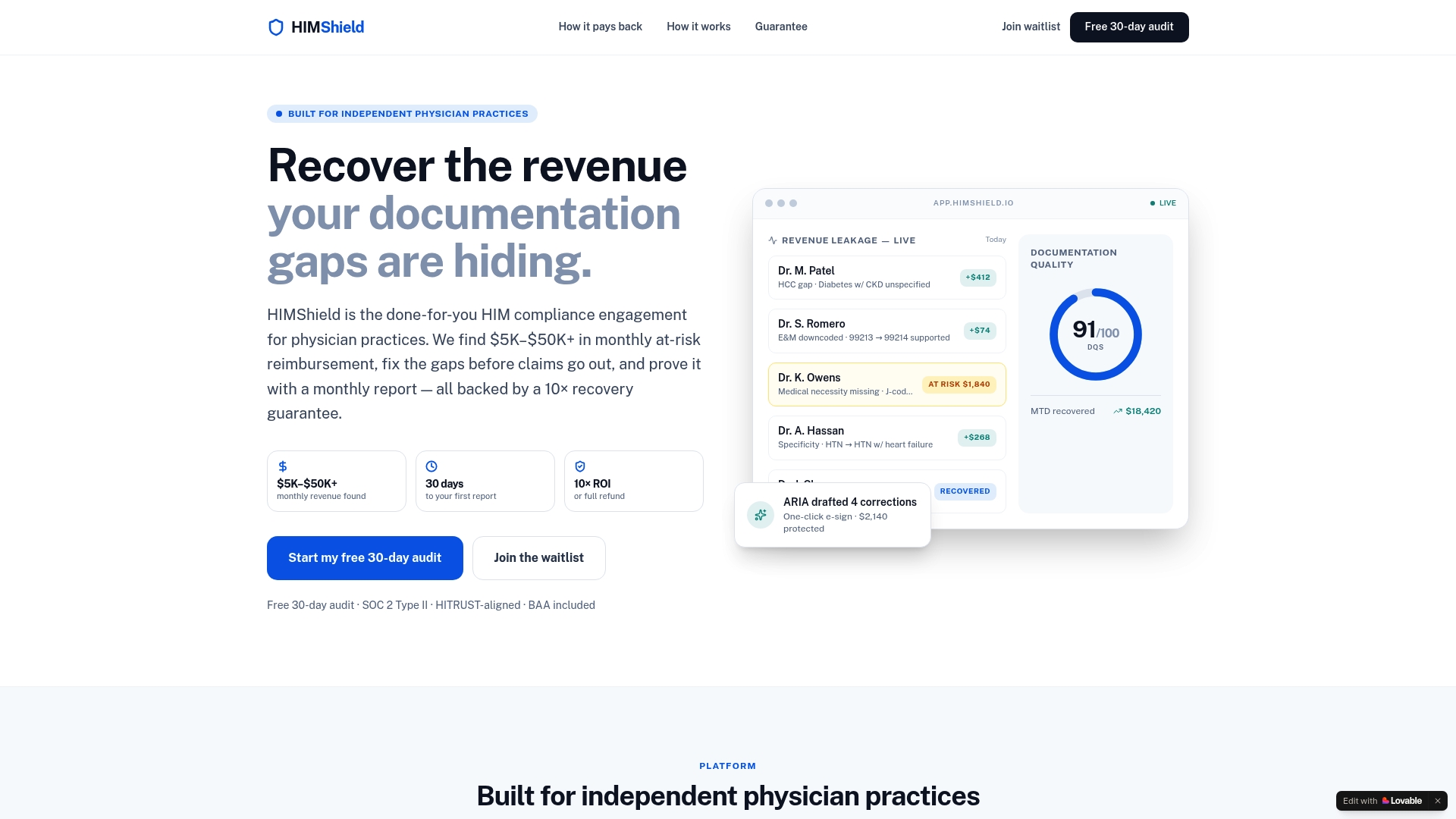
HIMShield scans EHR data for coding, documentation, and charge-capture gaps before claims are submitted, so fewer problems reach the payer as denials. The free 30-day Revenue Leakage Audit quantifies those gaps per provider and per payer, and it comes with a performance guarantee. You do not need new staff or software training to start.
If you want a full picture of your compliance exposure, learn more about our HIM compliance engagement.
FAQ
Is a rejected claim the same as a denied claim?
No. A rejected claim failed front-end electronic edits and was never entered into the payer's adjudication system. A denied claim was processed and the payer decided not to pay it, or not to pay it in full. Rejections are corrected and resubmitted. Denials are reviewed, then corrected, rebilled, or appealed.
Can I appeal a claim rejection?
Generally no, because there was no adjudication decision to appeal. You correct the error and resubmit the claim. If you believe the rejection itself was wrong, contact the payer or your clearinghouse with the acknowledgment details to find out how it handles disputes.
Which codes show that a claim was denied?
Look at the 835 remittance advice. The group code, Claim Adjustment Reason Code, and Remittance Advice Remark Code explain what was adjusted and why. A rejection, by contrast, appears in TA1, 999, or 277CA acknowledgments, not on the remittance.
Do rejected claims count toward timely filing?
It depends on the payer and your contract. Some payers measure from the date of a clean, accepted submission. Keep your original acknowledgments and check each payer's timely filing language. Resubmit rejections quickly so the question does not matter.
How do I reduce both rejections and denials?
Scrub claims before submission, verify eligibility and demographics up front, keep provider enrollment data current, and track the two problems separately. Then trace denials back to coding, documentation, and charge capture so the same errors stop recurring.
Sources
- Rejection vs. Denial (EDISS)
- Understanding Claim Rejections and How to Avoid Them (Louisiana Healthcare Connections)
- Box 33 Requirements (Indiana Medicaid IHCP)
- Operating Rules: EFT and Remittance Advice (HHS)
- Medicare Claims Processing Manual, Chapter 22 (CMS)
- MLN3171902: Checking Medicare Claim Status (CMS)
- Payments (RAs/EOBs), Appeals, and Secondary Claims (Maryland Department of Health)