
Prioritize front-end eligibility and prior authorization checks, coding accuracy at the point of care, and targeted automation to catch errors before submission. That combination stops the majority of avoidable denials before they start. Support it with the CMS prior authorization rule and a platform offering automated denial prevention, and most practices see a measurable drop in preventable denials within one to two billing cycles.
TL;DR:
- Most preventable denials stem from eligibility, authorization, coding, and documentation errors that can be caught early with targeted front-end checks and automation.
- Building a phased denial prevention plan over 30, 90, and 180 days helps practices systematically identify and fix key gaps before submitting claims.
- Monitoring key metrics weekly, such as denial rates and overturn percentages, allows quick identification of patterns and triggers timely escalation.
- Payer rule changes and updates require ongoing staff review to prevent compliance gaps, especially around prior authorization and coverage policies.
- HIMShield’s free audit identifies high-impact coding, documentation, and charge-capture risks upfront, enabling targeted remediation to reduce future denials.
Table of Contents
- Why a Denial Prevention Strategy Matters Right Now
- Priority Strategies for Preventing Claim Denials
- Building the 30, 90, and 180 Day Prevention Roadmap
- How CMS Prior Authorization Rules Change Your Workflow
- Metrics and Governance That Keep Prevention Working
- How Himshield’s Audit Finds Denial Risk Before It Costs You
- Reducing Denials Tied to Patient Financial Responsibility
- Catching Denials Immediately With Real-Time Claim Status Monitoring
- Working With Payers Directly to Prevent Repeat Denials
- Staying Ahead of Payer Rule and Contract Changes
- An Editorial Take on What Practices Get Wrong About Denial Prevention
- Get a Free Revenue Leakage Audit From Himshield
- Sources
- FAQ
Why a Denial Prevention Strategy Matters Right Now
Denials are not a rounding error. Reworking a single denied claim frequently costs more than the claim would have paid out, which means every prevented denial protects more revenue than any collections effort recovers after the fact, according to industry RCM analyses. Independent practices without dedicated denial-management staff feel this hardest, since the same biller who prevents the error is also the one appealing it three weeks later.
Success has specific markers: a falling initial denial rate, a rising overturn rate on the appeals you do file, and shrinking days in accounts receivable. Federal oversight backs up why the initial submission matters so much. The Office of Inspector General found that Medicare Advantage organizations overturned nearly all appealed skilled nursing facility admission denials, a pattern that points squarely at submission quality, not payer hostility.
Pro Tip: Track your overturn rate as closely as your denial rate. A high overturn rate is not proof the payer was wrong. It is proof your first submission was incomplete.
Priority Strategies for Preventing Claim Denials
These six tactics cover the largest share of preventable denials, in the order most practices should tackle them.
- Lock down front-end eligibility and prior authorization. Run real-time eligibility checks at scheduling, not at check-in, and monitor prior-authorization API responses instead of waiting on phone holds. Metric to track: percentage of claims denied for eligibility or missing authorization.
- Validate coding and documentation at the point of care. Concurrent charge capture, paired with a same-day documentation checklist, closes gaps before the claim ever leaves the practice. Metric: coding-related denial rate by provider.
- Run pre-submission claim validation against payer rules. Screen every claim for CARC/RARC risk and confirm medical necessity against the relevant LCD or NCD before it ships. Metric: clean claim rate, meaning claims accepted without payer touch.
- Build a denial-trend analytics workflow. Triage new denials by dollar impact first, then by root cause, so staff time goes to the errors draining the most revenue. Metric: top five denial reason codes by dollar volume.
- Standardize fast, structured appeals. A one-page appeal template with clinical citations built in beats a customized letter every time, because it gets filed inside the payer's response window instead of after it closes.
- Assign clear governance and hold a weekly KPI huddle. A simple RACI chart, showing who owns eligibility checks, coding audits, analytics, and appeals, prevents the "everyone assumed someone else caught it" failure mode.
Two of these deserve a second look before you build a workflow around them:
- Eligibility and authorization failures are almost entirely preventable with process, not judgment calls.
- Coding and documentation gaps are the most common denial driver, and the 99214 documentation checklist is a practical starting point for evaluation-and-management visits specifically.
Building the 30, 90, and 180 Day Prevention Roadmap
A denial prevention strategy fails when it launches as one big initiative instead of a sequence. Break it into three phases with distinct deliverables.
Days 1 to 30: Audit your last two quarters of denials by reason code and dollar value. Fix the single biggest eligibility or authorization gap you find. Assign ownership for front-end checks to a named person, not a department.
Days 31 to 90: Roll out point-of-care documentation checklists for your highest-denial visit types. Stand up a weekly denial-trend review and start tracking overturn rate alongside denial rate.
Days 91 to 180: Layer in automation, a rule engine or claim scrubber that flags payer-rule mismatches before submission, and a policy-lookup tool that checks current LCD/NCD coverage in real time. Research on claim-response prediction shows machine-learning models can flag denial probability and likely reason codes before submission, which lets staff focus manual review on the claims most likely to fail and worth the most money if they do.
Ownership matters more than tooling. Front-end checks belong to scheduling and registration. Coding governance sits with your coding lead or outsourced coder. Analytics needs one person checking the dashboard weekly, even if it is a part-time role. Appeals should route through whoever wrote the original documentation, since they know the clinical context.
Pro Tip: Pull your highest-overturn appeal cases every quarter and rebuild the original submission packet around what won the appeal. If a peer-reviewed clinical citation reversed a denial, that citation belongs in your initial submission template going forward.
How CMS Prior Authorization Rules Change Your Workflow
The CMS Interoperability and Prior Authorization final rule requires impacted payers to decide standard prior authorization requests within seven calendar days and expedited requests within 72 hours, and every denial must come with a specific reason. Payers also have to stand up prior-authorization APIs, with phased compliance starting in 2026 and expanded data access by 2027.
That timeline changes how you should operate today:
- Log every prior-authorization request ID the moment it goes out, so you can prove timing if a payer misses its window.
- Treat a vague denial reason as a red flag requiring immediate follow-up, not a dead end. CMS now requires specificity, and a payer that skips it may owe you a corrected response.
- If your overturn rate on a given payer stays high month after month, check your own submission packet first. OIG's findings on insufficient Medicare Advantage denial letters confirm this cuts both ways, but internal gaps are usually the faster fix.
Metrics and Governance That Keep Prevention Working
A denial prevention strategy decays fast without a dashboard someone actually checks. Track these weekly: initial denial rate, denial reason mix by dollar volume, overturn rate, time-to-first-response from payers, and cost-to-recover per denial.
A workable dashboard needs only four panels: this month's denial rate against last month, the top five reason codes by dollar impact, appeals pending against their response-window deadline, and overturn rate by payer. Review it in a fifteen-minute weekly huddle, not a monthly meeting that lets a bad pattern run for four extra weeks.
Set escalation triggers in advance:
- A denial rate climbing two months in a row on one payer means someone loops in the contracting team.
- A reason code appearing on more than 10% of denials for a single procedure code triggers a documentation review, not another appeal.
- Repeated authorization denials for the same service line, despite clean submissions, means it is time for a direct payer conversation, not another resubmission.
How Himshield’s Audit Finds Denial Risk Before It Costs You
Himshield's Free 30-day Revenue Leakage Audit scans your EHR data for coding, documentation, and charge-capture gaps before they become denials, no new staff or software training required. The audit delivers a per-provider, per-payer Revenue Leakage Report that quantifies exactly where reimbursement is at risk.
A typical 30-day audit surfaces patterns most practices never see on their own: one provider consistently under-documenting a specific visit type, a payer denying the same procedure code for a missing modifier, a charge-capture gap repeating across a whole service line. The output is a prioritized remediation plan, ranked by dollar impact, with automated compliance alerts and options for streamlined correction processes going forward.
Reducing Denials Tied to Patient Financial Responsibility
Patient responsibility denials, meaning claims rejected or reduced because of unmet deductibles, coverage lapses, or coordination-of-benefits errors, are one of the more preventable categories on this list. Financial clearance done before the appointment, not after, catches most of them.
Verify active coverage and remaining deductible at scheduling, not at check-in, and confirm which plan is primary when a patient has more than one. Coordination-of-benefits errors are a common and entirely avoidable source of denials, and they show up disproportionately in practices that rely on the patient's memory of their own coverage instead of a live payer check.
Give patients a clear cost estimate before the visit when possible, especially for anything beyond a standard office visit. A patient who understands they owe $150 after their deductible is far less likely to dispute the bill later, and disputes slow down collections even when the claim itself was clean. Collecting a reasonable co-pay or deposit at time of service, where your state and payer contracts allow it, reduces the volume of post-visit billing that turns into write-offs.
Train front-desk staff to flag self-pay or high-deductible patients for a short financial conversation before the visit rather than after. This is not a collections tactic. It is a denial-prevention tactic, because a patient who is surprised by a bill disputes it, and a disputed bill often triggers a resubmission cycle that looks and behaves exactly like a denial on your aging report even when the payer never rejected anything.
Catching Denials Immediately With Real-Time Claim Status Monitoring
A denial sitting unnoticed in a payer portal for three weeks is a denial that misses its appeal window. Real-time claim status monitoring closes that gap by flagging a rejection or denial within hours of the payer's decision instead of at the next manual claim run.
Most clearinghouses already support automated status checks through standard electronic transactions. The gap is usually not technical. It is procedural: nobody assigned ownership of watching the feed, so status updates sit in a queue until someone happens to open it.
Set up automated alerts that route directly to the biller or coder who submitted the claim, not to a shared inbox that nobody checks first. A denial routed within a day of the payer's decision gives your team the maximum runway against the CMS-mandated response windows described earlier. A denial discovered three weeks later has already burned a third of your appeal clock before anyone even reads the reason code.
This matters even more for high-dollar claims. Sort your monitoring queue by dollar value first, so a $40 denial does not sit ahead of a $4,000 one in the review order. Deep learning models trained on claims data can predict which claims are likely to be denied and roughly when a payer will respond, which lets you prioritize the monitoring queue before the denial even lands rather than after. That is prevention working one step upstream of the appeal, not a replacement for watching the queue itself.

Working With Payers Directly to Prevent Repeat Denials
Payer communication should not start after a denial lands. The practices with the lowest denial rates treat their major payers as ongoing relationships to manage, not adversaries to fight claim by claim.
Request a standing point of contact, or at minimum a named provider-relations representative, at each of your top three or four payers by claim volume. When a denial reason is unclear, a direct call to that contact resolves ambiguity faster than a written appeal, and it often surfaces whether the denial reflects a genuine coverage rule or a processing error on the payer's side.
Document every payer conversation, including the date, the representative's name, and what was said about a specific coverage rule. Payer policies shift, and a verbal confirmation from six months ago carries real weight in an appeal if you wrote it down at the time.
When a denial pattern repeats across multiple patients for the same service, escalate it as a pattern, not a series of individual disputes. A single letter describing five denied claims for the same procedure, citing the same misapplied policy, moves faster through a payer's provider-relations team than five separate appeals filed weeks apart. This is also where the appeal letter structure built around CMS and AMA guidance earns its keep, since a tight, well-cited letter gets read and acted on faster than a long narrative.

Staying Ahead of Payer Rule and Contract Changes
Payer rules do not hold still. A coverage policy that supported a claim in January can change by April, and the practices getting blindsided by denials are usually the ones relying on a rule they confirmed once and never checked again.
Assign someone, even part-time, to review payer bulletins and policy updates monthly for your top contracted payers. Most major payers publish policy change notices, but they rarely surface prominently, and a missed update on a prior-authorization requirement or a coverage criterion is exactly the kind of gap that produces a wave of denials before anyone notices the pattern.
Build a simple internal log of payer-specific rules, and date-stamp every entry. When a coding or documentation checklist references a payer's medical necessity criteria, note when that criteria was last confirmed. A six-month-old assumption about what a payer covers is a liability, not a shortcut.
Contract renewal periods deserve special attention. Reimbursement terms, prior-authorization requirements, and covered service lists often shift at renewal, and those changes rarely get communicated to the billing team with the urgency they deserve. Loop in whoever negotiates your payer contracts so billing has visibility into upcoming changes before they hit a claim, not after a denial reveals them.
An Editorial Take on What Practices Get Wrong About Denial Prevention
Most practices treat denial prevention as a training problem: teach the coders better, and denials will drop. That is only half right. The bigger lever is ownership. A named person checking eligibility, a named person watching the analytics dashboard, a named person filing appeals inside the window, that structure prevents more denials than any single training session.
Automation should support that structure, not replace it. A rule engine that flags a likely denial is useful only if a coder still reviews the flag with clinical judgment. The practices that hand every flag to software without a human check trade one kind of error for another.
If you do one thing this month, pull your last ninety days of denials and sort them by dollar impact. The pattern you find will tell you exactly where to start.
— Elena
Get a Free Revenue Leakage Audit From Himshield
Reading a denial prevention playbook is useful. Seeing your own practice's specific gaps quantified is what actually moves revenue. Himshield's Free 30-day Revenue Leakage Audit scans your EHR data for the coding, documentation, and charge-capture risks driving your denials, no new staff, no new software to learn, just a quantified report on where reimbursement is at risk.
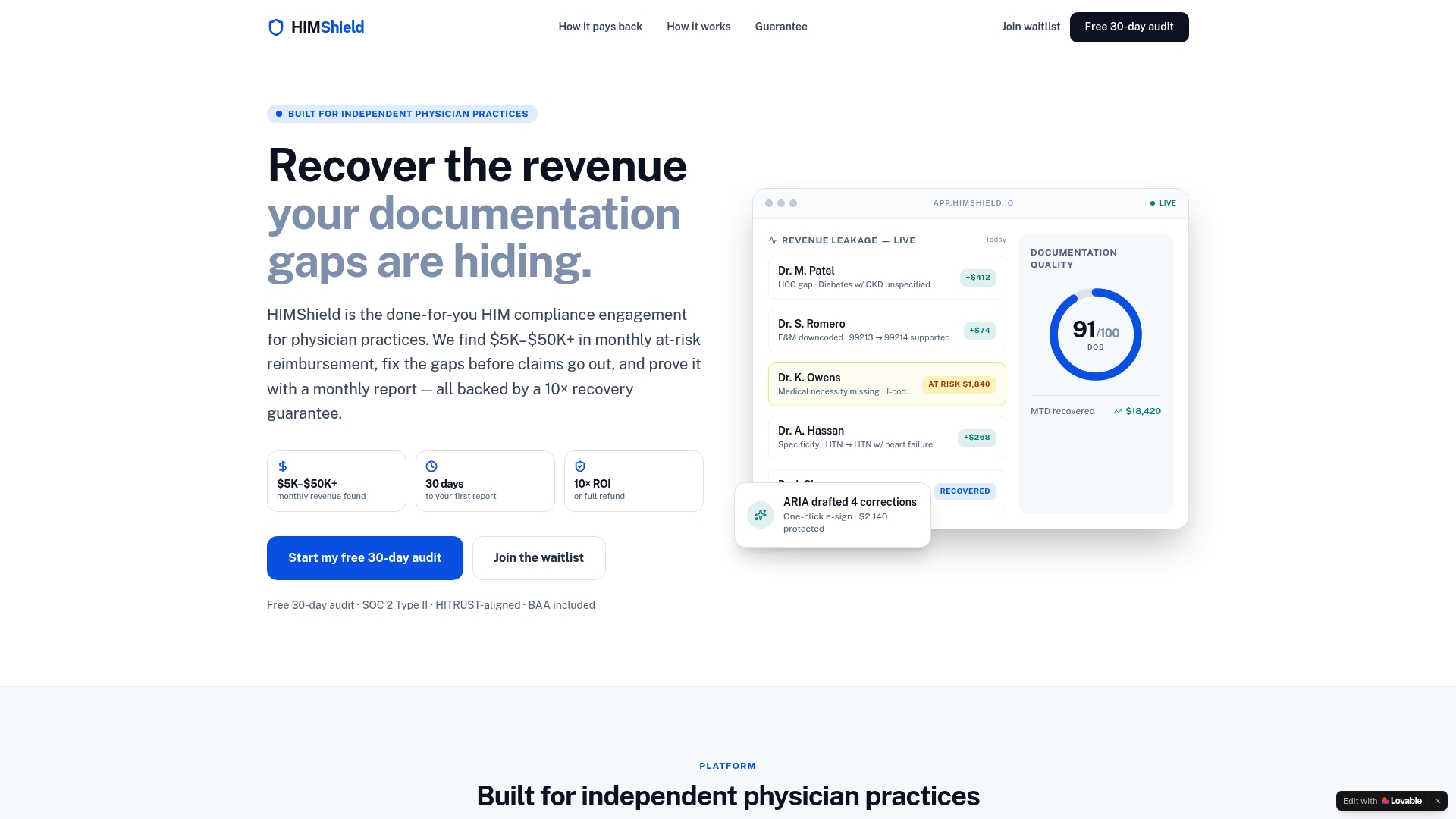
The audit maps directly onto the phased roadmap covered above: it identifies your highest-impact gaps in the first thirty days, the same window where most practices should be running their own denial audit anyway. The output is a prioritized remediation plan with estimated recovery opportunities by provider and payer, plus automated compliance alerts going forward. Visit Himshield to see how the platform fits into your existing workflow, or go straight to the audit request page to get your practice's numbers.
Sources
- CMS finalizes rule to expand access to health information and improve the prior authorization process
- Deep Claim: Payer response prediction from claims data with deep learning
FAQ
What Is the Most Effective Denial Prevention Strategy?
The most effective approach combines front-end eligibility and prior-authorization checks, accurate point-of-care coding, and automation that flags likely denials before submission. Practices that layer all three, rather than picking one, see the largest drop in preventable denials because each tactic catches errors the others miss.
What Are Some Effective Strategies for Managing Denials Already Submitted?
Sort pending denials by dollar impact first, then file structured appeals using a concise, citation-backed template inside the payer's response window. The CMS prior authorization rule requires payers to give a specific denial reason, so use that reason directly in your appeal instead of writing a generic rebuttal.
What Are Examples of Prevention Strategies for Claim Denials?
Common examples include real-time eligibility verification at scheduling, point-of-care documentation checklists, pre-submission claim scrubbing against payer rules, and weekly denial-trend reviews sorted by root cause. Financial clearance conversations with patients before high-cost visits also prevent a meaningful share of patient-responsibility denials.
What Are the Steps in Revenue Cycle Management That Affect Denials?
Revenue cycle management typically spans patient registration, eligibility verification, prior authorization, charge capture, coding, claim submission, payer adjudication, denial management, appeals, and payment posting. Denials most often originate in the earliest steps, registration, eligibility, and authorization, which is why front-end accuracy prevents more denials than back-end appeals ever recover.
Can Himshield Help Identify Denial Risk Before Claims Are Submitted?
Himshield's platform scans EHR data to identify coding, documentation, and charge-capture gaps before claims go out, and its Free 30-day Revenue Leakage Audit quantifies where a specific practice is losing reimbursement. Current pricing for ongoing subscriptions is available directly on the Himshield site.