
Claim denial is defined as a payer's refusal to reimburse a submitted charge, and it is the leading cause of revenue leakage in independent physician practices. Reducing claim denials in a physician practice requires targeting the right problems first: front-end eligibility errors, mid-cycle coding gaps, and back-end filing failures each demand a different fix. About 60–70% of denials stem from front-end issues such as eligibility errors, missing prior authorizations, and incorrect patient demographics. That single statistic tells you where to spend your prevention budget. Rework on a denied claim costs between $25 and $118 per claim, which adds up fast across a busy practice. The strategies below give you a clear path from reactive appeals to proactive denial prevention.
What are the most common reasons to reduce claim denials in a physician practice?
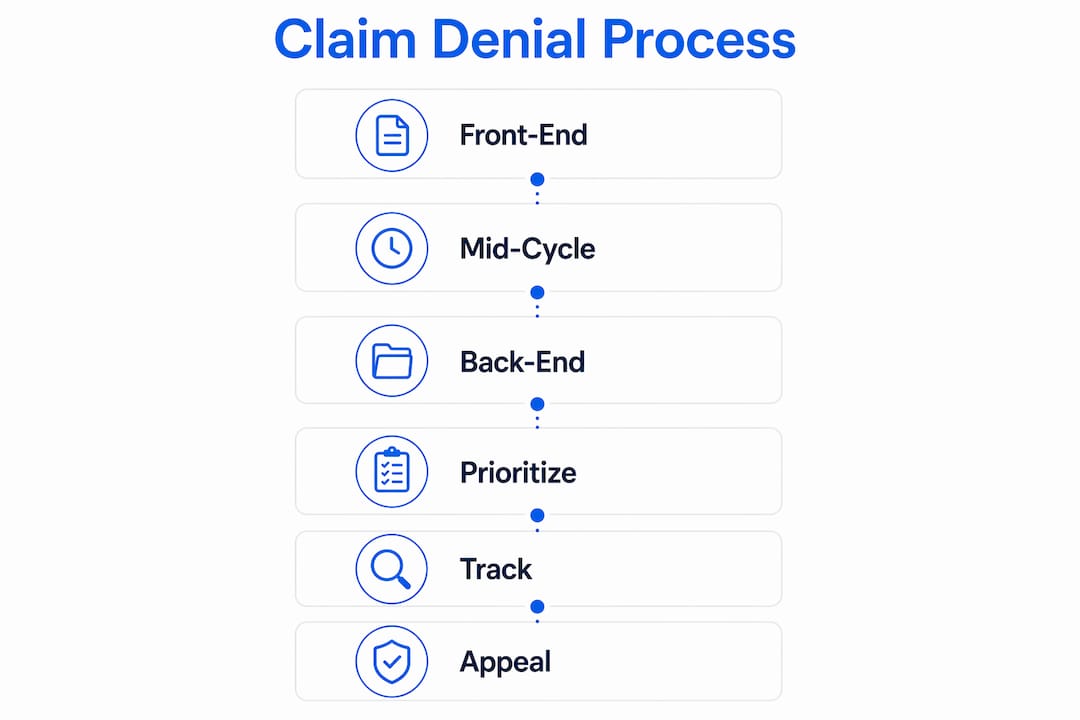
Denials fall into three distinct categories, and knowing which category is hitting you hardest determines where you act first.
Front-end denials occur before or at the point of service. They include eligibility failures, missing prior authorizations, and incorrect patient demographics. These are the most common and the most preventable.
Mid-cycle denials happen during coding and documentation review. Incorrect CPT codes, unsupported medical necessity, and missing modifiers all trigger mid-cycle rejections.
Back-end denials arrive after submission. Duplicate claim submissions and timely filing violations are the two most common back-end failure modes.
The prioritization method that works is simple: pull 12 months of denial data, sort by volume and dollar value, and identify your top three denial reasons. Practices that focus on the top three denial categories see more sustained success than those who try to fix everything at once. Fragmented efforts spread your billing team thin and produce inconsistent results.
A denial dashboard makes this analysis repeatable. Track denials by payer, denial code, provider, and service line. The table below shows how to frame your initial prioritization review.
| Denial category | Common trigger | Priority action |
|---|---|---|
| Front-end eligibility | Coverage lapsed or wrong plan | Real-time verification at scheduling |
| Prior authorization | Missing or expired auth | Automated auth tracking with hard stops |
| Coding/documentation | Unsupported medical necessity | Payer-specific coding audits |
| Timely filing | Claim submitted past deadline | Automated submission scheduling |
| Duplicate claims | Resubmission without correction | Claim scrubbing before submission |
Once you know your top three, build controls specifically around those before touching anything else. This focus protects your team's time and produces measurable improvement within 90 days.
How can automation and real-time eligibility verification reduce denials?
Real-time eligibility verification is the single highest-return investment for most independent practices. Running eligibility checks at scheduling and again 24–48 hours before the visit eliminates an entire category of preventable denials before service is rendered. That means no claim is submitted for a patient whose coverage lapsed last month or who switched plans mid-year.

The financial case is direct. Reworking a denied claim costs your team between $25 and $118 in staff time and administrative overhead. Preventing that denial costs a fraction of that amount. Multiply the rework cost across hundreds of monthly denials and the math becomes impossible to ignore.
Automation also addresses prior authorization failures, which rank among the top denial drivers for specialist practices. A structured workflow looks like this:
- Trigger auth check at scheduling. The system flags procedures requiring prior authorization the moment an appointment is booked.
- Set hard-stop controls. The scheduling or EHR system prevents the appointment from being confirmed until authorization is obtained or documented as not required.
- Track auth expiration dates. Automated alerts notify staff when an authorization is approaching its expiration window, particularly for ongoing treatment plans.
- Document auth numbers at the claim level. Every claim for an authorized service carries the authorization number before submission.
AI-powered triage adds another layer of protection at the back end. Agentic AI systems reduced overall denial rates by 38% in one documented revenue cycle management implementation. False-positive denials dropped from 23% to 3.4% when a three-tier decision model with a human review tier replaced binary rule engines. That means fewer valid claims get incorrectly flagged, and your billing team spends time on real problems.
Pro Tip: Integrate eligibility verification directly into your EHR scheduling workflow rather than running it as a separate step. When verification is embedded in the booking process, staff cannot skip it, and the check becomes automatic rather than optional.
Automated claim scrubbing and predictive validation can prevent up to 85% of avoidable denials and cut administrative costs per claim by nearly 25%. That level of prevention is not achievable through manual review alone.
What are best practices for registration accuracy and coding compliance?
Registration accuracy is the foundation of a clean claim. Errors in patient name, date of birth, insurance ID, or group number cause front-end rejections that have nothing to do with clinical care. The fix starts at the front desk.
Effective registration practices include:
- Verify demographics at every visit, not just at initial registration. Insurance information changes frequently, and a patient who had the same plan for three years may have switched employers last month.
- Scan insurance cards front and back at every visit and store images in the EHR. This creates a verifiable record if a payer disputes coverage information.
- Confirm the correct payer order for patients with multiple insurance plans. Billing the secondary payer first is a common and entirely avoidable error.
- Use structured data fields in your EHR rather than free-text entry for demographics. Structured fields reduce transcription errors and support automated validation.
Coding compliance requires a different discipline. Payer rules change frequently, and a code that was accepted last quarter may trigger a denial today. Quarterly coding audits catch payer-specific rule changes and emerging denial patterns before they grow into systemic revenue problems. Audits should review modifier usage, medical necessity documentation, and diagnosis code specificity for your highest-volume service lines. A guide on modifier usage in physician billing provides a practical reference for common modifier errors that trigger denials.
Documentation templates tied to specific diagnoses and procedures help physicians capture the clinical detail payers require to support medical necessity. Templates should be built around payer LCD (Local Coverage Determination) requirements, not just clinical preference. When documentation is insufficient, the denial follows automatically regardless of whether the care was appropriate.
Pro Tip: Involve both clinicians and front-desk staff in monthly denial review meetings. Physicians often do not know which documentation gaps are causing denials, and front-desk staff rarely see the downstream impact of registration errors. Shared visibility changes behavior faster than policy memos.
How to establish a data-driven denial tracking and appeals process
You cannot fix what you do not measure. Denial dashboards are the foundation of any sustained improvement effort. A dashboard that tracks denials by payer, denial code, provider, and service line reveals systemic patterns that individual claim reviews never surface.
A well-structured denial tracking system captures:
- Denial rate by payer. Some payers deny at significantly higher rates than others. Knowing this helps you allocate follow-up resources and adjust submission practices by payer.
- Denial reason code distribution. CO-4, CO-97, and PR-96 each point to a different root cause. Grouping denials by reason code shows you where the volume is concentrated.
- Days to denial. Claims denied within 14 days usually indicate front-end errors. Claims denied after 30 days often point to medical necessity or documentation issues.
- Appeal success rate by denial type. If you are winning 80% of your CO-97 appeals but only 20% of your CO-4 appeals, that tells you where to invest in prevention versus appeals.
Tracking denials by payer, code, provider, and service line identifies systemic issues rather than leaving your team reacting to individual claims. That shift from reactive to systemic is where the real revenue recovery happens.
A structured appeals workflow is equally critical. MGMA data shows that nearly 66% of denials are recoverable with a proper appeals process. Most practices recover far less than that because they appeal too few claims, miss filing deadlines, or submit appeals without supporting documentation.
| Appeals workflow step | Key requirement | Common mistake |
|---|---|---|
| Identify appealable denials | Review all denials within 5 business days | Ignoring low-dollar denials |
| Gather supporting documentation | Pull clinical notes, auth records, and EOBs | Submitting appeals without documentation |
| Submit within payer deadline | Track deadlines by payer in your dashboard | Missing the filing window |
| Track appeal status | Log submission date and expected response | Failing to follow up on pending appeals |
| Analyze appeal outcomes | Record win/loss by denial type | Not using outcomes to inform prevention |
Quarterly multidisciplinary reviews bring billing, coding, and clinical staff together to examine denial trends and agree on process changes. These reviews prevent the common failure mode where billing staff identify a problem but lack the authority or clinical context to fix it.
Key takeaways
Reducing claim denials in a physician practice requires targeting front-end eligibility errors first, automating verification workflows, and tracking denial patterns by payer and code to drive continuous improvement.
| Point | Details |
|---|---|
| Front-end errors dominate | 60–70% of denials originate from eligibility, authorization, and demographic errors. |
| Focus on top three denial reasons | Targeting the top three denial categories produces faster, more sustained results than broad fixes. |
| Automate eligibility verification | Running checks at scheduling and 24–48 hours pre-visit eliminates a full category of preventable denials. |
| Track denials with a dashboard | Monitoring by payer, code, provider, and service line reveals systemic patterns that manual review misses. |
| Appeal systematically | Nearly 66% of denials are recoverable, but only with a structured, deadline-aware appeals workflow. |
The case for shifting from denial management to denial prevention
Most practices I have worked with spend the majority of their billing team's time on appeals. That is understandable. Appeals feel productive because they recover money that was already lost. But the math on prevention is far more compelling.
The practices that make the biggest gains are the ones that stop treating denials as a billing department problem and start treating them as an operations problem. Front-end accuracy, registration quality, and prior authorization workflows are not billing functions. They involve schedulers, front-desk staff, and physicians. When those groups are not part of the solution, no amount of appeals work closes the gap.
The top-three focus is the most underused tactic I have seen. Practices routinely try to address 15 denial categories at once and make marginal progress on all of them. Practices that pick their three highest-volume, highest-dollar denial types and build hard controls around those three consistently outperform the ones chasing every denial code on the report.
AI-powered triage is real and it works, but it works best as a support layer for human judgment, not a replacement. The three-tier agentic model, where automated rules handle clear cases, AI handles ambiguous ones, and humans review edge cases, produces the false-positive reduction that matters. Practices that deploy AI without that human review tier often create new problems while solving old ones.
The HIM-physician alignment practices that support documentation accuracy are the same ones that prevent mid-cycle denials. These are not separate programs. They are the same investment with two payoffs.
— Elena
Himshield protects the revenue your practice has already earned
Independent practices lose thousands of dollars each month to denials that were preventable. Himshield identifies coding, documentation, and charge-capture risks before they become denials or audits, giving your billing team the information they need to act before a claim is rejected.
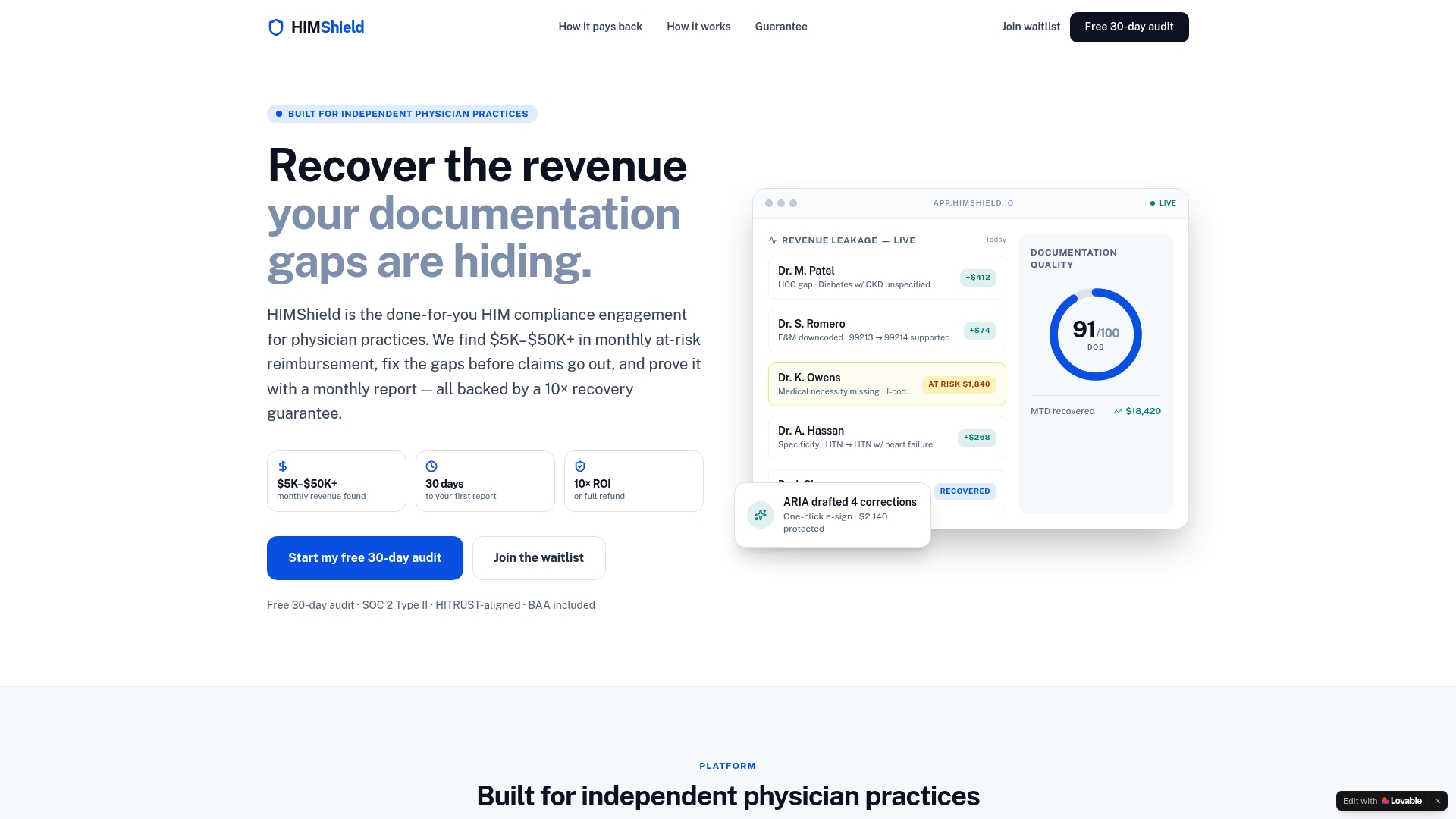
Himshield connects to your EHR through a FHIR API and delivers clear, physician-friendly risk alerts within 30 days of setup. The platform scans for HCC gaps, modifier errors, and medical necessity documentation issues that payers use to deny claims. Practices using Himshield have recovered $5K–$50K+ in hidden revenue by catching risks that manual review misses. See exactly how Himshield works and how quickly your practice can start recovering earned revenue.
FAQ
What percentage of claim denials are preventable?
Automated claim scrubbing and predictive validation can prevent up to 85% of avoidable denials. The majority of those preventable denials originate from front-end errors in eligibility, authorization, and patient demographics.
How does real-time eligibility verification reduce denials?
Running eligibility checks at scheduling and again 24–48 hours before a visit catches coverage lapses and plan changes before a claim is submitted. This eliminates an entire category of front-end denials without any rework cost.
What is the best way to appeal a denied claim?
Submit the appeal within the payer's filing deadline, include all supporting documentation such as clinical notes and authorization records, and track the appeal status in your denial dashboard. MGMA data confirms that nearly 66% of denials are recoverable with a structured appeals process.
How often should a practice conduct coding audits?
Coding audits should run at least quarterly. Quarterly reviews catch payer-specific rule changes and emerging denial patterns before they affect a significant volume of claims.
What denial data should a practice track in its dashboard?
Track denials by payer, denial reason code, provider, and service line. This combination reveals whether a denial problem is payer-specific, provider-specific, or tied to a particular procedure or diagnosis group.