
Payer-specific denials are denials tied to carrier rules or adjudication logic, not simple claim errors, and the fastest way to stop them is to detect payer patterns and apply payer-specific pre-submission controls before claims go out. Private payers initially deny close to 15% of claims. Federal rules under the No Surprises Act and CMS appeal guidance give you a defined path to fight back.
TL;DR:
- Nearly 15% of private payer claims are denied on first submission, costing hospitals and practices billions annually in overturn efforts.
- Payer-specific denials often stem from eligibility issues, prior authorization lapses, coding errors, or medical necessity mismatches and vary by carrier policies.
- Automated, AI-assisted adjudication, rising DRG downgrades, and post-payment recoupments are increasing reimbursement risks in 2026.
- Tracking denial rates, reason codes, and overturn success by payer helps identify patterns and prioritize prevention strategies effectively.
- Front-end controls like real-time eligibility verification, payer-specific edits, and aligned documentation can significantly reduce preventable denials before claims are submitted.
Table of Contents
- What Payer-Specific Denials Are and the Categories to Track
- Why Payers Deny Differently: Tactics and Trends Shaping Risk
- How to Detect Payer-Specific Denial Patterns in Your Data
- Prevention Playbook: Front-End Controls That Cut Denials
- If a Payer Denies: An Efficient Appeals Workflow
- How Automated Detection Prevents Payer-Specific Denials Before They Happen
- A Leadership Call to Action on Denial Prevention
- See Your Payer-Specific Risk With a Free 30-Day Audit
- FAQ
- Sources
What Payer-Specific Denials Are and the Categories to Track
A rejection happens before a claim enters adjudication, usually from a data or format error. A denial happens after adjudication, when a payer processes the claim and refuses payment under its own rules. A recoupment happens after payment, when a payer takes money back post-review. Payer-specific denials fall into this middle category, and they vary because each carrier applies its own bundling edits, modifier logic, and delegated review contractors differently, even for identical CPT codes.
The denial types billing teams see most often:
- Eligibility or coordination of benefits (COB): coverage lapsed, wrong payer billed first, or COB data was outdated.
- Prior authorization failures: missing, expired, or mismatched authorization numbers.
- Coding or modifier errors: wrong modifier, unbundled codes, or payer-specific pairing edits.
- Medical necessity or DRG downgrades: documentation doesn't match the payer's clinical criteria.
- Timely filing: claims submitted past a payer's specific deadline, which varies by contract.
A deeper breakdown of payer-specific denial trends shows how these categories stack up differently depending on payer mix.
Why Payers Deny Differently: Tactics and Trends Shaping Risk
Payers aren't denying the same way they did a few years ago. Sift Healthcare's fourth annual denials report identifies automated, AI-assisted adjudication, rising DRG downgrades, and a sharp increase in post-payment recoupments among the trends driving reimbursement risk in 2026.
Nearly 15% of private-payer claims are denied on first submission. Hospitals and health systems spent roughly $19.7 billion in 2022 just trying to overturn those denials. That cost falls on independent practices too, just at a smaller scale.
Quarterly policy updates compound the problem. A payer's delegated review contractor might change its documentation standard mid-year, and your team won't know until claims start bouncing. Specialties tied to imaging, high-cost injectables, and inpatient-adjacent services tend to draw disproportionate scrutiny, since those claims carry the highest dollar amounts at risk per denial; this is especially true in rural and critical access hospitals adapting to teleradiology.

How to Detect Payer-Specific Denial Patterns in Your Data
You can't fix what you can't see by payer. Most practices track an overall denial rate, but that number hides which carrier, reason code, or service line is actually driving the losses.
The metrics worth tracking weekly:
- Denial rate by payer: isolates which carriers are trending worse than your baseline.
- Reason-code frequency: flags whether eligibility, coding, or medical necessity dominates for a given payer.
- Overturn rate on appeal: shows which denials are worth fighting versus preventing earlier.
- Average days-to-appeal: measures whether your team is working fast enough against payer deadlines.
Provider-level trend views catch individual documentation habits before they become a pattern. When prioritizing fixes, weigh high-dollar claims against high-frequency ones separately, since a rare $8,000 denial and a weekly $150 denial both drain revenue but need different fixes.
Prevention Playbook: Front-End Controls That Cut Denials
Most payer-specific denials are preventable before the claim ever reaches a payer. The fix starts at intake, not in the billing department.
- Verify eligibility in real time. Confirm active coverage, correct payer ID, and COB status at every visit, not just at the first appointment.
- Centralize prior authorization tracking. Start the request as early as the schedule allows, assign one owner per authorization, and set alerts before expiration dates hit.
- Build payer-specific pre-submission edits. Custom rules in your clearinghouse or scrubber should catch modifier mismatches and bundling conflicts unique to each carrier before submission.
- Align documentation with payer clinical criteria. Use template-driven note elements that match what each payer's medical necessity policy actually requires, cutting DRG downgrades and necessity denials at the source.
- Train staff on payer-specific nuances, not just general coding. Role-based SOPs and quarterly payer refreshes keep front-desk, coding, and billing teams aligned as policies shift.
Pro Tip: Review your top three payers' medical policy bulletins every quarter. Most denial spikes trace back to a policy update nobody flagged internally.
Our guide on reducing claim denials in independent practices walks through how to sequence these fixes without adding headcount, and our documentation checklist for 99214 visits is a useful starting template for CDI alignment.
If a Payer Denies: An Efficient Appeals Workflow
When prevention doesn't catch everything, speed and documentation determine whether you recover the payment.
- Triage within 24 hours. Capture the exact denial code, pull the plan provision cited, and assign a single owner.
- Choose the right appeal path. Internal appeals come first; if that fails, CMS guidance on external review rights outlines required notice elements and timeframes under federal rules, including protections expanded by the No Surprises Act.
- Assemble targeted evidence. Pull the specific clinical notes, prior authorization record, EOB, and the payer's own published criteria that support your case, not the entire chart.
- Escalate when patterns repeat. Flag any payer denying the same code repeatedly, systemic documentation gaps across providers, or high-dollar claims at risk for leadership review.
Our medical necessity denials playbook and Medicare-specific audit guide both walk through evidence assembly in more detail.
How Automated Detection Prevents Payer-Specific Denials Before They Happen

Catching payer-specific risk before submission beats fighting it after denial. An automated detection layer scans EHR documentation against payer-specific coding and clinical-criteria rules, then produces a per-payer, per-provider leakage report ranking claims by dollar risk and denial likelihood.
A typical corrective workflow looks like this: the system flags a documentation gap tied to a specific payer's medical necessity policy, drafts the correction in plain language, routes it to the physician for a one-click e-signature, and the corrected claim resubmits with a stronger audit trail attached. This mirrors the kind of proactive documentation scanning that vendor data on rising payer audits suggests is now more effective than late-stage appeals, since even pre-approved claims face post-payment recoupment when documentation doesn't mirror payer criteria.
Detection before submission costs less than an appeal after denial, in time, in staff hours, and in the revenue that never gets recovered.
A Leadership Call to Action on Denial Prevention
Revenue-cycle leaders spend too much time refining appeal letters and not enough time fixing the documentation gaps that cause denials in the first place. Appeals matter, but they're a recovery tactic, not a prevention strategy.
My recommendation: shift budget and attention toward payer-pattern detection and CDI alignment before claims go out. If you haven't measured where your denials actually concentrate by payer, start there, and consider piloting a 30-day payer-pattern audit before your next contract renewal cycle.
— Elena
See Your Payer-Specific Risk With a Free 30-Day Audit
We built HIMShield to catch exactly the coding, documentation, and charge-capture gaps that turn into payer-specific denials, before they cost you reimbursement. Our automated platform scans your EHR data, quantifies revenue at risk by payer and provider, and drafts physician-ready corrections with one-click e-signature.
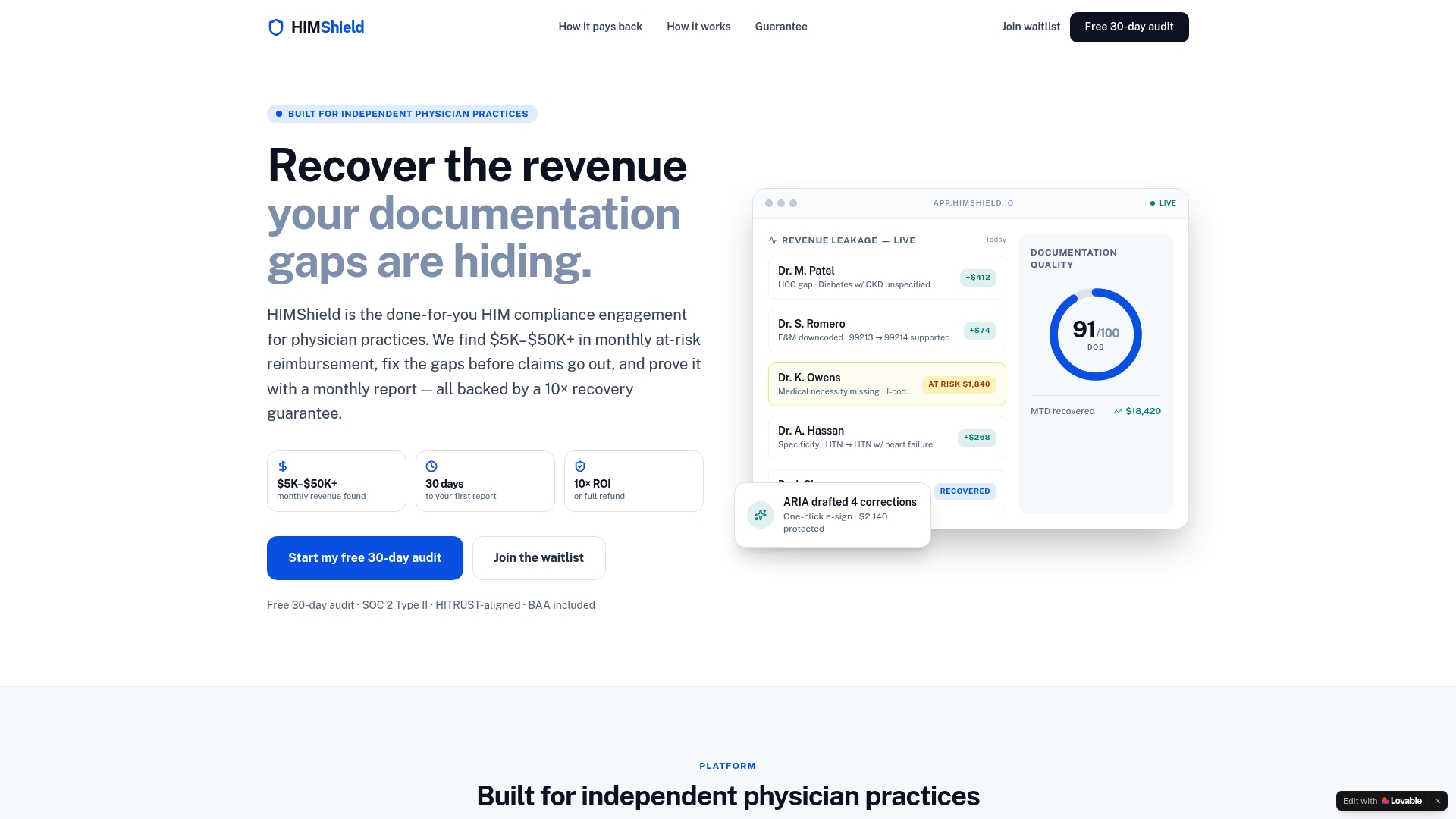
Our free 30-day Revenue Leakage Audit gives you a quantified picture of where you're losing reimbursement, with no new software to learn and no staff to hire. Start the audit and see what your payers are costing you.
FAQ
What are payer-specific denials?
Payer-specific denials are claim denials driven by a particular carrier's adjudication rules, medical policies, or delegated review logic rather than a basic data or billing error. They vary by payer because each carrier applies its own bundling edits, modifier requirements, and clinical necessity criteria.
What are the three types of claim denials?
The three broad categories are rejections, which occur before adjudication due to data or format errors, denials, which occur after a payer reviews and refuses payment, and recoupments, where a payer takes back money after it has already paid a claim. Within denials, common reasons include eligibility, prior authorization, coding errors, and medical necessity.
What does denial code CO 273 mean?
The CO code typically indicates a coverage or benefit-related denial, often tied to coordination of benefits or a coverage limit issue, though the exact meaning can vary slightly by payer. Always confirm the specific explanation on the remittance advice and the payer's own code definitions before appealing.
What is a payer denial document?
A payer denial document, often called an adverse benefit determination or explanation of benefits, is the formal notice a payer sends explaining why a claim was denied, including the reason code, plan provision cited, and appeal rights. CMS guidance outlines the required elements this notice must contain and the timeframes for internal appeal and external review.
Sources
For appeals rules and required notice elements, consult CMS appeal decision guidance. For payer denial benchmarks and cost data, see the AHA's analysis of payer denial tactics and KFF's review of ACA Marketplace denials. For emerging payer tactics, see Sift Healthcare's denials insights report.
- SIFT HEALTHCARE RELEASES FOURTH ANNUAL DENIALS INSIGHTS REPORT, IDENTIFYING NINE CRITICAL PAYER TRENDS SHAPING REIMBURSEMENT RISK IN 2026 – Health Technology Net
- Payer Denial Tactics — How to Confront a $20 Billion Problem — AHA
- Appeal decision guidance — CMS