
Setting up health information management (HIM) in a small practice comes down to five jobs. Name an owner for records. Write down how records are created, corrected, released and retained. Secure the data under HIPAA. Tie documentation to coding and charge capture. Then review a small sample of charts on a fixed schedule. You do not need a department to do this. You need clear ownership, short written procedures and a routine that someone actually follows.
This guide walks through each piece in the order most independent practices need it, with the federal resources worth bookmarking and the places where unreviewed documentation quietly costs you revenue.
TL;DR
- HIM in a small practice means owning the health record: how it is created, corrected, released, secured and retained.
- Start with one named records owner, a short set of written procedures and a HIPAA risk analysis.
- Check state rules for retention and release of information. When federal and state rules differ, follow the more restrictive one.
- Audit a small baseline sample of charts each month at first, then re-audit the risk areas you find.
- Link documentation to coding and charge capture early. That is where most small practices leave money on the table.
Table of Contents
- What HIM covers in a small physician practice
- Decide who owns HIM before you buy anything
- Write the record workflows first
- Build the privacy and security basics
- Choose systems and train staff
- Connect documentation to coding and charge capture
- Set a review routine you can sustain
- Prepare for the payer audit before it arrives
- Our perspective: HIM should pay for itself
- See what your own charts are leaving behind
- A 30-day setup plan
- FAQ
- Sources
What HIM covers in a small physician practice
HIM professionals act as custodians of patient health information. According to AHIMA guidance on moving from paper to EHRs, they set the policies and procedures for documentation, maintenance and disclosure. They also keep a matrix of the sources that make up the record, which matters whenever part of it lives in the EHR and part in scanned files, portals or faxes.
In a hospital, a department handles all of that. In a four-physician practice, it is usually a slice of someone's week. The work still falls into the same buckets:
- Record creation and completion: who documents what, how fast, and how a note is signed and closed.
- Corrections and amendments: how errors are fixed without overwriting the original entry.
- Release of information (ROI): who receives requests, verifies authorization and sends records.
- Privacy and security: HIPAA policies, access controls, risk analysis, breach response.
- Retention and destruction: how long each record type is kept and how it is disposed of.
- Coding and charge capture quality: whether what is documented supports what is billed.
The last bucket is the one practice owners tend to underestimate. A record that is complete and secure but does not support the codes on the claim still produces denials and audit exposure.
Decide who owns HIM before you buy anything
The most common setup mistake is spreading HIM tasks across everyone and giving them to no one. Pick a records owner, even if it is a part-time duty. Pick a backup. Write the names into your policy manual.
When time and staff are thin, put the compliance-sensitive duties first because they carry the most risk. One HIM staffing guide for one-person departments lists them as HIPAA compliance, ROI turnaround times, retention policy adherence, legal holds, audit readiness and secure destruction. Tasks like tidying scanned documents can wait.
Practical staffing arrangements
Most independent practices land on one of three models:
- Office manager as records owner. Works for practices with fewer than five providers if the manager has protected time and a trained backup.
- Dedicated part-time HIM or coding person. Useful once chart volume or payer mix creates a steady audit workload.
- Internal owner plus automation. The practice keeps ownership and accountability while software handles scanning charts for gaps and drafting corrections.
Whichever you choose, the physicians still own the clinical content. Your HIM owner's job is to make correct documentation easy and to catch problems before claims go out.
Write the record workflows first
Short written procedures beat long manuals nobody reads. For each workflow, write the owner, the start, the end, what staff may do and what they may not do.

A small-practice physician blog on records request workflows suggests a useful format. Describe ownership of requests in one sentence. Define a clear beginning and end. List permitted actions in observable language. Put a prohibited-action list next to them. It also recommends a stop condition: if authorization is unclear or the records are sensitive, the request goes to the privacy owner. Not every exception is urgent, but every exception needs an owner.
Workflows to document in your first month
| Workflow | What the procedure should answer |
|---|---|
| Note completion | How many days a note can stay open, and who follows up on unsigned notes |
| Corrections and addenda | Who may amend a record, how the original is preserved, how the change is dated and signed |
| Release of information | Who logs the request, how identity and authorization are verified, who sends the records, how it is tracked to completion |
| Retention and destruction | Retention period by record type and patient age, who approves destruction, how it is documented |
| Exceptions | Which situations stop the workflow and who decides |
For ROI quality control, AHIMA's release-of-information practices call for tracking each request from receipt through final disposition and handling requests by priority and efficiency, as summarized in a guide for solo and small practices. A simple log with request date, requester, authorization check, date sent and initials covers it.
Retention is a state question
There is no single national number for medical record retention. The same guide quotes one state's rule of at least seven years from the last treatment, or until a minor patient reaches age 21 if that is longer. It also advises checking state-specific timeframes, since records for minors often need longer retention. Confirm the rule with your state medical board or health department, then write the period into your policy.
HIPAA adds its own clock. A covered entity that discloses PHI under a release must keep a copy of the ROI form for six years from creation or last effective date, whichever is later.
Build the privacy and security basics
You do not have to invent this from scratch. Federal agencies publish material aimed at small practices.
- ONC and HHS maintain a privacy and security resources page for providers that includes a guide to privacy and security of electronic health information, a Security Risk Assessment (SRA) Tool for small practices, and a NIST toolkit for the HIPAA Security Rule.
- The HHS Small Practice Security Guide lays out a basic approach: reassess your security policies, perform a risk assessment, then put administrative, physical and technical safeguards in place as you adopt EHRs and other health IT.
The same guide offers advice that suits tight budgets. Weigh the benefit of each safeguard against its cost. A practice may not be able to justify expensive technology and can instead require staff to follow a new administrative safeguard that mitigates the risk just as well.
For release of information, AHIMA advises building policies that comply with federal and state law and following the more restrictive guideline when the two differ. It also recommends asking legal counsel to review new and revised policies and to help monitor compliance and corrective action. A healthcare attorney in your state is the right person to confirm the final wording. For a plain-language walk-through of the federal requirements, see our HIPAA compliance guide for practices.
Choose systems and train staff
Your EHR is the core system, but HIM also touches scanning, e-fax, patient portal, release-of-information tracking and e-signature. Two federal resources help with selection and rollout:
- The ONC Health IT Toolkit for Physician Offices helps small practices assess readiness, plan, select, implement and make effective use of health IT.
- The ONC Health IT Playbook is written for administrators, practice owners, clinicians and staff, and covers planning, selecting and implementing EHRs, meeting certified health IT requirements and protecting patient information.
Training works best when it is short and tied to a workflow. A fifteen-minute session on how to handle an ROI request, held when the procedure is rolled out and again at onboarding, does more than an annual slide deck. Record who attended and when.
If you add software, favor tools that fit into the way your physicians already work. Anything that demands new training from every provider will be skipped under a full schedule.
Connect documentation to coding and charge capture
This is where HIM setup turns into revenue protection. Every claim depends on three things lining up: what the physician documented, what the coder or biller selected, and what was actually charged. Gaps between them show up as three kinds of loss:
- Undercoding and missed charges. Services performed but not documented well enough to bill, or not charged at all.
- Denials. Claims rejected because documentation does not support medical necessity or the level of service.
- Audit exposure. Codes the record cannot defend if a payer asks for the chart.
The AMA's Private Practice Simple Solutions series offers webinars and resources on reducing E/M documentation burden, including a Simplified Outpatient Documentation and Coding toolkit for physician-owned practices. It is a solid starting point for aligning note templates with current E/M expectations.
To see how your own records measure up, run a small self-review. Our guides on self-auditing physician billing records and the annual coding review show how to pick a sample and score it. If risk-adjusted payers are a big part of your mix, the HCC documentation plan covers where gaps usually hide.
Set a review routine you can sustain
A setup is only as good as its monitoring. AHIMA's guidance on auditing and monitoring recommends that physician offices begin with baseline reviews of 10 to 15 records in areas such as evaluation and management and the most commonly performed procedures. It suggests monthly audits at first to establish a baseline, then re-audits in the risk areas you find.
The same guidance says the people doing audits should know coding and documentation well, have an extensive coding background and hold a credential such as RRA or ART, with CCS or CCS-P strongly recommended. Those credential names come from a 1999 publication, so check the current AHIMA and AAPC credential lineup when you hire or contract a reviewer.

A simple monthly scorecard
Track a handful of measures and keep them on one page:
- Percentage of notes signed within your policy window.
- Documentation error rate per provider in the sampled charts.
- Denial rate by payer and the top three denial reasons.
- ROI turnaround time against your own standard.
- Estimated revenue missed from charges or codes not supported, by provider.
Review it with your physicians in a short monthly meeting. Per-provider, per-payer views make the conversation specific and avoid generalities. When you want to go deeper on method, our risk-based audit guide explains how to focus on the highest-risk codes and payers first.
Prepare for the payer audit before it arrives
An audit request is much easier when your record workflows already exist. You know who gathers the charts, where each part of the record lives and how corrections were documented. Keep a standing audit-response folder and a named owner. Our payer audit preparation guide and audit survival checklist give you the steps and timelines to build into that folder.
Our perspective: HIM should pay for itself
Most small practices treat HIM as overhead, a set of rules to satisfy. We see it differently. Done right, it is the system that makes sure every service your physicians perform is documented, coded and charged correctly.
The trouble is capacity. An independent practice rarely has a coder or compliance officer with time to read charts before claims leave. So gaps persist: missing documentation, unsupported levels of service, charges that never reach the claim. They surface later as denials or in an audit.
That is why we built HIMShield™ to work on your existing EHR data, before submission. It identifies and quantifies coding, documentation and charge-capture gaps, shows them per provider and per payer, and drafts corrections your physician can approve with one e-signature. Our approach is designed so practices do not need new staff or software training.
Our advice is to put the ownership and written workflows in place first, as described above, then let automation do the scanning that no one has time for. Owners keep control, and physicians spend minutes on fixes instead of hours on charts.
Elena
See what your own charts are leaving behind
If your setup is in place and you want to know what it is costing you in missed revenue, we can quantify it. Our free 30-day Revenue Leakage Audit scans your EHR data for coding, documentation and charge-capture gaps and delivers per-provider, per-payer findings. Our service comes with a performance guarantee, and paid subscriptions follow only after you have seen the report.
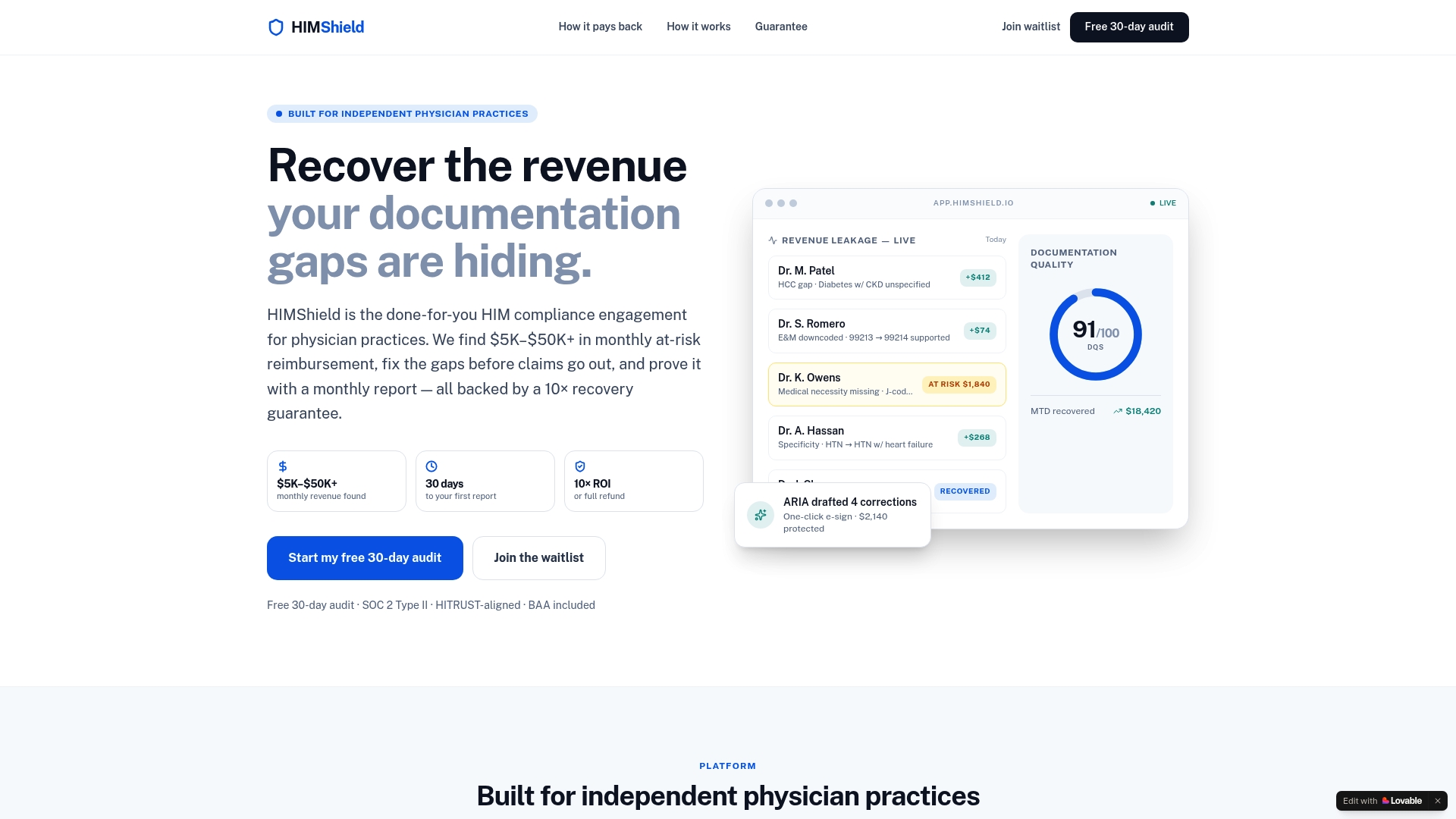
Start your free 30-day Revenue Leakage Audit, or learn how our HIM compliance engagement works for independent practices.
A 30-day setup plan
If you are starting from nothing, this order works:
- Week 1: Name the records owner and backup. List every place patient information lives.
- Week 2: Start the HIPAA security risk analysis using the federal SRA Tool. Confirm your state retention and release rules.
- Week 3: Write the note completion, correction, ROI and retention procedures on one page each. Train staff in short sessions.
- Week 4: Pull a baseline sample of 10 to 15 charts per area, score them and set the monthly review date.
Then repeat the review every month and adjust where the findings point.
FAQ
Does a small practice need a dedicated HIM professional?
Not necessarily. Many independent practices assign HIM duties to an office manager or part-time specialist and add outside coding review or automation for chart audits. What matters is that one person owns the records, has a trained backup and has protected time for the work.
How long should a small practice keep medical records?
It depends on your state and on the patient's age. One small-practice guide cites a state rule of at least seven years from last treatment, or until a minor reaches 21 if that is longer. Check your state medical board for the exact rule. HIPAA separately requires keeping certain documentation, such as ROI forms, for six years.
What is the first HIPAA step for a small practice?
Perform a security risk analysis. HHS and ONC provide an SRA Tool built for small practices, along with a Small Practice Security Guide that walks through risk assessment and safeguards. Have a healthcare attorney in your state confirm that your policies meet federal and state requirements.
How many charts should we audit when starting out?
AHIMA's auditing guidance recommends baseline reviews of 10 to 15 records in areas such as E/M and your most common procedures. It suggests monthly audits at first, followed by re-audits where you find risk.
How does HIM setup affect revenue?
Documentation drives coding, and coding drives payment. When notes do not support the level of service or a charge never reaches the claim, you lose revenue to denials, underpayment or audit findings. Regular chart review and charge-capture checks reduce that leakage.
Sources
- AHIMA: Managing the Transition from Paper to EHRs
- HIM staffing guide for one-person departments
- Medical records request workflow for a small practice
- Guide to Getting Started for Solo and Small Practices
- UNC School of Government: Creating Release of Information Forms
- ONC and HHS: Health IT Privacy and Security Resources for Providers
- HHS: Small Practice Security Guide
- AHIMA: Laws and Regulations Governing the Disclosure of Health Information
- ONC Health IT Toolkit for Physician Offices
- ONC Health IT Playbook
- AMA Private Practice Simple Solutions
- AHIMA: Auditing and Monitoring, Elements of HIM Compliance