
HIPAA compliance for healthcare practices is defined as the continuous fulfillment of federal requirements under the Health Insurance Portability and Accountability Act to protect patients' health information through the Privacy Rule, Security Rule, and Breach Notification Rule. The Department of Health and Human Services (HHS) and its Office for Civil Rights (OCR) enforce these rules across all covered entities, including independent physician practices. Understanding HIPAA compliance is not optional. Any practice that creates, receives, maintains, or transmits protected health information (PHI) is legally bound to comply. The single most important fact to internalize: HIPAA compliance is not a certification. There is no exam to pass and no badge to earn. Compliance is a living program that requires maintained policies, workforce training, and ongoing risk management.
What are the key components of HIPAA compliance for practices?
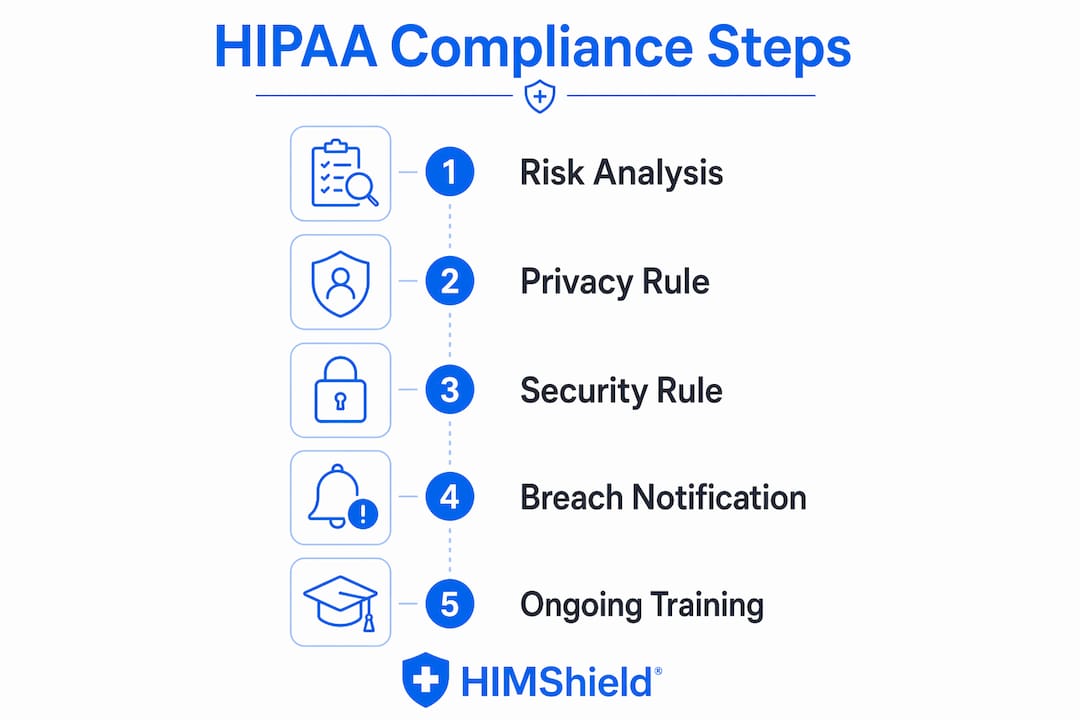
HIPAA contains three distinct rules, and each one governs a different aspect of how your practice handles patient information. The Privacy Rule covers PHI in any medium, including paper, verbal, and electronic formats. The Security Rule applies specifically to electronic PHI (ePHI). The Breach Notification Rule dictates what you must do when PHI is exposed without authorization.

The OCR enforces HIPAA privacy rights and provides public guidance on compliance obligations. OCR can investigate complaints, conduct audits, and impose civil monetary penalties. Independent practices are not exempt from enforcement scrutiny simply because of their size.
HIPAA regulations for healthcare also require practices to account for applicable state laws. State and local laws may impose additional protections beyond the federal baseline. Your compliance program must align with both federal and state requirements to avoid gaps.
How does the HIPAA Privacy Rule affect your practice?
The Privacy Rule defines PHI as any individually identifiable health information tied to a patient's past, present, or future physical or mental health condition, treatment, or payment. This includes names, dates, phone numbers, and diagnosis codes when linked to a specific patient. The rule governs how your practice uses and discloses that information.
Every covered practice must provide patients with a Notice of Privacy Practices (NPP). The NPP must meet the requirements of 45 CFR 164.520, including a description of how PHI is used, patients' rights, complaint procedures, and practice contact information. Omitting any required element puts your practice out of compliance.
Patients hold specific rights under the Privacy Rule:
- The right to access and receive copies of their PHI
- The right to request restrictions on certain uses or disclosures
- The right to request amendments to their records
- The right to receive an accounting of disclosures
- The right to file complaints with OCR without retaliation
Maintaining an up-to-date NPP is a common compliance pitfall. If your practice changes how it uses PHI, the NPP must be updated to reflect that change. Failing to update the notice after a material change in privacy practices is a direct violation of the Privacy Rule.
Pro Tip: Post your current NPP prominently in your waiting room and on your practice website. Patients must be able to access it easily, and you must document that you offered it at the first point of service.
How does the HIPAA Security Rule protect ePHI in your practice?
The Security Rule applies exclusively to ePHI, which is PHI stored or transmitted in electronic form. This includes data in your EHR system, billing software, patient portals, email, and any personal devices used by staff. The rule requires your practice to implement administrative, physical, and technical safeguards.
The Security Rule mandates a risk management approach grounded in a comprehensive risk analysis. That analysis must identify where ePHI exists across all systems, assess threats and vulnerabilities, and document the likelihood and impact of potential risks. Risk management plans must then address the findings with cost-effective safeguards.
Required safeguards break down into three categories:
- Administrative safeguards: Assign a designated HIPAA Security Officer, conduct workforce training, implement access management policies, and develop contingency plans.
- Physical safeguards: Control physical access to workstations and servers, implement device and media controls, and restrict facility access to authorized personnel.
- Technical safeguards: Deploy access controls, audit controls, integrity controls, and transmission security such as encryption for ePHI sent over networks.
| Safeguard Type | Examples | Common Pitfall |
|---|---|---|
| Administrative | Security Officer, training programs | No documented risk analysis |
| Physical | Workstation locks, server room access | Uncontrolled personal device use |
| Technical | Encryption, user authentication | Outdated software with known vulnerabilities |
OCR audits focus on actual implementation of recognized security practices, not just written policies. A binder full of policies with no evidence of training or monitoring will not satisfy an auditor.
Pro Tip: Map every location where ePHI lives before you build your risk analysis. Include EHR systems, billing platforms, messaging apps, and personal staff devices. Missing even one system creates a compliance gap.
What are HIPAA Breach Notification requirements?
A breach under HIPAA is defined as the unauthorized acquisition, access, use, or disclosure of PHI that compromises its security or privacy. Not every incident qualifies as a breach. Three exceptions exist: unintentional access by a workforce member acting in good faith, inadvertent disclosure between authorized personnel, and situations where the recipient could not reasonably retain the information.
When a breach does occur, your obligations are time-bound and specific:
- Notify affected individuals within 60 days of discovering the breach, in writing, with a description of what happened and what PHI was involved.
- Notify HHS through the OCR breach reporting portal. Breaches affecting fewer than 500 individuals may be reported annually. Breaches affecting 500 or more must be reported within 60 days.
- Notify prominent media outlets in the affected state or jurisdiction if the breach involves 500 or more individuals in that area.
Timely breach notification requires strict 60-day compliance from the date of discovery, not the date the breach occurred. That distinction matters. A breach discovered on march 1 must trigger notifications no later than april 30, regardless of when the unauthorized access began.
The most difficult part of breach notification is not writing the letter. It is building the internal workflow to detect a breach, confirm it, assess its scope, and route notifications correctly before the deadline expires.
Operationalizing breach detection workflows is where most independent practices fall short. Assign a clear incident response owner, document the steps from discovery to notification, and test the workflow at least once per year.
How to achieve HIPAA compliance in an independent practice
How to achieve HIPAA compliance requires building a structured program, not reacting to problems after they arise. The following steps form the foundation of a defensible compliance program.
- Conduct a risk analysis. Map every location where PHI and ePHI exist across your practice. Identify threats, vulnerabilities, and the likelihood of harm. Document everything.
- Develop a risk management plan. Address each identified risk with a specific safeguard. Prioritize by likelihood and impact. Set timelines and assign ownership.
- Write and maintain policies and procedures. Cover Privacy Rule obligations, Security Rule safeguards, breach response, and workforce conduct. Review and update policies at least annually or after any material change.
- Train your workforce. Every employee who touches PHI must receive HIPAA training at hire and at least annually thereafter. Document completion for every staff member.
- Execute Business Associate Agreements (BAAs). Vendors with access to PHI are business associates and must sign a BAA before receiving any PHI. This includes your EHR vendor, billing service, and any cloud storage provider.
- Monitor and evaluate continuously. Conduct periodic internal audits, review access logs, and test your breach response workflow. Compliance proof during audits consists of documented risk analyses, management plans, and evidence of periodic evaluation.
| Program Element | One-Time Setup | Ongoing Requirement |
|---|---|---|
| Risk analysis | Initial documentation | Annual review or after system changes |
| Workforce training | New hire onboarding | Annual refresher for all staff |
| Business Associate Agreements | Signed before PHI access | Updated when vendor scope changes |
| Policies and procedures | Written at program launch | Reviewed and updated annually |
| Breach response workflow | Documented at program launch | Tested and refined annually |
The importance of HIPAA for practices extends beyond avoiding penalties. A well-run compliance program protects your patients, reduces audit exposure, and signals to payers and partners that your practice operates with integrity. Practices that treat compliance as a daily discipline rather than a periodic project are far better positioned when OCR comes calling.
Key Takeaways
HIPAA compliance for independent practices is a continuous program built on three federal rules, documented risk management, trained staff, and executed Business Associate Agreements.
| Point | Details |
|---|---|
| Three core rules | The Privacy, Security, and Breach Notification Rules each govern distinct obligations for handling PHI. |
| Compliance is continuous | No certification exists; practices must maintain policies, training, and risk management year-round. |
| Risk analysis is the foundation | Map all PHI and ePHI locations, document threats, and build a management plan before implementing safeguards. |
| BAAs are non-negotiable | Every vendor with access to PHI must sign a Business Associate Agreement before receiving any patient data. |
| Breach timelines are strict | Affected individuals and HHS must be notified within 60 days of breach discovery, with media notification for breaches over 500 individuals. |
What independent practices get wrong about HIPAA
The most persistent misconception I encounter is that HIPAA compliance is something you complete. Practices invest in a policy binder, run one training session, and consider the box checked. That approach fails every time OCR audits for actual implemented practices, not documentation artifacts.
The second blind spot is business associates. Independent practices routinely sign contracts with billing services, transcription vendors, and cloud storage providers without executing a BAA. Every one of those vendors touches PHI. Every one of them creates liability if the agreement is missing.
The third issue is the Notice of Privacy Practices. Practices update their workflows, add a new telehealth service, or change how they share records with specialists, and the NPP never gets revised. That notice must reflect current reality. An outdated NPP is not a technicality. It is a documented failure to inform patients of their rights.
My strongest advice: treat your HIPAA compliance checklist as a living audit tool. Review it quarterly. Assign ownership to a specific person. And if you are preparing for an RADV or OCR audit, start with your risk analysis documentation. That is the first thing any auditor will request.
— Elena
How Himshield helps practices stay compliant and protect revenue
Independent practices face compliance pressure from every direction. Himshield connects directly to your EHR and scans for coding, documentation, and charge-capture risks before they become denials or audit findings.
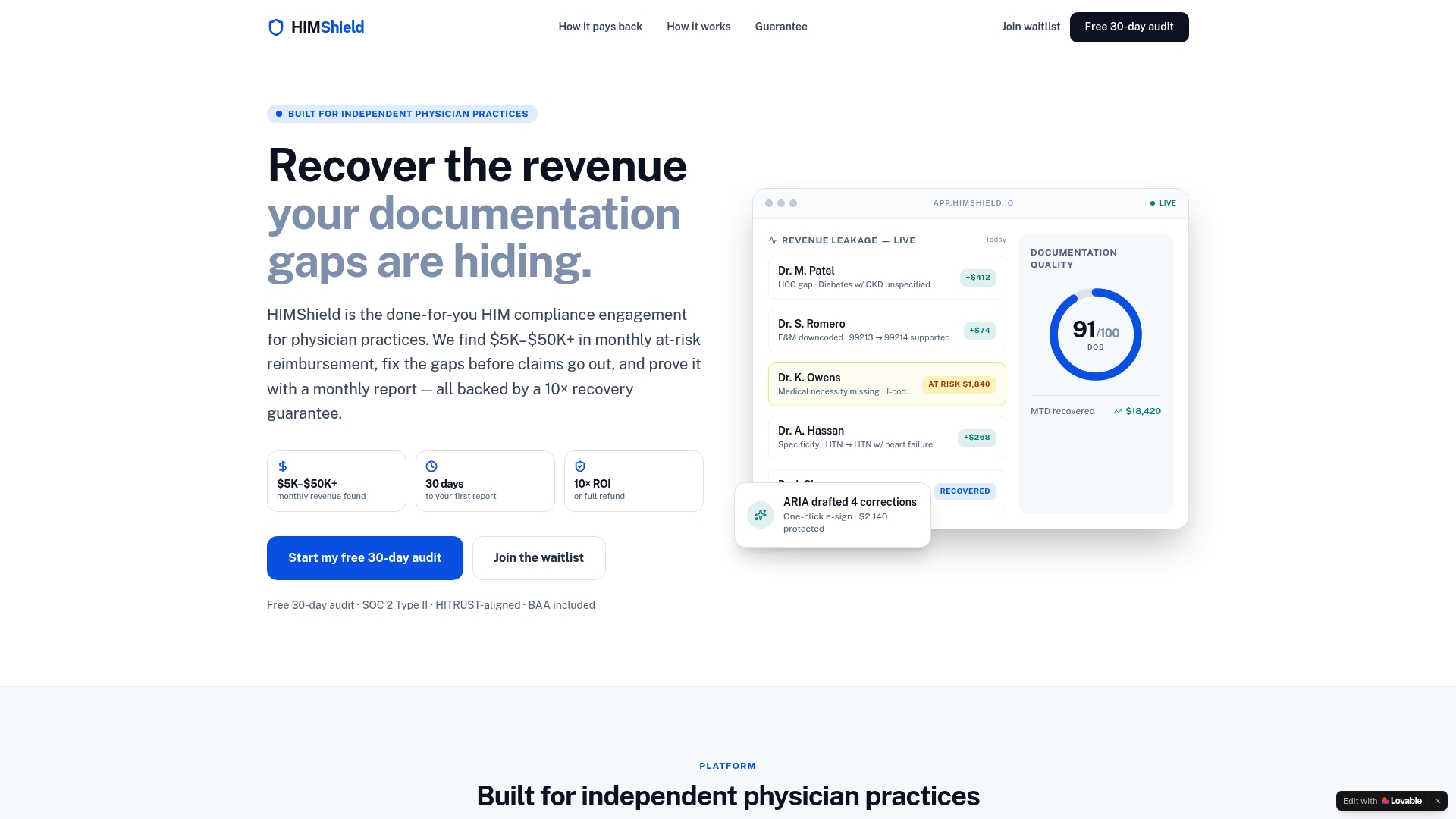
Compliance and revenue recovery are not separate problems. A documentation gap that triggers an OCR inquiry is often the same gap that causes a payer denial. Himshield quantifies at-risk reimbursement and surfaces compliance risks in one workflow, giving your practice a clear picture of what needs to be fixed and what revenue is recoverable. Practices like Lakeside Family Medicine have recovered $32K per month by addressing exactly these gaps. See what Himshield can find in your practice at himshield.com.
FAQ
What is HIPAA compliance for a medical practice?
HIPAA compliance means a practice continuously meets federal requirements under the Privacy, Security, and Breach Notification Rules to protect patient health information. There is no one-time certification. Compliance requires maintained policies, trained staff, and documented risk management.
Who enforces HIPAA for healthcare practices?
The Office for Civil Rights (OCR) within the Department of Health and Human Services (HHS) enforces HIPAA. OCR investigates complaints, conducts audits, and can impose civil monetary penalties for violations.
What is a Business Associate Agreement and when is it required?
A Business Associate Agreement (BAA) is a contract required before any vendor or third party receives access to PHI. This includes EHR vendors, billing services, and cloud storage providers. Operating without a BAA when a vendor handles PHI is a direct HIPAA violation.
How long does a practice have to report a HIPAA breach?
Practices must notify affected individuals and HHS within 60 days of discovering a breach. Breaches affecting 500 or more individuals in a state also require notification to prominent local media within the same 60-day window.
Does HIPAA compliance cover paper records and verbal communications?
Yes. The Privacy Rule applies to PHI in any medium, including paper records, verbal communications, and electronic data. Only the Security Rule is limited specifically to electronic PHI (ePHI).